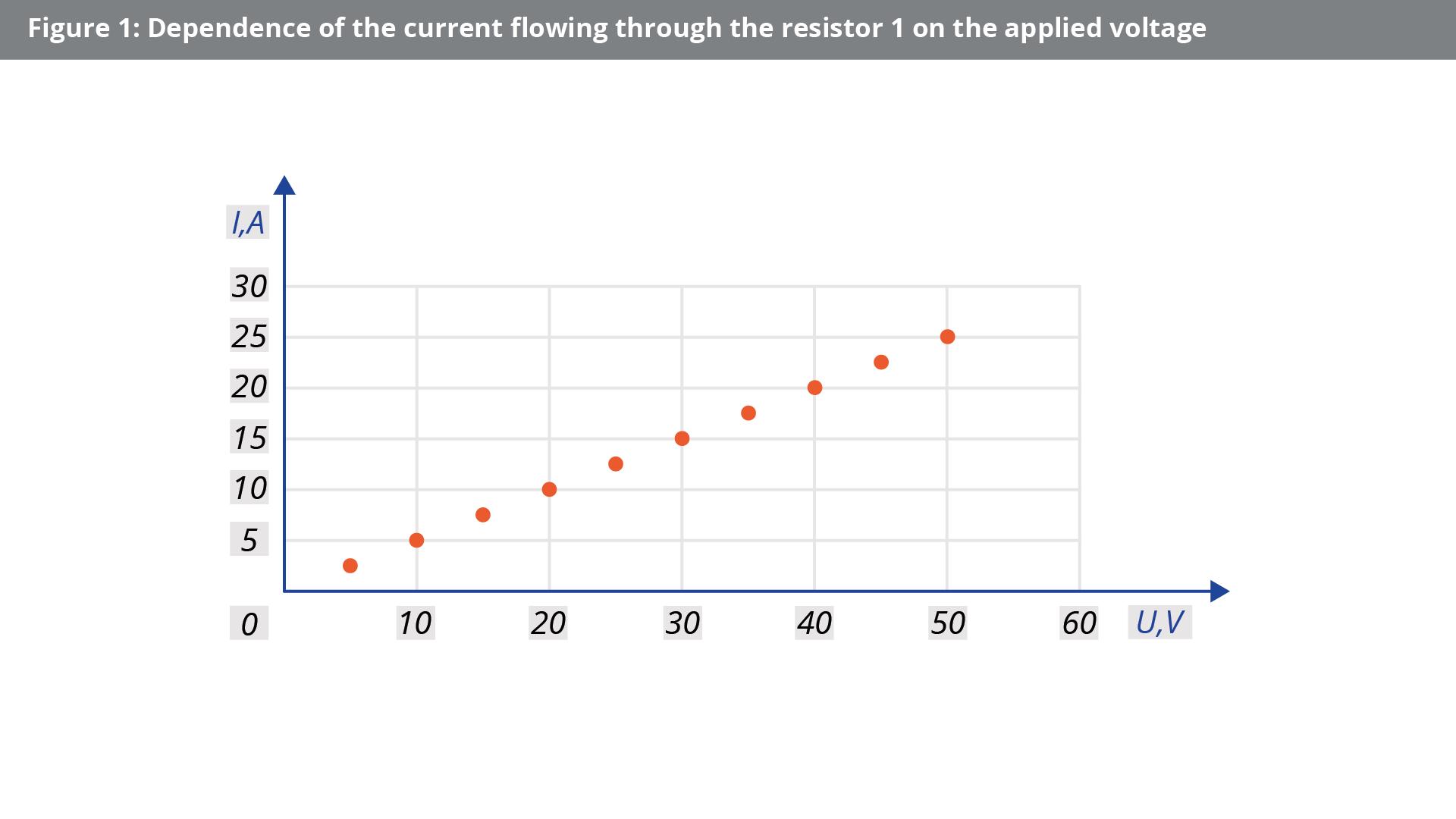
Rysunek przedstawia wykres zależności natężenia prądu płynącego przez opornik 1 od przyłożonego napięcia. Oś pozioma opisana U z jednostką V, skala od 0 do 60, odcinek jednostkowy 10. Oś pionowa opisana I z jednostką A, skala od 0 do 30, odcinek jednostkowy 5. Punkty zaznaczone: (5, 2,5), (10, 5), (15, 7,5), (20, 10), (25, 12,5), (30, 15), (35, 17,5), (40, 20), (45, 22,5), (50, 25).
Source: GroMar, licencja: CC BY 3.0.
R1SsiGN7E6GMU1
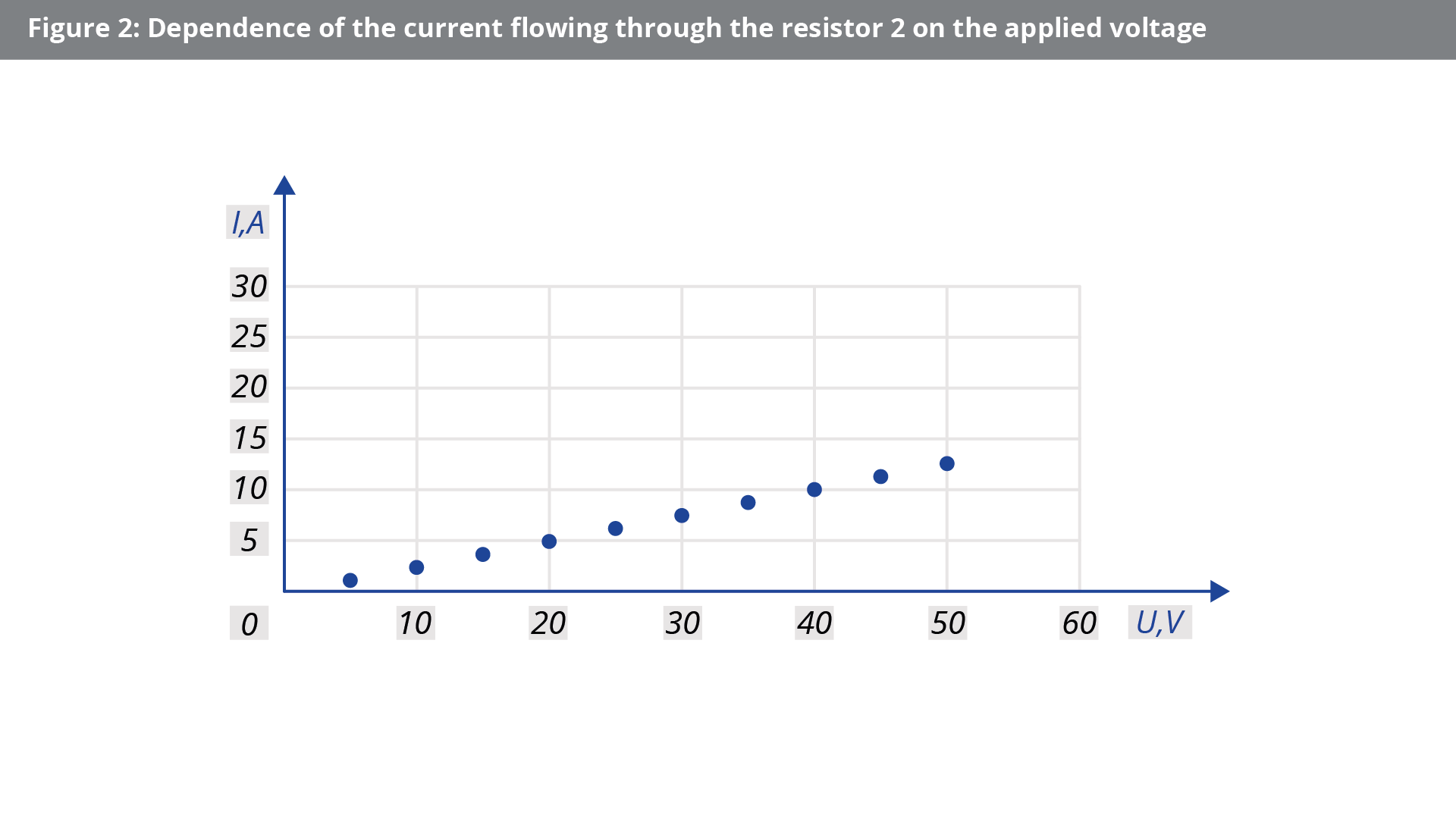
Rysunek przedstawia wykres zależności natężenia prądu płynącego przez opornik 2 od przyłożonego napięcia. Oś pozioma opisana U z jednostką V, skala od 0 do 60, odcinek jednostkowy 10. Oś pionowa opisana I z jednostką A, skala od 0 do 30, odcinek jednostkowy 5. Punkty zaznaczone: (5, 1,25), (10, 2,5), (15, 3,75), (20, 5), (25, 6,25), (30, 7,5), (35, 8,75), (40, 10), (45, 11,25), (50, 12,5).
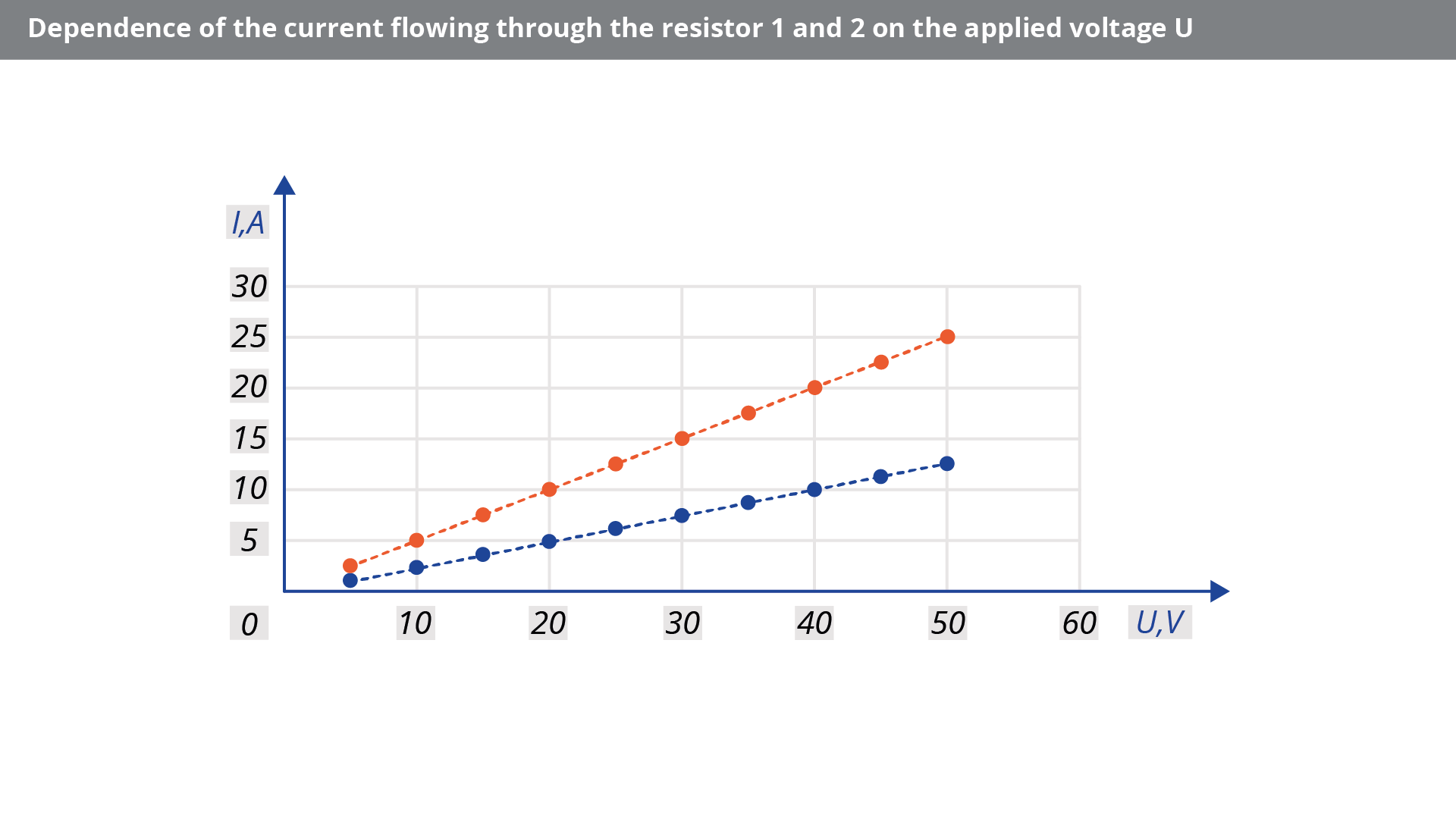
The above graphs clearly suggest a direct proportional relationship. This means that changing the applied voltage results in proportional changes in the current flowing. This confirms the previously obtained relationship, that .
RNmUUD35HsyP81
Rysunek przedstawia wykresy zależności natężenia prądu płynącego przez opornik 1 i opornik 2 od przyłożonego napięcia. Oś pozioma opisana U z jednostką V, skala od 0 do 60, odcinek jednostkowy 10. Oś pionowa opisana I z jednostką A, skala od 0 do 30, odcinek jednostkowy 5. Punkty opisujące opornik 1 zaznaczone: (5, 2,5), (10, 5), (15, 7,5), (20, 10), (25, 12,5), (30, 15), (35, 17,5), (40, 20), (45, 22,5), (50, 25). Punkty opisujące opornik 2 zaznaczone: (5, 1,25), (10, 2,5), (15, 3,75), (20, 5), (25, 6,25), (30, 7,5), (35, 8,75), (40, 10), (45, 11,25), (50, 12,5). Punkty na wykresach połączone linią przerywaną. Bardzo wyraźnie widać, że taka sama zmiana napięcia nie powoduje takiej samej zmiany natężenia prądu płynącego przez oporniki.
Imagine that we are performing some work, for example, moving the wardrobe. Or even two wardrobes - first one and then the other. The first wardrobe moves easily. You perform some work and the effect is visible - the wardrobe moves quickly. This means that the resistance to movement is small. It's worse with a second wardrobe. You perform the same work as the first time, but the wardrobe moves very slowly. Movement resistance is high. We can consider the speed at which a wardrobe moves when we perform a constant work as a measure of motion resistance. Could it not be possible to measure the resistance of the conductor to the current flow in a similar way?
Instead of a wardrobe, we have a portion of electric charge. The work done by electric forces over a portion of a charge of one coulomb is voltage. The speed of the cabinet, on the other hand, corresponds to the amount of charge that flows per second, i.e. the current intensity.
Thus, the measure of the electrical resistanceelectrical resistanceelectrical resistance can be the current intensity obtained under the influence of a given voltage.
Increasing the voltage (or increasing the work) will increase the amount of charge flowing in the time unit, i.e. the current intensity, but the resistance remains the same. It's as if we were trying to move the wardrobe harder and got higher speed.
The resistance of movement, however, will not change. Thus, the measure of the electrical resistanceelectrical resistanceelectrical resistance can be the ratio of the voltage applied to the conductor to the resulting current flowing through the conductor.
Like any physical quantity, resistance is expressed in certain units. The electric resistance unit is ohm. What is it? Well, ohm is the resistance of such a conductor, that the voltage of 1 volt causes in it a current of 1 ampere.
1 om równa się 1 wolt przez 1 amper.
1 om równa się 1 wolt przez 1 amper.
What is the relationship between the electrical voltage and the current intensity?
In the case of many conductors, this relationship is the simplest: the current (effect) is proportional to the applied voltage (cause). If the voltage at the ends of the conductor increases, say four times, then the current flowing through this conductor will increase fourfold.
This relationship between voltage and current is called Ohm's law. Let's write down this law properly.
The proportionality factor is the inverse of the electrical resistanceelectrical resistanceelectrical resistance. To convince yourself, it is enough to transform the formula slightly (definition of resistance).
or
RXbqe5vYXF2a2
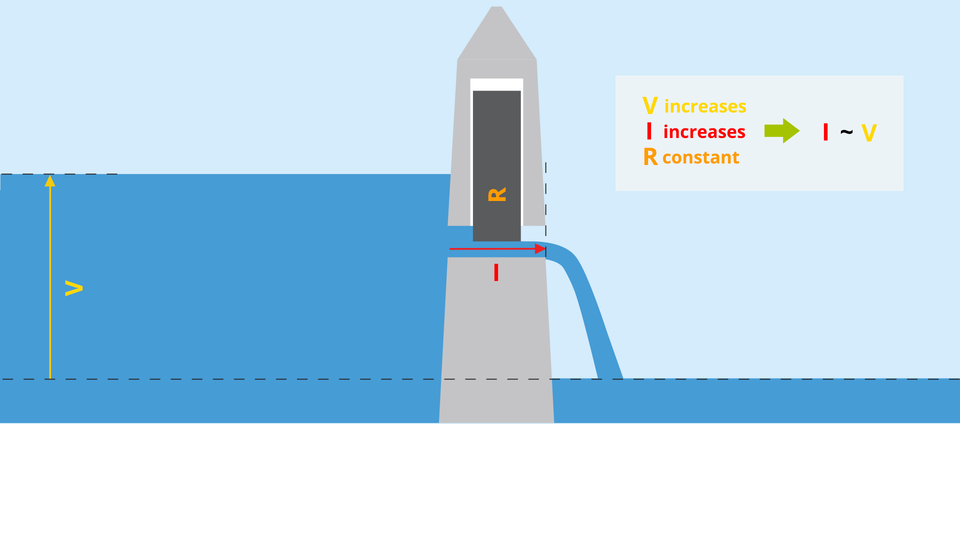
Pokaz slajdów – przepływ wody przez tamę a prawo Ohma. Instrukcja obsługi z poziomu klawiatury: 1. Uruchomienie aplikacji - ENTER, 2. Na każdym ze slajdów czytany jest automatycznie tekst alternatywny po polsku, 3. Przy pierwszym uruchomieniu na pierwszym slajdzie, czytanie tekstu po angielsku - TAB, 4. Przejście między slajdami: do następnego slajdu - TAB, do poprzedniego slajdu - TAB + SHIFT, 5. Przejście do czytania napisu po angielsku - strzałka w górę + strzałka w dół (czyta tekst po angielsku widoczny na slajdzie).
Pokaz slajdów – przepływ wody przez tamę a prawo Ohma. Instrukcja obsługi z poziomu klawiatury: 1. Uruchomienie aplikacji - ENTER, 2. Na każdym ze slajdów czytany jest automatycznie tekst alternatywny po polsku, 3. Przy pierwszym uruchomieniu na pierwszym slajdzie, czytanie tekstu po angielsku - TAB, 4. Przejście między slajdami: do następnego slajdu - TAB, do poprzedniego slajdu - TAB + SHIFT, 5. Przejście do czytania napisu po angielsku - strzałka w górę + strzałka w dół (czyta tekst po angielsku widoczny na slajdzie).
It is quite obvious. The larger the voltage we apply, the larger the current will flow. The bigger the resistance the conductor has, the lower the current. Recall the example of a wardrobe - the more work you do, the bigger the effect will be: the wardrobe will move faster. The greater the resistance of movement, the weaker the effect - the wardrobe will move more slowly.
Ohm's law describes the simplest case of the relationship between the voltage applied to the conductor (resistor) and the current flowing through this conductor.
Ohm's law describes the simplest case of the relationship between the voltage applied to the conductor (resistor) and the current flowing through this conductor.
Exercises
RgqkBy7Smlyyv
Exercise 1
Wersja alternatywna ćwiczenia: Determine which sentence is true. Możliwe odpowiedzi: 1. The amount of current flowing through the conductor does not depend on its resistance., 2. Ohm's law describes the relationship between the voltage applied to the conductor and the current flowing through the conductor., 3. From Ohm's law it follows that . Therefore, a twofold increase in voltage will double the resistance of the conductor., 4. When we apply a voltage of 2 V to the conductor, a current of 4 A flows through it. The resistance of the conductor is thus 8 Ω.
Wersja alternatywna ćwiczenia: Determine which sentence is true. Możliwe odpowiedzi: 1. The amount of current flowing through the conductor does not depend on its resistance., 2. Ohm's law describes the relationship between the voltage applied to the conductor and the current flowing through the conductor., 3. From Ohm's law it follows that . Therefore, a twofold increase in voltage will double the resistance of the conductor., 4. When we apply a voltage of 2 V to the conductor, a current of 4 A flows through it. The resistance of the conductor is thus 8 Ω.
Determine which sentence is true.
The amount of current flowing through the conductor does not depend on its resistance.
Ohm's law describes the relationship between the voltage applied to the conductor and the current flowing through the conductor.
From Ohm's law it follows that . Therefore, a twofold increase in voltage will double the resistance of the conductor.
When we apply a voltage of 2 V to the conductor, a current of 4 A flows through it. The resistance of the conductor is thus 8 Ω.
Exercise 2
Through a conductor with resistance of of 10 Ω, a charge of 120 C was flown in one minute.
a) Calculate the current flowing through the conductor.
b) Calculate the voltage applied to this conductor.
a) 2 A.
b) 20 V.
Exercise 3
Write a short biographical note about Georg Ohm in English.
RrPKLEZTmrVhN
Exercise 4
Wersja alternatywna ćwiczenia: Match Polish terms with their English equivalents. prawo Ohma Możliwe odpowiedzi: 1. Ohm’s law, 2. dependency of I on U, 3. electric current, 4. electrical resistance, 5. linear graph wykres liniowy Możliwe odpowiedzi: 1. Ohm’s law, 2. dependency of I on U, 3. electric current, 4. electrical resistance, 5. linear graph opór elektryczny Możliwe odpowiedzi: 1. Ohm’s law, 2. dependency of I on U, 3. electric current, 4. electrical resistance, 5. linear graph zależność I od U Możliwe odpowiedzi: 1. Ohm’s law, 2. dependency of I on U, 3. electric current, 4. electrical resistance, 5. linear graph prąd elektryczny Możliwe odpowiedzi: 1. Ohm’s law, 2. dependency of I on U, 3. electric current, 4. electrical resistance, 5. linear graph
Wersja alternatywna ćwiczenia: Match Polish terms with their English equivalents. prawo Ohma Możliwe odpowiedzi: 1. Ohm’s law, 2. dependency of I on U, 3. electric current, 4. electrical resistance, 5. linear graph wykres liniowy Możliwe odpowiedzi: 1. Ohm’s law, 2. dependency of I on U, 3. electric current, 4. electrical resistance, 5. linear graph opór elektryczny Możliwe odpowiedzi: 1. Ohm’s law, 2. dependency of I on U, 3. electric current, 4. electrical resistance, 5. linear graph zależność I od U Możliwe odpowiedzi: 1. Ohm’s law, 2. dependency of I on U, 3. electric current, 4. electrical resistance, 5. linear graph prąd elektryczny Możliwe odpowiedzi: 1. Ohm’s law, 2. dependency of I on U, 3. electric current, 4. electrical resistance, 5. linear graph
Match Polish terms with their English equivalents.
linear graph, dependency of I on U, Ohm’s law, electrical resistance, electric current
prawo Ohma
wykres liniowy
opór elektryczny
zależność I od U
prąd elektryczny
RaTlSYYskpuOm1
Interaktywna gra, polegająca na łączeniu wyrazów w pary w ciągu jednej minuty. Czas zaczyna upływać wraz z rozpoczęciem gry. Jeden ruch to odkrywanie najpierw jednej potem drugiej karty z wyrazem. Każdy wyraz jest odczytywany. Kolejny ruch to odkrywanie trzeciej i czwartej karty. W ten sposób odsłuchasz wszystkie wyrazy. Nawigacja z poziomu klawiatury za pomocą strzałek, odsłuchiwanie wyrazów enterem lub spacją. Znajdź wszystkie pary wyrazów.
Interaktywna gra, polegająca na łączeniu wyrazów w pary w ciągu jednej minuty. Czas zaczyna upływać wraz z rozpoczęciem gry. Jeden ruch to odkrywanie najpierw jednej potem drugiej karty z wyrazem. Każdy wyraz jest odczytywany. Kolejny ruch to odkrywanie trzeciej i czwartej karty. W ten sposób odsłuchasz wszystkie wyrazy. Nawigacja z poziomu klawiatury za pomocą strzałek, odsłuchiwanie wyrazów enterem lub spacją. Znajdź wszystkie pary wyrazów.
Match Polish terms with their English equivalents.
electric current
opór elektryczny
prąd elektryczny
wykres liniowy
Ohm’s law
electrical resistance
linear graph
prawo Ohma
dependency of I on U
zależność I od U
Source: Zespół autorski Politechniki Łódzkiej, licencja: CC BY 3.0.