Describe the shape of the magnetic field lines around the current‑carrying wire.
The current flowing in a wire creates a magnetic field, especially strong when the wire is wound into a coil and placed around the iron core. The magnetic field around a magnet can also influence a current‑carrying wire, by repelling or attracting the conductor with current.
Whenever a current‑carrying wire is placed in a magnetic field, this conductor experiences an Electrodynamic forceelectrodynamic forceElectrodynamic force. This force is perpendicularperpendicularperpendicular to both the magnetic field and the direction of electric current. These three directions - and therefore the movement of the wire - can be determined using a left‑hand ruleleft‑hand ruleleft‑hand rule.
We stretch the thumb, fore‑finger and middle finger of the left hand so that they become perpendicularperpendicularperpendicular to each other. The fore‑finger represents the direction of magnetic field (from the north to the south pole) and the middle finger stands for direction of current. The thumb represents the direction of force (and also the direction of the movement of the wire).
R1HJEADv2S9qQ
Po lewej stronie ilustracji interaktywnej przedstawiony jest rysunek lewej dłoni z wyciągniętym kciukiem do góry, palcem wskazującym i środkowym tak, by były one do siebie ustawione pod kątem prostym. Na dłoni narysowany jest układ współrzędnych. Oś wskazująca siłę elektrodynamiczną F przypisana jest do kciuka, oś wskazująca kierunek pola magnetycznego B do palca wskazującego, a kierunek przepływu prądu I do palca środkowego. Wszystkie siły opisane ze strzałką nad literą. Po prawej stronie ilustracji interaktywnej pokazane są dwa magnesy (prostopadłościany) skierowane do siebie przeciwnymi biegunami. Pole magnetyczne (3) między nimi oznaczone jest strzałkami o zwrocie od bieguna północnego do południowego. Na środku, pomiędzy nimi umieszczony jest przewodnik (2), w postaci cienkiego, długiego walca, w którym kierunek przepływu prądu (4) skierowany jest w stronę patrzącego na rysunek. Dodatkowo zaznaczona jest zielona strzałka (1) skierowana prostopadle do przewodnika i linii sił pola. Na ilustracji widoczne są numery, a na nich podpisy. 1. electrodynamic force {audio}, 2. conductor {audio}, 3. flux of magnetic field {audio}, 4. current {audio}.
Po lewej stronie ilustracji interaktywnej przedstawiony jest rysunek lewej dłoni z wyciągniętym kciukiem do góry, palcem wskazującym i środkowym tak, by były one do siebie ustawione pod kątem prostym. Na dłoni narysowany jest układ współrzędnych. Oś wskazująca siłę elektrodynamiczną F przypisana jest do kciuka, oś wskazująca kierunek pola magnetycznego B do palca wskazującego, a kierunek przepływu prądu I do palca środkowego. Wszystkie siły opisane ze strzałką nad literą. Po prawej stronie ilustracji interaktywnej pokazane są dwa magnesy (prostopadłościany) skierowane do siebie przeciwnymi biegunami. Pole magnetyczne (3) między nimi oznaczone jest strzałkami o zwrocie od bieguna północnego do południowego. Na środku, pomiędzy nimi umieszczony jest przewodnik (2), w postaci cienkiego, długiego walca, w którym kierunek przepływu prądu (4) skierowany jest w stronę patrzącego na rysunek. Dodatkowo zaznaczona jest zielona strzałka (1) skierowana prostopadle do przewodnika i linii sił pola. Na ilustracji widoczne są numery, a na nich podpisy. 1. electrodynamic force {audio}, 2. conductor {audio}, 3. flux of magnetic field {audio}, 4. current {audio}.
A current‑carrying wire placed in a constant magnetic field will be deflected. The greater the current, the larger the wire deflection. If the direction of current changes, than the direction of force and deflection will also change.
R1WVp95IzDJr41
Na rysunku przedstawione są dwie sytuacje, w których widać oddziaływanie pola magnetycznego magnesu w kształcie podkowy na przewodnik z prądem umieszczony wewnątrz magnesu. Po lewej stronie wychylenie przewodnika jest niewielkie, gdyż przyłożone jest mniejsze napięcie. Po prawej stronie wychylenie przewodnika jest duże, gdyż przyłożone jest większe napięcie.
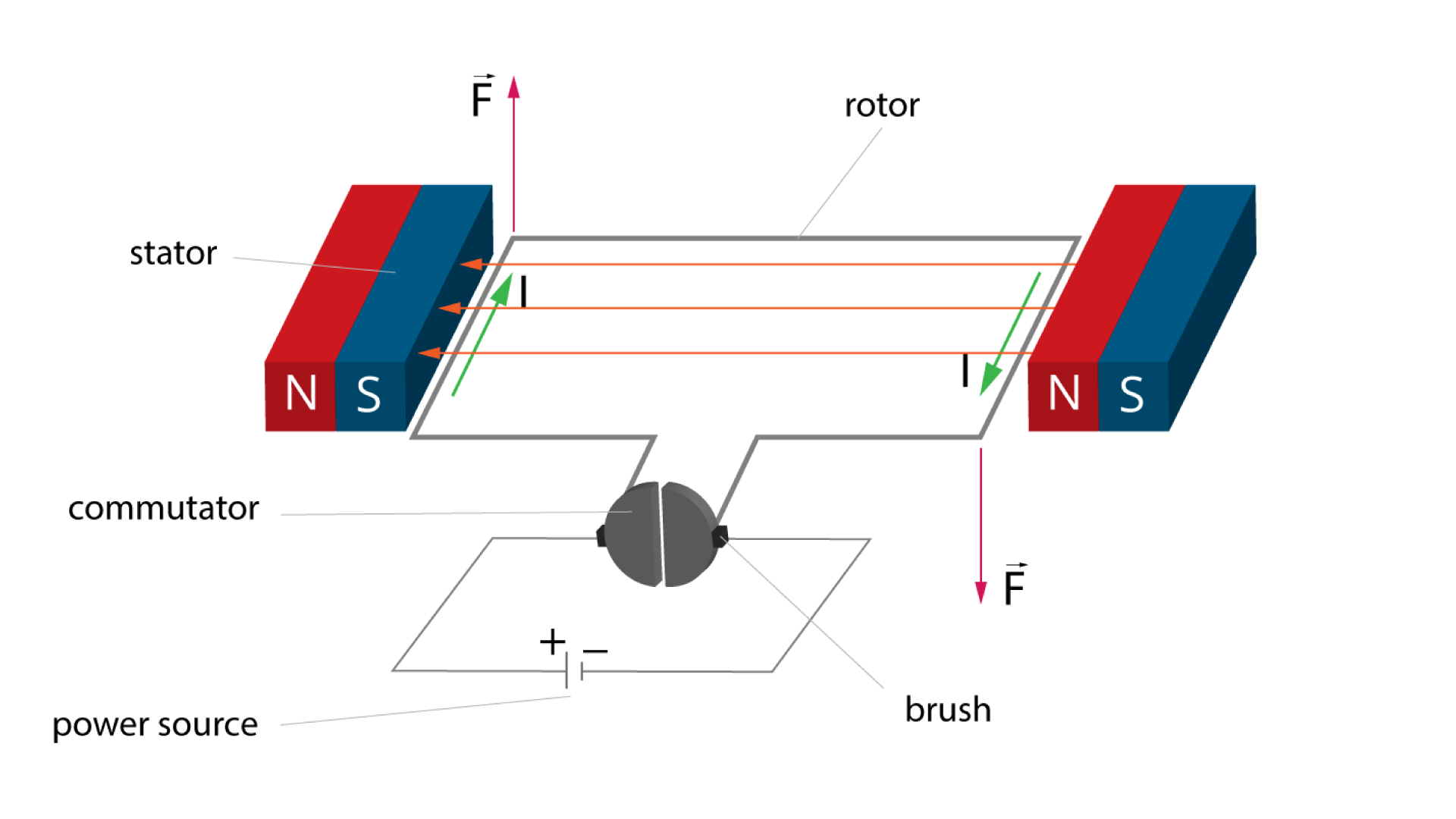
A simple electric motor can be constructed using a coil of wire (armaturearmaturearmature) that is free to rotate between two opposite magnetic poles.
When an electric current flows through the coil, it experiences a magnetic force and rotates. One side of the coil goes up and the other side moves down, according to the left‑hand ruleleft‑hand ruleleft‑hand rule. The direction of the current flow is reversed every half turn. Otherwise the coil would stop.
Changing the current direction in the coil is achieved using two conducting halves of ring, called commutatorcommutatorcommutator, which are connected to the armaturearmaturearmature. The commutator has an electric contact with the brushes. The brushes are just two pieces of springy metal or carbon that make electric contact with the commutator. This allows supplying voltage in the same direction all the time. The both magnets around the armature are called statorstatorstator. Instead of magnets electromagnets can also be used.
The number of rotations per second of a motor can be increased by either increasing the current flowing in the coil or by increasing the strength of the magnetic field.
RZ3yfMiYSry7H
Pomiędzy dwoma magnesami umieszczona jest ramka z drutu opisana rotor, podłączona do komutatorów (commutator) i szczotek (brush), a one do obwodu zamkniętego źródłem napięcia (power source). Magnes po lewej opisany stator. Zaznaczony jest kierunek linii pola magnetycznego (strzałki poziome między magnesami skierowane w lewo), przepływu prądu (strzałki wzdłuż magnesów zgodnie z ruchem wskazówek zegara) oraz kierunek działania siły elektromagnetycznej (strzałki skierowane pionowo. przy prawym magnesie w dół, przy lewym magnesie w górę).
The force exerted on a conductor through which electric current flows, placed in a magnetic field is called electrodynamic forceelectrodynamic forceelectrodynamic force. This force is perpendicularperpendicularperpendicular to both the magnetic field and the direction of electric current.
The rotation of a simple DC motorDC motorDC motor is possible due to electrodynamic force.
Exercises
R16hf0KnD971C
Exercise 1
Wersja alternatywna ćwiczenia: Determine which sentences are true. Możliwe odpowiedzi: 1. Flowing electric current can create magnetic fields., 2. A magnetic field is an area where a magnetic force can be detected., 3. A device that converts electrical energy into mechanical energy is called a DC motor., 4. A coil of wire in a motor is called a commutator.
Wersja alternatywna ćwiczenia: Determine which sentences are true. Możliwe odpowiedzi: 1. Flowing electric current can create magnetic fields., 2. A magnetic field is an area where a magnetic force can be detected., 3. A device that converts electrical energy into mechanical energy is called a DC motor., 4. A coil of wire in a motor is called a commutator.
Determine which sentences are true.
Flowing electric current can create magnetic fields.
A magnetic field is an area where a magnetic force can be detected.
A device that converts electrical energy into mechanical energy is called a DC motor.
A coil of wire in a motor is called a commutator.
zadanie
Source: GroMar, licencja: CC BY 3.0.
Zapoznaj się z treścią abstraktu i ułóż trzy przykładowe pytania na kartkówkę.
Zapoznaj się z treścią abstraktu i ułóż trzy przykładowe pytania na kartkówkę.
Exercise 2
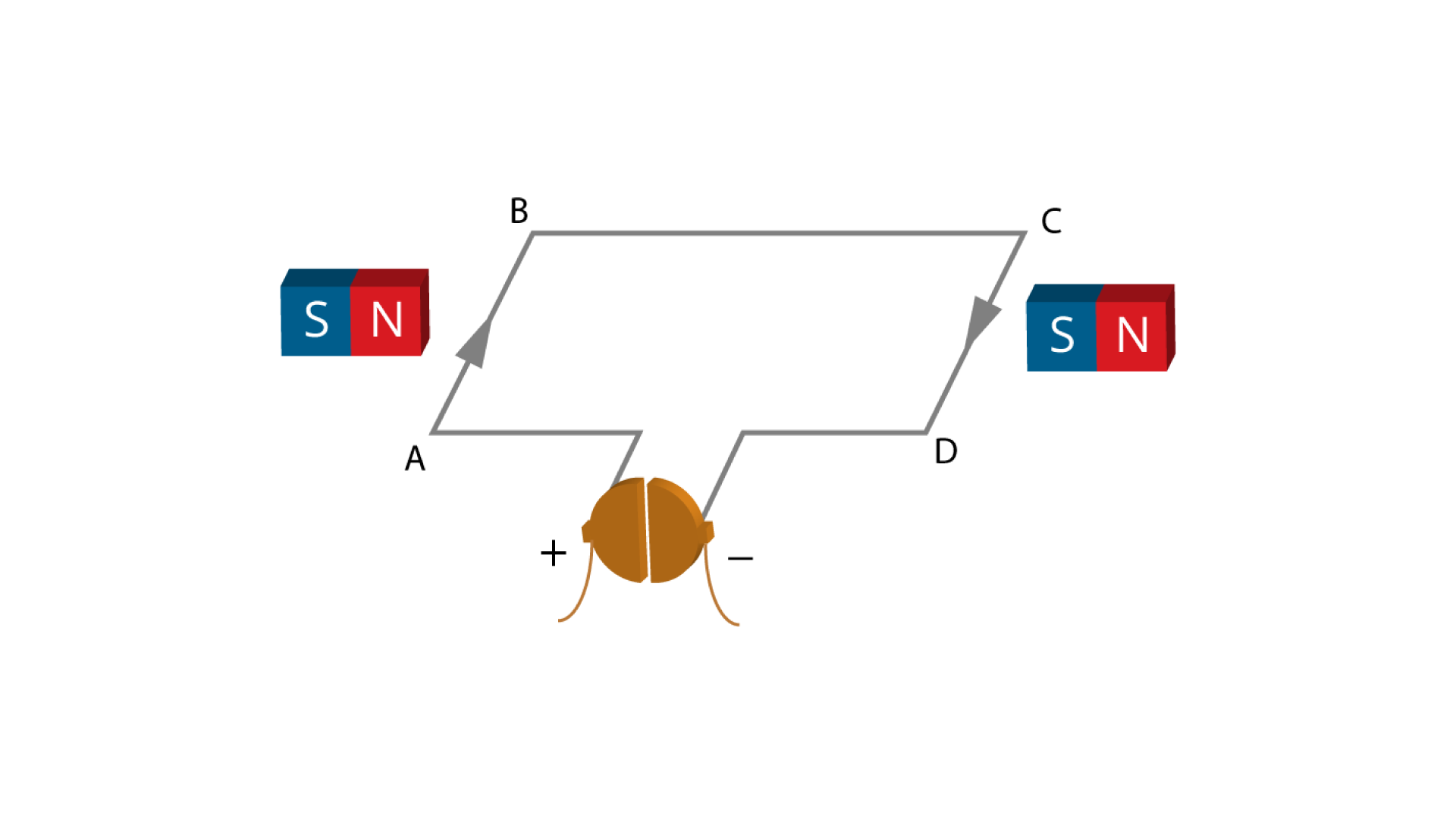
In which direction does the motor rotate?
RSFxOcGEhq0Vh
Pomiędzy dwoma magnesami SN umieszczona jest ramka z drutu w kształcie równoległoboku, podłączona do komutatorów i szczotek (z lewej strony znak minus, z prawej strony znak plus), a one do obwodu zamkniętego źródłem napięcia. Rogi ramki (wierzchołki równoległoboku) opisane są: na dole po lewej A, na górze po lewej B, na górze po prawej C, na dole po prawej D. Na ramce z drutu zaznaczony jest kierunek przepływu prądu (strzałka od A do B i strzałka od C do D).
DC motor
Source: GroMar, licencja: CC BY 3.0.
The motor rotates counter clockwise.
Exercise 3
Explain in English when an electrodynamic force appears.
R1RH9aLZDMvow
Exercise 4
Wersja alternatywna ćwiczenia: Indicate which pairs of expressions or words are translated correctly. Możliwe odpowiedzi: 1. stojan - DC motor, 2. siła elektrodynamiczna - electrodynamic force, 3. reguła lewej ręki - left-hand rule, 4. silnik prądu stałego - stator, 5. prostopadły - perpendicular, 6. szczotka - brush
Wersja alternatywna ćwiczenia: Indicate which pairs of expressions or words are translated correctly. Możliwe odpowiedzi: 1. stojan - DC motor, 2. siła elektrodynamiczna - electrodynamic force, 3. reguła lewej ręki - left-hand rule, 4. silnik prądu stałego - stator, 5. prostopadły - perpendicular, 6. szczotka - brush
Indicate which pairs of expressions or words are translated correctly.
stojan - DC motor
siła elektrodynamiczna - electrodynamic force
reguła lewej ręki - left-hand rule
silnik prądu stałego - stator
prostopadły - perpendicular
szczotka - brush
zadanie
Source: GroMar, licencja: CC BY 3.0.
RgEvGmAHA1DOl1
Interaktywna gra, polegająca na łączeniu wyrazów w pary w ciągu jednej minuty. Czas zaczyna upływać wraz z rozpoczęciem gry. Jeden ruch to odkrywanie najpierw jednej potem drugiej karty z wyrazem. Każdy wyraz jest odczytywany. Kolejny ruch to odkrywanie trzeciej i czwartej karty. W ten sposób odsłuchasz wszystkie wyrazy. Nawigacja z poziomu klawiatury za pomocą strzałek, odsłuchiwanie wyrazów enterem lub spacją. Znajdź wszystkie pary wyrazów.
Interaktywna gra, polegająca na łączeniu wyrazów w pary w ciągu jednej minuty. Czas zaczyna upływać wraz z rozpoczęciem gry. Jeden ruch to odkrywanie najpierw jednej potem drugiej karty z wyrazem. Każdy wyraz jest odczytywany. Kolejny ruch to odkrywanie trzeciej i czwartej karty. W ten sposób odsłuchasz wszystkie wyrazy. Nawigacja z poziomu klawiatury za pomocą strzałek, odsłuchiwanie wyrazów enterem lub spacją. Znajdź wszystkie pary wyrazów.
Match Polish terms with their English equivalents.
stojan
DC motor
prostopadły
reguła lewej ręki
silnik prądu stałego
stator
perpendicular
left-hand rule
siła elektrodynamiczna
electrodynamic force
Source: Zespół autorski Politechniki Łódzkiej, licencja: CC BY 3.0.