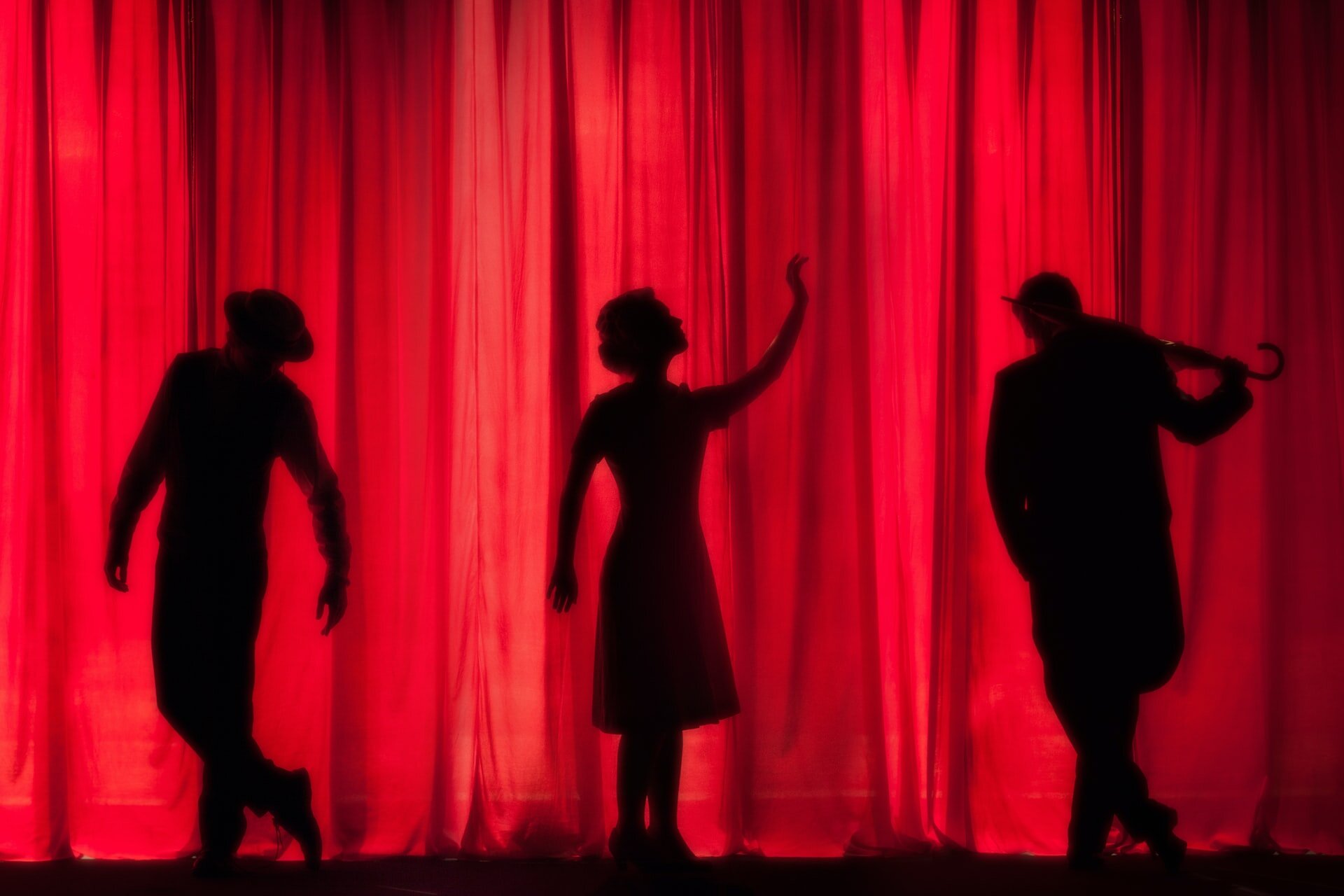
The picture below illustrates actors performing on stage. In this section, you are going to find out what two people say about the language used in Shakespeare’s plays.
Poniższe zdjęcie przedstawia aktorów na deskach teatru. W tej części materiału dowiesz się, co dwoje ludzi mówi o języku, w jakim zostały napisane sztuki Szekspira.
RocFPzEUSMBu0
Zdjęcie przedstawia czerwoną kurtynę, na której ukazano cienie trzech postaci. Dwóch mężczyzn oraz kobiety, która znajduje się między nimi.
Actors on stage
Aktorzy na scenie
Źródło: dostępny w internecie: www.unsplash.com [dostęp 15.03.2022], domena publiczna.
1
Exercise1
Drag the words to put them in the correct places, creating proverbs we use every day, taken from Shakespeare’s works.
R1PvItexwYRVj
Źródło: GroMar Sp. z o.o., licencja: CC BY-SA 3.0.
Exercise1
Drag the words to put them in the correct order, creating proverbs we use every day, taken from Shakespeare’s works.
R1dSVezIuBmy1
1. 1. not, 2. glitters, 3. gold, 4. is, 5. All, 6. that1. not, 2. glitters, 3. gold, 4. is, 5. All, 6. that1. not, 2. glitters, 3. gold, 4. is, 5. All, 6. that1. not, 2. glitters, 3. gold, 4. is, 5. All, 6. that1. not, 2. glitters, 3. gold, 4. is, 5. All, 6. that1. not, 2. glitters, 3. gold, 4. is, 5. All, 6. that.
1. 1. not, 2. glitters, 3. gold, 4. is, 5. All, 6. that1. not, 2. glitters, 3. gold, 4. is, 5. All, 6. that1. not, 2. glitters, 3. gold, 4. is, 5. All, 6. that1. not, 2. glitters, 3. gold, 4. is, 5. All, 6. that1. not, 2. glitters, 3. gold, 4. is, 5. All, 6. that1. not, 2. glitters, 3. gold, 4. is, 5. All, 6. that.
Źródło: GroMar Sp. z o.o., licencja: CC BY-SA 3.0.
Źródło: GroMar Sp. z.o.o., licencja: CC BY-SA 3.0.
Nagranie dźwiękowe
TRANSCRIPTazurewhite
Interviewer: Professor Brown, thank you for coming and giving the lecture today. Recently, we have been talking about Shakespeare. Many people cringe when they hear about him. I think it is about all these tongue twisters as: “Thine” and “Thee” and “Thou” and “Thy”, isn’t it? I’ve invited a professor, a linguist, to focus on the language Shakespeare used in his plays.
Professor: You’re right, these words might be a little annoying, especially for young people today who use a totally different language in their everyday communication and social media. If Shakespeare were to live today, he probably would not understand them saying GUCCI.
Interviewer: Professor, why is it that Shakespeare’s plays were made and remade so many times and still remain popular all over the world despite his sometimes unpopular or difficult topics for readers?
Professor: It is true that no other author’s plays have as many interpretations as Shakespeare’s. Well, I think this is mainly due to the words he used. Back in his time, the 1500s and early 1600s, language was a special tool to communicate and, like today, there was a lot to discuss. Those times were quite rich in courtly intrigues and other affairs that people closely followed. Shakespeare was the most skillful writer at that time, hardly anyone could describe love or hate or personal dramas so well. But one of his greatest accomplishments is his use of insults.
Interviewer: It can’t be! Did Shakespeare really insult?
Professor: Oh yes, many times.
Interviewer: How could that be? One of his devoted fans was Queen Elisabeth!
Professor: Queen Elisabeth was not only the protector of poets and playwrights but she also wrote her own poems. That is why she had such a great interest in theatre. And coming back to Shakespeare… He used a lot of words including insults, whose role was to unify the whole audience by means of laughter. Words in different settings were used for many different reasons. First of all, to set the mood of the scene, to provide the audience with the right atmosphere, and finally to show and develop the relationship between characters of the play.
Interviewer: I assume that insults were the perfect tool to achieve this aim.
Professor: They were, indeed, just like they are today. People say that sometimes it’s better and easier for them to use insults than to explain the whole context. Insults sometimes express our attitude and emotions in a straightforward way, don’t they?
Interviewer: I must admit I didn’t realise that Shakespeare’s language could be bad!
Professor: Everybody knows Romeo and Juliet, don’t they? There are two gangs of the Montagues and Capulets and two lovers between them who want to be together. In Act 1, Scene 1, the two families meet. Sampson, who is the Capulet’s servant, says that he would bite his thumb at the opponents. Abraham, the Montague’s servant asks “Do you bite your thumb at us, Sir?” Abraham seems to be shocked by the words he heard.
Interviewer: Why is he shocked, professor?
Professor: Well, today biting a thumb might not be a great deal, but Sampson took it in a negative way. It turns out that it was a very rude gesture at that time, meant to offend the opponent.
Interviewer: That does change things! Shakespeare was a true wordsmith. It seems to me that I need to reread the plays as there is so much I must have skipped… But this time, I’m going to focus on words more and what their real meanings are.
Professor: I truly encourage you to do so, it might be fun!
Interviewer: Thank you, Professor.
Professor: Thank you for inviting me here today.
Exercise2
R12yHtjSDY1iX
Study the sentences about the language Shakespeare used in his works and decide if they are true or false.
Study the sentences about the language Shakespeare used in his works and decide if they are true or false.
Źródło: GroMar Sp. z o.o., licencja: CC BY-SA 3.0.
Exercise3
RveG88bZC4XDR
Play the dialogue again if you need to and decide who expressed the following ideas: the Interviewer or Professor?
Play the dialogue again if you need to and decide who expressed the following ideas: the Interviewer or Professor?
Źródło: GroMar Sp. z o.o., licencja: CC BY-SA 3.0.
Exercise4
R1LGPAFT4jQuV
Match the phrases to create correct sentences.
Match the phrases to create correct sentences.
Źródło: GroMar Sp. z.o.o., licencja: CC BY-SA 3.0.