Contemporary societies tend to be more and more diverse, with many groups representing conflicting goals.
In the democracy, the role of the state authorities is to find ways to reconcileto reconcileto reconcile these conflicting goals to the best interest of the whole society and the state.
You will learn
You will be able to define the terms politics, ethics, and power, as well as explain why it is difficult to provide one unambiguousunambiguousunambiguous definition for each of these terms.
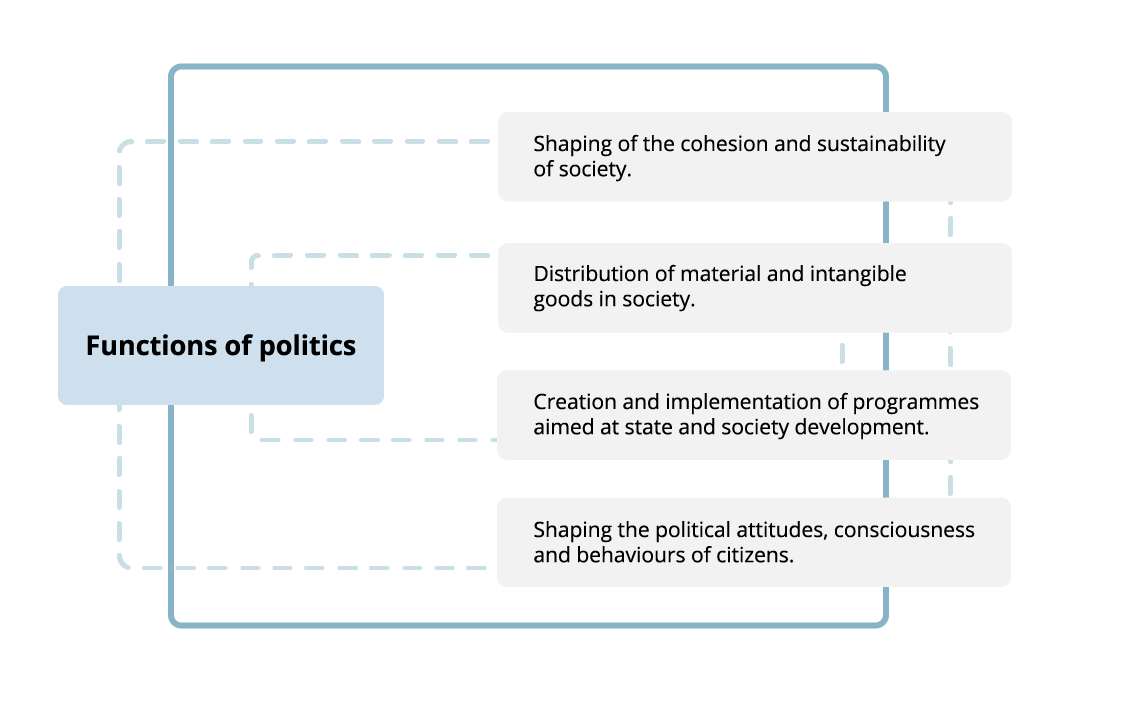
You will be able to name and explain the functions of politics.
You will be able to discuss the relationship between ethics and politics.
You will be able to name and explain various means of executing powerto execute (power)executing power over people.
Tablica interaktywna. Grafika przedstawia dwie ściskające się dłonie. Przenikają się one z mapą świata oraz napisem "politics". Ćwiczenie alternatywne. What do you associate politics with? What does the term mean? Present your suggestions, and then compare them with other students in your class.
Tablica interaktywna. Grafika przedstawia dwie ściskające się dłonie. Przenikają się one z mapą świata oraz napisem "politics". Ćwiczenie alternatywne. What do you associate politics with? What does the term mean? Present your suggestions, and then compare them with other students in your class.
What do you associate politics with? What does the term mean? Put your suggestions onto the board, and then compare them with other students in your class.
Politics
There is no one generally accepted definition of politics. Here are just a few most common examples of definitions you may come acrossto come acrosscome across:
conscious, organized actions aimed at gaining and exercising political power;
the art of governing society and the state;
decision‑making process that allows the needs and values of society, social groups and individuals to be met;
conflict resolution process, in which three basic methods are used: cooperation, coercion and compromise;
sphere of public activity of the state institutions, political parties, social organizations and individuals – citizens.
R1UrG03eKW4UR
Infografika, której głównym elementem jest napis "Functions of politics", od którego odchodzą następujące elementy "Shaping of the cohesion and sustainability of society", "Distribution of material and intangible goods in society", "Creation and implementation of programmes aimed at state and society development", "Shaping the political attitudes, consciousness and behaviours of citizens".
Ethics
RpN07PD5KEjpy
Exercise 1
Uzupełnij zdania. 1. A popular name for the Council of Ministers is…, 2. Poland is our…, 3. Another name for those in power is..., 4. Every citizen has certain obligations and…, 5. When making a decision we always have a…, 6. A large group of people inhabiting a common territory is a...
Uzupełnij zdania. 1. A popular name for the Council of Ministers is…, 2. Poland is our…, 3. Another name for those in power is..., 4. Every citizen has certain obligations and…, 5. When making a decision we always have a…, 6. A large group of people inhabiting a common territory is a...
Solve the crossword and you will learn what is one of the foundations of good governance.
A popular name for the Council of Ministers is…
Poland is our…
Another name for those in power is...
Every citizen has certain obligations and…
When making a decision we always have a…
A large group of people inhabiting a common territory is a...
1
2
3
4
5
6
Ethics indicatesto indicateindicates patterns of appropriate human behaviour and formulates the principles of their implementation. The content of norms and moral judgements is connected with the historical development of societies. In subsequentsubsequentsubsequent epochs it underwentto undergounderwent smaller or larger transformations, e.g. the changes in attitude towards slaveryslaveryslavery, racial discrimination, the use of violence in interpersonal relations or the scope of power and responsibility of the authorities.
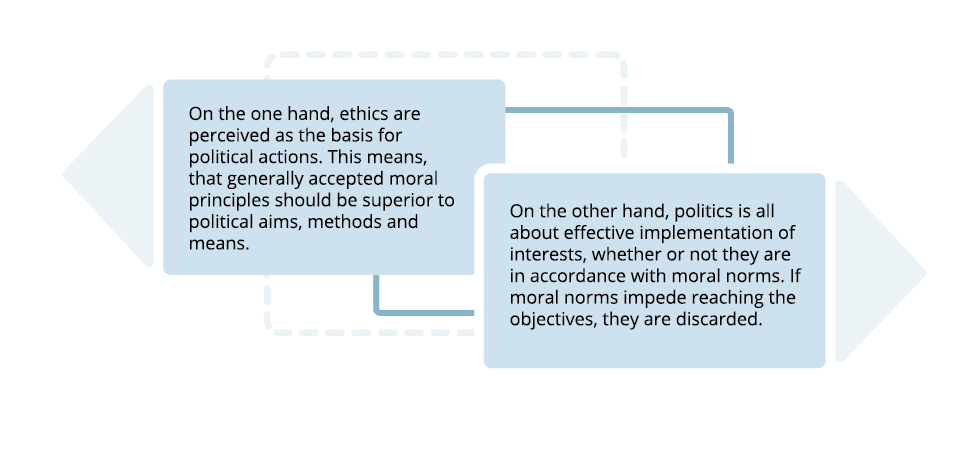
The role of ethics in political life has been disputed ever since antiquityantiquityantiquity. There are two positions in the dispute.
R1WODfMD3PZqc
Infografika, która składa się z dwóch strzałek, na których znajdują się następujące treści: Strzałka skierowana w lewo: "On the one hand, ethics are perceived as the basis for political actions. This means, that generally accepted moral principles should be superior to political aims, methods and means"; strzałka skierowana w prawo: "On the other hand, politics is all about effective implementation of interests, whether or not they are in accordance with moral norms. If moral norms impede reaching the objectives, they are discarded".
Anyone, who undertakes a political action, has to face the dilemmato face the dilemmato face the dilemma, and answer a couple of important questions:
Will these actions be good for the state and society? And what does “good” mean?
Does the welfare of the state justify immoral actions?
Should moral norms be broken to achieve the desired goals?
Is it at all possible to talk about the welfare of the state if one discards moral norms?
Regardless of the ongoing disputes, ethics are an important determinant of politics. People have always evaluated political activities not only by their effectiveness, but also by their moral value. States, political parties, social movements, political leaders, ordinary people refer to different – secularsecularsecular and religious – ethical concepts. This leads to various visions of society and the state, and thusthusthus, sometimes, also to serious political conflicts.
Power
The phenomenon of power appears in every community, group, organization or social institution – at school, in a political party, a family, a country, a peer group and an international organization, a company and an army. It is a necessary element regulating social life, and thus an important element of politics, and the functioning of the state.
The power is:
a system of social relations;
the right to govern, e.g. to govern a state
the governing bodies and institutions that make the key decisions
Those in power, the authorities, induceto induceinduce people to obeyto obeyobey, using various means:
R1WUdp5UxpUx8
Authority The ability to lead people without resorting to coercion and violence. People voluntarily submit to the person in power, because they respect, admire and recognize the person., Persuasion Convincing people to accept certain views, values, behaviours. Persuasion may be direct, e.g. a personal meeting with voters, or indirect, e.g. via tv or internet., Manipulation Implicit or partly deceptive way of influencing people’s views, feelings or behaviour. A manipulator usually conceals his real intentions, methods or real effects of his actions. He often achieves his goals by means of lies and conscious omissions., Coercion A form of influence referring to various types of penalties applied when people fail to properly perform the tasks imposed on them or refuse to submit to the decisions of the authorities., Violence Violence involves the use of physical strength against people or groups that do not respect the social order and the decisions of the government. The goal is to stop actions that do not comply with applicable standards and to force obedience.
Authority The ability to lead people without resorting to coercion and violence. People voluntarily submit to the person in power, because they respect, admire and recognize the person., Persuasion Convincing people to accept certain views, values, behaviours. Persuasion may be direct, e.g. a personal meeting with voters, or indirect, e.g. via tv or internet., Manipulation Implicit or partly deceptive way of influencing people’s views, feelings or behaviour. A manipulator usually conceals his real intentions, methods or real effects of his actions. He often achieves his goals by means of lies and conscious omissions., Coercion A form of influence referring to various types of penalties applied when people fail to properly perform the tasks imposed on them or refuse to submit to the decisions of the authorities., Violence Violence involves the use of physical strength against people or groups that do not respect the social order and the decisions of the government. The goal is to stop actions that do not comply with applicable standards and to force obedience.
What makes people obedient?
Authority The ability to lead people without resorting to coercion and violence. People voluntarily submit to the person in power, because they respect, admire and recognize the person.
Persuasion Convincing people to accept certain views, values, behaviours. Persuasion may be direct, e.g. a personal meeting with voters, or indirect, e.g. via tv or internet.
Manipulation Implicit or partly deceptive way of influencing people’s views, feelings or behaviour. A manipulator usually conceals his real intentions, methods or real effects of his actions. He often achieves his goals by means of lies and conscious omissions.
Coercion A form of influence referring to various types of penalties applied when people fail to properly perform the tasks imposed on them or refuse to submit to the decisions of the authorities.
Violence Violence involves the use of physical strength against people or groups that do not respect the social order and the decisions of the government. The goal is to stop actions that do not comply with applicable standards and to force obedience.
R1YgYWSMfrcJc
Exercise 2
Ćwiczenie alternatywne: Listen to the abstract recording to review the material and new vocabulary. Explain the meaning of following words: to resort to; to convince; implicit; to comply with; applicable; complexity; sustainability; intangible. If it's too difficult, use lesson's glossary.
Ćwiczenie alternatywne: Listen to the abstract recording to review the material and new vocabulary. Explain the meaning of following words: to resort to; to convince; implicit; to comply with; applicable; complexity; sustainability; intangible. If it's too difficult, use lesson's glossary.
Listen to the abstract recording to review the material and new vocabulary. Then do the vocabulary exercise. Match the pairs: English and Polish words.
nieuchwytny, niematerialny, trwałość, złożoność, przekonywać, obowiązujące, zgodne z, domniemany, uciekać się do