Przeczytaj
Under the Swiss‑French border, a huge circular system of tubes and experimental devices is buried deep underground. This is CERN, the European Council for Nuclear Research, and the home of the Large Hadron Collider, the world‑largest particle accelerator. Here is a text about this amazing facility and what it has been built for.
Na granicy szwajcarsko‑francuskiej, głęboko pod ziemią znajduje się ogromny, mający kształt okręgu system rur i urządzeń eksperymentalnych. To ośrodek badawczy CERN, czyli Europejskiej Organizacji Badań Jądrowych. Jest to także siedziba Wielkiego Zderzacza Hadronów – największego na świecie akceleratora cząstek. Z tego e‑materiału dowiesz się więcej o tym niesamowitym obiekcie i poznasz cel, w jakim został zbudowany.
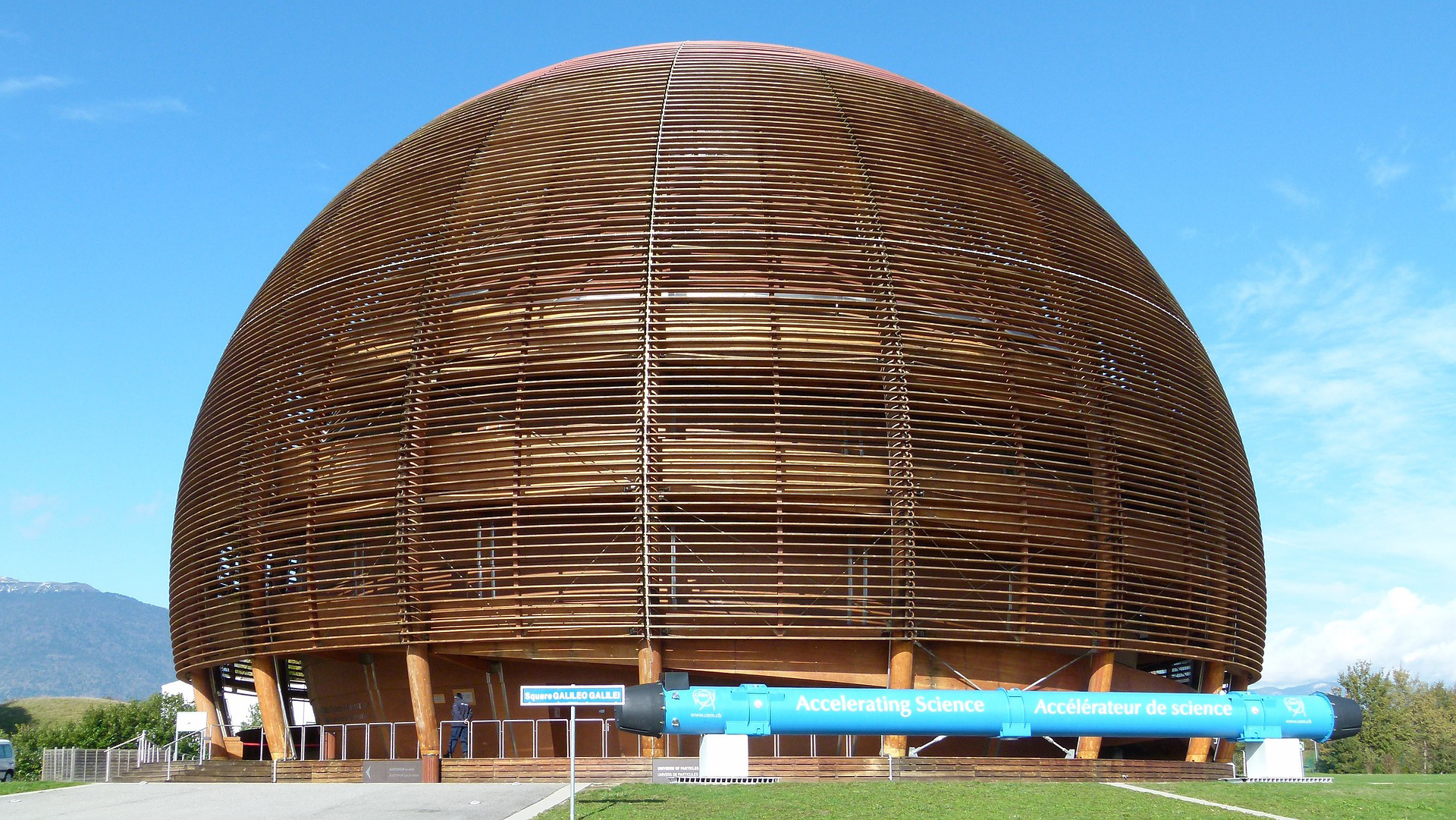
Study the text about the Large Hadron Collider and do the exercises below.
The Large Hadron ColliderScience is an area which provides many opportunities for international co‑operation and scientists from different countries very often join their efforts to make new, groundbreaking discoveriesgroundbreaking discoveries or work on important projects.
One such international undertaking is CERN – a research institutionresearch institution located near Geneva, Switzerland. CERN was founded in 1954 and today 22 nations are members of the organisation. It is the world's biggest laboratory for particle physicsparticle physics which deals with advanced and complex theories related to how our universe was created. One of the main facilities that CERN operates is The Large Hadron Collider.
The Large Hadron Collider (LHC) is the world’s biggest and most powerful particle accelerator. The installation has the form of a giant circular tunnelgiant circular tunnel built underground. The tunnel containing the accelerator tubes and other devices is 27 kilometres long, and between 50 and 175 metres below the ground. It lies beneath the border of Switzerland and France. Around 10,000 scientists and engineers from over 100 different countries worked together in the making of this project, and it cost $10 billion to build. It is now the largest and most complicated experimental research facilityexperimental research facility in the world.
As its name states, the research at the LHC involves the collision of hadronscollision of hadrons. A hadron is a particle which consists of a number of smaller elements, such as the parts of an atomparts of an atom: protonsprotons and neutronsneutrons. The LHC accelerates these particlesaccelerates these particles through the tunnel until they reach nearly the speed of lightspeed of light. Different particles are directedparticles are directed through the tunnel in opposite directions. When they collide, they create conditions similar to the early universeearly universe.
When the particles hit each other, their energy is converted intoconverted into many other particles, and sensitive detectorssensitive detectors keep track of the pieces that are created. By looking carefully at the detector datadetector data, scientists can study what the particles are made of and how they interact. This is the only way to see some particles because very high energy is needed to create them and the LHC is one of the very few places that have enough energy to do this.
The LHC attempts to study elementary particlesstudy elementary particles have already taught us a lot about quantum physicsquantum physics. Researchers are hoping to learn a lot more about the structure of space and timestructure of space and time by conducting more experiments at the facility. The observations researchers are able to make, can help us learn what the universe might have been like within milliseconds after the Big Bangmilliseconds after the Big Bang.
Because many people don’t understand how the LHC works, they think it could create a black holecreate a black hole, which would be very dangerous. There are two reasons not to be worried. The first is that the LHC won't do anything that the cosmic rays that hit the Earthcosmic rays that hit the Earth every day don't do, and these rays do not create black holes. The second reason is that even if the LHC did make black holes, they would be very tiny. The smaller a black hole is, the shorter its life. Very tiny black holes would die and turn into energyturn into energy before they could hurt people. This is why the Large Hadron Collider is a very safe facility and has no negative impact on the surroundings.
Źródło: Katarzyna Piotrowska, licencja: CC BY-SA 3.0.
a) in 22 countries.
b) under the Swiss-French border.
c) on many different computers.
2. The Large Hadron Collider is
a) a system of underground tubes and other devices.
b) a powerful magnet.
c) a scientific detector used in physics.
3. The creation of LHC involved
a) mainy Swiss researchers.
b) experts from 100 countries.
c) the cost of nearly $1 billion.
4. Inside the collider
a) neutrons move at a very slow speed.
b) particles collide with detectors.
c) particles hit each other with great energy.
5. The purpose of the Large Hadron Collider is
a) to create black holes.
b) to study cosmic rays.
c) to study elementary particles.
What does the Large Hadron Collider do? Why do some people consider it to be dangerous? Type in your answer in the space below. Use 4‑5 sentences.
Słownik
/ əkˈseləreɪts ðiːz ˈpɑːtɪkl̩z / / əkˈseləreɪt ˈpɑːtɪkl̩z /
przyspiesza te cząsteczki [przyspieszać cząsteczki] (give particles greater speed)
/ kəˈlɪʒn̩ əv ˈheidrəns /
zderzenie hadronów (neutrons or protons hitting each other)
/ ˈkɒzmɪk reɪz ðæt ˌhɪt ði ɜːtheta / / ˈkɒzmɪk reɪ ðæt hɪts ði ɜːtheta /
promienie kosmiczne, które uderzają w Ziemię [promień kosmiczny uderzający w Ziemię] (very powerful particles travelling through space at high speed which hit the Earth)
transcriptions
przekształcana w [przekształcać w]
/ kriːˈeɪt ə blæk həʊl /
tworzyć czarną dziurę (create a region of space having a gravitational field so intense that no matter or radiation can escape)
/ dɪˈtektə ˈdeɪtə /
dane z detektora (data gathered from a detector)
/ ˌɜ:li ˈjuːnɪvɜːs /
wczesny Wszechświat (the early state of all existing matter and space considered as a whole and created in the Big Bang about 13 billion years ago)
/ ɪkˌsperɪˈmentl̩ rɪˈsɜːtʃ fəˈsɪlɪti /
eksperymentalna jednostka badawcza (place where scientific experiments are carried out)
/ ˈdʒaɪənt ˈsɜːkjʊlə ˈtʌnl̩ /
gigantyczny tunel w kształcie okręgu (large tunnel that has the shape of a circle)
/ ˈɡraʊndˌbrekɪŋ dɪˈskʌvərɪz / / ˈɡraʊndˌbrekɪŋ dɪˈskʌvəri /
przełomowe odkrycia [przełomowe odkrycie] (new discoveries that are very important)
/ ˈmɪlisekəndz ˈɑːftə ðə bɪg bæŋ / / ˈmɪlisekənd /
milisekundy po Wielkim Wybuchu [milisekunda] (fractions of a second after the explosion that created the universe)
/ ˈnjuːtrɒnz / / ˈnjuːtrɒn /
neutrony [neutron] (part of an atom with a neutral electric charge)
/ ˈpɑːtɪkl̩ əkˈseləreɪtə /
przyspieszacz cząstek (machine that can force particles to travel at high speeds)
/ ˈpɑːtɪkl̩ ˈfɪzɪks /
fizyka cząstek elementarnych (field of physics that deals with particles)
/ ˈpɑːtɪkl̩z a: dɪˈrektɪd / / ˈpɑːtɪkl̩ ɪz dɪˈrektɪd /
cząsteczki są prowadzone [cząsteczka jest prowadzona] (particles are forced to travel along a path)
/ pɑːts əv ən ˈætəm / / pɑ:t əv ən ˈætəm /
części atomu [część atomu] (parts of the smallest particle of a chemical element that can exist)
/ ˈprəʊtɒnz / / ˈprəʊtɒn /
protony [proton] (part of an atom with a positive electric charge)
/ ˈkwɒntəm ˈfɪzɪks /
fizyka kwantowa (field of physics that deals with the quantum)
/ rɪˈsɜːtʃ ˌɪnstɪˈtjuːʃn̩ /
instytucja badawcza (institution that deals with new scientific discoveries or studies)
/ ˈsensətɪv dɪˈtektəz / / ˈsensətɪv dɪˈtektə /
czułe detektory [czuły detektor] (sensitive appliance that can measure something)
/ spi:d əv laɪt /
prędkość światła (speed that light travels at)
/ ˈstrʌktʃər əv speɪs ənd ˈtaɪm /
struktura przestrzeni i czasu (the way space and time are built)
/ ˈstʌdi ˌelɪˈmentəri ˈpɑːtɪkl̩z / / ˈstʌdi ˌelɪˈmentəri ˈpɑːtɪkl̩ /
badać cząstki elementarne [badać cząstkę elementarną] (study some of the smallest elements that can exist)
/ ˈtɜ:n ˈɪntə ˈenədʒi /
przemieniać w energię (change into energy)
transcriptions
fizyka kwantowa
Źródło: GroMar Sp. z o.o., licencja: CC BY‑SA 3.0