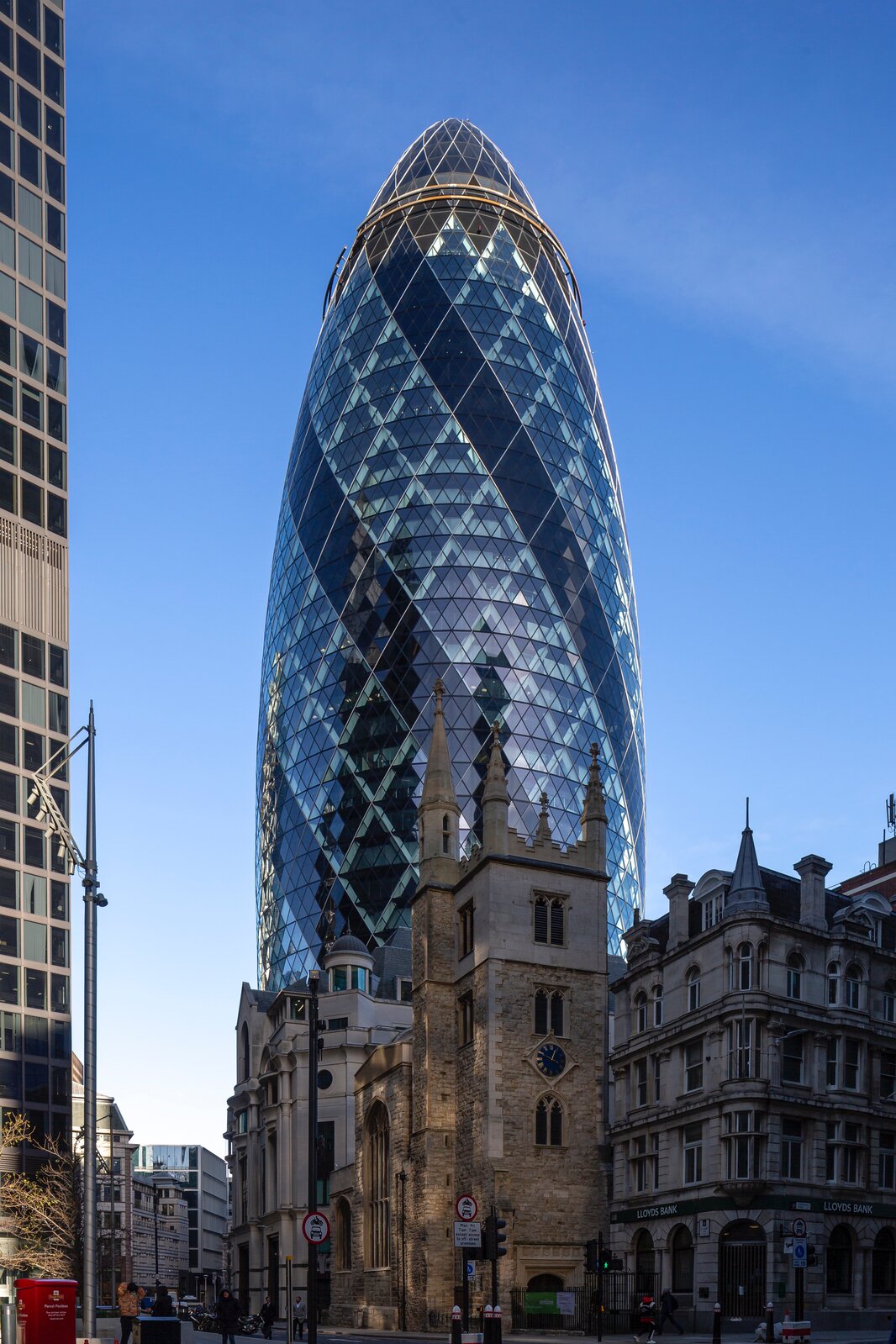
Londoners call this unusual skyscraper in the photo the Gherkin. Read about a school trip to London to find out more about its known and less known attractions.
Londyńczycy nazywają ten nietypowy wieżowiec Gherkin (korniszon). Przeczytaj relację z wycieczki szkolnej, aby dowiedzieć się więcej o znanych i mniej znanych miejscach w Londynie.
ROIHFhYST0ZSG
Zdjęcie przedstawia fragment dzielnicy finansowej w Londynie z wieżowcem 30 St Mary Axe, nazywanym The Gherkin, czyli Ogórek lub Swiss Re. Na pierwszym planie widoczne są niskie kamienice oraz zabytkowy kościół.
The Gherkin skyscraper
Wieżowiec Gherkin (korniszon)
Źródło: dostępny w internecie: www.pexels.com [dostęp 28.12.2021], domena publiczna.
Exercise1
Match the following words with the correct translations.
Połącz poniższe wyrazy z ich tłumaczeniami.
RmqGENQJXlrZi
a double-decker bus Możliwe odpowiedzi: 1. policjant, 2. piętrowy autobus, 3. metro, 4. autobus z otwartym dachem the tube Możliwe odpowiedzi: 1. policjant, 2. piętrowy autobus, 3. metro, 4. autobus z otwartym dachem a bobby Możliwe odpowiedzi: 1. policjant, 2. piętrowy autobus, 3. metro, 4. autobus z otwartym dachem an open-top bus Możliwe odpowiedzi: 1. policjant, 2. piętrowy autobus, 3. metro, 4. autobus z otwartym dachem
a double-decker bus Możliwe odpowiedzi: 1. policjant, 2. piętrowy autobus, 3. metro, 4. autobus z otwartym dachem the tube Możliwe odpowiedzi: 1. policjant, 2. piętrowy autobus, 3. metro, 4. autobus z otwartym dachem a bobby Możliwe odpowiedzi: 1. policjant, 2. piętrowy autobus, 3. metro, 4. autobus z otwartym dachem an open-top bus Możliwe odpowiedzi: 1. policjant, 2. piętrowy autobus, 3. metro, 4. autobus z otwartym dachem
Źródło: GroMar Sp. z o.o., licencja: CC BY-SA 3.0.
Exercise1
Drag the words to match them with the pictures.
Przeciągnij wyrazy, żeby połączyć je w pary z ilustracjami.
R1cDMzILuS0x1
Źródło: dostępny w internecie: www.pexels.com [dostęp 28.12.2021], pixabay.com [dostęp 28.12.2021], commons.wikimedia.org [dostęp 28.12.2021], domena publiczna.
Read the text below and do the exercises.
Przeczytaj tekst i wykonaj poniższe ćwiczenia.
London in a Nutshell
Anna LechLondon in a Nutshell
Hi guys!
We are back from our visit to London. It was only three days long, but this time we travelled by plane and had more time for sightseeingsightseeingsightseeing. Last year, as you may remember, we didn’t plan our trip well. We went to London by bus, and the journeyjourneyjourney to England took us almost two days! We missed our ferryferryferry across the English Channel, arrived in London late and couldn’t visit Madame Tussauds, the famous waxwaxwax figures museum. The tickets we had booked booked [book]booked back home expiredexpired [expire]expired. This year it was much better. Here is a short report from our great trip.
The tour guidetour guidetour guide called our first day in London “London in a nutshellin a nutshellin a nutshell” because we could see all the famous sightssights [sight]sights in just a few hours. We had a tour on an open‑top bus. It was fun although the weather was very English if you know what I mean… LuckilyluckilyLuckily, there were special tourist umbrellas on the bus. Anyway, we drove along Oxford Street, one of the best shopping streets in the world. Later, we saw the famous clock Big Ben and the Houses of Parliament. By the way, did you know that Big Ben is the name of the bellbellbell inside the tower? Then, of course, there was the London Eye. It’s a big wheelwheelwheel which offers a fantastic view of the whole city. Later, our guide was going to show us Tower Bridge, but it started raining so heavilyheavilyheavily that we had to get offget offget off the bus (remember it was an open‑top bus) and use a regular double‑decker bus to come back to our hotel.
On the second day, we explored London from an unusual perspective. We took a sightseeing boat on the river Thames. We departeddeparted [depart]departed from Westminster PierpierPier and enjoyed a spectacularspectacularspectacular city panorama from the river. We could see all the famous bridges from up closefrom up closefrom up close and the modern Canary Wharf skyscrapersskyscrapers [skyscraper]skyscrapers. The guide told us an interesting story about one of the skyscrapers. The building is all made of glass. When it was underunder constructionunderconstructionunder constructionconstruction, it reflectedreflected [reflect]reflected sunlight and meltedmelted [melt]melted some parts of a car parked in the street! People sometimes give funny names to London skyscrapers. One of them looks like a cucumber so people call it the Gherkinthe Gherkin the Gherkin.
On the third day, we were travelling round the city by the underground, or the tube as Londoners call it. London has the oldest underground system in the world and there are more than 250 stations! Some stations have funny names, for example “Elephant & Castle” or “Angel”. It was 9 am, the peak timepeak timepeak time, when everyone commutescommutes [commute]commutes to work. The train was so crowded that we found it difficult to get onget onget on and when it was time to leave the carriagecarriagecarriage, I just didn’t manage to get off with my group. I was pretty scared. I got off at the next station and saw my class waiting for me at the platformplatformplatform. Our guide was already talking to a policeman wearing a funny black hat. Remember, if you ever get lost in London, you can always talk to a police officer, or bobbybobby bobby as English people call them. Bobbies are very helpful and they never refuserefuserefuse when you want to take a photo with them. Now I have a great souvenirsouvenirsouvenir from the trip – a selfie with a London bobby! I’m going to print it out and put it on my bedroom wall. Speaking of photos, we are going to organise an exhibitionexhibitionexhibition of the photos from the trip in our school hall. It’s going to be called “The London Snaps”, it’s on next week, you must see it!
1 Źródło: Anna Lech, licencja: CC BY-SA 3.0.
Exercise2
Read the text again and decide if the following sentences are true or false.
Przeczytaj tekst ponownie, a następnie zdecyduj, czy podane zdania są prawdziwe, czy fałszywe.
RJl0TGR8JZ9ni
The author of the text had never been to London before. TRUE FALSE
The group didn’t have tickets to Madame Tussauds. TRUE FALSE
On the first day the group planned to see Tower Bridge. TRUE FALSE
There was a problem with one of the modern buildings. TRUE FALSE
In the morning, the underground was packed with commuters. TRUE FALSE
The author of the text had never been to London before. TRUE FALSE
The group didn’t have tickets to Madame Tussauds. TRUE FALSE
On the first day the group planned to see Tower Bridge. TRUE FALSE
There was a problem with one of the modern buildings. TRUE FALSE
In the morning, the underground was packed with commuters. TRUE FALSE
Źródło: GroMar Sp. z o.o., licencja: CC BY-SA 3.0.
Exercise3
Drag the words below to the correct places. (There is one extra word which you do not need.)
Przeciągnij podane wyrazy w odpowiednie luki. (Jeden z nich nie pasuje do żadnej luki).
RqijaypRgQtrZ
You can take a 1. bus, 2. nutshell, 3. skyscrapers, 4. commutes, 5. Bobbies, 6. ferry, 7. sights, 8. peak time across the English Channel.
“London in a 1. bus, 2. nutshell, 3. skyscrapers, 4. commutes, 5. Bobbies, 6. ferry, 7. sights, 8. peak time” trip lets you see all the famous 1. bus, 2. nutshell, 3. skyscrapers, 4. commutes, 5. Bobbies, 6. ferry, 7. sights, 8. peak time in just a few hours.
Everyone 1. bus, 2. nutshell, 3. skyscrapers, 4. commutes, 5. Bobbies, 6. ferry, 7. sights, 8. peak time to work in 1. bus, 2. nutshell, 3. skyscrapers, 4. commutes, 5. Bobbies, 6. ferry, 7. sights, 8. peak time.
Sunlight from one of the 1. bus, 2. nutshell, 3. skyscrapers, 4. commutes, 5. Bobbies, 6. ferry, 7. sights, 8. peak time damaged a car parked in te street.
You can take a 1. bus, 2. nutshell, 3. skyscrapers, 4. commutes, 5. Bobbies, 6. ferry, 7. sights, 8. peak time across the English Channel.
“London in a 1. bus, 2. nutshell, 3. skyscrapers, 4. commutes, 5. Bobbies, 6. ferry, 7. sights, 8. peak time” trip lets you see all the famous 1. bus, 2. nutshell, 3. skyscrapers, 4. commutes, 5. Bobbies, 6. ferry, 7. sights, 8. peak time in just a few hours.
Everyone 1. bus, 2. nutshell, 3. skyscrapers, 4. commutes, 5. Bobbies, 6. ferry, 7. sights, 8. peak time to work in 1. bus, 2. nutshell, 3. skyscrapers, 4. commutes, 5. Bobbies, 6. ferry, 7. sights, 8. peak time.
Sunlight from one of the 1. bus, 2. nutshell, 3. skyscrapers, 4. commutes, 5. Bobbies, 6. ferry, 7. sights, 8. peak time damaged a car parked in te street.
Źródło: GroMar Sp. z o.o., licencja: CC BY-SA 3.0.
Exercise4
Guess the London landmarks. Type the missing words in the correct places.
Odgadnij, o jakie charakterystyczne atrakcje Londynu chodzi. Wpisz w puste miejsca właściwe wyrazy.
R15R4NVTYglpG
In this place you can “meet” famous people – Tu uzupełnij
A bus for tourists – a/an Tu uzupełnij
This river flows through London – the Tu uzupełnij
You can see a lot of very tall, modern buildings in this area – Tu uzupełnij
Sightseeing boats depart from there – Tu uzupełnij
In this place you can “meet” famous people – Tu uzupełnij
A bus for tourists – a/an Tu uzupełnij
This river flows through London – the Tu uzupełnij
You can see a lot of very tall, modern buildings in this area – Tu uzupełnij
Sightseeing boats depart from there – Tu uzupełnij
Źródło: GroMar Sp. z o.o., licencja: CC BY-SA 3.0.
GRAMATYKA
Zaplanowana przyszłość – czasPresent Continuous, konstrukcjabe going to
CzasPresent Continuous
W języku angielskim istnieje wiele sposobów na opisanie tego, co wydarzy się w przyszłości.
Jeżeli mówimy o czynnościach, które są już zaplanowane, odbędą się w niedalekiej przyszłości i podjęliśmy już pewne kroki, aby je zrealizować, używamy czasuPresent Continuous. Zdania formułujemy w identyczny sposób jak wtedy, kiedy mówimy o tym, co dzieje się w danym momencie. Typowe określenia czasu wykorzystywane w takiej wypowiedzi odnoszą się jednak nie do teraźniejszości, ale do przyszłości. Przykłady: tomorrow, this week/morning/eveningitp., next week/month/Tuesdayitp.
We are flying to London next week.
Our group is visiting Madame Tussauds museum on Monday afternoon.
I’m writing a difficult maths test tomorrow.
Are you going out tonight?
Is she having lunch with Tom this Thursday?
Exercise5
Drag the elements below in the correct order.
Przeciągnij podane elementy i ułóż je w odpowiedniej kolejności.
R170JWeCYxNCQ
1. “What 1. are, 2. doing, 3. you 1. are, 2. doing, 3. you 1. are, 2. doing, 3. you this weekend?” “Nothing, I don’t have any plans yet”
1. “What 1. are, 2. doing, 3. you 1. are, 2. doing, 3. you 1. are, 2. doing, 3. you this weekend?” “Nothing, I don’t have any plans yet”
Źródło: GroMar Sp. z o.o., licencja: CC BY-SA 3.0.
R19Q81YI5KqAe
2. I’m so excited! We 1. are, 2. flying 1. are, 2. flying to New York in two days!
2. I’m so excited! We 1. are, 2. flying 1. are, 2. flying to New York in two days!
Źródło: GroMar Sp. z o.o., licencja: CC BY-SA 3.0.
Źródło: GroMar Sp. z o.o., licencja: CC BY-SA 3.0.
RXZxEPgONaYHr
5. “I’m 1. not, 2. to, 3. the party, 4. coming 1. not, 2. to, 3. the party, 4. coming 1. not, 2. to, 3. the party, 4. coming 1. not, 2. to, 3. the party, 4. coming I’m ill!”
5. “I’m 1. not, 2. to, 3. the party, 4. coming 1. not, 2. to, 3. the party, 4. coming 1. not, 2. to, 3. the party, 4. coming 1. not, 2. to, 3. the party, 4. coming I’m ill!”
Źródło: GroMar Sp. z o.o., licencja: CC BY-SA 3.0.
Exercise6
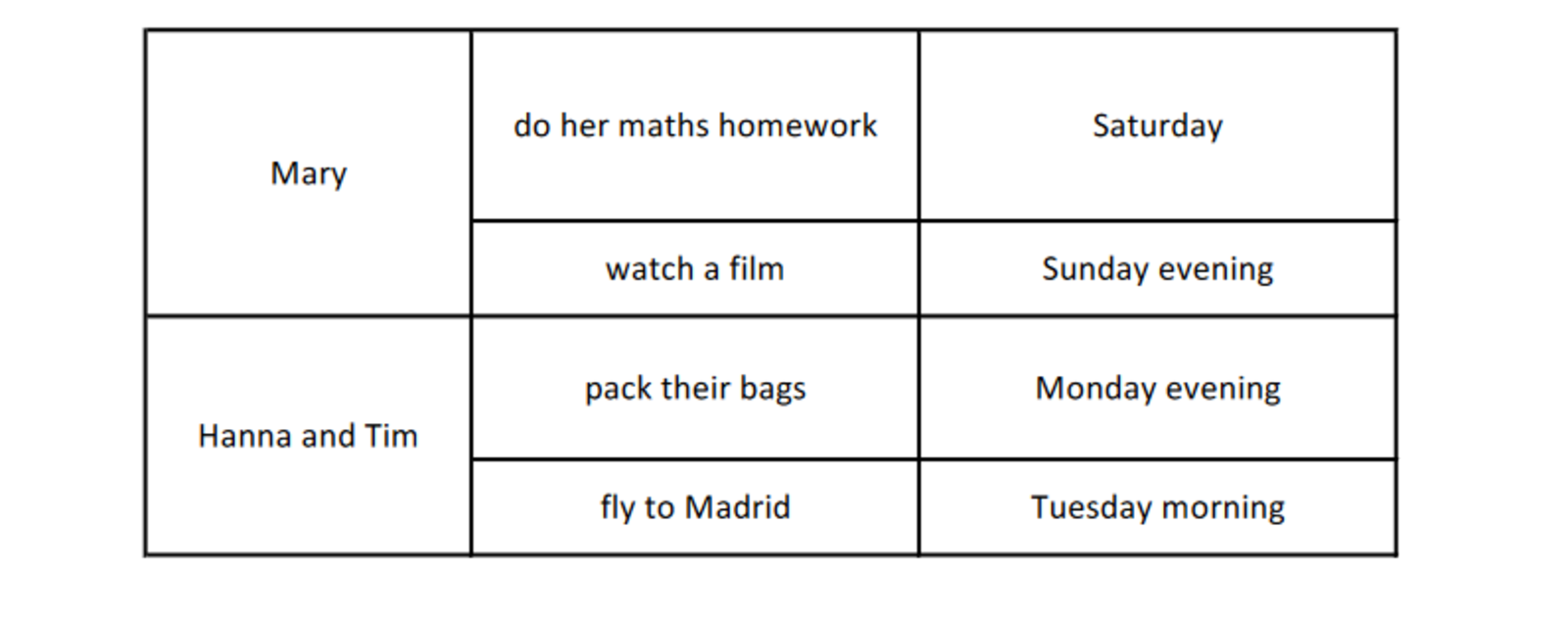
Look at the information in the chart and answer the questions in full sentences.
Zapoznaj się z informacjami z tabelki, a następnie odpowiedz pełnym zdaniem na każde z pytań.
R1VXvz6I7hfAu
Ilustracja z tabelą, która przedstawia harmonogram zadań dla Mary oraz Hanny i Tima. W pierwszej kolumnie znajdują się imiona osób, w drugiej opisy ich zadań, a w trzeciej dni, w których zadania są wykonywane. Mary: w sobotę robi zadanie domowe z matematyki, a w niedzielny wieczór ogląda film. Hanna i Tim: w poniedziałkowy wieczór pakują torby, a we wtorkowy poranek lecą do Madrytu. Tabela jest podzielona na sekcje, ukazując plan zajęć obu osób (lub grupy).
Ilustracja z tabelą, która przedstawia harmonogram zadań wykonanych przez Mary oraz Hannę i Tima.
Źródło: GroMar Sp. z o.o., licencja: CC BY-SA 3.0.
R13vn9NLQbcMe
1. What is Mary doing on Saturday? She Tu uzupełnij.
1. What is Mary doing on Saturday? She Tu uzupełnij.
Źródło: GroMar Sp. z o.o., licencja: CC BY-SA 3.0.
Rkwg8MdGbpRxz
2. What is Mary doing on Sunday evening? She Tu uzupełnij.
2. What is Mary doing on Sunday evening? She Tu uzupełnij.
Źródło: GroMar Sp. z o.o., licencja: CC BY-SA 3.0.
RqMudHHMv1U6Z
3. What are Hanna and Tim doing on Monday evening? They Tu uzupełnij.
3. What are Hanna and Tim doing on Monday evening? They Tu uzupełnij.
Źródło: GroMar Sp. z o.o., licencja: CC BY-SA 3.0.
R1ABbP6RHZkDB
4. What are Hanna and Tim doing on Tuesday morning? They Tu uzupełnij.
4. What are Hanna and Tim doing on Tuesday morning? They Tu uzupełnij.
Źródło: GroMar Sp. z o.o., licencja: CC BY-SA 3.0.
Konstrukcjabe going to
Konstrukcjębe going tostosujemy do wyrażania planów, intencji i zamierzeń dotyczących przyszłości oraz do opisu sytuacji, gdy wszystko wskazuje na to, że coś się stanie (jest to właściwie pewne). Wyrażenie to często tłumaczymy na język polski jako „mieć zamiar”.
Na konstrukcję tę składa się czasownikto bew czasie teraźniejszym, wyrażeniegoing tooraz czasownik w bezokoliczniku.
I*’m going to print** the photo out.*
She*’s going to** help me after school.*
What are you going to do with this problem?
Look at the clouds, it*’s going to rain**.*
Exercise7
Complete each gap with a full form of “be going to”.
Wpisz w każdą lukę pełną formę konstrukcji be going to w odpowiedniej osobie.
RVZBUMp6IsB8h
It’s raining today. I don’t have an umbrella. I Tu uzupełnij take the bus.
Mum is very tired. She Tu uzupełnij have a rest.
They are a very good team. They Tu uzupełnij win the match.
We have a free afternoon, we Tu uzupełnij help grandma in the garden.
During the holidays, Anna Tu uzupełnij stay with her grandparents for two weeks.
It’s raining today. I don’t have an umbrella. I Tu uzupełnij take the bus.
Mum is very tired. She Tu uzupełnij have a rest.
They are a very good team. They Tu uzupełnij win the match.
We have a free afternoon, we Tu uzupełnij help grandma in the garden.
During the holidays, Anna Tu uzupełnij stay with her grandparents for two weeks.
Źródło: GroMar Sp. z o.o., licencja: CC BY-SA 3.0.
Present Continuousa konstrukcjabe going to
Jeśli przedsięwzięliśmy już jakieś kroki w celu realizacji naszych planów, na przykład zakupiliśmy bilety na zaplanowaną wycieczkę, używamy czasuPresent Continuous. Przykłady:
I’m going to visit granny. (Zamierzam to zrobić)
I’m visiting granny on Saturday.(Już się umówiliśmy na wizytę)