Przeczytaj
The picture below shows a rubbish bin with some food waste in it. What if it could speak? In this section, you are going to read a text about food waste from the perspective of this object. Before you read it, think: do you waste food? Could you use the excess food in a useful way?
Poniższe zdjęcie przedstawia kosz na śmieci z odpadkami w środku. Co by było, gdyby potrafił mówić? W tej sekcji przeczytasz tekst na temat marnowania żywności napisany z perspektywy tego przedmiotu. Zanim przeczytasz, zastanów się: czy ty marnujesz jedzenie? Czy mógłbyś/mogłabyś wykorzystać nadprogramową żywność w bardziej pożyteczny sposób?
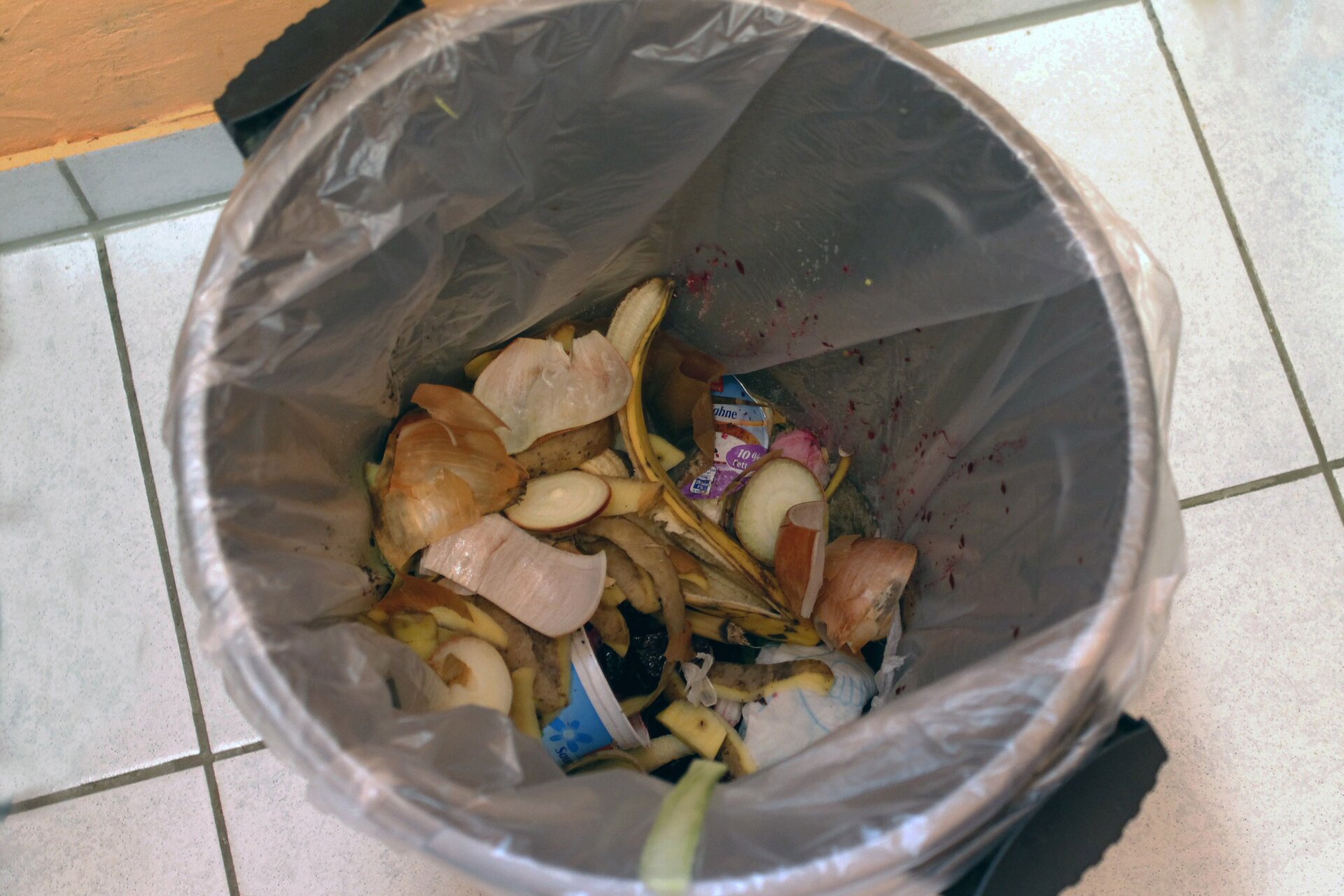
Study the text and do the exercises below.
A Day in the Life of a Rubbish BinToday was no different from any other day. It started with some mouldymouldy bread (the mouldmould just began to show on one side), egg shells, some meat which started to go offgo off, smelly cheese, and a rottenrotten tomato. Around lunch, a piece of stalestale cake was added to my contents. After dinner, the leftoversleftovers landed on the pile as well, even though most of them hadn’t even started to rotrot yet. I just don’t get it: people stock up onstock up on food and then half of it will go to wastego to waste! It just doesn’t make any sense to me.
But food that can go badgo bad and become inedibleinedible is not the only type of waste they discarddiscard. The domestic refusedomestic refuse that they produce is so varied: it can be anything from dust, cans, bottles, paper or bones to sanitary waste — anything generated from day‑to‑day household activities. Luckily, they segregate garbage, so all these things don’t land inside me. Nearby, there are other bins, my friends, which specialise in a given type of rubbish. Still, people wastewaste too much, and overconsumptionoverconsumption is to blame if you ask me.
The food industryfood industry has become so complex, and with all the machinery and technology that is used for food processingfood processing (you know: washing, chopping, pasteurising, freezing, fermenting, packaging, etc.), it can produce more and more, until it’s too much and it ends up in uncontrolled overproductionoverproduction. But people want more! They get easily taken in by shop promotions of the BOGOFBOGOF type: they buy one product and get one free. Then, it turns out that this second product was totally unnecessary and eventually it lands in a dumpsterdumpster.
What worries me is the fact that people rarely think about their rubbish and its impact on the environment. I’m proud that most of my contents consists of biodegradable wastebiodegradable waste, which means that it can be decomposed by other living organisms and recycled through compostingcomposting thus enriching the soil to help plants grow. I’m sure, however, that most people don’t know that of those billions of pounds of food that go to waste every year, much is perfectly edibleedible and nutritiousnutritious, so it could actually still be eaten. Unfortunately, food safety regulationsfood safety regulations state that only 10‑15% of unused perishableperishable food can be re‑purposedre‑purposed or donated once it reaches its best before datebest before date, which means that most of such food ends up in landfill siteslandfill sites.This is dangerous because it gradually breaks down there to form methane, a greenhouse gas that is 86 times more powerful than carbon dioxide.
One last final thought for today: food loss vs food wastefood loss vs food waste. The formerThe former refers to any edible food which goes damaged or is not used at the production, storage, processing or distribution stage, whereas the latterthe latter is food wasted at the consumer or retail level. So, a yoghurt which got spilt during transportation is food loss, while an apple with a dark spot, which landed in a rubbish bin for this reason, is food waste.
That’s it for today. Hope you will pay more attention to what you put inside me!
Źródło: Agnieszka Sękiewicz‑Magoń , licencja: CC BY-SA 3.0.
- From the first paragraph, we can draw the conclusion that the rubbish bin’s purpose is
a) hazardous waste.
b) organic waste.
c) solid waste.
d) garden waste.
- According to the description in the second paragraph, domestic refuse includes:
a) metal and plastic objects.
b) hazardous waste.
c) organic waste.
d) all of the above if generated at home
- BOGOF is
a) a type of food processing.
b) a type of shop.
c) a type of promotion.
d) a type of product.
- According to the text, throwing perishable organic food in a landfill site
a) is what we should do.
b) adds to the greenhouse effect.
c) helps to create compost.
d) is dangerous because it produces carbon dioxide.
- Which of the sentences below is expressed in the text as a fact, not an opinion?
a) Only about one tenth of unused food can be given away or reused.
b) Overconsumption is the main reason for food waste.
c) People waste too much food.
d) People don’t realise that most of the wasted food is still good to eat.
- The steak was burnt, but not 1. LEFTOVERS, 2. ROT, 3. STALE, 4. MOULD, 5. INEDIBLE, 6. DISCARD, 7. GO TO WASTE, 8. FOOD PROCESSING.
- If you notice 1. LEFTOVERS, 2. ROT, 3. STALE, 4. MOULD, 5. INEDIBLE, 6. DISCARD, 7. GO TO WASTE, 8. FOOD PROCESSING on bread or a vegetable, you shouldn’t eat it.
- I love using 1. LEFTOVERS, 2. ROT, 3. STALE, 4. MOULD, 5. INEDIBLE, 6. DISCARD, 7. GO TO WASTE, 8. FOOD PROCESSING from the previous day in a creative way by making new meals.
- 1. LEFTOVERS, 2. ROT, 3. STALE, 4. MOULD, 5. INEDIBLE, 6. DISCARD, 7. GO TO WASTE, 8. FOOD PROCESSING can sometimes negatively affect the nutritional quality of food by losing some minerals and vitamins.
- We shouldn’t 1. LEFTOVERS, 2. ROT, 3. STALE, 4. MOULD, 5. INEDIBLE, 6. DISCARD, 7. GO TO WASTE, 8. FOOD PROCESSING all the food that we can’t eat at once.
- Plastic and metal do not 1. LEFTOVERS, 2. ROT, 3. STALE, 4. MOULD, 5. INEDIBLE, 6. DISCARD, 7. GO TO WASTE, 8. FOOD PROCESSING, as they are not biodegradable.
- After several days the bread became so 1. LEFTOVERS, 2. ROT, 3. STALE, 4. MOULD, 5. INEDIBLE, 6. DISCARD, 7. GO TO WASTE, 8. FOOD PROCESSING that you couldn’t even cut a slice.
- It’s a pity that so much good food will 1. LEFTOVERS, 2. ROT, 3. STALE, 4. MOULD, 5. INEDIBLE, 6. DISCARD, 7. GO TO WASTE, 8. FOOD PROCESSING if more people don’t come.
- Every year, around nine million tonnes of food Tu uzupełnij in Poland, although it could be eaten or reused.
- Greenhouse gases produced by decomposing food have a very negative Tu uzupełnij the environment.
- I think the milk Tu uzupełnij, don’t drink it.
- The more waste is recycled, the less is sent to Tu uzupełnij.
- Always check Tu uzupełnij dates and pay special attention to Tu uzupełnij foods like dairy products or ham.
- Government regulators have introduced tougher Tu uzupełnij in response to several cases of contaminated food products found in supermarkets.
- One of the reasons why we waste so much food is Tu uzupełnij, when too much is produced.
Słownik
/ best bɪˈfɔː deɪt /
termin przydatności do spożycia (data najlepszej jakości) (the date after which the food will still be edible but may not be at its best)
/ ˌbaɪəʊdɪˈɡreɪdəbl̩ weɪst /
odpady biodegradowalne (waste capable of being decomposed)
/ ˈbɑːɡɑːf/ / baɪ wʌn ˈget wʌn friː /
kup jeden, dostaniesz drugi za darmo (getting two of the same product but paying only for one)
/ ˈkɑ:bən ˈfʊtprɪnt /
ślad węglowy (the amount of carbon dioxide released into the atmosphere as a result of the activities of a particular individual, organisation, or community)
/ ˈkɒmpɒstɪŋ / / ˈkɒmpɒst /
kompostowanie [kompostować] (to collect and store plant material so it can decay and be added to soil to improve its quality)
/ dɪˈskɑːd /
wyrzucać (to throw something away or get rid of it because you no longer want or need it)
/ dəˈmestɪk rɪˈfjuːz /
odpady domowe (waste created at home)
/ ˈdəmpstə /
śmietnik (a very large container for rubbish, US trademark)
/ ˈedɪbl̩ /
jadalny (fit or suitable to be eaten)
/ fuːd ˈɪndəstri /
przemysł spożywczy (a complex, global network of diverse businesses that supplies most of the food consumed by the world's population)
/ fuːd ˈlɒs viːz fuːd weɪst /
strata żywności versus marnowanie żywności (losing food due to specific circumstances versus wasting perfectly fine food)
/ fuːd ˈprəʊsesɪŋ /
przetwarzanie żywności (the action of performing a series of mechanical or chemical operations on food in order to change or preserve it)
/ fuːd ˈseɪfti ˌreɡjʊˈleɪʃn̩z /
przepisy dotyczące bezpieczeństwa żywności (regulations concerning how food should be made, packaged etc.)
/ ˈɡəʊ bæd /
zepsuć się (to become inedible)
/ ˈɡəʊ ɒf /
zepsuć się (to become inedible)
/ ˈɡəʊ tu weɪst /
zmarnować się (to be unused or expended to no purpose)
/ ɪmˈpækt ˈɒn ði ɪnˈvaɪərənmənt /
wpływ na środowisko (influence of specific actions on the environment)
/ ɪnˈedəbl̩ /
niejadalny (not fit or suitable to be eaten)
/ ˈlændfɪl saɪts / / ˈlændfɪl saɪt /
wysypiska śmieci [wysypisko śmieci] (waste that is buried in the ground in large amounts)
/ ˈleftəʊvəz /
resztki jedzenia, pozostałości (food left from cooking)
/ məʊld /
pleśń (a soft, green or grey growth that develops on old food or on objects that have been left for too long in warm, wet air)
/ ˈməʊldi /
spleśniały (covered in mould)
/ njuːˈtrɪʃəs /
odżywczy (rich in nutrients)
/ ˈəʊvəkənˌsəmpʃən /
nadmierna konsumpcja (the action or fact of consuming something to excess)
/ ˌəʊvəprəˈdʌkʃn̩ /
nadprodukcja (the action of producing something to excess)
/ ˈperɪʃəbl̩ /
łatwo psujący się (likely to go bad quickly)
/ ˌriːˈpəːpəst /
wykorzystany ponownie (used again)
/ rɒt /
gnić (to go bad)
/ ˈrɒtn̩ /
zgniły (a thing that has gone bad)
/ steɪl /
czerstwy, stęchły, nieświeży (no longer fresh and pleasant to eat; hard, musty, or dry)
/ stɒk ˈʌp ɒn /
zaopatrzyć się w (to get a large quantity of something for later use)
/ ðə ˈfɔːmə ðə ˈlætə /
pierwszy z nich… drugi z nich… (the first and the second)
/ weɪst /
marnować (to use or expend carelessly, extravagantly, or to no purpose)