Przeczytaj
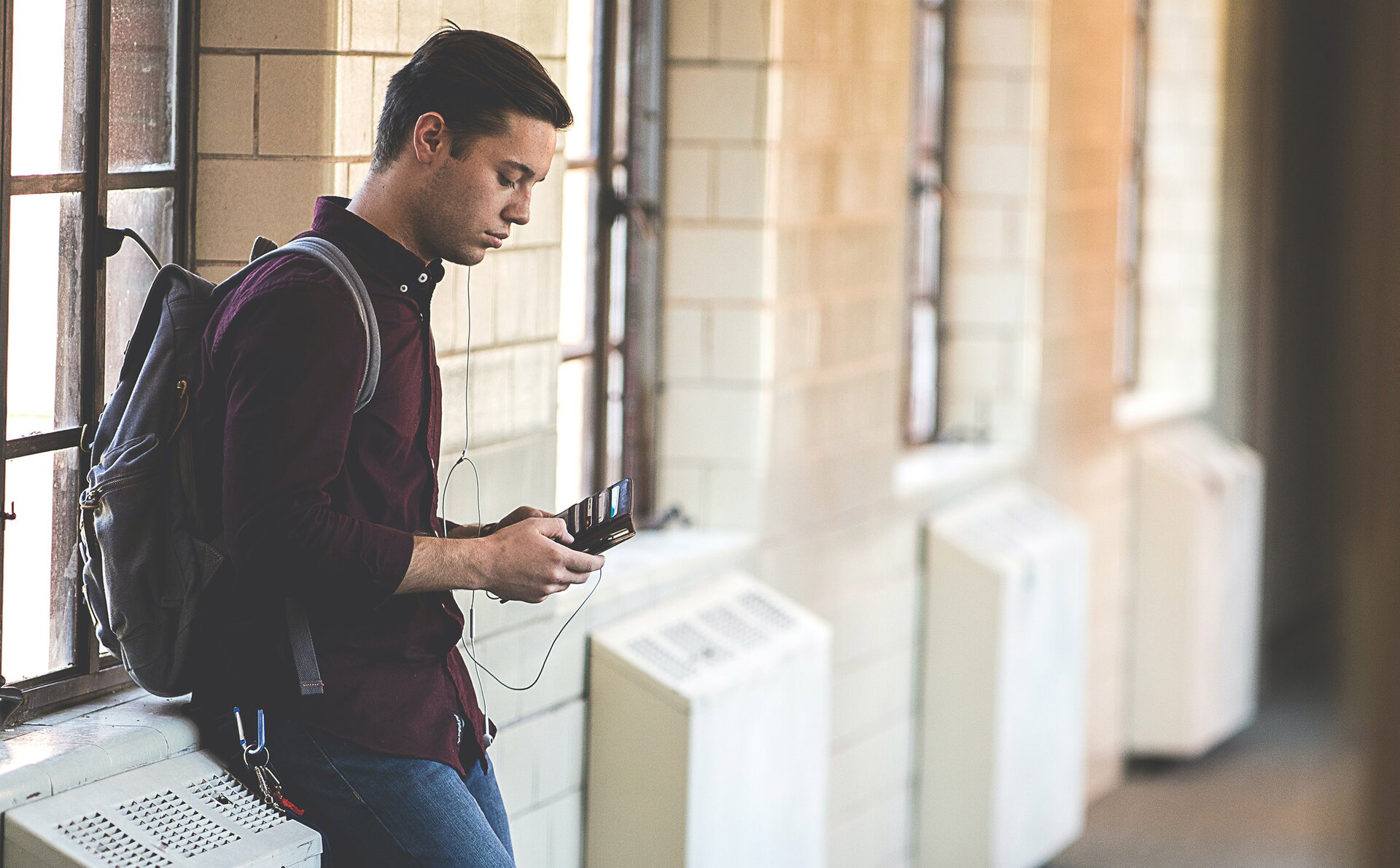
The picture below shows a teenager using a smartphone at school. What do you think he’s doing there? Do you think it’s connected with schoolwork or private matters? Are you allowed to use your mobile phone or tablet at your school? Do you do that? What for? In this section, you are going to read a text analysing the advantages and disadvantages of using electronic devices at school and/or for school‑related purposes.
Poniższe zdjęcie przedstawia nastolatka korzystającego ze smartfona w szkole. Jak myślisz, co na nim robi? Wydaje ci się to związane z pracą szkolną czy sprawami prywatnymi? Czy możesz korzystać z telefonu komórkowego lub tabletu w swojej szkole? Robisz to? W jakim celu? W tej części przeczytasz tekst analizujący zalety i wady korzystania z urządzeń elektronicznych w szkole i/lub w celach szkolnych.
Digital School?Schools and universities use lots of different materials in order to teach their students. This includes lessons, books, presentations, and now, since the technology is available, tabletstablets. Tablets and laptopslaptops are becoming much more commonplacecommonplace in the classroom than they once were. Both the textbook and the tablet industriesindustries are now multi‑billion dollar enterprises, and as such, they have their own prospros and conscons.
Many teachers will favour the use of tablets, because they can hold thousands of textbooks worth of information in one place. This is a benefit as it means students have access to more material. They are also much lighter in weight than traditional textbooks, meaning they are more portableportable. Imagine carrying a textbook for each lesson on a busy school day. It could become very tiring to carry so much. Using tablets could also mean that students do not forget the correct textbook for a specific class because all books are in one place.
However, there are also some people who raise valid criticismcriticism of using tablets in schools, such as the initial cost of buying a tablet. This is a stumbling blockstumbling block for poorer students because they cannot affordafford to buy them. Another downsidedownside of using tablets is that they can often prove distractingdistracting for students. Tablets have access to everything on the Internet, so students may use them for other things than studying.
It has also been noted that the use of tablets can increase a student’s interest in a topic because the material can have a more varied form than the one in a normal textbook. Some ebooks will have interactiveinteractive topics, which means that students' engagementengagement levels could be much higher. If someone is enjoying their time learning, they are more likely to continue, which means that students using tablets often end up scoring higher on tests.
Another issue with tablets, however, is that they are much easier to break than a traditional textbook. Technical problems may make them unusable or in need of repairrepair, which again costs both time and money. A textbook can withstandwithstand much more damage than a tablet, especially in the hands of younger children. The tablet screens have also led to some people getting headaches or eye straineye strain, which means that the time they can be used should be limited.
An important argument in favour of tablets though is that they save paper. Unlike regular, printed textbooks, tablets are therefore environmentally friendly. This also usually means that the digitaldigital version of the textbook can be cheaper than a physical copy. Tablets are fascinating devices!
Overall, both traditional textbooks and digital ones on tablets have their pros and cons, and it is most likely down to the individual user to decide for themselves which they prefer to use. Both are great tools in education.
Źródło: Chris Howard, licencja: CC BY-SA 3.0.
- Electronic devices
a) are a little more popular than they used to be.
b) are gaining popularity.
c) are much more unpopular at schools.
d) are really common in each classroom.
- Tablets
a) are limited because of their storage.
b) are all very light in weight.
c) make more resources available for students.
d) are less portable than books.
- One of the disadvantages of using tablets at school may be the fact that
a) they may influence students’ focus.
b) they are always expensive.
c) children have access to the Internet.
d) all students use them for playing games.
- Interactive topics often result in
a) students’ limited attention.
b) students not being interested in learning.
c) increase of students’ involvement.
d) students finishing tests faster.
- Using devices with screens
a) always causes headaches.
b) may lead to health issues.
c) cause eye damage and blindness.
d) should be limited to schools only.
- Digital versions of books are not
a) electronic
b) eco-friendly
c) cheaper
d) boring
Słownik
/ əˈfɔːd /
pozwolić sobie na coś (have enough money to pay for sth)
/ ˈkɒmənpleɪs /
powszechny/powszechna (ordinary)
/ kɒnz / / kɒn /
wady [wada] (a downside)
/ ˈkrɪtɪsɪzəm /
krytyka (the expression of disapproval of someone or something on the basis of perceived faults or mistakes)
/ ˈdɪdʒɪtl̩ /
cyfrowy/cyfrowa (relating to computer technology)
/ dɪˈstræktɪŋ /
rozpraszający/rozpraszająca (making it difficult for someone to give their attention to something)
/ ˈdaʊnsaɪd /
wada (con)
/ ɪnˈɡeɪdʒmənt /
zaangażowanie (the fact of being involved with sth)
/ eɪ streɪn /
nadwyrężenie wzroku (tired or painful eyes as a result of too much reading, looking at a computer screen, etc.)
/ ˈɪndəstrɪz / / ˈɪndəstri /
przemysł (the people and activities involved in one type of business)
/ ˌɪntəˈræktɪv /
interaktywny/interaktywna (involving communication between people or reactions between things that work together)
/ ˈlæptɒpz / / ˈlæptɒp /
laptopy [laptop] (a computer that is small enough to be carried around easily and is flat when closed)
/ ˈpɔːtəbl̩ /
przenośny/przenośna (light and small enough to be easily carried or moved)
/ prəʊz / / prəʊ /
zalety [zaleta]
/ rɪˈpeə /
naprawa (the act of fixing something that is broken or damaged)
/ ˈstʌmblɪŋ blɒk /
przeszkoda (an obstacle)
/ ˈtæblɪts / / ˈtæblɪt /
tablety [tablet] (a small, flat computer that is controlled by touching the screen or by using a special pen)
/ wɪðˈstænd /
wytrzymać (to be strong enough, or not be changed by something, or to oppose a person or thing successfully)