Przeczytaj
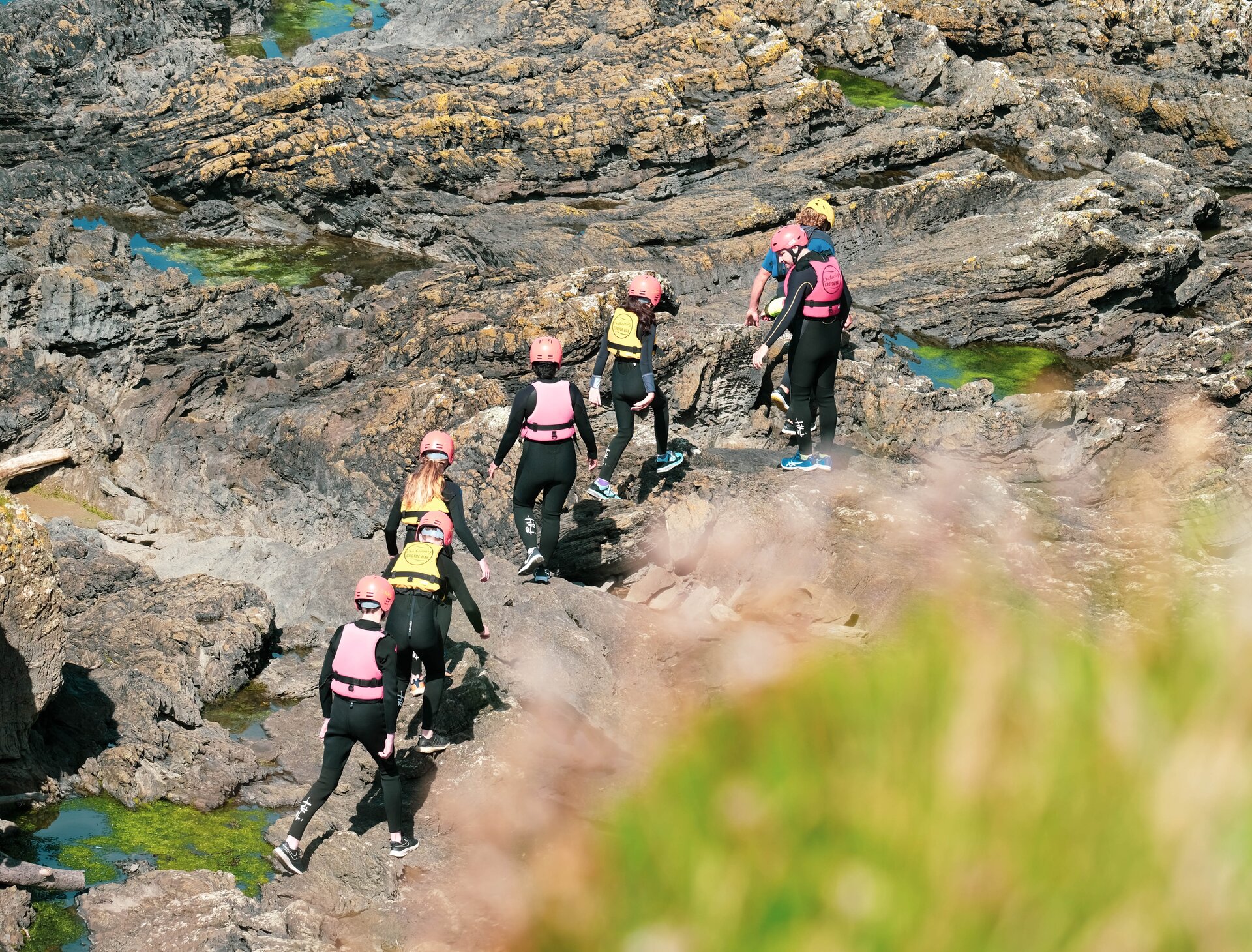
The picture depicts a group of people walking some rocky terrain. As you might guess, they are probably coasteering fans and heading for a new adventure. They are wearing almost identical outfits. Can you name the items? People doing this sport must protect their bodies against the cold and injuries. In this part of the material you are going to find out what the best place for coasteering is, what kind of equipment people are supposed to have to minimise the risk of injuries.
Zdjęcie przedstawia grupę ludzi w jakimś skalistym terenie. Pewnie już się domyślasz, że osoby z fotografii są fanami coasteeringu i zmierzają ku nowej przygodzie. Zauważ, że wszyscy są niemalże identycznie ubrani. Ludzie uprawiający ten sport muszą chronić się przed kontuzjami, dlatego zakładają odpowiedni strój. Czy jesteś w stanie wymienić jego części? Z poniższego materiału dowiesz się, czym w zasadzie jest coasteering, jakie jest najlepsze miejsce, by się nim zająć i o jakim sprzęcie trzeba pamiętać, by zminimalizować ryzyko kontuzji.
Study the text and do the exercises below.
Thrilling Activity You Need To Try!Have you ever seen such a picture: people jumping off the cliffjumping off the cliff with no ropes into the wild sea? They were probably fans of coasteeringcoasteering, which is a cross between rock pooling and an obstacle course. With no ropes, participants are to traverse the impact zone, where the sea hits the land. Coasteering is a pretty new activity. It started in the 1980s by surfers in Pembrokeshire in the UK, which still remains one of the most desired destinations.
A.
The United Kingdom is believed to be the cradle of coasteering. Within the UK more and more venues spread along the 30,000 km coastline. Pembrokeshire, where it all began, is still one of the most preferable destinations. The more popularity this activity gains, the more places are on offer.
B.
The name itself is the blend of the words ‘coast’ and ‘mountaineering’. It is said that it’s more like scramblingscrambling than mountaineering, though. The National Coasteering Charter explains it as: ‘Exploring and journeying through the impact zone between the levels of high and low, often including total immersiontotal immersion in seawater.’
C.
The aim of coasteering is to travel along the coastline where the sea meets the land. It involves getting wet as you are in and out of water, scrambling up and climbing over rocks, swim‑walking through gulliesgullies, and even exploring the cavesexploring the caves. Be prepared for whirlpoolswhirlpools or pour‑overspour‑overs! For many, the main attraction is jumping off high cliffs into the water, which is a true adrenaline kickadrenaline kick. So, coasteering may include swimming, climbing or scrambling, and jumping into water.
D.
There is no standardised method of reaching your destination. Everybody chooses the best way, the most suitable and the easiest for them. But remember, there are no boats or fixed ropes to assist. You are totally self‑dependent. The only kind of assistance might be a guide if you decided on one before the journey.
E.
Coasteering is a non‑costly sportnon‑costly sport and your list of essentials would be pretty short. Actually, there are some must‑have items: a helmet, a full‑length wetsuitfull‑length wetsuit to keep you warm, and wetsuit boots to protect your feet not only against the cold but also against jagged rocks. Some choose to wear gloves to protect their hands, too. You simply cannot forget to get buoyancy aidbuoyancy aid, which makes you extra buoyantbuoyant. Those who asked for an instructor’s assistance might count on some more equipment, like a first aid kit or extra ropes.
F.
The biggest hazards in coasteering are rock impact and cold water. That is why it’s necessary to have a proper wetsuit and a helmet. If you’re a beginner, you should take a guide, for your safety. The guides' knowledge of the local area and best routes guarantees safe fun. If you go on your own, before you even set off, make sure you get a good knowledge of the terrainget a good knowledge of the terrain to know where the rip tidesrip tides are to avoid injuries.
Whether you’re trying the sport for the first time or you’re an experienced jumper, there’s such a great variety of beautiful places along the British coastline that you’re sure to find somewhere new and stunning to visit.
Źródło: Anna Faszcza, licencja: CC BY-SA 3.0.
B. 1. How to ensure safety?, 2. Can one make friends with anybody?, 3. What are the origins?, 4. What activities are included?, 5. How much do I have to pay for the suit?, 6. What does it concern?, 7. Will you be given a helping hand?, 8. What are the essentials?, 9. What is the shortest route?
C. 1. How to ensure safety?, 2. Can one make friends with anybody?, 3. What are the origins?, 4. What activities are included?, 5. How much do I have to pay for the suit?, 6. What does it concern?, 7. Will you be given a helping hand?, 8. What are the essentials?, 9. What is the shortest route?
D. 1. How to ensure safety?, 2. Can one make friends with anybody?, 3. What are the origins?, 4. What activities are included?, 5. How much do I have to pay for the suit?, 6. What does it concern?, 7. Will you be given a helping hand?, 8. What are the essentials?, 9. What is the shortest route?
E. 1. How to ensure safety?, 2. Can one make friends with anybody?, 3. What are the origins?, 4. What activities are included?, 5. How much do I have to pay for the suit?, 6. What does it concern?, 7. Will you be given a helping hand?, 8. What are the essentials?, 9. What is the shortest route?
F. 1. How to ensure safety?, 2. Can one make friends with anybody?, 3. What are the origins?, 4. What activities are included?, 5. How much do I have to pay for the suit?, 6. What does it concern?, 7. Will you be given a helping hand?, 8. What are the essentials?, 9. What is the shortest route?
Tu uzupełnij
2. A pool of water by the beach makes a nice and safe place to swim.
Tu uzupełnij
3. We wanted to explore the ravines formed by water because there were many trees growing there, which made a breathtaking view.
Tu uzupełnij
4. Wood seems to be able to stay on the surface of water: when you throw it into the lake, it doesn’t sink.
Tu uzupełnij
5. While swimming in rivers, you must be extra careful because many masses of water that rotate quickly may appear unexpectedly.
Tu uzupełnij
6. If you find yourself in strong currents near the beach, don’t panic. Don’t try to swim back to the shore but try to call and wave for help.
Tu uzupełnij
Based on the knowledge from the text, answer each of the following questions. Write 3‑4 sentences to each question.
What is the main purpose of coasteering?
What precautions must be taken to enjoy this sport safely?
Where can people go to take up this activity?
Słownik
/ əˈdrenəlɪn ˈkɪks / / əˈdrenəlɪn ˈkɪk /
uderzenia adrenaliny [uderzenie adrenaliny] (excitement that is caused by the adrenaline produced in induced stress situations)
/ ˈbɔɪənsi eɪd /
kamizelka ratunkowa (accessory for water sports to protect you against drowning )
/ ˈbɔɪənt /
wyporny/wyporna, utrzymujący/utrzymująca się na powierzchni (able to float)
/ kəʊˈstɪərɪŋ /
koasterowanie, poruszanie się wzdłuż linii brzegowej łączące pływanie i wspinaczkę (moving along the coastline which involves scrambling up the rocks and swimming)
/ ɪkˈsplɔːrɪŋ ðə keɪvz / / ɪkˈsplɔː ðə keɪv /
odkrywanie jaskiń [odkrywać jaskinię] (to search and discover large holes in the cliff)
/ fʊl ˈleŋtheta ˈwetsuːt /
pianka do nurkowania na całe ciało, kombinezon do nurkowania (a suit that is made from neoprene that cover the whole body to protect you against the cold water)
/ ˈget ə gʊd ˈnɒlɪdʒ əv ðə teˈreɪn /
dobrze poznać teren (to study thoroughly the characteristics of the area)
/ ˈɡʌlɪz / / ˈɡʌli /
wąwozy [wąwóz] (a ravine formed by water)
/ ˈdʒʌmpɪŋ ɒf ðə klɪf / / dʒʌmp ɒf ðə klɪf /
skaczący/skacząca z klifu [skakać z klifu] (to leap from a cliff)
/ ˌnɒn ˈkɒstli spɔːt /
niedrogi sport (inexpensive sport)
/ ˈɒbstəkl̩ kɔːs /
tor przeszkód (a series of difficulties on the way to overcome)
/ pɔːr ˈəʊvəz / / pɔːr ˈəʊvə /
zalania [zalanie] (parts of rock that become completely filled with water)
/ ˈrɪp taɪdz / / ˈrɪp taɪd /
pływy przybrzeżne [pływ przybrzeżny] (a strong current near the beach)
/ ˈrɒk ˈpuːlɪŋ /
eksploracja basenów pływowych, czyli skalistych zbiorników wypełnionych wodą morską znajdujących się w pobliżu oceanu (exploring rock pools, i.e. pools of water among rocks, usually along a shoreline)
/ ˈskræmbl̩ɪŋ / / ˈskræmbl̩ /
chodzenie po stromym terenie bez użycia lin [chodzić po stromym terenie bez użycia lin] (to walk up a steep terrain without using ropes)
/ ˈtəʊtl̩ ɪˈmɜːʃn̩ /
całkowite zanurzenie ( getting yourself completely into water)
/ ˈtrævɜːs ði ɪmˈpækt zəʊn /
przemierzyć strefę uderzenia (to get through the area where the sea meets the land)
/ ˈwɜːlpuːlz / / ˈwɜːlpuːl /
wiry [wir] (a quickly moving and rotating mass of water)
Źródło: GroMar Sp. z o.o.,licencja CC BY‑SA 3.0