bg‑azure

Work or holidays? Digital nomads don’t have to choose. That beach in the picture could be one of the places you might work from. The text below explains what being a digital nomad means.

Praca czy wakacje? Cyfrowi nomadzi nie muszą wybierać. Ta plaża na zdjęciu może być jednym z miejsc, w którym będziesz wykonywać swoją pracę. Poniższy tekst wyjaśnia, co oznacza bycie cyfrowym nomadą.

RDcuZs7kqDPRg
Greetings from my new office!
Pozdrawiam z nowego biura!
Źródło: dostępny w internecie: pexels.com [dostęp 10.12.2021], domena publiczna.
Exercise 1

Match the idiomatic expressions about work with their translations.

RJJczltiV2WI9
to be snowed under Możliwe odpowiedzi: 1. pracować do późnej nocy, 2. rozmawiać o sprawach służbowych, 3. zostać zwolnionym, 4. mieć za dużo pracy, 5. spełniać swe zadanie, 6. przykładać się do pracy to put one’s nose to the grindstone Możliwe odpowiedzi: 1. pracować do późnej nocy, 2. rozmawiać o sprawach służbowych, 3. zostać zwolnionym, 4. mieć za dużo pracy, 5. spełniać swe zadanie, 6. przykładać się do pracy to burn the midnight oil Możliwe odpowiedzi: 1. pracować do późnej nocy, 2. rozmawiać o sprawach służbowych, 3. zostać zwolnionym, 4. mieć za dużo pracy, 5. spełniać swe zadanie, 6. przykładać się do pracy to talk shop Możliwe odpowiedzi: 1. pracować do późnej nocy, 2. rozmawiać o sprawach służbowych, 3. zostać zwolnionym, 4. mieć za dużo pracy, 5. spełniać swe zadanie, 6. przykładać się do pracy to pull one’s weight Możliwe odpowiedzi: 1. pracować do późnej nocy, 2. rozmawiać o sprawach służbowych, 3. zostać zwolnionym, 4. mieć za dużo pracy, 5. spełniać swe zadanie, 6. przykładać się do pracy to get the boot Możliwe odpowiedzi: 1. pracować do późnej nocy, 2. rozmawiać o sprawach służbowych, 3. zostać zwolnionym, 4. mieć za dużo pracy, 5. spełniać swe zadanie, 6. przykładać się do pracy
Źródło: GroMar Sp. z o.o., licencja: CC BY-SA 3.0.
Exercise 1
RuYLMXiA4jF9l1
Play memo and match the idiomatic expressions about work with their translations.
Źródło: GroMar Sp. z o.o., licencja: CC BY-SA 3.0.

Study the text and do the exercises below.

Digital Nomads
Justyna Płachta Digital Nomads

The term “nomad” refers to a person who often moves to and from areas in order to find the most or best resources for them, so how is someone supposed to be a digital nomaddigital nomaddigital nomad? Well, it mostly refers to their place of work, meaning they have no fixed workplace. It is becoming more common to see people working for companies in countries which they do not live in. This can be beneficial for them as they can earn a larger wage compared to the cost of living in their country, however, it does have its drawbackshave its drawbackshave its drawbacks. In order to do so, they must comply with the country’s visa regulationsvisa regulations [visa regulation]visa regulations. Digital nomads often work remotelywork remotelywork remotely, meaning they can work from anywhere with a reliable connectionreliable connectionreliable connection. Coffee shops, libraries, shared officesshared officesshared offices, or anywhere they can get internet connectivityinternet connectivityinternet connectivity is a possible place for these people to work.

Why would you want to work from a coffee shop, though? Well, the ability to set your own scheduleset your own scheduleset your own schedule is a big plus to some people, and it is very important to them. Being self‑employedself‑employedself‑employed or freelancingfreelancingfreelancing is also very popular, as you are your own boss and can work on your own time, whenever and wherever you wish. Having your work schedule fit around your personal one is often seen as a major benefit of this modern lifestyle.

Many start‑upstart‑upstart‑up businesses such as e‑commerce or online stores will adopt this kind of nomadic work style, as saving money is often a high priority for them. Especially in the early stages of the business, co‑workingco‑workingco‑working or utilisingutilising [utilize]utilising co‑living spacesco‑living spaces [co‑living space]co‑living spaces can help reduce expendituresexpendituresexpenditures on rent or office spaces.

You may think that this lifestyle is for the younger generations, being mostly online, however it can also be utilised by people who are of retirement ageretirement ageretirement age and want to continue to work and earn an income. Some people refer to themselves as semi‑retiredsemi‑retiredsemi‑retired as they are over the age of retirement but continue to work. Snowbirdssnowbirds [snowbird]Snowbirds are another type of people who may not work full time, but instead work seasonally. Moving from either cooler climates to warmer ones in summer, or vice versa in case of Sunbirdssunbirds [sunbird]Sunbirds, these people will often declare their residence in lower tax areas, therefore paying less in tax than in their home country or state. Some see this as a loopholeloopholeloophole into legal tax evasiontax evasiontax evasion as their income taxincome taxincome tax would be calculated with lower rates, allowing them to save money. Although there are often visa regulations put in place to try and stop this from happening, they only occur when people are trying to work in another country, not state.

1 Źródło: Justyna Płachta, dostępny w internecie: Digital nomad, https://en.wikipedia.org/wiki/Digital_nomad [dostęp 9.11.2021], licencja: CC BY-SA 3.0.
R1HB2dlAFgy8c
Exercise 2
Study the text. Then read the questions below and choose the correct answers. More than one answer may be correct in each question.
  1. A nomad is a person who
    a) never stays long in one place.
    b) frequently travels for pleasure.
    c) often moves home.
    d) does not have one place to call home.
  2. Digital nomads can work
    a) from an office.
    b) from a café.
    c) remotely.
    d) offline.
  3. Which of the following advantages of the lifestyle are mentioned in the text?
    a) Stable income.
    b) Being your own boss.
    c) Adjusting your work hours to your own preferences.
    d) Lower work costs.
  4. This nomadic lifestyle is well-suited to
    a) people who want additional income after they have retired.
    b) people who spend their summers in a different place than their winters.
    c) people who want to avoid paying taxes.
    d) owners of online stores.
Źródło: GroMar Sp. z o.o., licencja: CC BY-SA 3.0.
RHGRQAfydfDi9
Exercise 3
Study the text above. Then drag and drop the phrases below to fill in the text. There are two extra phrases you won’t need. I used to work in an office, a 9 to 5 job, with a decent salary and some benefits, but then, one very cold winter, I realised that I was not well-suited for this kind of life. I started checking my options and it turned out I could     1. 1. tax evasion, 2. retirement age, 3. income tax, 4. work remotely, 5. snowbird, 6. co-living, 7. digital nomad, 8. reliable connection, 9. set my own schedule, 10. sunbird,     and I only needed a     2. 1. tax evasion, 2. retirement age, 3. income tax, 4. work remotely, 5. snowbird, 6. co-living, 7. digital nomad, 8. reliable connection, 9. set my own schedule, 10. sunbird     to the internet to make that happen. So I became a     3. 1. tax evasion, 2. retirement age, 3. income tax, 4. work remotely, 5. snowbird, 6. co-living, 7. digital nomad, 8. reliable connection, 9. set my own schedule, 10. sunbird.     Now I sometimes work from my home in Canada, or from a     4. 1. tax evasion, 2. retirement age, 3. income tax, 4. work remotely, 5. snowbird, 6. co-living, 7. digital nomad, 8. reliable connection, 9. set my own schedule, 10. sunbird     space in southern California. Well, I don’t exactly     5. 1. tax evasion, 2. retirement age, 3. income tax, 4. work remotely, 5. snowbird, 6. co-living, 7. digital nomad, 8. reliable connection, 9. set my own schedule, 10. sunbird     or pay lower     6. 1. tax evasion, 2. retirement age, 3. income tax, 4. work remotely, 5. snowbird, 6. co-living, 7. digital nomad, 8. reliable connection, 9. set my own schedule, 10. sunbird,     but it’s still a better solution for me. I firmly believe that I will continue being a     7. 1. tax evasion, 2. retirement age, 3. income tax, 4. work remotely, 5. snowbird, 6. co-living, 7. digital nomad, 8. reliable connection, 9. set my own schedule, 10. sunbird     until I have reached the     8. 1. tax evasion, 2. retirement age, 3. income tax, 4. work remotely, 5. snowbird, 6. co-living, 7. digital nomad, 8. reliable connection, 9. set my own schedule, 10. sunbird.
Źródło: GroMar Sp. z o.o., licencja: CC BY-SA 3.0.
RmHYToBzga9tp
Exercise 4
Study the text above. Then type in the missing words to complete the sentences below.
  1. A     Tu uzupełnij     nomad is a person who doesn’t have a fixed workplace.
  2. If you want to work abroad, you must comply with the country’s     Tu uzupełnij     regulations.
  3. Being     Tu uzupełnij     could be a great idea if you want to be your own employer.
  4. Many     Tu uzupełnij     businesses adopt this flexible work style.
  5. How can we reduce our     Tu uzupełnij     and save some money on rent?
  6. Tax     Tu uzupełnij     sometimes involves finding legal loopholes.
Źródło: GroMar Sp. z o.o., licencja: CC BY-SA 3.0.
Exercise 5

Fill in the gaps with the phrases listed below.

R1DAUSCHX4ZQQ
Exercise 5

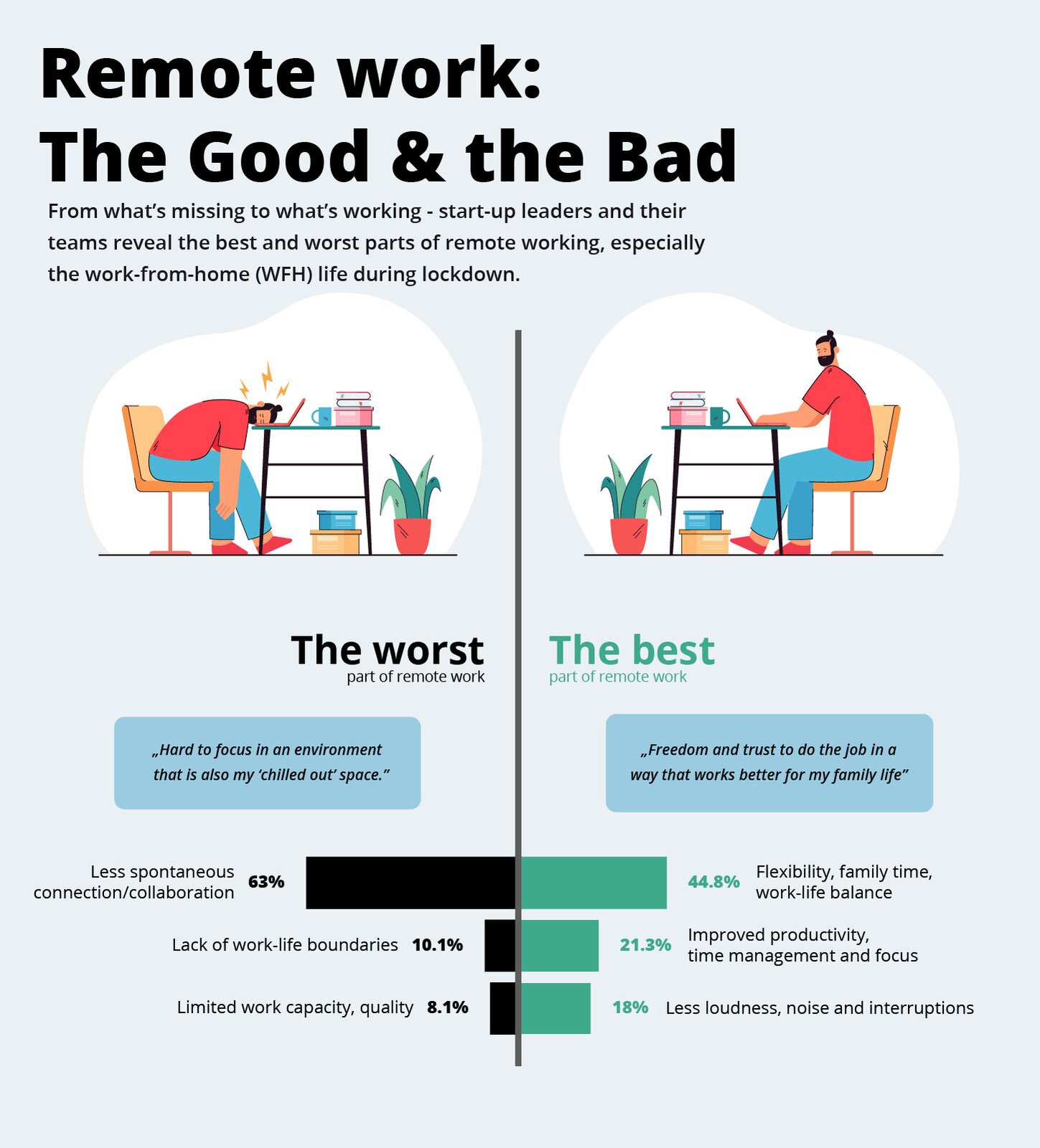
Type in the missing words to fill in the gaps in the text. Your answer should be based on the infographic below.
R94y5gaJnAeS6
Źródło: Maciej Tomaszewski, dostępny w internecie: www.freepik.com [dostęp 15.12.2021], domena publiczna.
R1RDEqG4LG89e
According to the survey, over 63% of participants say that the worst part of remote work is less     1. Tu uzupełnij/    collaboration. 8.1% also identify limited     2. Tu uzupełnij     and quality, and 10.1% claim it’s lack of     3. Tu uzupełnij.     On the other hand, 44.8% find     4. Tu uzupełnij     together with flexibility and work-life balance as positives, while 21.3% quote     5. Tu uzupełnij,     time management, and improved focus. 18% participants dislike loudness, noise, and 6. Tu uzupełnij in the office. But social interactions are important to the overwhelming majority of those who miss their office.
Źródło: GroMar Sp. z o.o., licencja: CC BY-SA 3.0.

Słownik

co‑living spaces [co‑living space]

/ kəʊ ˈlɪvɪŋ speɪsɪz / / kəʊ ˈlɪvɪŋ speɪs /

R3ninkhVJlUco1
Nagranie dźwiękowe

domy lub duże mieszkania, w których mieszka kilkoro współlokatorów [dom lub duże mieszkanie, w którym mieszka kilkoro współlokatorów]

(premises with many inhabitants)

R1R1XLzzfW5r61
Nagranie dźwiękowe
co‑working
co‑working

/ kəʊ ˈwɜːkɪŋ /

RLVwX7lfMKwkU1
Nagranie dźwiękowe

coworking (sposób pracy polegający na dzieleniu jednego biura przez kilka samozatrudnionych osób, zazwyczaj w celu dzielenia się pomysłami)

(way of working that involves several self‑employed people sharing one office, usually to share ideas)

R194I1i3CZKOn1
Nagranie dźwiękowe
digital nomad
digital nomad

/ ˈdɪdʒɪtl̩ ˈnəʊmæd /

RotpbOHgTANsY1
Nagranie dźwiękowe

osoba pracująca zdalnie i łącząca pracę z podróżowaniem

(a person doing his job entirely over the Internet while traveling)

RfHwSbVysZO4F1
Nagranie dźwiękowe
expenditures
expenditures

/ ɪkˈspendɪtʃəz /

RAcuUa1fzCimz1
Nagranie dźwiękowe

wydatki

 (expenses or the act of spending money)

RPctnSWOCIU1R1
Nagranie dźwiękowe
freelancing
freelancing

/ ˈfriːlɑːnsɪŋ /

R199y4X9bKZIw1
Nagranie dźwiękowe

wolny strzelec (typ wykonywanej pracy)

 (typ wykonywania pracy) (self‑employment)

RuCfc74YN07Cs1
Nagranie dźwiękowe
have its drawbacks
have its drawbacks

/ həv ɪts ˈdrɔːbæks /

RSUiM2yK3cgSn1
Nagranie dźwiękowe

mieć swoje wady

(to have a disadvantage)

RtNzGINQ0Y73n1
Nagranie dźwiękowe
income tax
income tax

/ ˈɪnkʌm tæks /

RgZlAk9zJMprq1
Nagranie dźwiękowe

podatek dochodowy

(tax on income generated by business or a private person)

R1SkbUbrKaOZ51
Nagranie dźwiękowe
internet connectivity

/ ˈɪntənet ˌkɒnekˈtɪvɪti /

R1503s2RFTl8x1
Nagranie dźwiękowe

połączenie internetowe

(the way people are connected to the Internet)

R1a7Etcd4lVZE1
Nagranie dźwiękowe
loophole
loophole

/ ˈluːphəʊl /

RMeUptQ9XzV751
Nagranie dźwiękowe

luka (np. w prawie)

(an error or ambiguity in the regulations which allow person to avoid certain required action without punishment)

R1YY3aatEHi0I1
Nagranie dźwiękowe
reliable connection
reliable connection

/ rɪˈlaɪəbl̩ kəˈnekʃn̩ /

RVJkWz7v5365m1
Nagranie dźwiękowe

stabilne łącze, stabilne połączenie

(connection allowing reliable data transfer between nodes)

R17JCBvHzLLis1
Nagranie dźwiękowe
retirement age
retirement age

/ rɪˈtaɪəmənt eɪdʒ /

Rj44GecJmkxhg1
Nagranie dźwiękowe

wiek emerytalny

(the age at which a person is expected or required to cease employment)

R16tjBcIrwNTo1
Nagranie dźwiękowe
self‑employed
self‑employed

/ ˌself ɪmˈplɔɪd /

R1dGh2xtoyDLe1
Nagranie dźwiękowe

samozatrudniony/samozatrudniona

(an independent contractor who runs their own business)

R1RmjARXIUi421
Nagranie dźwiękowe
semi‑retired
semi‑retired

/ ˈsemi rɪˈtaɪəd /

R1EdZhW1c0VEd1
Nagranie dźwiękowe

osoba w wieku emerytalnym, która wciąż pracuje

(person entitled to pension but still doing some part‑time work)

Rjcey7fMsWFRk1
Nagranie dźwiękowe
shared offices
shared offices

/ ʃeəd ˈɒfɪsɪz /

RnRrQv9tr7Wyf1
Nagranie dźwiękowe

przestrzeń biurowa należąca do firmy, która wykorzystuje jej część, a resztę wynajmuje innym firmom

(office space owned by a company that uses part of it and rents the rest to other companies)

R6yQOtA0cJW9J1
Nagranie dźwiękowe
small hours
small hours

/ smɔ:l ˈaʊəz /

R1M5yHSy9YdaJ1
Nagranie dźwiękowe

wczesne godziny poranne

 (the early hours of the morning)

R1SiXWusJoS7G1
Nagranie dźwiękowe
snowbirds [snowbird]

/ ˈsnoˌbərdz /  / ˈsnoˌbərd /

R8XSz2TvrY5UH1
Nagranie dźwiękowe

(AmE) potocznie: osoby [osoba] udające [udająca] się na zimę w cieplejsze rejony

(a person from the North who moves to a warmer southern state in the winter)

R1bsLLCNsLDHe1
Nagranie dźwiękowe
start‑up
start‑up

/ ˈstɑːˈtəp /

RqfXNq2fOwRXC1
Nagranie dźwiękowe

startup (nowa firma)

(new business that intends to grow large)

RqCKtdjlWnyED1
Nagranie dźwiękowe
sunbirds [sunbird]
sunbirds [sunbird]

/ ˈsənˌbərdz /  / ˈsənˌbərd /

R164BAKlNVbRq1
Nagranie dźwiękowe

AmE) potocznie: osoby [osoba] udające [udająca] się w lato w chłodniejsze rejony

(a person from the South who moves to a colder northern state in the summer)

RYfvIzQJQjD5t1
Nagranie dźwiękowe
tax evasion
tax evasion

/ tæks ɪˈveɪʒn̩ /

R1ew1zgx4vl4S1
Nagranie dźwiękowe

unikanie płacenia podatku

(illegal non‑payment of tax)

R1HQGdLFZyti11
Nagranie dźwiękowe
to be snowed under
to be snowed under

/ tu bi snəʊd ˈʌndə /

R1TDd3ePSiuu21
Nagranie dźwiękowe

mieć za dużo pracy

(to have too much work)

RMndzjb4VhZfa1
Nagranie dźwiękowe
to burn the midnight oil

/ tu ˈbɜ:n ðə ˈmɪdnaɪt ɔɪl /

RCpw1JurzwoYl1
Nagranie dźwiękowe

pracować do późnej nocy

(to work until late)

Rs0NxTJ0OzVQw1
Nagranie dźwiękowe
to get the boot
to get the boot

/ tu ˈget ðə buːt /

R6cgjMHakhwk31
Nagranie dźwiękowe

zostać zwolnionym

(to be fired)

R5Zc94EapV2vQ1
Nagranie dźwiękowe
to pull one’s weight

/ tu pʊl wʌnz weɪt /

RGmzHJOzymz7y1
Nagranie dźwiękowe

spełniać swe zadanie

(to do what one was supposed to)

R1Gqel0ttd3Qf1
Nagranie dźwiękowe
to put one’s nose to the grindstone

/ tu ˈpʊt wʌnz nəʊz tu ðə ˈɡraɪndstəʊn /

Rr7jgPX81K4uF1
Nagranie dźwiękowe

przykładać się do pracy

(to work hard)

R1JOwtuq1EkjT1
Nagranie dźwiękowe
to talk shop
to talk shop

/ tu ˈtɔːk ʃɒp /

R1GFsy3W4ediN1
Nagranie dźwiękowe

rozmawiać o sprawach służbowych

(to talk about professional business)

RivChZoJS0o021
Nagranie dźwiękowe
utilising [utilize]
utilising [utilize]

/ ˈjuːtɪlaɪzɪŋ / / ˈjuːtɪlaɪz /

Ra0tdjvisG6dU1
Nagranie dźwiękowe

używają, wykorzystują [używać, wykorzystywać]

(make practical and effective use of)

RMKdVQInIIJIC1
Nagranie dźwiękowe
visa regulations [visa regulation]

/ ˈviːzə ˌreɡjʊˈleɪʃn̩z / / ˈviːzə ˌreɡjʊˈleɪʃn̩ /

RETnOCTliXl5s1
Nagranie dźwiękowe

przepisy dotyczące wiz [przepis dotyczący wiz]

(laws concerning obtaining and using a visa)

R1ASfqZG7hmNw1
Nagranie dźwiękowe
work remotely
work remotely

/ ˈwɜ:k rɪˈməʊtli /

R1XcyWlaV7YDj1
Nagranie dźwiękowe

pracować zdalnie

(work from home)

RWOPXqxHUeea01
Nagranie dźwiękowe
Yay or Nay
Yay or Nay

/ ˈjeɪ ɔː neɪ /

R1P3qjUtCECEI1
Nagranie dźwiękowe

za czy przeciw

(utworzone z wyrażenia: Yea or Ney – formuły używanej przy głosowaniu) (coinage based on the Yea or Nay used in voting)

R1PBKAXnMmQzD1
Nagranie dźwiękowe

Źródło: GroMar Sp. z o.o., licencja: CC BY‑SA 3.0.

R1W4W0Ywp6vPy
(Uzupełnij).
Źródło: GroMar Sp. z o.o., licencja: CC BY-SA 3.0.
set your own schedule

/ set jər əʊn ˈʃedjuːl /

R2LGVFqM6jPeL1
Nagranie dźwiękowe

ustalać własne godziny pracy

(establish your own working hours)

R14dHUjhn4p4u1
Nagranie dźwiękowe