How much do you know about the human body? Do you know why some body parts come in pairs? In this section, you’re going to read a text about it.
Ile wiesz o ludzkim ciele? Czy wiesz, dlaczego niektóre części ciała są do pary? W tej sekcji przeczytasz tekst na ten temat.
RJog4RzP7d7N4
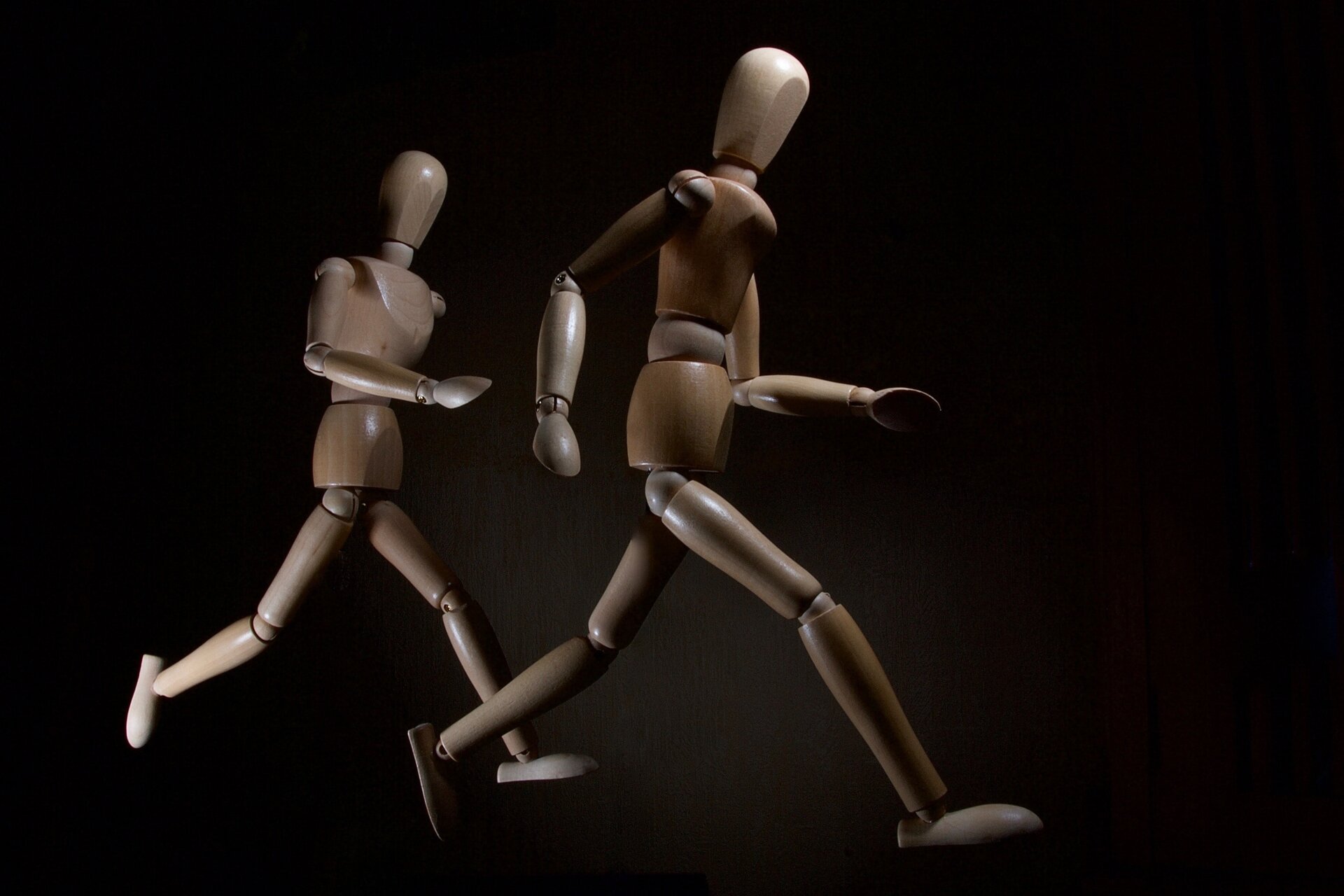
Ilustracja przedstawia dwa drewniane manekiny na czarnym tle, które ustawiono tak, aby naśladowały duże kroki wykonywane podczas marszu.
The human body is very interesting!
Ludzkie ciało jest niezwykle fascynujące!
Źródło: dostępny w internecie: unsplashcom [dostęp 27.09.2021], domena publiczna.
Exercise1
Match the words below with their definitions.
Połącz poniższe wyrazy z ich definicjami.
RuWiom5k9O8sN
elbow Możliwe odpowiedzi: 1. This body part helps you walk., 2. This body part makes your foot move., 3. This body part makes your arm move., 4. This body part makes your leg move., 5. This body part helps you smell things. knee Możliwe odpowiedzi: 1. This body part helps you walk., 2. This body part makes your foot move., 3. This body part makes your arm move., 4. This body part makes your leg move., 5. This body part helps you smell things. ankle Możliwe odpowiedzi: 1. This body part helps you walk., 2. This body part makes your foot move., 3. This body part makes your arm move., 4. This body part makes your leg move., 5. This body part helps you smell things. leg Możliwe odpowiedzi: 1. This body part helps you walk., 2. This body part makes your foot move., 3. This body part makes your arm move., 4. This body part makes your leg move., 5. This body part helps you smell things. nose Możliwe odpowiedzi: 1. This body part helps you walk., 2. This body part makes your foot move., 3. This body part makes your arm move., 4. This body part makes your leg move., 5. This body part helps you smell things.
elbow Możliwe odpowiedzi: 1. This body part helps you walk., 2. This body part makes your foot move., 3. This body part makes your arm move., 4. This body part makes your leg move., 5. This body part helps you smell things. knee Możliwe odpowiedzi: 1. This body part helps you walk., 2. This body part makes your foot move., 3. This body part makes your arm move., 4. This body part makes your leg move., 5. This body part helps you smell things. ankle Możliwe odpowiedzi: 1. This body part helps you walk., 2. This body part makes your foot move., 3. This body part makes your arm move., 4. This body part makes your leg move., 5. This body part helps you smell things. leg Możliwe odpowiedzi: 1. This body part helps you walk., 2. This body part makes your foot move., 3. This body part makes your arm move., 4. This body part makes your leg move., 5. This body part helps you smell things. nose Możliwe odpowiedzi: 1. This body part helps you walk., 2. This body part makes your foot move., 3. This body part makes your arm move., 4. This body part makes your leg move., 5. This body part helps you smell things.
Źródło: GroMar Sp. z o.o., licencja: CC BY-SA 3.0.
Read the text about the human body and then do the exercises below.
Przeczytaj tekst na temat ludzkiego ciała, a następnie wykonaj poniższe ćwiczenia.
Why is Our Body Like This?
Zuzanna KościukWhy is Our Body Like This?
Do you sometimes wonder why we’ve got two armsarms [arm]arms, legslegs [leg]legs, ears and eyeseyes [eye]eyes? The answer is simple: the human bodyhuman bodyhuman body is very smart.
We only need two legs to walk and jump. Two hands are enoughare enough [be enough]are enough to eat, write and touchtouch (verb)touch. We’ve got two ears to hear soundshear sounds [hear a sound]hear sounds from left and right. We’ve got two eyes to seeseesee things in front of usin front of usin front of us. We don’t need more to livelivelive, so we’ve only got two of some body partsbody parts [body part]body parts. Of course, we can see with one eye and hear with one ear. However, we can see and hear better when we have two. It’s how evolutionevolutionevolution works!
What about other body parts? We’ve got two anklesankles [ankle]ankles and two kneesknees [knee]knees to movemove (verb)move our legs. Two elbowselbows [elbow]elbows help move our arms. But we’ve got only one nosenosenose and mouthmouthmouth. Sometimes that’s enough for the body to work wellwork wellwork well.
1 Źródło: Zuzanna Kościuk, licencja: CC BY-SA 3.0.
Exercise2
Match the words from the text with their translations.
Źródło: GroMar Sp. z o.o., licencja: CC BY-SA 3.0.
Exercise2
Match the words from the text with the correct pictures.
Połącz wyrazy z tekstu z właściwymi zdjęciami.
R1L9W2JQZCY9m
Źródło: GroMar Sp. z o.o., licencja: CC BY-SA 3.0.
Exercise3
Based on the information from the text, decide if the following sentences are true or false.
Korzystając z informacji zawartych w tekście, zdecyduj, czy poniższe zdania są prawdziwe, czy fałszywe.
R9Q6SMOEfkYru
Źródło: GroMar Sp. z o.o., licencja: CC BY-SA 3.0.
Exercise4
Type in the missing words to fill in the gaps.
Wpisz brakujące słowa,, tak aby uzupełnić luki.
RANir8ZgPG6dD
1. Thanks to two ears, we can hTu uzupełnij sTu uzupełnij from two directions. 2. The hTu uzupełnij bTu uzupełnij looks like this because of the eTu uzupełnij. 3. Often, we can lTu uzupełnij even if we lose one body part out of two. 4. There are many bTu uzupełnij pTu uzupełnij that come in pairs.
1. Thanks to two ears, we can hTu uzupełnij sTu uzupełnij from two directions. 2. The hTu uzupełnij bTu uzupełnij looks like this because of the eTu uzupełnij. 3. Often, we can lTu uzupełnij even if we lose one body part out of two. 4. There are many bTu uzupełnij pTu uzupełnij that come in pairs.
Źródło: GroMar Sp. z o.o., licencja: CC BY-SA 3.0.
Gramatyka
Formyhave got(mieć) używamy najczęściej wtedy, gdy opisujemy ludzi i ich cechy fizyczne, a także gdy mówimy o rzeczach, które posiadamy.
Zdania z tą formą tworzymy według wzoru:
osoba + have got/ has got
Uwaga! Has gotużywamy tylko pohe/she/it.
Formahave gotczęsto ulega skróceniu.
Przykłady:
PEŁNA FORMA
SKRÓCENIE
TŁUMACZENIE
I have got two arms.
I’ve got two arms.
Mam dwa ramiona.
She has got two legs.
She’s got two legs.
Ona ma dwie nogi.
We have got red hair.
We’ve got red hair.
Mamy rude włosy.
Przeczenia z formąhave gottworzymy poprzez dodanienot po havewedług wzoru:
osoba + have/has + not + got
W przypadku przeczeń najczęściej stosujemy formę skróconą.
Przykłady:
PEŁNA FORMA
SKRÓCENIE
TŁUMACZENIE
She has not got big eyes.
She hasn’t got big eyes.
Ona nie ma dużych oczu.
You have not got long legs.
You haven’t got long legs.
Nie macie długich nóg.
They have not got blond hair.
They haven’t got blond hair.
Nie mają blond włosów.
Pytania z formąhave gottworzymy według wzoru:
have + osoba + got
Przykłady:
Have I got green eyes? – Czy mam zielone oczy?
Has he got brown hair? – Czy on ma brązowe włosy?
Have you got blue eyes? – Czy macie niebieskie oczy?
Exercise5
Choose the correct answer.
Wybierz poprawne odpowiedzi.
R7nMJ4e1CKPZi
1. I haven’thasn’t got blond hair. My hair is red!
2. HaveHas she got blue eyes?
3. We havehas got long legs.
4. He haven’thasn’t got short hair.
5. They havehas got green eyes.
1. I haven’thasn’t got blond hair. My hair is red!
2. HaveHas she got blue eyes?
3. We havehas got long legs.
4. He haven’thasn’t got short hair.
5. They havehas got green eyes.
Źródło: GroMar Sp. z o.o., licencja: CC BY-SA 3.0.
Exercise6
Fill in the gaps with the correct forms of have got.
Uzupełnij luki poprawnymi formami have got.
R1EWR6bdf2pRy
1. She Tu uzupełnij (have/not/got) red hair. 2. Tu uzupełnij (have/got/you) blue eyes? 3. He Tu uzupełnij (have/got) really long arms. 4. We Tu uzupełnij (have/got) two of many body parts! 5. They Tu uzupełnij (have/not/got) brown eyes.
1. She Tu uzupełnij (have/not/got) red hair. 2. Tu uzupełnij (have/got/you) blue eyes? 3. He Tu uzupełnij (have/got) really long arms. 4. We Tu uzupełnij (have/got) two of many body parts! 5. They Tu uzupełnij (have/not/got) brown eyes.
Źródło: GroMar Sp. z o.o., licencja: CC BY-SA 3.0.