Przeczytaj
Have you ever found yourself in a situation where you had to stay late because you had left an important task until the last minute? If you have, that means you have procrastinated. Don’t worry, everybody’s doing it! To fight it and achieve a good work‑life balance and increased productivity, try organising your time better. Here are eight tips on how to do that.
Czy zdarzyła ci się kiedyś sytuacja, że musiałeś/musiałaś pracować do późna, bo zostawiłeś/zostawiłaś jakieś ważne zadania na ostatnią chwilę? Jeśli tak, to znaczy, że prokrastynujesz. Nie martw się jednak, wszyscy to robią! Jeśli chcesz powalczyć z tym nawykiem i znaleźć równowagę między życiem zawodowym a prywatnym oraz zwiększyć własną produktywność, to spróbuj lepiej organizować swój czas. Poniżej znajdziesz osiem wskazówek, które mogą ci w tym pomóc.

From the list below, choose all the objects that can help you organise your work.
Read the text and do the exercises below.
Eight Tips on Time Managementis about taking control of the time you spend on your daily activities with the aim to improve your
productivityproductivity
and
efficiencyefficiency
and
countercounter
procrastinationprocrastination
, especially during
project managementproject management
. Time cannot be stretched
infinitelyinfinitely
, but with proper
handlinghandling
, the duties to your loved ones, your boss, your school, as well as leisure time can be arranged and
prioritisedprioritised
. Here are eight tips on how to start:
CREATE THE RIGHT ENVIRONMENT
First of all, make sure you have the right environment that is conduciveconducive to the tasks you are required to do. Removing distractionsdistractions is the first step. Music, barking dogs, your loved ones who need something from you, TV, Facebook - they’re all distractorsdistractors that stand in the wayin the way of finishing your task. InsulateInsulate yourself from them to give yourself a space that is comfortable, quiet and temptationtemptation-free. Furthermore, make sure you are timingtiming your tasks – some tasks require you to have a lot of time and energy.
PRIORITIESPRIORITIES AND GOALS SET YOUR
Your goals can be sometimes overwhelmingoverwhelming, so it is important to break them downbreak them down into smaller componentscomponents. After you do this, you can prioritise the most important ones, proceed to plan them out and then set a timeframetimeframe for completing them. You can do it using ABCD analysisABCD analysis, in which activities are rankedranked as:
A – Tasks that are perceivedperceived as being urgent and important,
B – Tasks that are important but not urgenturgent,
C – Tasks that are unimportantunimportant but urgent,
D – Tasks that are unimportant and not urgent.
SET TIME LIMITS
Once you have the goals broken into tasks that have priorities assigned, you can proceed to evaluateevaluate how much time each sub‑task needs for completioncompletion. This will result in a schedule, or a calendar of activities with deadlinesdeadlines. Make sure you watch out for dependentdependent activities: those that will depend on the completion of others. Make sure you prioritise the latterlatter using a Gantt chartGantt chart or another time management tool.
MANAGE STRESS BY TAKING SMART BREAKS
Breaks are crucialcrucial. Make sure they are properly scheduledscheduled and that you keep track of their time, unless you want to end up on another stressful bingebinge of Friends on TV or ‘doom scrollingdoom scrolling’ on social media. Breaks are important to refresh, destress, and give rest to your brain. Without rest, the concentration and memory capabilitiescapabilities of your brain deterioratedeteriorate, so remember to get some proper sleep, too. Try not to think about the task during your breaks – they should be about pleasure. Make them short but make them count.
IDENTIFY AND PREVENT PROCRASTINATION
Make sure you analyse your day‑to‑dayday‑to‑day activities to identify low‑importance, low‑benefit ones, especially if they don’t bring you pleasure (you’d be surprised how much time we waste on those!). Don’t be in denialdenial - we all do unnecessary things that clog upclog up our days. Keep a diary of your activities and count the time you spend on them, and assessassess them according to their value. After a few days, you will have a clear overviewoverview of what contributes to your procrastination and avoidanceavoidance of work. The awareness of the sheer amountsheer amount of time you waste and the specific moments this happens will help you manage your time better. If you want, you can create a ‘not‑to‑do list’!
CREATE TO‑DO‑LISTS
These are great to ‘offloadoffload’ the huge, intimidatingintimidating and mind‑cloggingmind‑clogging burdenburden that you carry around in your head and worry about. The multitudemultitude of things that you need to do can often be mentally exhaustingmentally exhausting and lead to a ‘brain freezebrain freeze’. A simple act of writing them down on a piece of paper or typing them into an app relieves you of this weight and of the stress of having to constantly remember them.
USE HELPFUL TOOLS
Getting Things Done, or GTDGTD in short, is a very simple tool created by David Allen, which helps to record and handle tasks, projects and deadlines.
Another helpful tool is the ‘pomodoropomodoro’ technique based on the principleprinciple of time blockingtime blocking: reserving a certain amount of time to do only the given task. It is named after the tomato‑shaped kitchen timer, an essential accessory (don’t worry, though, you can use a phone app instead) which can be used to divide your time into 30‑minute time intervalstime intervals known as ‘pomodoros’, consisting of 25 minutes of work and 5 minutes of break time. Four pomodoros in a rowin a row will get a lot of work done, and after that you will have a sense of achievementachievement and can have a longer break.
PLAN AHEAD
Finally, it is essential to plan ahead and schedule your tasks as early as possible so that you know what to expect. Careful planning will let you plan‑in important slack timeslack time and prevent you from double‑bookingdouble‑booking activities and having to suffer through deadly crunchescrunches and meltdownsmeltdowns.
Źródło: Tomasz Wiśniewski, [na podstawie:] https://francescocirillo.com/products/the-pomodoro-technique# [dostęp 16.12.2021], https://clockify.me/time-management-techniques [dostęp 16.12.2021], https://www.businessnewsdaily.com/6129-good-manager-skills.html [dostęp 16.12.2021], licencja: CC BY-SA 3.0.
- Time management is aimed to improve
a) time control.
b) productivity and efficiency.
c) stress.
- Overwhelming goals can be
a) ignored.
b) in the way of finishing your task.
c) divided into smaller ones.
- Dependent activities are activities that
a) have to be prioritised.
b) can’t be finished before others have been completed.
c) require a calendar.
- According to the text, breaks are important to
a) watch a favourite series or visit social media.
b) have some sleep and do something pleasurable.
c) freshen up, rest, and reduce stress.
- A great way to stop stressing about things to do is
a) procrastination.
b) avoidance.
c) typing them onto a list.
- Dividing time into parts devoted to certain tasks is called
a) pomodoro.
b) time blocking.
c) deadlines.
- A pomodoro usually lasts for
a) half an hour.
b) 25 minutes.
c) five minutes.
- Planning ahead prevents
a) booking meetings and activities.
b) unnecessary stressful situations.
c) planning-in slack time.
- The effectiveness of work being done. 1. overwhelming, 2. avoidance, 3. priority, 4. distractions, 5. procrastination, 6. deadline, 7. dependent, 8. temptation, 9. urgent, 10. productivity, 11. intimidating, 12. schedule
- An activity that is the most important at a given time. 1. overwhelming, 2. avoidance, 3. priority, 4. distractions, 5. procrastination, 6. deadline, 7. dependent, 8. temptation, 9. urgent, 10. productivity, 11. intimidating, 12. schedule
- Items, noises and things that take away our attention. 1. overwhelming, 2. avoidance, 3. priority, 4. distractions, 5. procrastination, 6. deadline, 7. dependent, 8. temptation, 9. urgent, 10. productivity, 11. intimidating, 12. schedule
- An attractive thing that we want but don’t necessarily need. 1. overwhelming, 2. avoidance, 3. priority, 4. distractions, 5. procrastination, 6. deadline, 7. dependent, 8. temptation, 9. urgent, 10. productivity, 11. intimidating, 12. schedule
- When there is too much of something stressful. 1. overwhelming, 2. avoidance, 3. priority, 4. distractions, 5. procrastination, 6. deadline, 7. dependent, 8. temptation, 9. urgent, 10. productivity, 11. intimidating, 12. schedule
- An organised list of things to do. 1. overwhelming, 2. avoidance, 3. priority, 4. distractions, 5. procrastination, 6. deadline, 7. dependent, 8. temptation, 9. urgent, 10. productivity, 11. intimidating, 12. schedule
- If something needs to be done quickly, it is… 1. overwhelming, 2. avoidance, 3. priority, 4. distractions, 5. procrastination, 6. deadline, 7. dependent, 8. temptation, 9. urgent, 10. productivity, 11. intimidating, 12. schedule .
- If something requires another thing to be completed, it is… 1. overwhelming, 2. avoidance, 3. priority, 4. distractions, 5. procrastination, 6. deadline, 7. dependent, 8. temptation, 9. urgent, 10. productivity, 11. intimidating, 12. schedule .
- The tendency to put off activities to do until later. 1. overwhelming, 2. avoidance, 3. priority, 4. distractions, 5. procrastination, 6. deadline, 7. dependent, 8. temptation, 9. urgent, 10. productivity, 11. intimidating, 12. schedule
- The tendency to keep away from one’s duties and run away from them. 1. overwhelming, 2. avoidance, 3. priority, 4. distractions, 5. procrastination, 6. deadline, 7. dependent, 8. temptation, 9. urgent, 10. productivity, 11. intimidating, 12. schedule
- Scary, terrifying. 1. overwhelming, 2. avoidance, 3. priority, 4. distractions, 5. procrastination, 6. deadline, 7. dependent, 8. temptation, 9. urgent, 10. productivity, 11. intimidating, 12. schedule
- The moment when work should be finished. 1. overwhelming, 2. avoidance, 3. priority, 4. distractions, 5. procrastination, 6. deadline, 7. dependent, 8. temptation, 9. urgent, 10. productivity, 11. intimidating, 12. schedule
Trzeci okres warunkowy to struktura, za pomocą której nawiązujemy do przeszłości. Wyrażamy nią marzenia, jednak tylko takie, które nie mają – niestety – żadnej szansy się spełnić, ponieważ nie jesteśmy w stanie cofnąć czasu i zmienić tego, co było. Struktura ta służy więc do wyrażania żalu w związku ze zrobionymi lub niezrobionymi rzeczami.
Przykład:
If I had found more time yesterday, I would have finished the task. – Gdybym znalazł/znalazła wczoraj więcej czasu, skończyłbym/skończyłabym zadanie.
Struktura zdania w trzecim okresie warunkowym wygląda następująco:
If + past perfect (had + trzecia forma czasownika), would have + trzecia forma czasownika
Tak jak w pozostałych okresach warunkowych, także w trzecim możemy zamienić kolejnością części zdania – nie używamy wtedy przecinka:
I would have finished the task if I had found more time yesterday. – Skończyłbym/skończyłabym zadanie, gdybym znalazł/znalazła wczoraj więcej czasu.
Had i would można zapisać skrótowo, używając tzw. contraction:
If I’d found more time yesterday, I’d have finished the task. – Gdybym wczoraj miał/miała więcej czasu, skończyłbym/skończyłabym to zadanie.
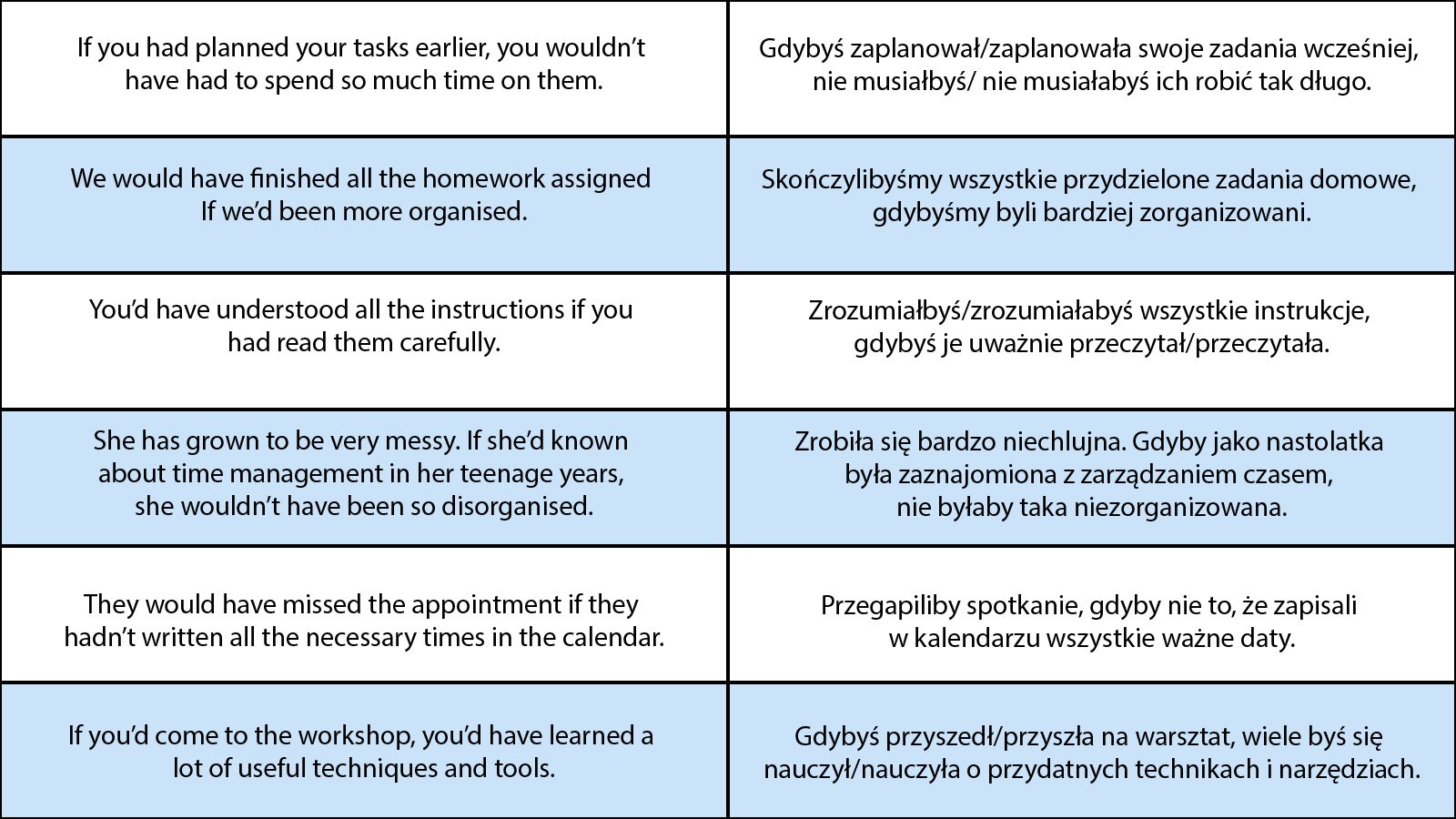
Przykłady użycia trzeciego okresu warunkowego:
English | Polish |
|---|---|
If you had planned your tasks earlier, you wouldn’t have had to spend so much time on them. | Gdybyś zaplanował/zaplanowała swoje zadania wcześniej, nie musiałbyś/ nie musiałabyś ich robić tak długo. |
We would have finished all the homework assigned if we’d been more organised. | Skończylibyśmy wszystkie przydzielone zadania domowe, gdybyśmy byli bardziej zorganizowani. |
You’d have understood all the instructions if you had read them carefully. | Zrozumiałbyś/zrozumiałabyś wszystkie instrukcje, gdybyś je uważnie przeczytał/przeczytała. |
She has grown to be very messy. If she’d known about time management in her teenage years, she wouldn’t have been so disorganised. | Zrobiła się bardzo niechlujna. Gdyby jako nastolatka była zaznajomiona z zarządzaniem czasem, nie byłaby taka niezorganizowana. |
They would have missed the appointment if they hadn’t written all the necessary times in the calendar. | Przegapiliby spotkanie, gdyby nie to, że zapisali w kalendarzu wszystkie ważne daty. |
If you’d come to the workshop, you’d have learned a lot of useful techniques and tools. | Gdybyś przyszedł/przyszła na warsztat, wiele byś się nauczył/nauczyła o przydatnych technikach i narzędziach. |
Słownik
/ ˌeɪbiːˈsiːdiː əˈnæləsɪs /
analiza priorytetów ABCD
(ABCD is an acronym that stands for Advantages, Benefits, Constraints and Disadvantages)
/ əˈtʃiːvmənt /
osiągnięcie
(something that has been accomplished, especially by hard work, ability, or heroism)
/ əˈses /
oceniać
(judge the worth, importance etc. of; evaluate)
/ əˈsaɪn /
przydzielać
(select for (a job), give out (a task, a problem))
/ əˈvɔɪdəns /
unikanie
(the act of keeping away from or preventing from happening)
/ bɪndʒ /
niepohamowanie, wykonywanie czynności w sposób niepohamowany
(excessive indulgence in anything)
/ bi ɪn dɪˈnaɪəl /
nie dopuszczać do siebie faktów, tkwić w stanie zaprzeczenia
(refuse to accept the unpleasant truth about a situation or admit what you are feeling)
/ ˈbreɪn friːz /
nieformalnie: krótkotrwały problem z koncentracją lub pamięcią; również: nagły silny ból głowy po spożyciu czegoś bardzo zimnego (np. lodów)
(here: (informal) a temporary lapse of memory or concentration; also: a sudden shooting pain in the head caused by ingesting very cold food (such as ice cream) or drink)
/ ˈbreɪk ðəm daʊn / / ˈbreɪk ˈsʌmthetaɪŋ daʊn /
podzielić je
(separate into smaller parts in order to make it easier to understand or deal with)
/ ˈbɜːdn̩ /
ciężar
(something that is exacting, oppressive or difficult to bear)
/ ˌkeɪpəˈbɪlɪtɪz /
możliwości
(characteristics that may be developed; potential aptitude)
/ ˈklɒg ʌp /
tu: zapchać (się)
(block (become blocked) so that little or nothing can pass through)
/ kəmˈpliːʃn̩ /
ukończenie
(conclusion; fulfilment)
/ kəmˈpəʊnənts / / kəmˈpəʊnənt /
części składowe [część składowa]
(parts or aspects of something more complex)
/ kənˈdjuːsɪv /
sprzyjający/sprzyjająca
(contributing, leading or tending to something)
/ ˈkaʊntə /
przeciwdziałać
(say or do (something) in reply, defence or retaliation)
/ ˈkruːʃl̩ /
kluczowy/kluczowa
(involving a final or supremely important decision or event; decisive; critical)
/ ˈkrʌntʃɪz / / krʌntʃ /
kryzysy [moment krytyczny]
(a difficult situation which forces you to make a decision or act quickly)
/ ˈdeɪtəˈdeɪ /
codzienne
(happening every day as part of your normal life)
/ ˈdedlaɪnz / / ˈdedlaɪn /
terminy [termin]
(the point in time at which something must be completed)
/ dɪˈnaɪəl /
zaprzeczenie
(a statement that something is not true or did not happen)
/ dɪˈpendənt /
zależny/zależna
(affected by something else and changing if the other thing changes)
/ ˌdiːˈstrɛs /
odstresować
(reduce the stress in a person)
/ dɪˈtɪərɪəreɪt /
pogarszać się
(become worse)
/ dɪˈstrækʃn̩z / / dɪˈstrækʃn̩ /
rozpraszacze, rzeczy rozpraszające uwagę [rozpraszacz, rzecz rozpraszająca uwagę]
(something that gets your attention and prevents you from concentrating on something else)
/ dɪˈstraktəz / / dɪˈstraktə /
osoby lub rzeczy, które rozpraszają uwagę [osoba lub rzecz, która rozprasza uwagę]
(a person or thing that distracts)
/ duːm skrəʊlɪŋ /
stresujące przewijanie strony internetowej
(the activity of spending a lot of time looking at your phone or computer and reading bad or negative news stories)
/ ˌdʌbl ˈbʊkɪŋ /
rezerwacja dwóch czynności na jeden termin
(promise the same room, seat, ticket, etc. to more than one person or group)
/ ɪˈfɪʃnsi /
efektywność
(the good use of time and energy in a way that does not waste any)
/ ɪˈvæljʊeɪt /
oceniać
(judge or calculate the quality, importance, amount or value of something)
/ ˈɡænt tʃɑːt /
wykres Gantta
(one of the most popular and useful ways of showing activities (tasks or events) displayed against time. On the left of the chart is a list of the activities and along the top is a suitable time scale. Each activity is represented by a bar; the position and length of the bar reflects the start date, duration and end date of the activity)
/ dʒiːtiːdiː /
metoda organizacji zajęć, doprowadzanie spraw do końca
(the idea of moving all items of interest, relevant information, issues, tasks and projects out of one's mind by recording them externally and then breaking them into actionable work items with known time limits)
/ ˈhændl̩ɪŋ / / ˈhændl̩ /
prowadzenie, radzenie sobie z sytuacją, wykonywanie [prowadzić, radzić sobie z sytuacją, wykonywać]
(the way in which someone deals with a particular situation, problem or person)
/ ɪn ə raʊ /
z rzędu
(if something happens a number of times in a row, it happens that many times without interruption)
/ ɪn ðə ˈweɪ /
na przeszkodzie, na drodze
(forming an obstacle or hindrance to movement or action)
/ ˈɪnfɪnətli /
nieskończenie
(continuing forever without end)
/ ˈɪnsjʊleɪt /
izolować
(here: protect someone from unpleasant knowledge or harmful experiences)
/ ɪnˈtɪmɪdeɪtɪŋ /
onieśmielający/onieśmielająca, zagrażający/zagrażająca
(making you feel nervous, frightened or less confident)
/ ˈlætə /
drugi z dwóch wspomnianych wcześniej elementów
(used for referring to the second of two people, things or groups that have just been mentioned)
/ ˈmænɪdʒd /
zarządzany/zarządzana
(controlled)
/ ˈmeltdaʊnz / / ˈmeltdaʊn /
kryzysy, załamania nerwowe [kryzys, załamanie nerwowe]; także: porażka, krach finansowy
(a decline or breakdown in a situation or condition; also: a complete failure, especially in financial matters)
/ ˈmentəli ɪɡˈzɔːstɪŋ /
wykańczający/wykańczająca psychicznie
(exhaustion that affects mental keenness)
/ ˈmaɪlstəʊnz / / ˈmaɪlstəʊn /
kamienie milowe [kamień milowy]
(an event or achievement that marks an important stage in a process)
/ ˈmaɪnd ˈklɒɡɪŋ /
zapychający/zapychająca umysł
(creating clutter in your mind)
/ ˈmʌltɪtjuːd /
mnogość
(a large number)
/ ˈɒfˈləʊd /
odciążyć, pozbyć się
(tell someone all your problems and difficulties so that you feel better)
/ ˈəʊvəvjuː /
przegląd
(a general summary of a subject)
/ ˌəʊvəˈwelmɪŋ /
przytłaczający/przytłaczająca
(very strong, intense)
/ ˈpiːpl̩ skɪlz /
umiejętności interpersonalne
(patterns of behaviour and behavioural interactions)
/ pəˈsiːvd /
postrzegany/postrzegana
(considered, believed to be)
/ ˌpɑːməˈdɔːəʊ /
technika odmierzania czasu pracy za pomocą minutnika
(a time management technique which uses a timer to break work into intervals, typically 25 minutes in length, separated by short breaks)
/ ˈprɪnsəpl̩ /
zasada
(a basic truth or law or assumption)
/ praɪˈɒrɪtɪz / / praɪˈɒrɪti /
priorytety [priorytet]
(something important that must be done first or needs more attention than anything else)
/ praˈjɔːəˌtaɪzd /
priorytetyzowany/priorytetyzowana, uszeregowany/uszeregowana pod względem ważności
(treated as more important than other things)
/ prəʊˌkræstɪˈneɪʃn̩ /
prokrastynacja, odkładanie spraw na później
(the action of delaying or postponing something)
/ ˌprɒdʌkˈtɪvɪti /
produktywność
(the rate at which goods are produced, especially in relation to the time, money and workers needed to produce them)
/ ˈprɒdʒekt ˈmænɪdʒmənt /
zarządzanie projektami
(the process of leading the work of a team to achieve all project goals within the given constraints)
/ ræŋkt /
w rankingu
(arranged in a sequence of grades or ranks)
/ rɪˈzɔːsɪz / / rɪˈzɔːs /
zasoby [zasób]
(available sources of wealth; new or reserve supplies that can be drawn upon when needed)
/ ˈʃedjuːld /
zaplanowany/zaplanowana
(planned to happen at a particular time or day)
/ ʃɪər əˈmaʊnt /
sama ilość
(nothing other than; unmitigated (used for emphasis) amount of something)
/ slæk ˈtaɪm /
zapas czasu
(the amount of time a task can experience delay, without delaying the completion time of a project)
/ tempˈteɪʃn̩ /
pokusa
(a strong feeling of wanting to have or to do something, especially something that is bad for you)
/ ˈtaɪm ˈblɒkɪŋ /
układanie czynności w bloki czasowe
(a time management method that asks you to divide your day into blocks of time, with each block dedicated to accomplishing a specific task)
/ ˈtaɪm ˈɪntəvl̩z /
przedziały czasowe
(a period of time with fixed, well‑defined limits)
/ ˈtaɪm ˈmænɪdʒmənt /
zarządzanie czasem
(the ability to use one's time effectively or productively, especially at work)
/ ˈtaɪmˌfrem /
ramy czasowe
(a period of time especially with respect to some action or project)
/ ˈtaɪmɪŋ / / ˈtaɪm /
tu: mierzysz czas [mierzyć czas]
(use a clock to measure something, for example how long something lasts or how often something happens within a particular period)
/ ˌʌnɪmˈpɔːtnt /
nieważny/nieważna
(not important or noteworthy)
/ ˈɜːdʒənt /
pilny/pilna
(requiring immediate action)
Źródło: GroMar Sp. z o.o., licencja: CC BY‑SA 3.0