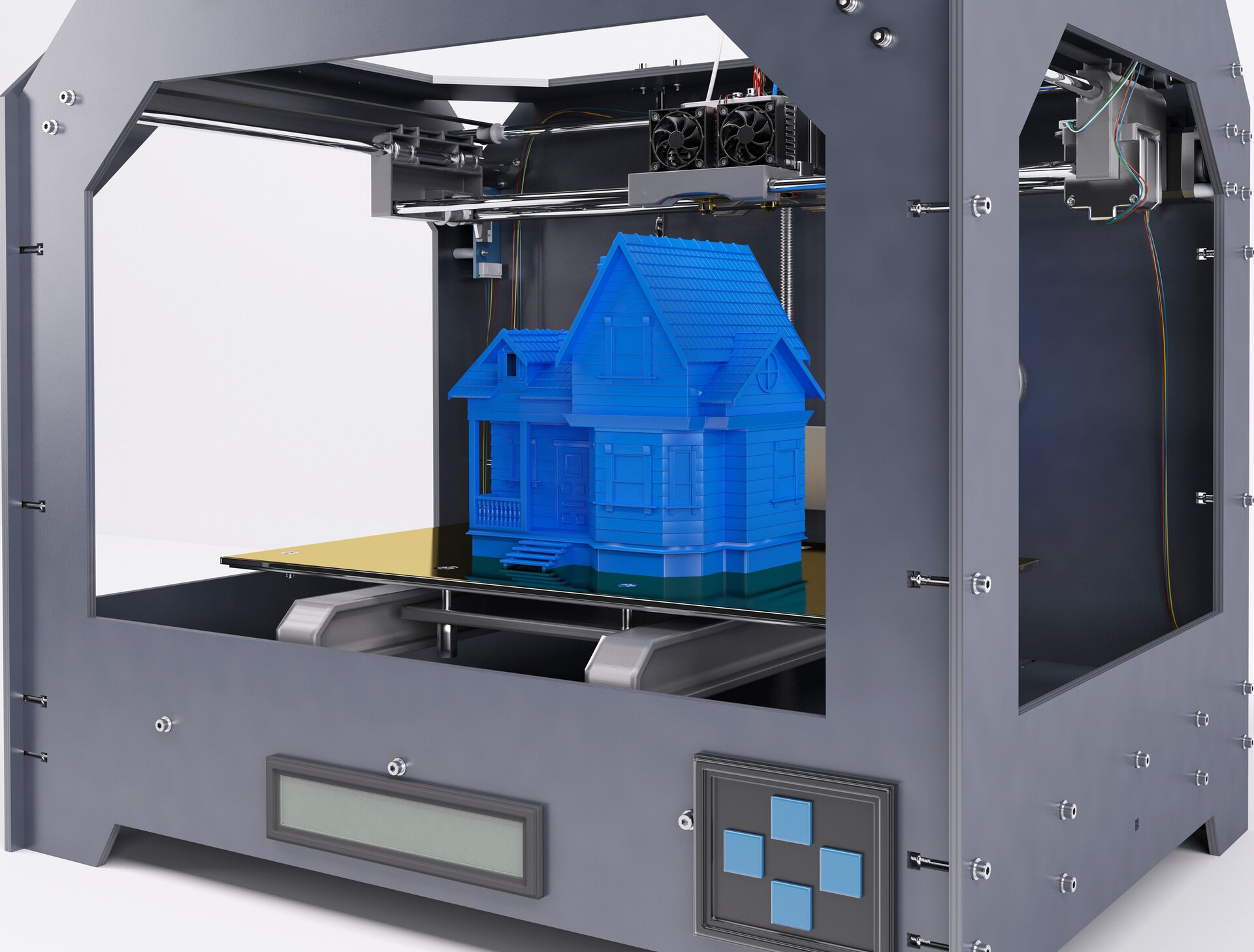
You’re going to read part of an Internet forum discussion where people talk about the idea of 3D printing of entire houses, using the process that you can see in the picture. Have you ever heard of such homes? Do you think it’s possible? Would you trust a house like that?
Przeczytasz fragment dyskusji na forum internetowym, w której uczestnicy rozmawiają o pomyśle drukowania domów technologią 3D. Przyjrzyj się poniższej ilustracji i sprawdź, jak to może wyglądać. Słyszałeś/Słyszałaś kiedyś o takich domach? Myślisz, że drukowanie całych domów jest możliwe? Zaufałbyś/Zaufałabyś takiej konstrukcji?
R1SRnEQXsffkL
Grafika przedstawia drukarkę 3D, urządzenie w kształcie sześcianu, który ma otwory, przypominjące okna, w ścianach bocznych oraz frontowej. Panel oraz przyciski znajdują się na dole przedniej obudowy. Otwory umieszczone z trzech stron urządzenia ukazują jego wnętrze, na które składa się platforma robocza, na której jest drukowany model domu, nad którym znajduje się głowica drukująca.
This might be the future of house building
To może być przyszłość budownictwa mieszkaniowego
Źródło: dostępny w internecie: freepik.com [dostęp 26.11.2021], domena publiczna.
Exercise1
RRX96G5rGGBkA
Odpowiedz na pytania lub uzupełnij tekst. 1. A rectangular hole in the door or in a wall near the entrance of a house or other building, through which letters, etc. are delivered., 2. A cover that can be closed over the outside of a window., 3. The part of a building that is partly or completely below the level of the ground., 4. Transparent building material made mostly of sand., 5. An area inside or below a building where you can leave your car., 6. The overhead upper surface of a room., 7. A piece of metal on a door that you use to announce your arrival., 8. A wide path for a car that joins someone’s house to a street.
Odpowiedz na pytania lub uzupełnij tekst. 1. A rectangular hole in the door or in a wall near the entrance of a house or other building, through which letters, etc. are delivered., 2. A cover that can be closed over the outside of a window., 3. The part of a building that is partly or completely below the level of the ground., 4. Transparent building material made mostly of sand., 5. An area inside or below a building where you can leave your car., 6. The overhead upper surface of a room., 7. A piece of metal on a door that you use to announce your arrival., 8. A wide path for a car that joins someone’s house to a street.
Źródło: GroMar Sp. z o.o., licencja: CC BY-SA 3.0.
Read the text below and complete the exercises.
3D Homes Forum
Joanna Sobierska‑Paczesny3D Homes Forum
Daan: I agree, 3D homes are so cool! I know the couple who were the first people in the Netherlands to rentrentrent a 3D‑printed house. The couple, whose names are Lutz and Dekkers, had lived in various homes before that one, so you could say they’re inhabitantsinhabitants [inhabitant]inhabitants with experience. And they appreciate this place! You can hear voices that a house which is constructed without a “skeleton” of some sort of beams that normally go into constructingconstructing [construct]constructing a house seems breakablebreakablebreakable or not resistantresistantresistant to natural disasters, such as tornadoes or earthquakes. To Dekker, it actually felt safe, but I guess people might be worried because there are “ripplesripples [ripple]ripples” visible on the walls, so they don’t look soundsoundsound. But that’s the places where the layerslayers [layer]layers meet. And having so many “seamsseams [seam]seams” doesn’t weakenweaken weaken the construction. It’s still concreteconcreteconcrete after all – science is science, the test results speak for themselves. And this irregularityirregularityirregularity of walls and the shape of the house which resemblesresembles [resemble]resembles a boulderboulderboulder is what drew Lutz and Dekkers to it in the first place. She says that the moment she saw the ad she said to herself, “it looks like one of those fairy tale houses! I want to live in it!” I mean, on the inside, it’s just a regular bungalowbungalowbungalow. It’s got 94 square meters of living space, where all the rooms are situatedsituatedsituated along one hallway, which runsruns [run]runs from one end of the house to the other. The only thing which makes it special, I guess, is that a house whose walls and roof are rounded has no sharp corners inside. There’s a softness to it. But on the other hand, the walls inside also have that structure of layeredlayeredlayered concrete. To me, it’s really cosycosycosy, but of course, that’s a matter of tastematter of tastematter of taste. I’d love to live in one!
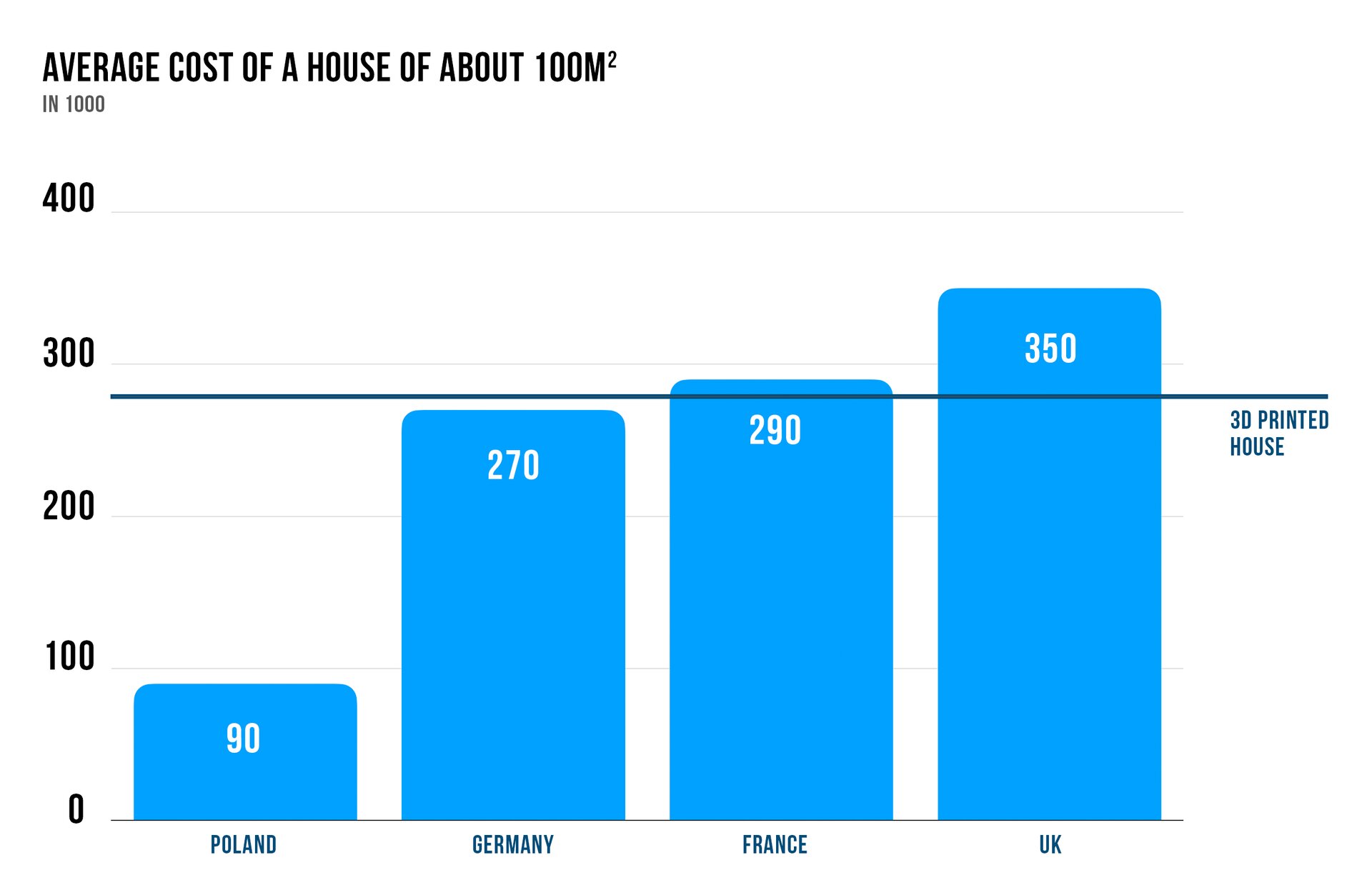
ARTIE: Well, that’s all nice and fine, but there’s so much more to 3D houses than futuristicfuturisticfuturistic looks. The couple in the Netherlands who got to be the first to be the first tenantstenants [tenant]tenants, they’re not paying an enormousenormousenormous price for it. The €800 rent is actually about half the regular rentregular rentregular rent in this area, because the building company was looking tolooking to [look to]looking to advertise it. But it’s not their final price, and that’s not just my opinion, they’ve stated it very clearly themselves. This technology is anything but cheap at this point. The price of constructing a three‑bedroom unitunitunit like that would be around €300,000. When you compare these numbers with the rent or sales prices, they’re not impressive. I mean, just look at the table below.
RtZy97qhs5L6U
Ilustracja przedstawia wykres słupkowy wzrostu cen mieszkań. U góry widoczny jest napis w języku angielskim: Average cost of a house of about 100m2 in 1000. Poniżej, po lewej stronie wykresu, w kolumnie na osi pionowej, widoczne są cyfry od dołu: 0, 100, 200, 300, 400. Poniżej cyfry 300 przebiega pozioma linia, na końcu której po prawej stronie widnieje napis w języku angielskim: 3D printed houses. Na osi poziomej widoczne są cztery niebieskie słupki, od lewej – słupek z podpisem Poland i z liczbą 90; słupek z podpisem Germany i z liczbą 270; słupek z podpisem France i z liczbą 290; słupek z podpisem UK i z liczbą 350.
Źródło: Daniel Łyżwiński, domena publiczna.
Lou @Artie, you’re so right, we need to look beyond the cool options for constructing buildings straight out of science‑fiction books.
1 Źródło: Joanna Sobierska‑Paczesny, dostępny w internecie: Dutch couple become Europe’s first inhabitants of a 3D‑printed house, https://www.theguardian.com/technology/2021/apr/30/dutch-couple-move-into-europe-first-fully-3d-printed-house-eindhoven [dostęp 26.06.2022], These Sleek Houses Are 3D Printed, and They Fit in Your Backyard, https://singularityhub.com/2020/08/13/these-sleek-houses-are-3d-printed-and-they-fit-in-your-backyard/ [dostęp 26.06.2022], Logan Architecture and ICON complete „first 3D‑printed homes for sale in the US”, https://www.dezeen.com/2021/08/31/east-17th-street-residences-3d-printed-homes-icon-austin/ [dostęp 26.06.2022], The rise of 3D‑printed houses, https://www.economist.com/science-and-technology/the-rise-of-3d-printed-houses/21803667 [dostęp 26.06.2022], licencja: CC BY-SA 3.0.
Źródło: GroMar Sp. z o.o., licencja: CC BY-SA 3.0.
RacblldlkwDMW
Exercise2
Drag the words to match them with the appropriate pictures.
Drag the words to match them with the appropriate pictures.
Źródło: dostępny w internecie: pixabay.com [dostęp 28.11.2021], pexels.com [dostęp 28.11.2021], domena publiczna.
Exercise3
RxFrDfKAgo5d2
Read the sentences below and based on the texts you’ve read, choose the correct answer. Only one answer is correct.
In the entry created by Daan, which is given as a fact, NOT an opinion?
a) The places where the concrete layers meet are not weaker.
b) A house without beams is less stable and safe.
c) The walls that have ripples and seams are less reliable.
d) The 3D printed house is comfortable and warm.
The 3D house in the Netherlands is constructed in such a way that
a) the walls don’t let through any sound.
b) you can see it was inspired by fairy tales.
c) on the inside, it looks exactly like a regular house.
d) some parts of the interior show it’s 3D printed.
The tone of Artie’s entry is
a) enthusiastic.
b) undecided.
c) practical.
d) disappointed.
What conclusion can be drawn from the graph Artie included?
a) The prices of houses have been rising since 3D printed houses appeared.
b) It’s always more economical to build a 3D printed unit than a regular one.
c) The prices of 3D printed units are rising similarly to the regular house prices.
d) In many areas, 3D printed units are not a threat to the regular house market.
Read the sentences below and based on the texts you’ve read, choose the correct answer. Only one answer is correct.
In the entry created by Daan, which is given as a fact, NOT an opinion?
a) The places where the concrete layers meet are not weaker.
b) A house without beams is less stable and safe.
c) The walls that have ripples and seams are less reliable.
d) The 3D printed house is comfortable and warm.
The 3D house in the Netherlands is constructed in such a way that
a) the walls don’t let through any sound.
b) you can see it was inspired by fairy tales.
c) on the inside, it looks exactly like a regular house.
d) some parts of the interior show it’s 3D printed.
The tone of Artie’s entry is
a) enthusiastic.
b) undecided.
c) practical.
d) disappointed.
What conclusion can be drawn from the graph Artie included?
a) The prices of houses have been rising since 3D printed houses appeared.
b) It’s always more economical to build a 3D printed unit than a regular one.
c) The prices of 3D printed units are rising similarly to the regular house prices.
d) In many areas, 3D printed units are not a threat to the regular house market.
Źródło: GroMar Sp. z o.o., licencja: CC BY-SA 3.0.
Exercise4
Drag the following words to make sentences.
R19XS45dUg8o5
1. Modern interiors filled with concrete, steel and glass don’t seem very 1. cosy, 2. futuristic to me – I like everything that’s comfortable, soft and fluffy.
I want my home to have a 1. cosy, 2. futuristic look, with star-shaped windows and furniture in strange shapes.
1. Modern interiors filled with concrete, steel and glass don’t seem very 1. cosy, 2. futuristic to me – I like everything that’s comfortable, soft and fluffy.
I want my home to have a 1. cosy, 2. futuristic look, with star-shaped windows and furniture in strange shapes.
Źródło: GroMar Sp. z o.o., licencja: CC BY-SA 3.0.
R17D2nvCZuvuh
2. The balcony 1. runs, 2. is situated around the whole first floor of the house.
The house 1. runs, 2. is situated in beautiful surroundings.
2. The balcony 1. runs, 2. is situated around the whole first floor of the house.
The house 1. runs, 2. is situated in beautiful surroundings.
Źródło: GroMar Sp. z o.o., licencja: CC BY-SA 3.0.
RBfWvJMhR64oO
3. $5,000,000? Why would you pay such a(n) 1. enormous, 2. regular price for a house?
£300 is actually quite cheap, a(n) 1. enormous, 2. regular price for a unit like this is around £400.
3. $5,000,000? Why would you pay such a(n) 1. enormous, 2. regular price for a house?
£300 is actually quite cheap, a(n) 1. enormous, 2. regular price for a unit like this is around £400.
Źródło: GroMar Sp. z o.o., licencja: CC BY-SA 3.0.
RNPhIfgwL2xuA
4. Careful, these cups are made of 1. breakable, 2. sound glass, so don’t drop them!
Don’t worry, the glass roof on the winter garden is really 1. breakable, 2. sound. In fact, you can safely walk on it!
4. Careful, these cups are made of 1. breakable, 2. sound glass, so don’t drop them!
Don’t worry, the glass roof on the winter garden is really 1. breakable, 2. sound. In fact, you can safely walk on it!
Źródło: GroMar Sp. z o.o., licencja: CC BY-SA 3.0.
R1ON0fO0Vm3p1
5. The archeologists dug up a prehistoric village and it seems its 1. tenants, 2. inhabitants mostly lived in round houses.
I want to rent out my flat for the two years I’ll spend in France, but finding good 1. tenants, 2. inhabitants won’t be easy.
5. The archeologists dug up a prehistoric village and it seems its 1. tenants, 2. inhabitants mostly lived in round houses.
I want to rent out my flat for the two years I’ll spend in France, but finding good 1. tenants, 2. inhabitants won’t be easy.
Źródło: GroMar Sp. z o.o., licencja: CC BY-SA 3.0.
GRAMATYKA
GRAMATYKA
RELATIVE CLAUSES
Zdania względne (Relative Clauses) to zdania podrzędnie złożone, które zawierają dodatkową informację na temat danej osoby, rzeczy, czasu lub miejsca. W języku angielskim dzielimy je na określające (defining) i nieokreślające (non‑defining). Zdania podrzędne tworzymy za pomocąwho / which / whose / whom / where / when / that. Pamiętaj, że w przeciwieństwie do języka polskiego nie zawsze używamy tu przecinków.
who – odnosi się do osób
Przykład:
I know the people who rented this place. – Znam ludzi, którzy wynajęli to mieszkanie.
which -odnosi się do zwierząt i rzeczy
Przykład:
Have you read the book which I lent you? – Czy przeczytałeś/przeczytałaś już książkę, którą ci pożyczyłem/pożyczyłam?
when – odnosi się do czasu
Przykład:
The time when I was living with my friends was the best time of my life. – Okres, kiedy mieszkałem/mieszkałam z przyjaciółmi, był najlepszym okresem mojego życia.
where – odnosi się do miejsca
Przykład:
Look, this is the place where they filmed 'Jurassic Park'. – Patrz, to miejsce, gdzie filmowaliJurassic Park.
whom – odnosi się do ludzi, stosowany jest w języku oficjalnym w znaczeniu „którego”, „którą”, „których”, „które”
Przykład:
Do you know what happened to the couple whom you offered to help when their hotel was full? – Czy wiesz, co stało się z ludźmi, którym zaoferowałeś/zaoferowałaś pomoc, gdy ich hotel był przepełniony?
whose – odnosi się do ludzi i określa przynależność
Przykład:
The architect whose design won the competition comes from Germany. – Architekt, którego projekt wygrał konkurs, pochodzi z Niemiec.
that – odnosi się do ludzi, zwierząt i przedmiotów, najczęściej stosowany jest w mowie potocznej
Przykład:
The cake that Irma baked was amazing. – Ciasto, które upiekła Irma, było niesamowite.
Defining relative clausesto zdania, które określają konkretne osoby, zwierzęta, przedmioty, miejsca lub czas. Bez tej informacji nie wiedzielibyśmy, o kogo lub o co konkretnie chodzi. Ponieważ ta część zdania zawiera informacje istotne dla zrozumienia całej wypowiedzi, nie stosujemy przecinków do oddzielenia jej od reszty zdania.
Non‑defining clauseswprowadzają dodatkową informację, którą można usunąć i nie wpłynie to na zrozumienie przez odbiorcę, o kim lub o czym mówimy. Takie zdanie podrzędne oddzielone jest od reszty wypowiedzi przecinkami.Wnon‑defining clausesnie stosujemy zaimkathat!
Porównaj przykłady:
The book that/which I lent you is my favourite novel. – Książka, którą ci pożyczyłem/pożyczyłam, to moja ulubiona powieść. (zdanie podrzędne identyfikuje książkę, czyli nie stosujemy przecinka)
This house, which is very expensive, used to belong to a famous singer. – Ten dom, który jest bardzo drogi, należał kiedyś do słynnego/słynnej piosenkarza/piosenkarki. (zdanie podrzędne zawiera dodatkową informację, która nie jest konieczna do zrozumienia, o który dom nam chodzi – tu musimy użyć przecinka)
R1cDjdbM8XTtD
Exercise5
Complete the sentences with the correct pronouns.
The woman Tu uzupełnij gave me the key said not to lock the door from the inside.
The tenants to Tu uzupełnij I rented my place last year were taking really good care of my flat.
The flats Tu uzupełnij you have shown us are too expensive.
The person Tu uzupełnij garden is the most beautiful will get a reward from our mayor.
This park is the place Tu uzupełnij you can meet old friends and make new ones.
Complete the sentences with the correct pronouns.
The woman Tu uzupełnij gave me the key said not to lock the door from the inside.
The tenants to Tu uzupełnij I rented my place last year were taking really good care of my flat.
The flats Tu uzupełnij you have shown us are too expensive.
The person Tu uzupełnij garden is the most beautiful will get a reward from our mayor.
This park is the place Tu uzupełnij you can meet old friends and make new ones.
Źródło: GroMar Sp. z o.o., licencja: CC BY-SA 3.0.