How to fill in an application? In this section, you are going to read a form for Amanda who is applying for one of the courses offered by a summer school in Kent.
Jak wypełnić kwestionariusz osobowy? W tej sekcji przeczytasz formularz Amandy, która aplikuje o miejsce na jeden z kursów oferowany przez letnią szkołę w Kent.
1
RLDRTNJvCV0pA
Zdjęcie przedstawia kobietę od szyi w dół, siedzącą na krześle. Postać ma założoną nogę na nogę, na kolanie opiera podkładkę z kartką. Podkładkę podtrzymuje prawą dłonią, a w lewej trzyma długopis.
Please fill in the application and send it back to us.
Prosimy o wypełnienie podania i odesłanie go do nas.
Źródło: dostępny w internecie: https://www.pexels.com/ [dostęp 22.10.2021], domena publiczna.
Exercise1
Drag and drop the words to the appropriate group. The number of words in each group is equal.
Uzupełnij tabelę, przeciągając wyrazy do odpowiednich grup. Liczba wyrazów w każdej grupie jest taka sama.
RTH3VGXcMTaZf
country Możliwe odpowiedzi: 1. France, 2. Burmese, 3. Swiss, 4. Colombia, 5. Korea, 6. British, 7. Thai, 8. Portugal, 9. Sweden, 10. Norwegian nationality Możliwe odpowiedzi: 1. France, 2. Burmese, 3. Swiss, 4. Colombia, 5. Korea, 6. British, 7. Thai, 8. Portugal, 9. Sweden, 10. Norwegian
country Możliwe odpowiedzi: 1. France, 2. Burmese, 3. Swiss, 4. Colombia, 5. Korea, 6. British, 7. Thai, 8. Portugal, 9. Sweden, 10. Norwegian nationality Możliwe odpowiedzi: 1. France, 2. Burmese, 3. Swiss, 4. Colombia, 5. Korea, 6. British, 7. Thai, 8. Portugal, 9. Sweden, 10. Norwegian
Źródło: GroMar Sp. z o.o., licencja: CC BY-SA 3.0.
Read the text about summer school application and do the exercises below.
Przeczytaj tekst o podaniu do letniej szkoły i wykonaj poniższe ćwiczenia.
Justyna Płachta
Applicationsapplications [application]Applications for the summer school are open!
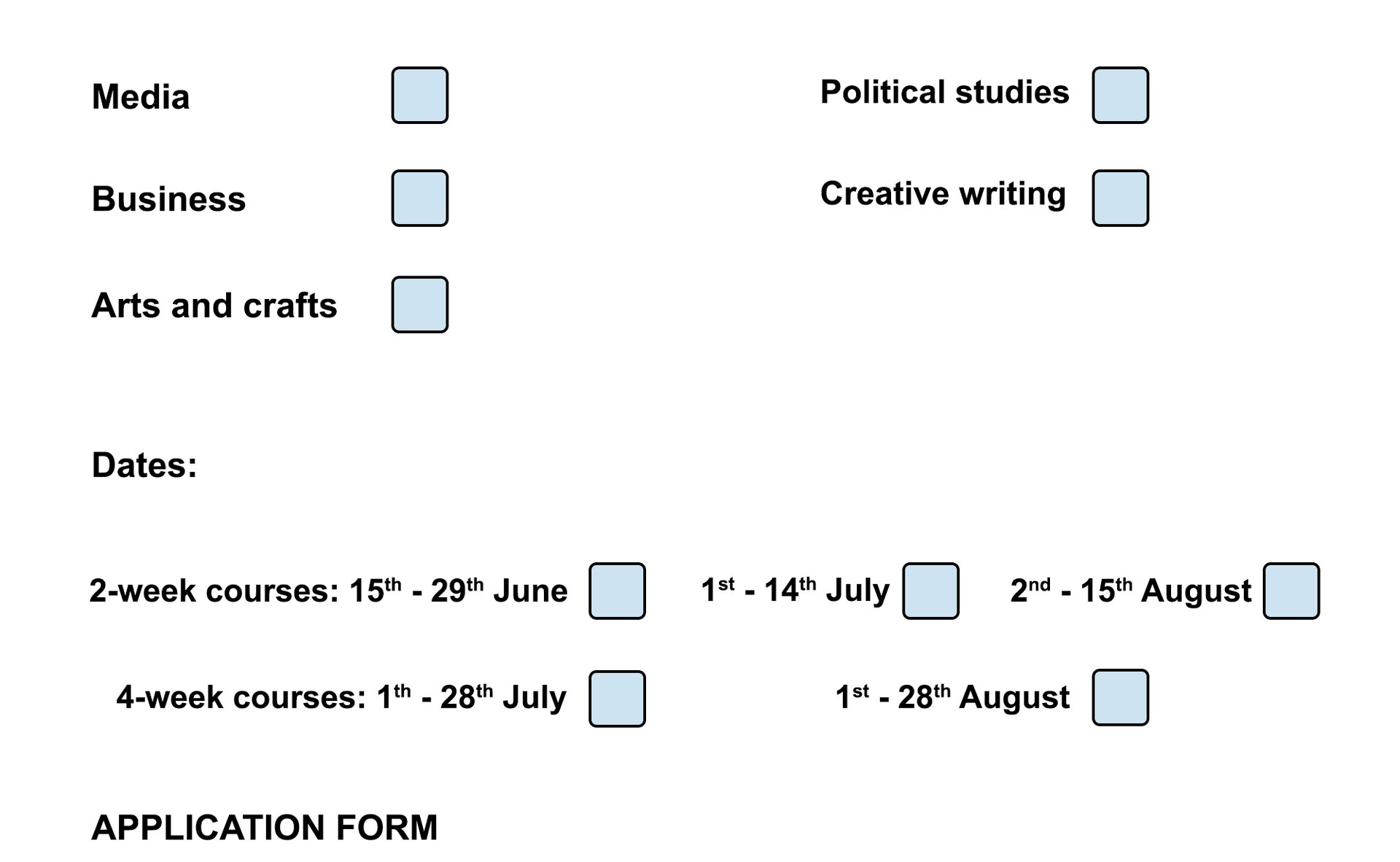
Available coursesavailable courses [available course]Available courses:
RX5u3m6T49gBt1
Grafika przedstawia fragment ankiety dla osób aplikujących na kursy letnie. Znajdują się na niej następujące informacje po angielsku:Media, Business, Arts and Crafts, Political Studies, Creative Writing, Dates, 2‑week courses 15th - 29th June, 1st‑14th July, 2nd‑15th August, 4‑week courses, 1st - 28 July, 1st‑28 August.Obok każdej informacji znajduje się miejsce, które można zaznaczyć.
Źródło: GroMar Sp. z o.o., licencja: CC BY-SA 3.0.
Kent Summer School 16
Deer Street
Dartford
DA1 1ET
Summer School Application Form
Student’s details
Last name: CORTEZ
First name: AMANDA
Middle namemiddle name Middle name (initialinitial [initials]initial): L
Address: 12th Street 37D, Bogota, Colombia, 110121
Email: m_oreiro@gmail.com
Phone: 57 253 984 7126
1 Źródło: Justyna Płachta, licencja: CC BY-SA 3.0.
Exercise2
Read the text and choose the correct answers. More than one answer may be correct in each point.
Przeczytaj tekst, a następnie wybierz właściwe odpowiedzi. W każdym pytaniu więcej niż jedna odpowiedź może być prawidłowa.
Rz1y3KrlHActK
1. The school offers courses: Możliwe odpowiedzi: 1. in business., 2. in arts and crafts., 3. in social studies., 4. in creative writing.
Źródło: GroMar Sp. z o.o., licencja: CC BY-SA 3.0.
RUwKaU6eqvkrg
2. It is possible to attend… Możliwe odpowiedzi: 1. a 4-week course starting in the first half of June., 2. a 2-week course starting in the second half of July., 3. a 2-week course beginning on the 2nd of August., 4. a 4-week course starting and ending in August.
Źródło: GroMar Sp. z o.o., licencja: CC BY-SA 3.0.
RWe3LWeIESBj6
3. Kent Summer School is: Możliwe odpowiedzi: 1. in Bogota., 2. in Dartford., 3. on Deer Street in Dartford., 4. on Dear Street in Bogota.
Źródło: GroMar Sp. z o.o., licencja: CC BY-SA 3.0.
Exercise3
Read the text. Drag and drop the words below to fill the blank spaces. There are two extra words you don’t need.
Przeczytaj tekst i uzupełnij luki. Przeciągnij podane wyrazy w odpowiednie miejsca. Dwa z podanych wyrazów nie będą ci potrzebne.
RhvTAzm00V1Sj
The text is an 3.1 1. first, 2. apply, 3. business, 4. media, 5. application, 6. Colombian, 7. summer, 8. mother form for a girl named Amanda. She wants to attend a 3.2 1. first, 2. apply, 3. business, 4. media, 5. application, 6. Colombian, 7. summer, 8. mother course at a school in Dartford. Amanda is 3.31. first, 2. apply, 3. business, 4. media, 5. application, 6. Colombian, 7. summer, 8. mother by birth and she lives with her 3.4 1. first, 2. apply, 3. business, 4. media, 5. application, 6. Colombian, 7. summer, 8. mother in Bogota. She would like to attend a course in 3.5 1. first, 2. apply, 3. business, 4. media, 5. application, 6. Colombian, 7. summer, 8. mother in the 3.6 1. first, 2. apply, 3. business, 4. media, 5. application, 6. Colombian, 7. summer, 8. mother half of July.
The text is an 3.1 1. first, 2. apply, 3. business, 4. media, 5. application, 6. Colombian, 7. summer, 8. mother form for a girl named Amanda. She wants to attend a 3.2 1. first, 2. apply, 3. business, 4. media, 5. application, 6. Colombian, 7. summer, 8. mother course at a school in Dartford. Amanda is 3.31. first, 2. apply, 3. business, 4. media, 5. application, 6. Colombian, 7. summer, 8. mother by birth and she lives with her 3.4 1. first, 2. apply, 3. business, 4. media, 5. application, 6. Colombian, 7. summer, 8. mother in Bogota. She would like to attend a course in 3.5 1. first, 2. apply, 3. business, 4. media, 5. application, 6. Colombian, 7. summer, 8. mother in the 3.6 1. first, 2. apply, 3. business, 4. media, 5. application, 6. Colombian, 7. summer, 8. mother half of July.
Źródło: GroMar Sp. z o.o., licencja: CC BY-SA 3.0.
Exercise4
Read the text again and then put the words in the correct order to make questions.
Przeczytaj tekst ponownie, a następnie ułóż wyrazy we właściwej kolejności, aby utworzyć pytania.
R1YrHpmJmo4hL
1. 1. last, 2. Amanda’s, 3. is, 4. name, 5. What 1. last, 2. Amanda’s, 3. is, 4. name, 5. What 1. last, 2. Amanda’s, 3. is, 4. name, 5. What 1. last, 2. Amanda’s, 3. is, 4. name, 5. What 1. last, 2. Amanda’s, 3. is, 4. name, 5. What ?
1. 1. last, 2. Amanda’s, 3. is, 4. name, 5. What 1. last, 2. Amanda’s, 3. is, 4. name, 5. What 1. last, 2. Amanda’s, 3. is, 4. name, 5. What 1. last, 2. Amanda’s, 3. is, 4. name, 5. What 1. last, 2. Amanda’s, 3. is, 4. name, 5. What ?
Źródło: GroMar Sp. z o.o., licencja: CC BY-SA 3.0.
RuUMxnUBmTNs9
2. 1. Amanda, 2. Where, 3. was, 4. born 1. Amanda, 2. Where, 3. was, 4. born 1. Amanda, 2. Where, 3. was, 4. born 1. Amanda, 2. Where, 3. was, 4. born ?
2. 1. Amanda, 2. Where, 3. was, 4. born 1. Amanda, 2. Where, 3. was, 4. born 1. Amanda, 2. Where, 3. was, 4. born 1. Amanda, 2. Where, 3. was, 4. born ?
Źródło: GroMar Sp. z o.o., licencja: CC BY-SA 3.0.
Źródło: GroMar Sp. z o.o., licencja: CC BY-SA 3.0.
1
GRAMATYKA
GRAMATYKA
Tworzenie pytań w czasie teraźniejszym
Pytania w czasie teraźniejszymPresent Simpletworzymy przy użyciu wyrazów pomocniczychdo (dla I/you/we/you/they) lubdoes (dla he/she/it) według wzoru:
Do + I/you/we/you/they + bezokolicznik + reszta zdania + znak zapytania
Does + he/she/it + bezokolicznik + reszta zdania + znak zapytania
Są to tzw. pytania ogólne.
Przykłady:
Do you like tea? – Czy lubisz herbatę?
Doesshe really live in London? – Czy ona naprawdę mieszka w Londynie?
Dothey have a dog? – Czy oni mają psa?
W czasiePresent Simplemożemy też zadawać pytania szczegółowe przy użyciu wyrazów pytających, takich jakwhat, which lub when. W takim przypadku stawiamy je na samym początku zdania.
Przykłady:
What books do you like reading? – Jakie książki lubisz czytać?
Which school does he attend? – Do jakiej szkoły on chodzi?
When do they finish classes on Mondays? – O której oni kończą lekcje w poniedziałki?
W pytaniach o podmiot (kto? co?) nie dodajemydo/does. Używamy za to czasownika z końcówką -(e)s.
Przykłady:
Who knows the answer? – Kto zna odpowiedź?
What causes the problem? – Co powoduje problem?
Pytania w czasie teraźniejszym możemy też zadawać przy pomocy czasownikato be. W takim przypadku zamieniamy miejscami osobę orazam/are/is.
Przykłady:
Are you certain? – Czy jesteś pewien/pewna?
Is she hungry? – Czy ona jest głodna?
Are they ever on time? – Czy oni kiedykolwiek są na czas?
Poniższe ćwiczenie pomoże w zapamiętaniu tych reguł:
1
Exercise5
Drag and drop the words to the correct places in the sentences below.
Przeciągnij wyrazy w odpowiednie luki w zdaniach.
RsmyZwIGfWaKT
What 1. Does, 2. Are, 3. does, 4. is, 5. Do, 6. do he want?
How 1. Does, 2. Are, 3. does, 4. is, 5. Do, 6. do you know?
1. Does, 2. Are, 3. does, 4. is, 5. Do, 6. do she attend summer school?
1. Does, 2. Are, 3. does, 4. is, 5. Do, 6. do they want another cup of tea?
1. Does, 2. Are, 3. does, 4. is, 5. Do, 6. do Tom and Sarah happy together?
Why 1. Does, 2. Are, 3. does, 4. is, 5. Do, 6. do he absent?
What 1. Does, 2. Are, 3. does, 4. is, 5. Do, 6. do he want?
How 1. Does, 2. Are, 3. does, 4. is, 5. Do, 6. do you know?
1. Does, 2. Are, 3. does, 4. is, 5. Do, 6. do she attend summer school?
1. Does, 2. Are, 3. does, 4. is, 5. Do, 6. do they want another cup of tea?
1. Does, 2. Are, 3. does, 4. is, 5. Do, 6. do Tom and Sarah happy together?
Why 1. Does, 2. Are, 3. does, 4. is, 5. Do, 6. do he absent?
Źródło: GroMar Sp. z o.o., licencja: CC BY-SA 3.0.
1
Pytania w czasie przeszłymPast Simpletworzymy przy użyciu wyrazu pomocniczegodidwedług wzoru:
Did + osoba + bezokolicznik + reszta zdania + znak zapytania
Są to tzw. pytania ogólne.
Przykłady:
Did you like the film? – Czy podobał ci się film?
Did she really say that? – Czy ona naprawdę to powiedziała?
Did they know the truth? – Czy oni znali prawdę?
W czasiePast Simplemożemy też zadawać pytania szczegółowe przy użyciu wyrazów pytających, takich jakwhat, which lub when. W takim przypadku stawiamy je na samym początku zdania.
Przykłady:
Where did you buy this dress? – Gdzie kupiłaś tę sukienkę?
What did he tell you about me? – Co on ci o mnie powiedział?
When did they finish classes yesterday? – O której oni skończyli wczoraj lekcje?
W pytaniach o podmiot (kto? co?) nie dodajemydid. Używamy za to czasownika z końcówką -edlub nieregularnego w drugiej formie.
Przykłady:
Who told you that? – Kto ci to powiedział?
What caused the problem? – Co spowodowało problem?
Pytania w czasie przeszłym możemy też zadawać przy pomocy czasownikato be (were/was). W takim przypadku zamieniamy miejscami osobę orazwere/was.
Were you home an hour ago? – Czy byłeś/byłaś w domu godzinę temu?
Was she very hungry? – Czy ona była bardzo głodna?
Wykonaj poniższe ćwiczenie, żeby lepiej zapamiętać zasady.
1
Exercise6
Type the missing words in the sentences below.
Wpisz brakujące wyrazy w luki.
R15DQC29VCRhz
What Tu uzupełnij they do?
Why Tu uzupełnij they here yesterday?
How Tu uzupełnij you solve the problem?
Why Tu uzupełnij she sad?
Tu uzupełnij they happy?
Tu uzupełnij they ask you any questions?
What Tu uzupełnij they do?
Why Tu uzupełnij they here yesterday?
How Tu uzupełnij you solve the problem?
Why Tu uzupełnij she sad?
Tu uzupełnij they happy?
Tu uzupełnij they ask you any questions?
Źródło: GroMar Sp. z o.o., licencja: CC BY-SA 3.0.