Przeczytaj
Everyone does something at home. Some of us empty the dishwasher while others water the plants. In this section, you’re going to read a text about Nick’s family and their housework.
Każdy z nas robi coś w domu. Jedni opróżniają zmywarkę, inni podlewają rośliny. W tej sekcji przeczytasz tekst o obowiązkach domowych rodziny Nicka.
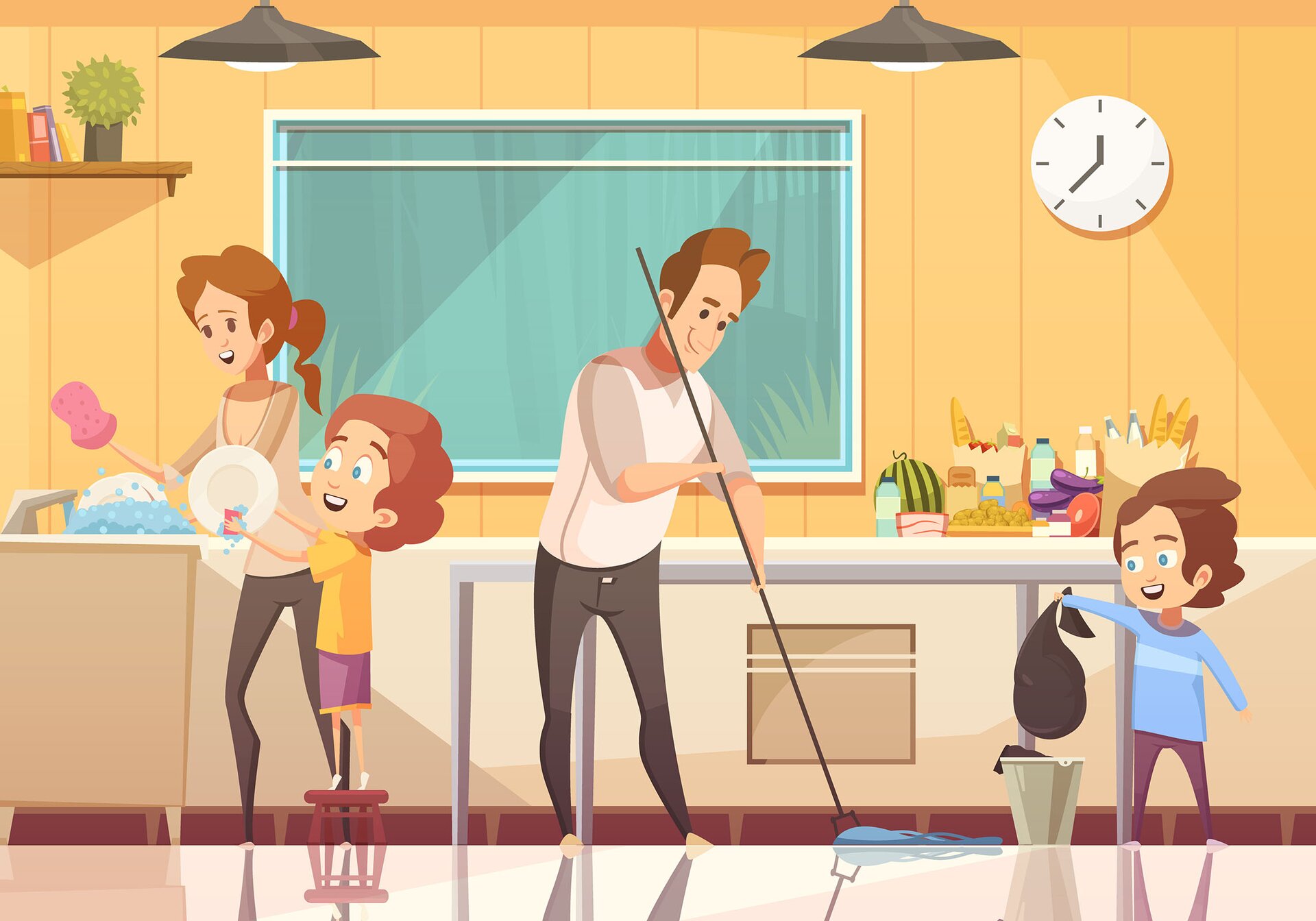
Match phrases with their definitions.
Połącz w pary wyrażenia z ich definicjami.
Read the text about housework and then do the exercises below.
Przeczytaj tekst o obowiązkach domowych, a następnie wykonaj poniższe ćwiczenia.
My Family's HouseworkMy family has got a housework schedulehousework schedule. We all do something different. I empty and load the dishwasherempty and load the dishwasher every day. I don’t like it, but there are worse kinds of houseworkhousework! For example, my brother, Jack, always does the dustingdoes the dusting on Wednesdays and Saturdays. My mum sometimes does the dusting too, but it doesn’t happen often. She usually does the washingdoes the washing and my dad hangs the washinghangs the washing outside. He mows the lawnmows the lawn, too. He does it every two weeks and our dogs hate it! My mum never mows the lawn, but she waters the plantswaters the plants in our garden every evening. I never water the plants - I hate it!
There is some housework we all do. For example, the whole family sweeps the floorssweeps the floors. My mum does it in the living room. My dad sweeps the floor in the kitchen. My brother and I sweep the rest of the house! Sometimes we scrub the floorscrub the floor, too. It happens when it’s very dirty. Sometimes my mum scrubs the bathtub and the sinks. We all work very hard to keep the house clean!
Nick
Źródło: Zuzanna Kościuk, licencja: CC BY-SA 3.0.
Read the text and choose the correct answer.
Po przeczytaniu tekstu wybierz prawidłowe odpowiedzi.
2. Mum does the dustingwashingmowing sometimes, but Jack does this housework regularly.
3. Dad hangs the washingwaters the plantsloads the dishwasher and mows the lawn.
4. The entire family sweepsscrubswaters the floors.
5. Nick hates to mow the lawnscrub the bathtubwater the plants and he never does it.
Search for the information in the text and decide if the following sentences are true or false.
Znajdź w tekście potrzebne informacje, a następnie zdecyduj, czy podane zdania są prawdziwe, czy fałszywe.
Based on the information from the text, drag the words given below to fill in the gaps.
Korzystając z informacji zawartych w tekście, przeciągnij podane wyrażenia w odpowiednie luki.
2. Jack always 1. waters the plants, 2. mows the lawn, 3. housework schedule, 4. does the dusting, 5. scrubs the floors.
3. Jack's mum 1. waters the plants, 2. mows the lawn, 3. housework schedule, 4. does the dusting, 5. scrubs the floors.
4. Jack's dad 1. waters the plants, 2. mows the lawn, 3. housework schedule, 4. does the dusting, 5. scrubs the floors every two weeks.
5. Jack's family sometimes 1. waters the plants, 2. mows the lawn, 3. housework schedule, 4. does the dusting, 5. scrubs the floors.
Gramatyka
Czasu Present Simple używamy, gdy mówimy o czynnościach, które się powtarzają lub wykonywane są regularnie. Ponadto używamy go do wyrażania różnych stanów tj. stanu naszej wiedzy (I know English), stanu uczuć (I love Jenny) oraz stanu posiadania (I have a new car).
I sweep the floor every day. - Każdego dnia zamiatam podłogę.
My mother does the washing on Mondays. - Moja mama robi pranie co poniedziałek.
Every Tuesday Martin mows the lawn. - Martin kosi trawę w każdy wtorek.
We do the dusting on Wednesdays. - Wycieramy kurze w środy.
Charakterystyczna końcówka dla czasu teraźniejszego Present Simple to: ‘-s’
Pojawia się ona w czasownikach w trzeciej osobie liczby pojedynczej, czyli he/she/it. Uwaga! Używaj jej tylko w zdaniach twierdzących!
Wyjątki:
Jeśli czasownik kończy się na ‘-ss’, ‘-sh’, ‘-x’, ‘-ch’, ‘-o’, dodajemy końcówkę ‘-es’ do czasownika w trzeciej osobie liczby pojedynczej.
np. fix – fixes, watch – watches
Jeśli czasownik kończy się na ‘-y’, końcówka ta zmienia się w ‘-ies’.
np. cry - cries
Jeżeli przed końcówką ’-y’ jest samogłoska (a, e, i, o, y, u), wówczas na końcu dodajemy końcówkę ‚-s’.
np. buy - buys
Warto też pamiętać, że z czasem Present Simple często występują niektóre przysłówki częstotliwości. Są to na przykład:
always - zawsze
often - często
sometimes - czasami
never - nigdy
every - każdego (np. każdego miesiąca lub każdego dnia tygodnia)
Przysłówki te stawiamy przed czasownikiem.
I always do my housework! - Zawsze wykonuję moje obowiązki domowe!
I often do the washing. - Często robię pranie.
I never make my bed. - Nigdy nie ścielę mojego łóżka.
UWAGA! Jeśli zdanie tworzymy z czasownikiem ‘być’, przysłówek stawiamy po nim.
I am never late. - Nigdy się nie spóźniam.
He is always tired after work. - Zawsze jest zmęczony po pracy.
Drag the words to fill in the gaps.
Przeciągnij poniższe wyrazy w odpowiednie luki.
2. My sister 1. know, 2. tidies, 3. scrub, 4. loves@@enjoys, 5. loves@@enjoys household chores.
3. They 1. know, 2. tidies, 3. scrub, 4. loves@@enjoys, 5. loves@@enjoys how to mow the lawn.
4. My brother 1. know, 2. tidies, 3. scrub, 4. loves@@enjoys, 5. loves@@enjoys his room every day.
5. My dad 1. know, 2. tidies, 3. scrub, 4. loves@@enjoys, 5. loves@@enjoys doing the dishes.
Słownik
/ dəz ðə ˈdʌstɪŋ / / du: ðə ˈdʌstɪŋ /
wyciera kurze [wycierać kurze]
/ dəz ðə ˈwɒʃɪŋ / / du: ðə ˈwɒʃɪŋ /
robi pranie [robić pranie]
/ ˌempti ðə ˈdɪʃwɒʃə /
opróżniać zmywarkę
/ hæŋz ðə ˈwɒʃɪŋ / / ˈhæŋ ðə ˈwɒʃɪŋ /
rozwiesza pranie [rozwieszać pranie]
/ ˈhaʊswɜːk /
obowiązek domowy
/ ˈhaʊswɜːk ˈskedʒʊl /
lista obowiązków domowych, harmonogram obowiązków domowych
/ ˈmeɪks ðə ˈbedz / / ˈmeɪk ðə bed /
ścieli łóżka [ścielić łóżko]
/ məʊz ðə lɔːn / / məʊ ðə lɔːn /
kosi trawnik [kosić trawnik]
/ ˈreɡjʊləli /
regularnie
/ skrʌb ðə flɔː /
szorować podłogę
/ swiːps ðə flɔː / / swiːp ðə flɔː /
zamiata podłogę [zamiatać podłogę]
/ ˈwɔːtəz ðə plɑːnts / / ˈwɔ:tə ðə plɑːnts /
podlewa rośliny [podlewać rośliny]
Źródło: GroMar Sp. z o.o., licencja: CC BY‑SA 3.0