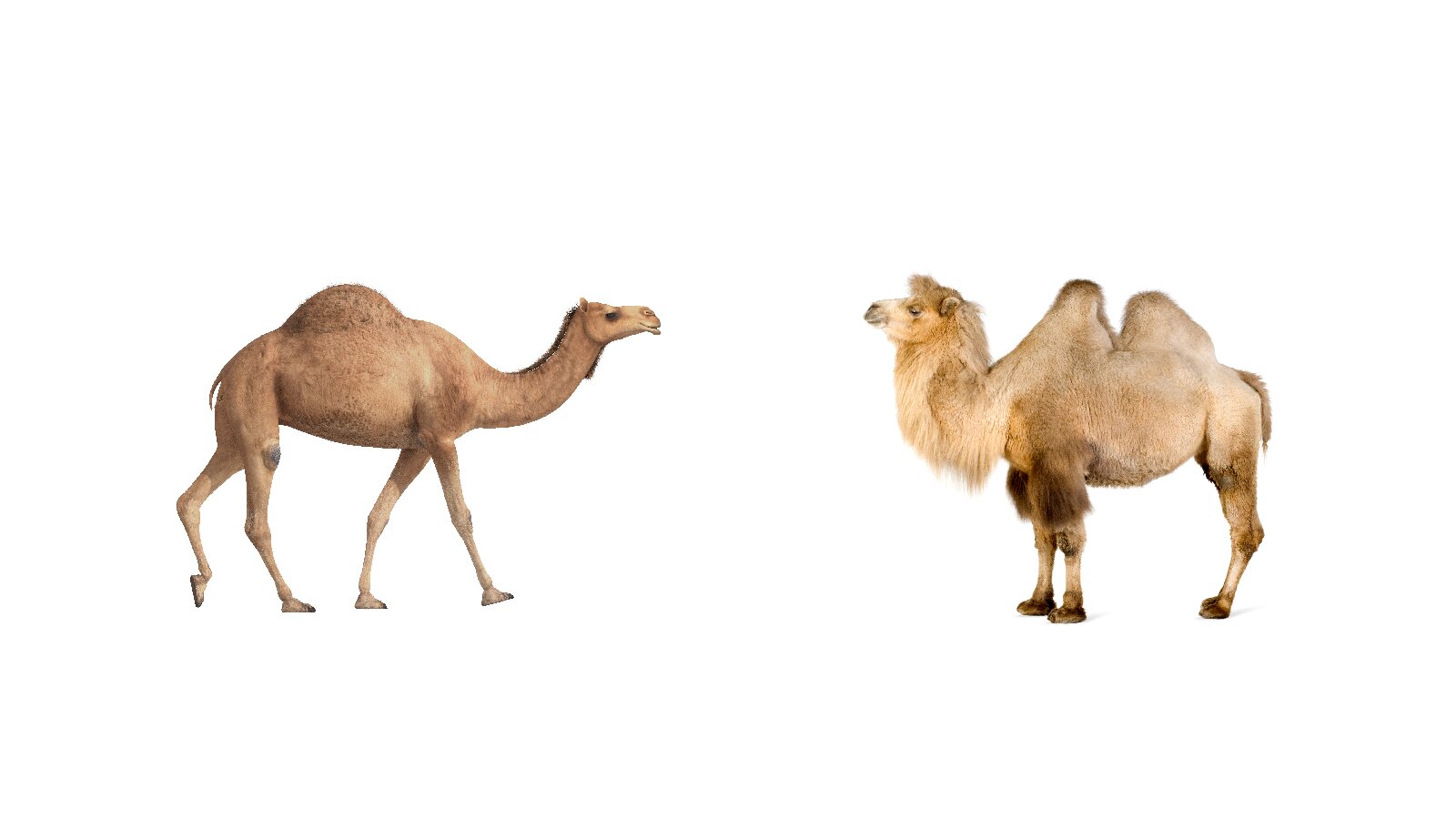
The picture below shows different camels - animals that live in the desert. You are going to read a text about life in the desert. Also, you are going to find out that in English there is very little difference between a desert and something sweet!
Zdjęcie przedstawia różne gatunki wielbłądów, zwierząt, które żyją na pustyni. Przeczytasz tekst o życiu na pustyni i dowiesz się, że w języku angielskim jest niewielka różnica między wyrazem oznaczającym pustynię, a określeniem na słodką przekąskę!
RCj2g0T9rdXtb
Ilustracja przedstawia dwa wielbłądy, stojące na przeciwko siebie. Wielbłąd z lewej strony obrazka ma jeden garb, a drugi, stojący z prawej strony, ma dwa garby.
One or two humps?
Jeden czy dwa garby?
Źródło: dostępny w internecie: https://www.freepik.com/ [dostęp 17.02.2022], domena publiczna.
Exercise1
Match the following words with their translations.
Źródło: GroMar Sp. z o.o., licencja: CC BY-SA 3.0.
Exercise1
Drag the expressions to match them with pictures.
Połącz poniższe wyrazy z odpowiednimi ilustracjami.
R3ggnxmaMnfRj
Ilustracja przedstawia cztery obrazki. Pierwszy od lewej dwugarbny wielbłąd, drugi to pustynia, trzeci ciastko deserowe i ostatni piasek.
Ilustracja przedstawia cztery obrazki. Pierwszy od lewej dwugarbny wielbłąd, drugi to pustynia, trzeci ciastko deserowe i ostatni piasek.
Źródło: GroMar Sp. z o.o., licencja: CC BY-SA 3.0.
Read the text below and do the exercises.
Przeczytaj poniższy tekst i wykonaj ćwiczenia.
Life in the Desert
AnnaLechLife in the Desert
Hello everybody!
It’s Natan again. Welcome back to my “Natan and Nature!” blog. Today I’d like to tell you about desertsdeserts [desert]deserts. But… before we start I have to warnwarnwarn you! Be careful about the spellingspellingspelling. A dry area with a lot of sandsandsand is a DESERT (with one letter 's'). A dessertdessertdessert (which you also say in a different way) is a sweet snack after dinner!
Now, let’s come back to the topictopictopic of today’s blog post. Deserts are the driest places on Earth. They get very little rain. In fact there may be lesslessless than 2.5 cm of rain a year. Can you imagine that? That is very, very little! The driest place on Earth is the Atacama Desert in Chile in South America. Sometimes the Atacama doesn’t get any rain for a fewa fewa few years!
Can any plants or animals live in these extremely dry places? Well, very fewvery fewvery few plants can growgrowgrow and survivesurvivesurvive there. They usually have very long rootsroots [root]roots to get to water deep underground and they can storestorestore water. A good example of such plants are cactusescactuses [cactus]cactuses. And the animals which can survive in the desert? Camelscamels [camel]Camels, of course!
There are two main types of camels: some have one humphumphump and some have two. Many people think that there is water in a camel’s hump. That is not true. Camels don’t carry water in their humps, they use them to store fatfatfat. It helps them go for days without any food or water. Camels also have long eyelasheseyelashes [eyelash]eyelashes. No, not in order to look cutecutecute. Eyelashes keep their eyes safe from sand. Camels’ feet have special “cushionscushions [cushion]cushions” to help them walk on extremely hot sand.
How about the temperatures in the desert? FewfewFew people know that deserts don’t have to be very hot places. In the Sahara, it’s very hot during the day and could be around 60°C, but at night the temperature may be as lowlowlow as 0°C.
You may be surprised, but apart fromapart fromapart from hot deserts such as the Sahara there are also cold deserts. These have hot summers but very cold winters. Just like hot deserts, cold deserts have very little rain or snow. One of the coldest deserts in the world is the Gobi Desert in Asia. In winter it may be as cold as –40°C!
I hope my blog helps you with your sciencesciencescience homework. Please remember these three things and you will surprise your classmates and your teacher!
Number one: deserts don’t have to be hot.
Number two: camels don’t carry water in their humps.
And finally, number three: spell desert with a singlesinglesingle “s” if you don’t want to talk about food in your science lesson!
Till next time!
Natan
1 Źródło: AnnaLech, licencja: CC BY-SA 3.0.
Exercise2
Read the sentences below and choose the correct answers.
Przeczytaj poniższe zdania i wybierz prawidłowe odpowiedzi.
R4AnxxcL3hIrn
A dessert is an extremely dry area a sweet snack.
Desert plants have long roots flowers.
Camels can store water fat.
In the Sahara, it’s hot cold at night.
The Gobi is a hot cold desert.
A dessert is an extremely dry area a sweet snack.
Desert plants have long roots flowers.
Camels can store water fat.
In the Sahara, it’s hot cold at night.
The Gobi is a hot cold desert.
Źródło: GroMar Sp. z o.o., licencja: CC BY-SA 3.0.
Exercise3
Drag the following phrases to make logical sentences.
Przeciągnij i upuść poniższe wyrażenia tak, żeby utworzyć logiczne zdania.
R6ByO1LRTft2a
Some deserts get Możliwe odpowiedzi: 1. 2 letters “s”., 2. -40°C., 3. 0°C., 4. 2.5 cm of rain a year., 5. 60°C during the day. In the Sahara, the temperatures may be around Możliwe odpowiedzi: 1. 2 letters “s”., 2. -40°C., 3. 0°C., 4. 2.5 cm of rain a year., 5. 60°C during the day. In some hot deserts, the temperatures at night may drop to Możliwe odpowiedzi: 1. 2 letters “s”., 2. -40°C., 3. 0°C., 4. 2.5 cm of rain a year., 5. 60°C during the day. In the Gobi Desert, the temperatures in winter are around Możliwe odpowiedzi: 1. 2 letters “s”., 2. -40°C., 3. 0°C., 4. 2.5 cm of rain a year., 5. 60°C during the day. If you mean a sweet snack you need to spell the word with Możliwe odpowiedzi: 1. 2 letters “s”., 2. -40°C., 3. 0°C., 4. 2.5 cm of rain a year., 5. 60°C during the day.
Some deserts get Możliwe odpowiedzi: 1. 2 letters “s”., 2. -40°C., 3. 0°C., 4. 2.5 cm of rain a year., 5. 60°C during the day. In the Sahara, the temperatures may be around Możliwe odpowiedzi: 1. 2 letters “s”., 2. -40°C., 3. 0°C., 4. 2.5 cm of rain a year., 5. 60°C during the day. In some hot deserts, the temperatures at night may drop to Możliwe odpowiedzi: 1. 2 letters “s”., 2. -40°C., 3. 0°C., 4. 2.5 cm of rain a year., 5. 60°C during the day. In the Gobi Desert, the temperatures in winter are around Możliwe odpowiedzi: 1. 2 letters “s”., 2. -40°C., 3. 0°C., 4. 2.5 cm of rain a year., 5. 60°C during the day. If you mean a sweet snack you need to spell the word with Możliwe odpowiedzi: 1. 2 letters “s”., 2. -40°C., 3. 0°C., 4. 2.5 cm of rain a year., 5. 60°C during the day.
Źródło: GroMar Sp. z o.o., licencja: CC BY-SA 3.0.
Exercise4
Answer the questions.
Odpowiedz pisemnie jednym lub dwoma zdaniami na każde z poniższych pytań.
How can plants survive in the desert?
What is special about camels' eyes?
RXVcC07bFvx6B
(Uzupełnij).
Źródło: GroMar Sp. z o.o., licencja: CC BY-SA 3.0.
Show hintazurewhite
1. Desert plants have long…
2. Camels have very long…
Show answerazurewhite
1. Desert plants have long roots.
2. Camels have very long eyelashes to protect their eyes from sand.
GRAMATYKA
Wyrażenialittle, a littleorazfewia few
Na pewno pamiętasz, że w języku angielskim występują rzeczowniki policzalne i niepoliczalne. Rzeczowniki policzalne to na przykład: book, camel, desert. Rzeczowniki niepoliczalne to rzeczy, których nie możemy policzyć – płyny, substancje sypkie, pojęcia abstrakcyjne, na przykład: water, sand, time, friendship.
Kiedy określamy przybliżoną liczbę w przypadku rzeczowników policzalnych, używamy wyrazówa few – „kilka” orazfew – „mało”, „niewiele”.
Przykłady:
I have a few plants in my room. – Mam w pokoju kilka roślin.
Few plants grow in deserts. – Niewiele roślin rośnie na pustyniach.
Kiedy określamy przybliżoną ilość w przypadku rzeczowników niepoliczalnych, używamy wyrazówa little – „trochę” orazlittle – „mało”, „niewiele”.
Przykłady:
There is a little water in the bottle. – W butelce jest trochę wody.
There is very little water in the desert. – Na pustyni jest bardzo mało wody.
Zwróć uwagę, że wyrazylittleorazfew zazwyczaj informują nas, że czegoś jest za mało.
Przykłady:
She has few friends, and she is lonely. – Ona ma niewielu (za mało) przyjaciół i jest samotna.
We have little time, so we will not finish the task. – Mamy niewiele (za mało) czasu, więc nie skończymy zadania.
Pamiętaj, że wyrazylittleifewmożemy przetłumaczyć na język polski jako „mało” i „niewiele”. Wyrazlittlestosujemy tylko w odniesieniu do rzeczowników niepoliczalnych, natomiastfewużywamy tylko przy rzeczownikach policzalnych.
Exercise5
Choose the correct answer.
Wybierz prawidłową odpowiedź.
R1JzEhE0DIM1u
Źródło: GroMar Sp. z o.o., licencja: CC BY-SA 3.0.
Exercise5
Choose the correct image.
Przeczytaj poniższe zdania i wybierz właściwą ilustrację do każdego ze zdań.
RFZUYSYzjL113
1. There is a little water in the glass.
1. There is a little water in the glass.
Źródło: GroMar Sp. z o.o., licencja: CC BY-SA 3.0.
R1WAafJpMr5in
2. There are a few students in the classroom.
2. There are a few students in the classroom.
Źródło: GroMar Sp. z o.o., licencja: CC BY-SA 3.0.
Rt89pJViUWGmn
3. I have little money.
3. I have little money.
Źródło: GroMar Sp. z o.o., licencja: CC BY-SA 3.0.
R1dUTJkzKBvhg
4. We had a little rain yesterday.
4. We had a little rain yesterday.
Źródło: GroMar Sp. z o.o., licencja: CC BY-SA 3.0.
R1MqOl6y3Z20g
5. There are few apples in the basket.
5. There are few apples in the basket.
Źródło: GroMar Sp. z o.o., licencja: CC BY-SA 3.0.
Exercise6
Complete the sentences with a little / little / few / a few.
Uzupełnij luki wyrazami a little / little / few / a few.
R1dK9EyZFxLrY
Camels can walk for Tu uzupełnij days without any food or water. There are Tu uzupełnij camels that still live in the wild. We need to go shopping because there is Tu uzupełnij food left. I have Tu uzupełnij free time this Saturday. Why don’t you come and see me? I’m very busy because I’m studying for my exams. I have Tu uzupełnij free time.
Camels can walk for Tu uzupełnij days without any food or water. There are Tu uzupełnij camels that still live in the wild. We need to go shopping because there is Tu uzupełnij food left. I have Tu uzupełnij free time this Saturday. Why don’t you come and see me? I’m very busy because I’m studying for my exams. I have Tu uzupełnij free time.
Źródło: GroMar Sp. z o.o., licencja: CC BY-SA 3.0.