Przeczytaj
The picture below shows two different flats for rent. Which one would you choose to move into? Why? You are going to read a text which explains a few important issues related to renting a property, which might seem a bit complicated at a glance.
Na poniższym zdjęciu przedstawiono dwa różne mieszkania do wynajęcia. Do którego z nich wolałbyś/wolałabyś się wprowadzić? Dlaczego? Przeczytasz tekst objaśniający kilka ważnych kwestii związanych z wynajmem nieruchomości, które na pierwszy rzut oka mogą wydawać się nieco skomplikowane.
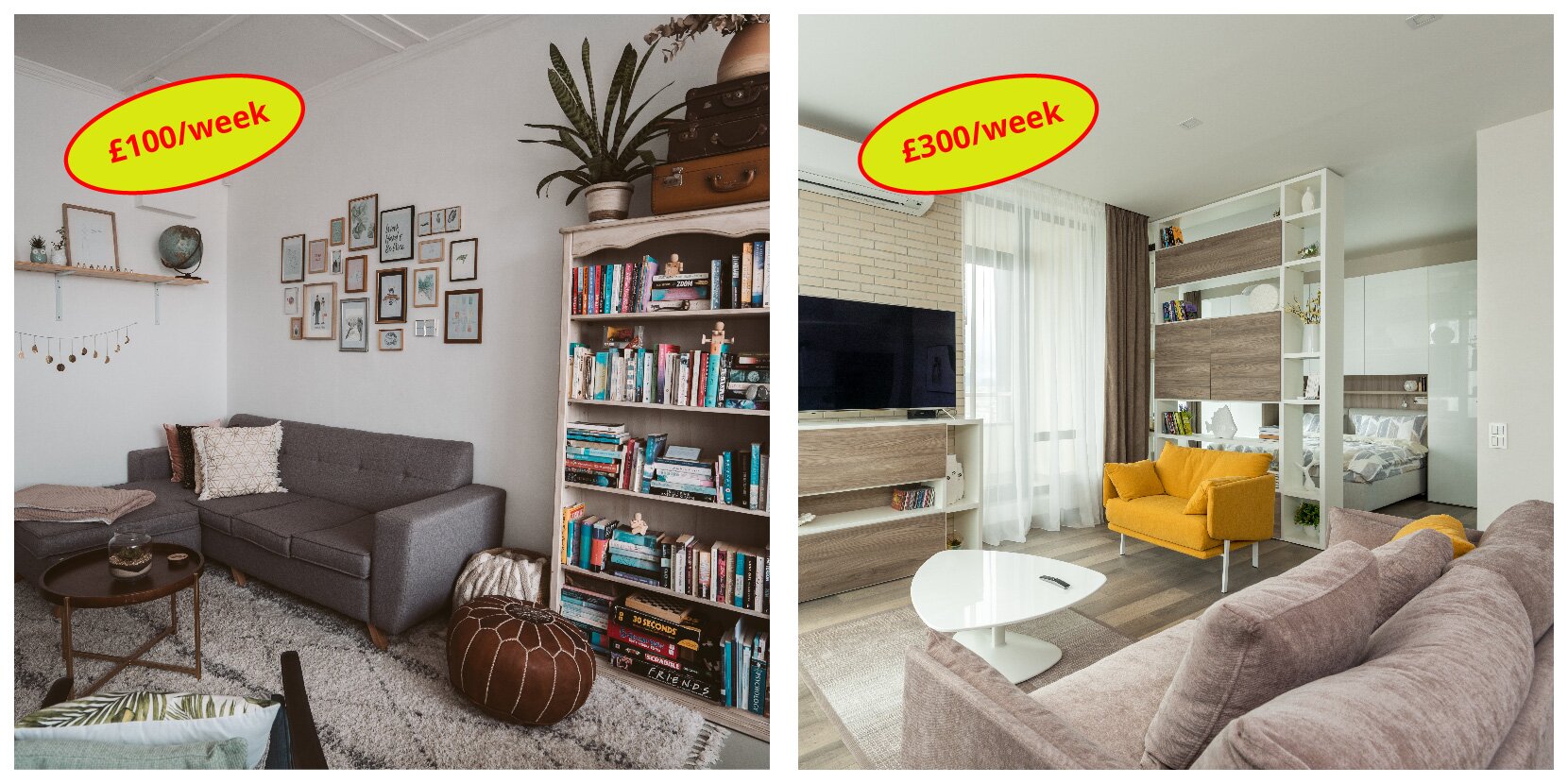
Read the text and do the exercises below.
Home Sweet (Rented) HomeMost people today live in a house or flat, but have you ever thought of who owns it? If you live with your parents, there is a likely chance they will own the home you live in and pay a monthly fee to the bank, which is known as a mortgagemortgage, as well as council taxcouncil tax, which is paid to the government.
What about those people who cannot afford to buy their own home? Where do they live? Most of these people will rentrent a house, flat, or apartment. This means they have a landlordlandlord who owns the propertyproperty they live in, and instead of paying a monthly mortgage, they pay a monthly billbill, known as rentrent. This monthly bill to the landlord should often cover the home itself, but also any needed repairsrepairs.
When renting a property, people will sign a tenancy agreementtenancy agreement, which is basically the terms and conditionsterms and conditions of the arrangement, deciding how much the tenanttenant will pay monthly. It is also very common for the landlord to ask for a depositdeposit in advance. This is usually an extra payment of no more than 5 weeks' rent. The purpose of the depisit is to make sure that the tenant will stick to the terms and conditions included in the tenancy agreement. If a tenant is unable to pay the rent, and they fall behind with paymentsfall behind with payments, the landlord may serve an eviction noticeeviction notice. After the landlord has given noticegiven notice, the tenant must move out of the property within the given time period.
Most people today will rent early in their lives, while saving money to put down a depositput down a deposit on buying a house. Such deposits are usually much more expensive, and often go through real estate agentsreal estate agents. These are people who can help you find your perfect home, or the perfect piece of real estatereal estate to build your house on.
So, to rent or to buy your sweet home? It is important to consider all positive and negative aspects before making a decision.
Źródło: Anna Caruk, licencja: CC BY-SA 3.0.
- If you own a flat or house, you need to pay
a) rent.
b) mortgage.
c) council tax.
- A landlord is a person who
a)is a real estate agent.
b) owns a property.
c) pays rent.
- A tenant is a person who
a) lives in a place and pays a rent.
b) helps people to find a flat / house.
c) can serve an eviction notice.
- To fall behind with payment means to
a) pay a rent far too late.
b) always pay the rent on time.
c) pay in advance.
- You can get an eviction notice when
a) you buy your own flat / house.
b) you are a landlord.
c) you stop paying rent.
- Real estate means
a) real conditions.
b) a room.
c) land and / or buildings.
- A tenancy agreement is likely to include:
a) your monthly rent.
b) the address of the local tax office.
c) your monthly mortgage.
- An extra payment a landlord usually asks is called:
a) a bill.
b) an extra rent.
c) a deposit.
GRAMATYKA
Reporting verbs – suggest, recommend, insist, demand
Powyższe czasowniki łączy jedna bardzo ważna cecha. Wszystkie niejako dyktują zasady dotyczące tego, co następuje po nich w zdaniu (w sensie gramatycznym). Tych wzorów warto się nauczyć, by poprawnie wyrażać sugestie, rekomendacje, nacisk oraz żądania w języku angielskim.
a) suggest (sugerować):
1. suggest + noun phrase
Could you suggest a good restaurant near here? – Czy możesz polecić jakąś dobrą restaurację w pobliżu?
2. suggest + that + somebody does/ should do something
She suggests (that) we (should) leave before midnight. – Ona sugeruje, że powinniśmy wyjść przed północą.
3. suggest + ‘-ing’ form
They suggested going to the cinema as a form of entertainment tonight. – Oni zaproponowali wyjście do kina jako formę rozrywki na dzisiejszy wieczór.
4. suggest + wh- question word
Tom, can you suggest where I can leave my luggage, please? – Tom, czy możesz mi doradzić, gdzie mogę zostawić swój bagaż?
2. Anna 1. solution, 2. suggesting, 3. that, 4. suggested, 5. should, 6. that I, 7. suggest, 8. we, 9. going 1. solution, 2. suggesting, 3. that, 4. suggested, 5. should, 6. that I, 7. suggest, 8. we, 9. going to the cinema in the evening. What do you think?
3. Can you 1. solution, 2. suggesting, 3. that, 4. suggested, 5. should, 6. that I, 7. suggest, 8. we, 9. going any 1. solution, 2. suggesting, 3. that, 4. suggested, 5. should, 6. that I, 7. suggest, 8. we, 9. going to the problem? I can’t figure it out.
4. Maya entered the room and suggested 1. solution, 2. suggesting, 3. that, 4. suggested, 5. should, 6. that I, 7. suggest, 8. we, 9. going 1. solution, 2. suggesting, 3. that, 4. suggested, 5. should, 6. that I, 7. suggest, 8. we, 9. going close the windows. It was quite cold in the room.
b) recommend (polecać):
1. recommend + that + somebody does/ should do something
My mother recommends that I (should) study harder if I want to get into a good university. – Moja mama zaleca, żebym uczyła się pilniej, jeśli chcę się dostać na dobry uniwersytet.
2. recommend + something (to someone)
Could you recommend an interesting place to visit in your town? – Czy możesz polecić jakieś interesujące miejsce do odwiedzenia w twoim mieście?
3. recommend + ‘-ing’ form
May I recommend eating dinner together tomorrow? - Czy mogę polecić wspólne zjedzenie kolacji jutro?
Study the sentences and choose the correct ones. There is more than one correct answer.
c) insist (naciskać/nalegać):
1. insist + on + (possessive pronoun/noun in the possessive form/ or personal pronoun (informal)) + doing something
He insisted on my going to the cinema with him. – On naciskał, żebym poszła z nim do kina.
He insisted on Jane’s going to the cinema with him. – On naciskał, żeby Jane poszła z nim do kina.
2. insist + that‑clause
He insisted that it wasn’t his fault. – On upierał się, że to nie była jego wina.
3. insist (that) somebody does/should do something
Mark and Sally insist that we (should) pay for the damage our son has caused in their house. – Mark i Sally naciskają, żebyśmy zapłacili za szkody, jakie nasz syn wyrządził w ich domu.
d) demand (żądać):
1. demand to do something
I demand to see him now! – Żądam, bym mógł/mogła się z nim zobaczyć w tej chwili!
2. demand + that + somebody does/should do something
She demands that he should quit the job. – Ona żąda/wymaga, by on zrezygnował z tej pracy.
3. demand + a noun phrase
We demand a fair trial! – Żądamy sprawiedliwego procesu!
Study the situations below and match them with the correct sentences.
- He recommended … at the new restaurant. It’s called Tuxo.
a) ate
b) eat
c) eating
- She insisted … me going to the cinema with her tonight but I refused.
a) about
b) on
c) with
- Could you suggest … I can park my car near here?
a) where
b) if
c) unless
- He demanded ... see the doctor immediately! He was shouting.
a) to see
b) seeing
c) saw
- Well, young man, I suggest you… your mother with more respect.
a) to treat
b) to be treating
c) treat
- They insisted … it wasn’t them who did it.
a) about
b) saying
c) that
Słownik
/bɪl/
rachunek (a piece of paper with a request for payment for something)
/ˈkaʊns(ə)l tæks/
podatek lokalny (an amount of money that people in the UK pay, which is used for public services such as collecting rubbish, repairing roads, etc.)
/dɪˈpɒzɪt/
zaliczka, kaucja (an amount of money which you pay when you rent something which is returned to you when you stop renting it; an amount of money paid as a first part of the amount you have to pay)
/i(ː)ˈvɪkʃən ˈnəʊtɪs/
nakaz eksmisji (a written document which orders a tenant to move out of a property)
/fɔːl bɪˈhaɪnd wɪð ˈpeɪmənt rɛnt/
spóźniać się z opłatą, spóźniać się z czynszem (to not pay your rent on time)
/gɪv ˈnəʊtɪs/
wypowiadać, zawiadamiać (to inform somebody in a written form that you want to finish cooperating with them, for example you want to stop renting a flat from/to them)
/ˈlændlɔːd/
gospodarz, właściciel wynajmowanego mieszkania/domu (an owner of a property)
/ˈmɔːɡɪdʒ/
kredyt hipoteczny (a loan given by banks to people who want to buy their own flat or house)
/ˈprɒpəti/
posiadłość, nieruchomość (a building or area of land)
/pʊt daʊn ə dɪˈpɒzɪt/
wpłacać zaliczkę (to pay the first part of the amount of money you have to pay for something)
/ˈriːəl ɪsteɪt/
nieruchomość (property in a form of buildings or land)
/ˈriːəl ɪsteɪt eɪdʒənt/
agent/agentka nieruchomości (a person whose job is to help people buy, sell, and rent property)
/rent/
czynsz (an amount of money a tenant pays a landlord for being able to live in his property)
/rent/
wynajmować (to let somebody live in your property and earn money for that)
/rɪˈpeəz/ /rɪˈpeə/
naprawy [naprawa] (fixing something that has been broken)
/ˈtɛnənsi əˈgriːmənt/
umowa najmu (a written document which lists terms and conditions that tenants and landlords agree to obey)
/ˈtenənt/
lokator/lokatorka, najemca/najemczyni (a person who rents a flat or a house from somebody)
/tɜːmz ənd kənˈdɪʃənz/
regulamin (a list of rules that sides of the contract promise to obey)