Przeczytaj
Sociologists, anthropologists and political scientists have been studying multiculturalism for many decades. They have come up with different theories describing the extent to which societies consisting of diverse nationalities, ethical and religious groups can integrate and merge into a uniform group. Better understanding is essential to live peacefully alongside each other and draw on each other’s experience, so let’s make sure we never stop exploring other cultures!
Naukowcy i naukowczynie z takich dziedzin jak socjologia, antropologia czy nauki polityczne od dziesięcioleci badają różne aspekty wielokulturowości. Stopień, do którego ludzie odmiennych narodowości czy pochodzący z różnych etnicznie i religijnie społeczeństw mogą się zintegrować został opisany za pomocą kilku teorii. Lepsze zrozumienie siebie nawzajem jest podstawą stworzenia społeczeństwa złożonego z różnych mniejszości, które są w stanie pokojowo współistnieć i czerpać ze swoich doświadczeń.
- This manual was supposed to be simple but, honestly, I’ve read it three times and it’s still all Tu uzupełnij to me!
- I said the meal was on me, but he insisted on going Tu uzupełnij, so I decided not to argue and we split the bill 50/50.
- They took Tu uzupełnij leave. I didn’t expect them to disappear without even saying goodbye.
- X: What did you say?
- Y: Pardon my Tu uzupełnij, but what else can you say to describe this ridiculous situation?!
- We didn’t expect Tu uzupełnij summer this year. The forecast was for a cold and wet autumn so it’s a really nice surprise to have this sunny spell.
Read the text about multiculturalism and then do the exercises below.
The More the MerrierMulticulturalism is not a new addition to our societies. It might have accelerated with globalisation and the increased mobilityincreased mobility, but people have lived in communities comprising of representatives of different ethical, religious, racial and cultural groups for centuries. What is new, however, is the belief that all these minority groupsminority groups can contribute to the creation of a pluralistic societypluralistic society. It is also strongly believed that their contributions should be acknowledged and they should be given equal treatmentequal treatment within the dominant culturedominant culture.
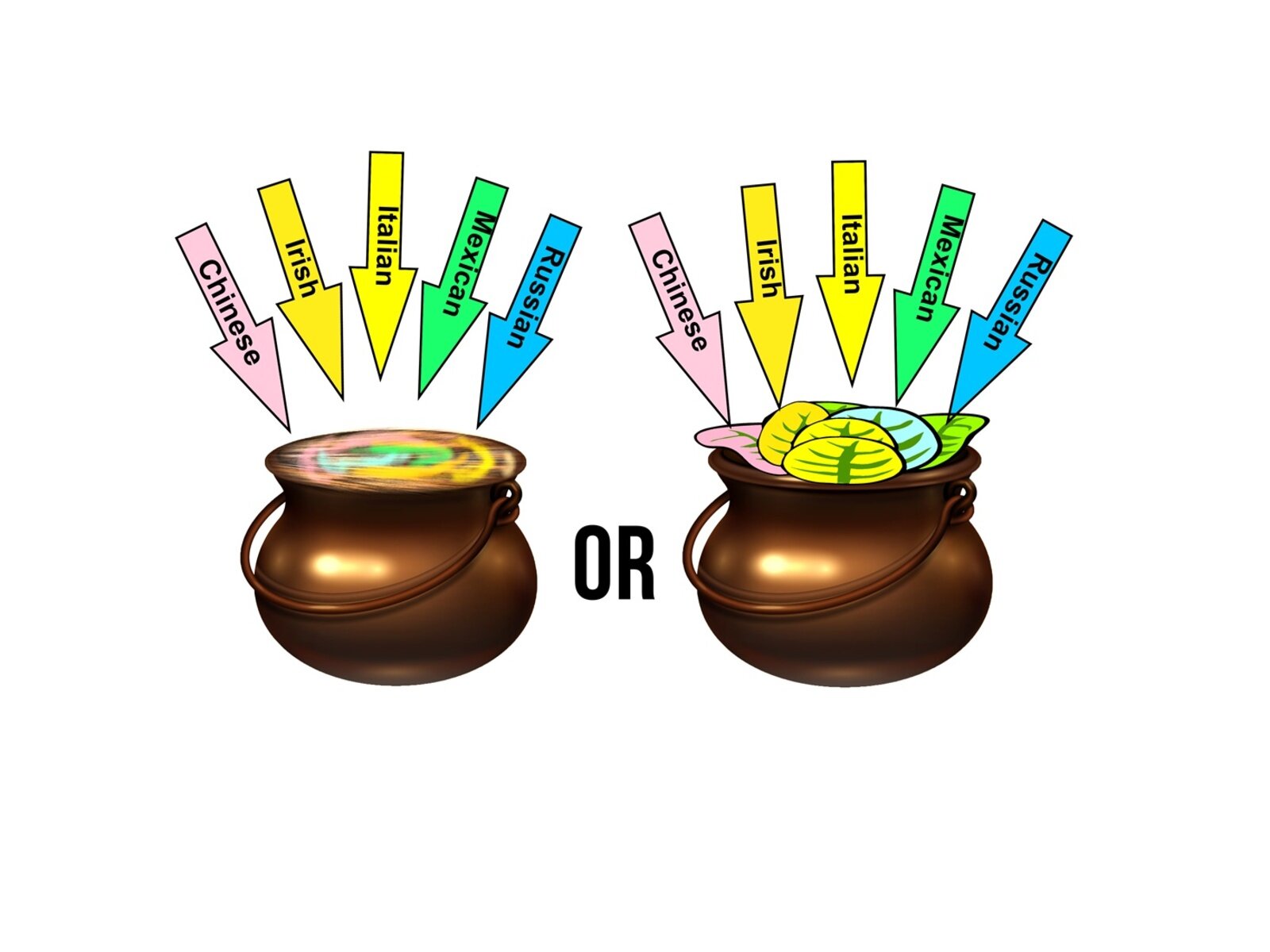
In social sciences, there are a few approaches to multiculturalism and the interactions between the groups which contribute to the creation of cultural diversitycultural diversity. According to one of them, a multicultural society resembles a melting pot.melting pot. This metaphor illustrates the creation of a new homogenous societyhomogenous society in the process of melting and mixing the qualities of all the groups which entered into an interaction with each other. In other words, ethnic and cultural groups give up their individual traitsindividual traits in order to become a part of an unified body. Although some findings suggest that the term melting pot has been used since the 18th century, it gained momentumgained momentum after the publication of The Melting Pot by Israel Zangwill in 1908. It was a play which depicted the United States as a new Promised LandPromised Land in which the Irish, German, Russian and all other nations become a brand newbrand new society that lives in peace despite its cultural diversity.
Another concept of a multicultural society is dubbeddubbed a salad bowlsalad bowl and makes allowances formakes allowances for the fact that it’s rather unlikely for nations which decide or are forced to live with each other, to sacrifice their individual characteristics. Unlike the melting pot theory, a salad bowl one is based on the premisepremise that different cultures can coexist alongside each othercoexist alongside each other while maintaining their unique qualitiesmaintaining their unique qualities. Members of a salad bowl type of society are not expected to abandon their cultural heritagecultural heritage in order to be considered fully‑functioning members of the target society.
No matter which model of a multicultural society we discuss, each of them has got its advantages and challenges. To start on a positive note, multicultural societies teach tolerance and acceptance. Although modern states are usually organised around the dominant culture, cultural diversity, if understood as a chance to enrichenrich the lives of citizens, can be a fantastic laboratory of inclusioninclusion. From things as simple as diverse cuisinescuisines, to broadening our perspective on how other people see and understand the reality around us. Living alongside each other gives us a chance to learn and exercise our reactions to one another, which can later benefit us in business or educational situations.
Multiculturalism is not without its challenges, and they are mostly of systemic naturesystemic nature. If we assume that all cultures participating in the creation of a new society should be given equal rights and treatment, it raises questions about, for example, days off work given to people celebrating holidays connected with their cultures and religions. Another problem is connected with education. If we were to do justice to all cultures contributing to the creation of societies in Europe or the United States, the curriculacurricula in those places would have to be heavily revised. For decades, they have prioritised the Western literary canon and rarely have presented students with examples originating from a different cultural circle.
Citizens, public administrators and political leaders have to face up the challenge of balancing the acknowledgement of minority groups and the interests of the whole society. It’s not an easy task, but definitely worth undertaking. The increased recognition and participation of diverse groups can benefit everyone on condition it is done with respect and full comprehension of various aspects of this phenomenon.
Źródło: Anna Posyniak-Dutka, licencja: CC BY-SA 3.0.
Study the idioms in the warm‑up section again and answer the questions in 1‑2 sentences each.
Is it a good idea to go Dutch on a date?
Which school subject is all Greek to you?
What’s wrong with taking French leave?
How do you like to spend your Indian summer?
If you say “Pardon my French”, does it make the use of a swear word any more justifiable?
Słownik
/ ˌæbəˈrɪdʒn̩əl /
rodowity/rodowita, rdzenny/rdzenna (a member of a race of people who were the first people to live in a country, before any colonists arrived)
/ ˌæbəˈrɪdʒn̩əl /
Aborygen/Aborygenka, aborygeński (a word for a member of one of the groups of people who were the first people to live in Australia)
/ ˈænsestəz / / ˈænsestə /
przodkowie [przodek] (a person related to you who lived a long time ago)
/ bɪˈspəʊk /
na miarę, na zamówienie (specially made for a particular person, organization, or purpose)
/ bɜ:theta reɪt /
współczynnik dzietności (a measure of how many children are born during a period of time in a particular place)
/ ˌbræn ˈnju: /
zupełnie nowy/nowa (completely new)
/ ˈkeɪv ˈpeɪntɪŋz / / ˈkeɪv ˈpeɪntɪŋ /
malowidła jaskiniowe [malarstwo jaskiniowe] (prehistoric paintings found on the walls in caves around the world)
/ ˌkəʊɪɡˈzɪst əˌlɒŋˈsaɪd iːtʃ ˈʌðə /
żyć obok siebie (to live together in peace)
/ ˌkwɪˈziːnz / / kwɪˈziːn /
kuchnie [kuchnia] (a style of cooking)
/ ˈkʌltʃərəl daɪˈvɜːsɪti /
różnorodność kulturowa (the existence of a variety of cultural or ethnic groups within a society)
/ ˈkʌltʃərəl ˈherɪtɪdʒ /
dziedzictwo kulturowe (an expression of the ways of living developed by a community and passed on from generation to generation)
/ kəˈrɪkjʊlə / / kəˈrɪkjʊləm /
programy nauczania [program nauczania] (the subjects studied in a school, college, etc. and what each subject includes)
/ ˈdesɪmeɪtɪd / / ˈdesɪmeɪt /
zdziesiątkowani [zdziesiątkować] (to kill a large number of something, or to reduce something severely)
/ dɪsˈpleɪst / / dɪsˈpleɪs /
wysiedleni [wysiedlić] (to force someone to leave their home)
/ ˈdɒmɪnənt ˈkʌltʃə /
kultura dominująca (a cultural practice that is dominant within a particular political, social or economic entity, in which multiple cultures co‑exist)
/ dʌbd / / dʌb /
nazwany/nazwana [nazwać] (to give something or someone a particular name)
/ ɪnˈrɪtʃ /
wzbogacić (to improve the quality of something by adding something else)
/ ˈiːkwəl ˈtriːtmənt /
równe traktowanie (the principle of equal treatment establishes that all people have the right to receive the same treatment and not to be discriminated against on the basis of criteria such as age, disability, nationality, race and religion)
/ ˈfɔːfɑːðəz / / ˈfɔːfɑːðə /
przodkowie [przodek] (someone's relative who lived a long time ago)
/ ˈfɒstə ˌɪntɪˈɡreɪʃn̩ /
wspierać integrację (support integration)
/ ɡeɪnd məˈmentəm / / ɡeɪn məˈmentəm /
nabrał/nabrała rozpędu [nabrać rozpędu] (to keep developing or happening more quickly and becoming less likely to stop)
/ həˈmɑːdʒənəs səˈsaɪəti /
jednorodne społeczeństwo (a society consisting of people that are similar to each other)
/ ɪn ˌhaɪ dɪˈmɑːnd /
tu: jest (na to) wysokie zapotrzebowanie (sought after)
/ ɪnˈkluːʒn̩ /
włączenie (the idea that everyone should be able to use the same facilities, take part in the same activities, and enjoy the same experiences)
/ ɪnˈkriːst məʊˈbɪlɪti /
zwiększona mobilność (better mobility)
/ ˌɪndɪˈvɪdʒʊəl treɪts / / ˌɪndɪˈvɪdʒʊəl treɪt /
cechy indywidualne [cecha indywidualna] (a personality characteristic that has met three criteria: it must be consistent, stable, and vary from person to person)
/ meɪnˈteɪnɪŋ ðeə juːˈniːk ˈkwɒlɪtɪz / / meɪnˈteɪnɪŋ ðeə juːˈniːk ˈkwɒlɪti /
zachowując niepowtarzalne cechy [zachować niepowtarzalną cechę] (continuing to have unique qualities)
/ ˈmeɪks əˈlaʊənsɪz fɔː / / ˈmeɪk əˈlaʊənsɪz fɔː /
uwzględnia [uwzględniać] (to prepare for the possibility of)
/ ˈmeltɪŋ ˈpɒt /
tygiel (naczynie z materiału ogniotrwałego lub miejsce, w którym mieszają się różne wpływy, narodowości, wyznania) (a place where many different people and ideas exist together, often mixing and producing something new)
/ maɪˈnɒrɪti ɡruːps / / maɪˈnɒrɪti ɡruːp /
mniejszości [mniejszość] (any small group in society that is different from the rest because of their race, religion or political beliefs)
/ ˈplʊərəlɪst səˈsaɪəti /
pluralistyczne społeczeństwo (a society in which many different groups and political parties are allowed to exist)
/ ˈpremɪs /
założenie (an idea or theory on which a statement or action is based)
/ ˈprɒmɪst lænd /
ziemia obiecana (a place where someone will be happy and successful)
/ ˌræmɪfɪˈkeɪʃn̩z / / ˌræmɪfɪˈkeɪʃn̩ /
konsekwencje [konsekwencja] (the possible results of an action)
/ rɪˈpleɪsmənt reɪt /
współczynnik zastępowalności (the number of children that a couple would have to have over the course of their reproductive years in order to replace themselves)
/ ˈsæləd bəʊl /
miska sałatkowa (a metaphor for the way a multicultural society can integrate different cultures while maintaining their separate identities)
/ sɪˈstemɪk ˈneɪtʃə /
natury systemowej [natura systemowa] (relating to the whole system)
/ ˈtrɪpl̩d / / ˈtrɪpl̩ /
potroiła się [potroić się] (happening three times)
/ ˌʌndəˈteɪk ðə tɑːsk /
podjąć się zadania (to do or begin to do something, especially something that will take a long time or be difficult)
Źródło: GroMar Sp. z o.o., licencja: CC BY‑SA 3.0