Przeczytaj
In this section of the material, you’re going to read a text about different character types. Each one of us has an idea of what type of personality they have. We even assign personalities to animals. Look at the animals below - what personalities would you say they have? Would you identify with any of them?
W tej części materiału przeczytasz tekst o różnych typach charakterów. Każdy z nas ma swoje wyobrażenie na temat typu osobowości, którą posiada. Przypisujemy nawet osobowości zwierzętom. Spójrz na poniższe zwierzęta - jakie cechy osobowości byś im przypisał/przypisała? Czy identyfikowałbyś/identyfikowałabyś się z którymś z nich?
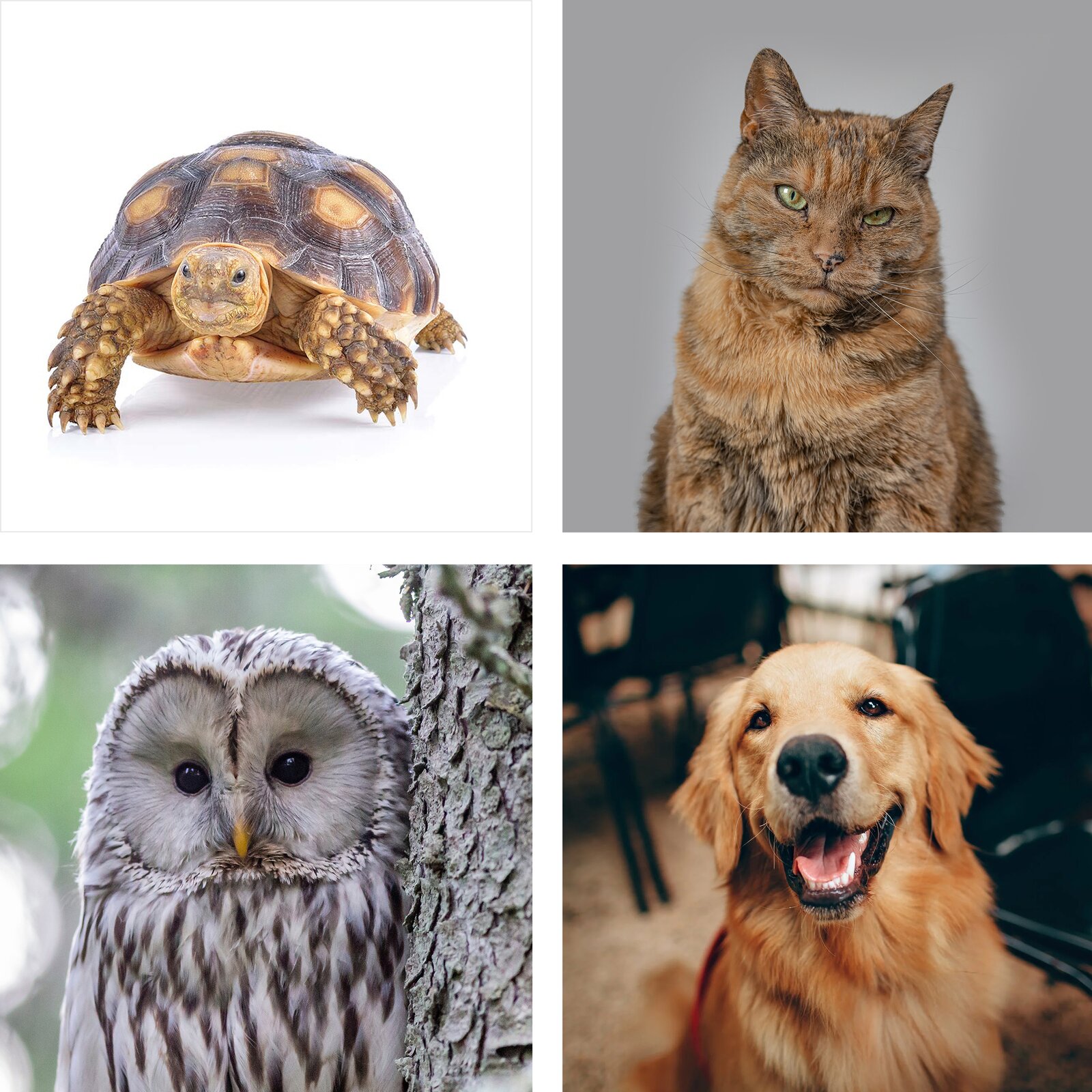
It’s easy to imagine these four animals have very particular characters. Drag and drop the labels to the correct names of animals, to describe their potential character traits.
\ Read the text and the tables below it to find out about different personality types.
Trying to Figure Out Who We AreWhether you’re someone who likes to take various internet tests, someone who’s curious about themselves, or someone planning a career in a large company, chances are at some point you’ll take the Myers‑Briggs or the Big Five personality testpersonality test. What are these tests?
The Myers‑Briggs test (MBTI for short) is taken by over 2 million people a year, making it one of the most popular tests used by the biggest companies and institutions to determinedetermine the potential abilitiespotential abilities of their employees. A list of questions helps to judgejudge a candidate's personalitypersonality within four categories. Each category has two ends of the spectrumspectrum and depending on which end you land on – that’s one of the four markers of your personality. The first category is extrovertextrovert (E) vs. introvertintrovert (I), second is sensingsensing (S) vs. intuitionintuition (N), then thinking (T) vs. feeling (F), and finally judging (J) vs. perceivingperceiving (P). The test then tells you whether your personality is ISFJ, ESTP etc.
The test results assigningassigning you one of the 16 MBTI personalities should then be a starting point of a discussion about your potential strengthsstrengths and weaknessesweaknesses. This, in turn, should lead to assigning you a perfect role in the company or team that you’re part of. Hundreds of managers claim it works. Hundreds of psychologypsychology professors insist, however, that it doesn’t. According to psychologists, the test doesn’t measuremeasure what it promises because the same people might get different results.
The scientists prefer the Big Five test, which describes your personality in terms of how high or low you score on five big personality traits scales. The first scale measures opennessopenness - if you score low here, you’re very cautiouscautious. The second one is conscientiousnessconscientiousness, i.e. how hard‑workinghard‑working you are. Interestingly, a low here means you’re easy‑goingeasy‑going. Then, there’s extroversion vs. introversion. Next - agreeableness i.e. judging how agreeableagreeable (easy to like) you are. Finally, there is neuroticism. This last trait gets a lot of criticism in the times of positive psychology. It’s often renamed as emotional stability. A low score here is translated into high sensitivitysensitivity. Still, you can see why companies might not like a test that suggests you're unstable or disagreeable.
Both tests are available online, so you can take them and see what they tell you. However, don’t worry too much about the results. Psychologists stress that the same person can be either toughtough or gentlegentle, lazylazy or responsibleresponsible – depending on circumstances. We’re much more complicated than any label can ever describe.
Źródło: Joanna Sobierska‑Paczesny, licencja: CC BY-SA 3.0.
MBTI aspect of personality | choice 1 | choice 2 |
|---|---|---|
me and others | Extrovert – looking ‘outside themselves’, likes social situations and action | Introvert – looking ‘inside themselves’, feels good alone but enjoys deep conversations |
looking at the world | Sensing – trusts what can be seen, experienced, and proven through experiments and data | Intuition – appreciates ideas that come from patterns, impressions, abstract ideas and future possibilities |
decision making | Thinking – prefers to make decisions based on rational thinking, are logical or even cold in their decisions | Feeling – when making decisions takes into consideration emotions, their own and others’ |
dealing with life | Judging – deals with life and the world by logic and decisive action, required by the situation | Perceiving – deals with life by just rolling with the punches, prefers to be flexible, open and adaptable |
- Scrooge was 1. sensitive, 2. greedy, 3. easy-going, 4. jealous, 5. arrogant, 6. gentle
Słownik
/ əˈɡriːəbl̩ /
miły/miła, zgodny/zgodna (pleasant and easy to like)
/ əˈsaɪnɪŋ / / əˈsaɪn /
przypisujące, przyporządkowujące [przypisywać, przyporządkowywać] (to say that something has a particular value or function, or happens at a particular time or place)
/ ˈkɔːʃəs /
ostrożny/ostrożna (being careful about what you say or do, especially to avoid danger or mistakes; not taking any risks)
/ kəmˈpæʃənət /
współczujący/współczująca (feeling or showing sympathy for people or animals who are suffering)
/ ˌkɒnʃɪˈenʃəsnəs /
sumienność (the quality of doing things carefully and correctly)
/ dɪˈpendəbl̩ /
taki/taka, na których można polegać (that can be relied on to do what you want or need)
/ dɪˈtɜːmɪn /
ustalić (to discover the facts about something; to calculate something exactly)
/ ˈiːzɪˌɡəʊɪŋ /
wyluzowany/wyluzowana, nieprzejmujący/nieprzejmująca się wieloma rzeczami (relaxed and happy to accept things without worrying or getting angry)
/ ɪˈməʊʃn̩əl stəˈbɪlɪti /
stabilność, równowaga emocjonalna (predictability and consistency in emotional reactions, with absence of rapid mood changes)
/ ˈekstrəvɜːt /
ekstrawertyk/ekstrawertyczka (a lively and confident person who enjoys being with other people)
/ ˈfleksəbl̩ /
elastyczny/elastyczna, ustępliwy/ustępliwa, łatwo się dostosowujący/łatwo się dostosowująca (able to change and adapt to new conditions or situations)
/ ˈdʒentl̩ /
delikatny/delikatna, łagodny/łagodna (calm and kind; doing things in a quiet and careful way)
/ ˈhɑːdˌwɜːkɪŋ /
pracowity/pracowita (putting a lot of effort into a job and doing it well)
/ ɪnˈsɪst /
nalegać, uparcie twierdzić (to state clearly that something is true, especially when other people do not believe you)
/ ˌɪntrəˈvɜːt /
introwertyk/introwertyczka (a quiet person who is more interested in their own thoughts and feelings than in spending time with other people)
/ ˌɪntjuːˈɪʃn̩ /
intuicja (the ability to know something by using your feelings rather than considering the facts)
/ dʒʌdʒ /
osądzać (to form an opinion about somebody/something, based on the information you have)
/ ˈleɪzi /
leniwy/leniwa (unwilling to work or be active; doing as little as possible)
/ ˈmeʒə /
mierzyć, oceniać (to judge the importance, value or effect of something)
/ ˈəʊpənnəs /
otwartość (the quality of being honest and not hiding information or feelings)
/ pəˈsiːvɪŋ /
obserwacja (reacting to the observed world)
/ ˌpɜːsəˈnælɪti /
osobowość (the various aspects of a person’s character that combine to make them different from other people)
/ ˌpɜːsəˈnælɪti ˈtest /
test osobowości (a test taken to check the kind of personality a person has)
/ pəˈtenʃl̩ əˈbɪlətiz / / pəˈtenʃl̩ əˈbɪləti /
potencjalne możliwości, zdolności [potencjalna możliwość, zdolność] (an ability that is possible to be developed)
/ saɪˈkɒlədʒi /
psychologia (the scientific study of the mind and how it influences behaviour)
/ ˌriːˈneɪm /
przemianowywać, nazwać ponownie (to give somebody/something a new name)
/ rɪˈzɜːvd /
skryty/skryta, zamknięty/zamknięta w sobie (slow or unwilling to show feelings or express opinions)
/ rɪˈspɒnsəbl̩ /
odpowiedzialny/odpowiedzialna (having the job or duty of doing something or taking care of somebody/something, so that you may be blamed if something goes wrong)
/ ˈsensɪŋ /
poznanie (collecting real and tangible information)
/ ˌsensəˈtɪvɪti /
wrażliwość (the ability to understand other people’s feelings)
/ ˈspektrəm /
spektrum (a complete or wide range of related qualities, ideas, etc.)
/ ˈspɪrɪt ˈænɪml̩ /
totem, duchowy patron (spirit which helps guide or protect a person on a journey and whose characteristics that person shares or embodies)
/ streŋthetas / / streŋtheta /
mocne strony [mocna strona] (a quality or an ability that a person or thing has that gives them an advantage)
/ səˈpɔːtɪv /
wspierający/wspierająca (encouraging somebody or giving them help or sympathy)
/ tʌf /
twardy/twarda (strong enough to deal successfully with difficult conditions or situations)
/ ˈwiːknəsɪz / / ˈwiːknəs /
słabości, słabe strony [słabość, słaba strona] (a weak point in a system, somebody’s character, etc.)