Przeczytaj
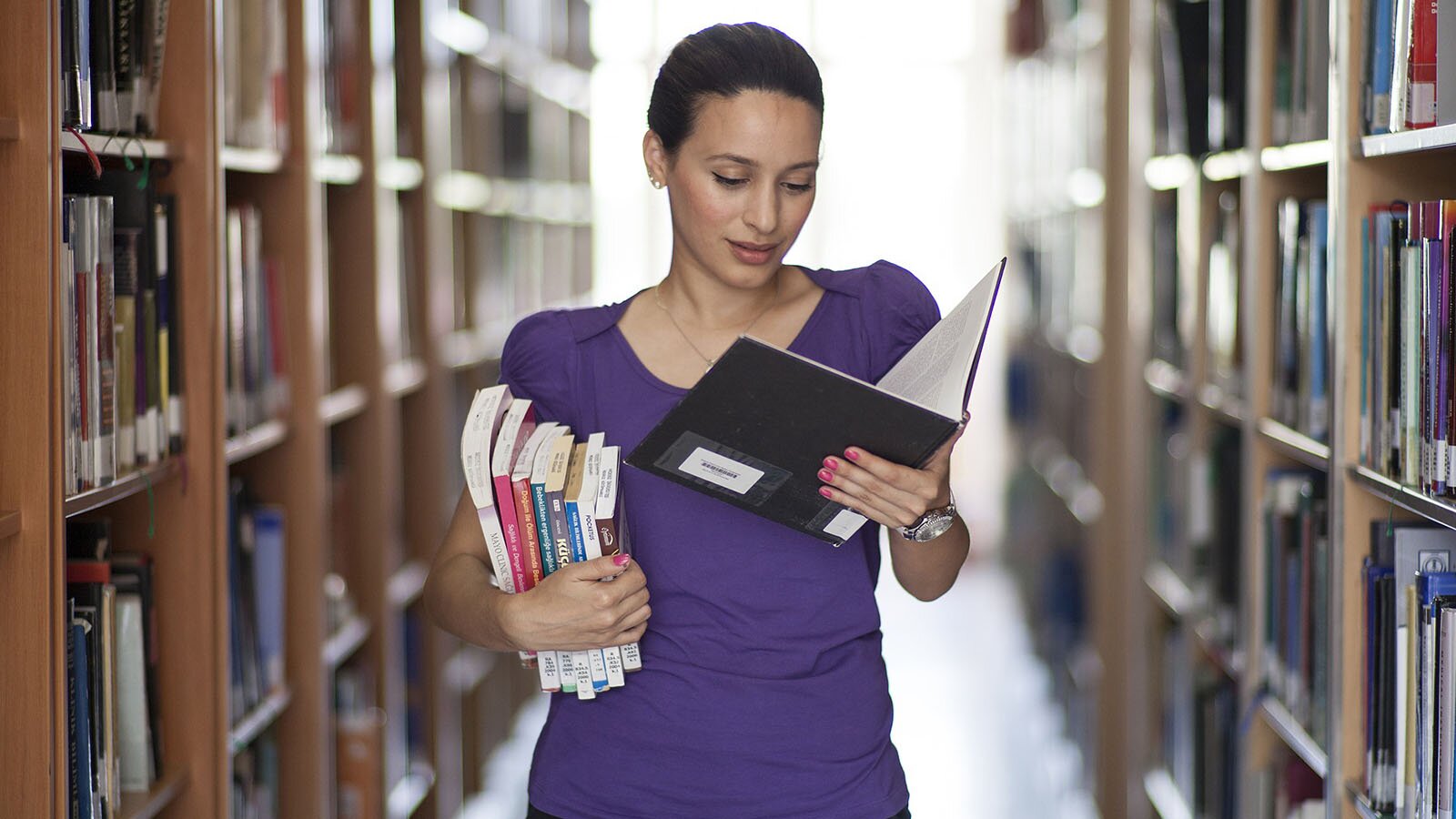
The picture below shows a woman in a library. She’s probably going to borrow the books she’s holding. Read the text to find out interesting facts about libraries. Did you know that some libraries don’t actually have books? What else can you find in them?
Poniższe zdjęcie przedstawia kobietę w bibliotece. Prawdopodobnie zamierza ona wypożyczyć książki, które trzyma w rękach. Przeczytaj tekst, aby dowiedzieć się kilku ciekawych faktów o bibliotekach. Czy wiesz, że niektóre z nich wcale nie oferują książek do wypożyczenia? Co innego możesz więc w nich znaleźć?
2. Our school library has quite a big 1. volume, 2. title, 3. collection, 4. bookcase, 5. reading room of books about ancient history.
3. Harry Potter and the Chamber of Secrets is the second 1. volume, 2. title, 3. collection, 4. bookcase, 5. reading room in the series about a wizard.
4. We used to have a big 1. volume, 2. title, 3. collection, 4. bookcase, 5. reading room in our living room where my mum kept all her books, but she sold it.
5. I wish we had a 1. volume, 2. title, 3. collection, 4. bookcase, 5. reading room in our library. I could study and read books in silence.
Read the text to learn more about interesting libraries around the world. Have you ever heard about any of them before?
LibrariesLibraries come in many forms and sizes and are a doorway todoorway to a limitless amount of knowledge, whether it is a library located in a small village, or the collection of the Library of Congress in Washington, D.C., which is the biggest library in the world. In her book A Library Miscellany, writer Claire Cock‑Starkey shares some interesting facts about various libraries in the world, and they are not only about books!
In Versailles, France, there is a library of scentsscents called the Osmothèque. The Osmothèque was set upset up in 1990 and has approximatelyapproximately 3,200 scents, 400 of which are no longer produced. Many fragrancefragrance companies and perfumiersperfumiers have given samplessamples of their scents, both modern and vintage, in order to preserve their formulaeformulae for the collection, which serves as a recordrecord of the history of perfume‑making.
In Manhattan, New York, the Conjuring Arts Research Centre was founded in 2003. It is a nonprofitnonprofit organisation whose main function is to serve as a library for literature on magic and related performing artsperforming arts including jugglingjuggling, ventriloquismventriloquism, sleight of handsleight of hand, and hypnosis. The library presently has about 12,000 volumes on magic, including rarerare works from the 15th century, in a varietyvariety of languages. The collection has more than 500 volumesvolumes on magic that were published before 1700, making it particularly rich in early magic. In addition to books, the library contains a large collection of manuscriptsmanuscripts including magic techniques, a number of magic periodicalsperiodicals, and almost 20,000 pieces of communication between magicians.
A colony of bats is permitted to live in the Rococo Library in Portugal’s Mafra National Palace in order to consume the pestspests which damage book collections. The bats sleep behind the fancy bookcases during the day and only come out at night, when the library is closed, to consume all the bothersomebothersome insects. However, the cleaners must clean their droppingsdroppings every morning before the library opens. It’s a minorminor price to pay to protect the collection.
Pope Paul V established the Vatican Secret Archive in 1612. It includes all of the Holy SeeHoly See’s activities as well as papalpapal communications, official documents, and financial records. The current pope is the owner of the archive, which will be passed to his successorsuccessor after his death. Because the collection is essentially the private archive of the pope, the word „secret” used in the title stemsstems from the word's earlier connotationconnotation of ‘private’ or ‘personal.’ Since 1881, scholarsscholars have had access to the archives, which now spanspan 53 kilometres of shelvingshelving and over 600 archivalarchival groupings with objects dating as far back as the eighth century.
After 122 years, one of the most overdueoverdue library books ever was returned. An original copy of Charles Darwin's InsectivorousInsectivorous Plants came back to the Australian Camden School of Arts lendinglending library in 2011. Before the library stamplibrary stamp was discovered and the book was returned, around 122 years after it had been checked outchecked out in 1889, it had been lying in the book collection of a retired veterinarian.
Źródło: Dorota Giżyńska , licencja: CC BY-SA 3.0.
TRUEFALSE
2. A card player who would like to trick his/her opponents might find useful information in the collection of the Conjuring Arts Research Centre.
TRUEFALSE
3. The Rococo Library in Portugal has a collection of volumes protected by bats.
TRUEFALSE
4. Visitors need to pay a small fee to be able to read the collection at Rococo Library.
TRUEFALSE
5. The papal collection at the Vatican Secret Archive contains top secret information of the Holy See.
TRUEFALSE
6. Charles Darwin’s book was found in a vet’s collection and given back to the library after 122 years.
TRUEFALSE
a) should have been returned some time ago.
b) is borrowed from a library.
c) is returned in a bad condition.
2. If you check out a book, you
a) lend it to somebody else.
b) borrow it from someone.
c) flick through it.
3. If you pay a minor price for something, it’s
a) too high.
b) quite high.
c) not very high.
4. If something serves as a record, it’s
a) a doorway to a different place.
b) used to store information and data.
c) used to play music.
5. A fragrance company is connected with
a) pests.
b) scents.
c) droppings.
Tu uzupełnij
2. The library’s group of books is really impressive.
Tu uzupełnij
3. The library has a number of books which are not common to find.
Tu uzupełnij
4. Many people who have been studying the subject of magic said that the book was authentic.
Tu uzupełnij
5. You can find different types of books on the subject in our library.
Tu uzupełnij
6. I went to the library to read a magazine on travelling which is published regularly.
Tu uzupełnij
Answer the questions related to libraries. Write 2–3 sentences to each question.
Which library mentioned in the text would you like to visit? Why?
How often do you borrow books from a library? Why?
Do you think libraries will become a thing of the past in the future? Why? Why not?
Słownik
/ əˈprɒksɪmətli /
około (about)
/ ɑːˈkaɪvl̩ /
archiwalne [archiwalny/archiwalna] (relating to historical documents)
/ ˈbʊk keɪs /
regał na książki (a piece of furniture for storing books)
/ ˈbɒðəsəm /
dokuczliwy/dokuczliwa (annoying)
/ tʃekt ˈaʊt / / tʃek ˈaʊt /
wypożyczony/wypożyczona [wypożyczać coś od kogoś] (to borrow)
/ kəˈlekʃn̩ /
kolekcja (a group of things)
/ ˌkɒnəˈteɪʃn̩ /
konotacja, skojarzenie (an idea that is suggested by the word in addition to its meaning)
/ ˈdɔːweɪ tuː /
drzwi, wejście do czegoś (an entrance to a place)
/ ˈdrɒpɪŋz /
odchody (solid waste matter of birds and small animals)
/ ˈfɔːmjʊliː / / ˈfɔːmjʊlə /
formuły, przepisy, recepty [formuła, przepis, recepta] (a rule)
/ ˈfreɪɡrəns /
zapach (a pleasant smell)
/ ˈhəʊli ˈsiː /
Stolica Apostolska (an area where Pope has authority)
/ ˌɪnsekˈtɪvərəs /
owadożerne [owadożerny] (an animal or plant that eats insects)
/ ˈdʒʌɡl̩ɪŋ /
żonglerka (tossing objects into the air and catching and throwing them up continuously so that one or more stays in the air)
/ ˈlendɪŋ / / lend /
wypożyczający/wypożyczająca [wypożyczać coś komuś] (to give something to somebody on the understanding that it will be returned)
/ ˈlaɪbrəri stæmp /
pieczątka biblioteczna (an inked mark on the surface given in the library)
/ ˈmænjʊskrɪpts / / ˈmænjʊskrɪpt /
manuskrypty, rękopisy [manuskrypt, rękopis] (a book or a document written by hand)
/ ˈmaɪnə /
drobny/drobna, niewielki/niewielka (not great in importance)
/ nanˈprɑːfət /
niedochodowy/niedochodowa, nieprzynoszący/nieprzynosząca zysków (not intended to make a profit)
/ ˌəʊvəˈdjuː /
zaległy/zaległa (not done on time)
/ ˈpeɪpl̩ /
papieski/papieska (relating to a pope)
/ pəˈfɔːmɪŋ ɑːts /
sztuka widowiskowa (music, dance and drama performed for an audience)
/ pəˈfjuːmɪəz / / pəˈfjuːmɪə /
perfumiarze [perfumiarz/perfumiarka (osoba tworząca kompozycje zapachowe)] (a person who creates fragrances)
/ ˌpɪərɪˈɒdɪkl̩z / / ˌpɪərɪˈɒdɪkl̩ /
czasopisma, periodyki [czasopismo, periodyk] (a newspaper or magazine that is regularly published)
/ pests / / pest /
insekty, robaki, szkodniki [insekt, robak, szkodnik] (a destructive insect)
/ reə /
rzadko spotykany/spotykana (not occurring frequently)
/ ˈriːdɪŋ ru:m /
czytelnia (a public place where people can read books or magazines)
/ ˈrekɔːd /
ewidencja, rejestr (an official document that tells about the past)
/ ˈsɑːmpl̩z / / ˈsɑːmpl̩ /
próbki [próbka] (a small part of something that is to show how the whole works)
/ sents / / sent /
zapachy [zapach] (a pleasant smell)
/ ˈskɒləz / / ˈskɒlə /
badacze, uczeni [badacz/badaczka, uczony/uczona] (a specialist)
/ set ˈʌp / / set ˈʌp /
założony/założona [zakładać] (to establish)
/ ˈʃelvɪŋ /
półki, regały (shelves)
/ slaɪt əv hænd /
zręczne ręce, umiejętność w oszukiwaniu (skillful deception, tricks)
/ spæn /
obejmują [obejmować] (to include)
/ stemz / / stem /
pochodzi, wywodzi się [pochodzić, wywodzić się] (to originate from)
/ səkˈsesə /
następca/następczyni (a person who has a position and title after someone else)
/ ˈtaɪtl̩ /
tytuł (a name that is given to somebody or something)
/ vəˈraɪəti /
różnorodność (a collection of different things)
/ venˈtrɪləkwɪzəm /
brzuchomówstwo (the art of speaking without moving the lips)
/ ˈvɒljuːmz / / ˈvɒljuːm /
woluminy, książki [wolumin, książka] (a part of a book)
Źródło: GroMar Sp. z o.o., licencja: CC BY‑SA 3.0