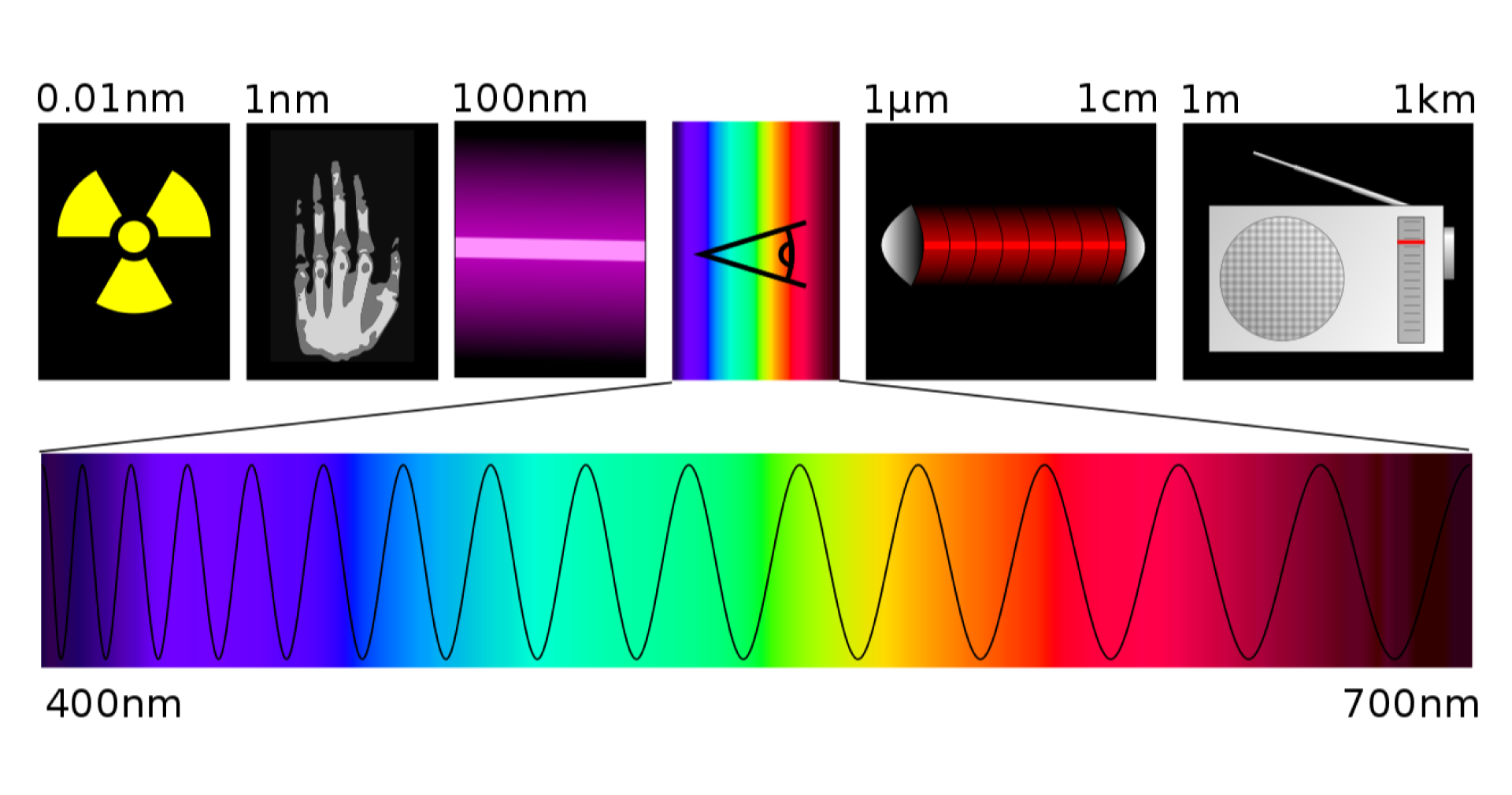
What the spectrumspectrumspectrum of electromagnetic radiation looks like?
The properties of electromagnetic radiation, or electromagnetic waves, are described by several parameters. These include wave frequencyfrequencyfrequency, wavelength, periodperiodperiod and amplitudeamplitudeamplitude.
In the graphic description of the wave, the following concepts are also helpful: the peakpeakpeak, the troughtroughtrough, the rest position.
RmQqCboWkKPP2
Na ilustracji interaktywnej przedstawiona jest linia pozioma przerywana, a na niej schematycznie fala elektromagnetyczna za pomocą sinusoidy. Zaznaczona jest długość fali (1) symbolem lambda, jej amplituda (2) literą A, najwyższy punkt sinusoidy (3), punkt styku (4) sinusoidy i linii poziomej oraz najniższy punkt sinusoidy (5). Kierunek ruchu fali wskazuje pozioma strzałka skierowana w prawo opisana direction of propagation. Na ilustracji widoczne są numery, a na nich podpisy. 1. wavelength {audio}, 2. amplitude {audio}, 3. peak {audio}, 4. point of equilibrium {audio}, 5. trough {audio}.
Na ilustracji interaktywnej przedstawiona jest linia pozioma przerywana, a na niej schematycznie fala elektromagnetyczna za pomocą sinusoidy. Zaznaczona jest długość fali (1) symbolem lambda, jej amplituda (2) literą A, najwyższy punkt sinusoidy (3), punkt styku (4) sinusoidy i linii poziomej oraz najniższy punkt sinusoidy (5). Kierunek ruchu fali wskazuje pozioma strzałka skierowana w prawo opisana direction of propagation. Na ilustracji widoczne są numery, a na nich podpisy. 1. wavelength {audio}, 2. amplitude {audio}, 3. peak {audio}, 4. point of equilibrium {audio}, 5. trough {audio}.
WavelengthwavelengthWavelength (symbol: λ, unit: m) is the distance between two points of maximum displacement of a wave, i.e. between successive peaks (or troughs). The longer the wave, the smaller its energy.
AmplitudeamplitudeAmplitude (symbol: A, unit: m) is the maximum displacement of a given wave point from the rest position. The higher the amplitude, the higher the wave intensity.
FrequencyfrequencyFrequency (symbol: f, unit: Hz) is the number of full displacements of a given wave point from the rest position made within 1 second.
PeriodperiodPeriod (symbol: T, unit: s) is the time required for the given wave point to cover the distance equal to the wavelengthwavelengthwavelength.
Wave speedwave speedWave speed (symbol: c - in a vacuum, v - in any medium, unit: ) - the speed with which a given wave point propagates in space. Electromagnetic waves in a vacuum move at the speed of light:
R18mN3J5GHhhN
Na rysunku pokazane są za pomocą ikon różne rodzaje długości fal: od lewej promieniowanie gamma 0,01 nm, rentgenowskie 1 nm, ultrafioletowe 100 nm, widzialne, podczerwone 1 mikrometr do 1 cm, radiowe 1 m do 1 km. Poniżej znajduje się pasek z widmem światła widzialnego od 400 nm do 700 nm, a na nim zaznaczona jest sinusoidalna krzywa, która ma większą długość w obszarze światła czerwonego, a mniejszą w obszarze światła niebieskiego.
1. Which wave has the greater intensity? 2. Which wave corresponds to higher‑energy radiation? 3. Which wave represents green light, and which represents infrared radiation?
RRN28GbD8XCk5
Na rysunku pokazane są dwie fale o różnej amplitudzie i częstotliwości. Zobrazowane są za pomocą sinusoid. W punkcie a sinusoida jest wyższa i węższa, w punkcie b sinusoida jest niższa i szersza.
Two different waves
Source: GroMar, licencja: CC BY 3.0.
1. a 2. b 3. b - green light, a - infrared radiation
Compare the results of X‑ray measurements with radio waves:
1. Which one is moving at a higher speed? 2. Which one has a longer wavelength? 3. Which of them has a higher frequency?
1. Both types of radiation belong to electromagnetic waves, so they move at the same speed. 2. Radio waves are longer than X‑ray waves. 3. X‑rays have a higher frequency.
The global positioning system (GPS) that we use in mobile phones or navigation devices, e.g. in cars, requires very accurate timing and reading of the position of the satellites on the orbits. Each of the satellites uses an atomic clock that sends signals using two frequencies of 1575,42 MHz and 1227,6 MHz. Calculate the wavelengths that these frequencies correspond to. Specify what kind of waves they belong to.
Popular laser pointers usually emit green, red and blue light. Search on the Internet for the wavelengths corresponding to the colour of light emitted by these pointers. Then calculate what frequencies they correspond to. Are pointers also available with different colours?
Compare how far the light beam of these pointers can reach.
What should you pay attention to when using them?
R3JOxIkxUXiw8
Na zdjęciu pokazane są trzy wskaźniki laserowe świecące na czerwono, zielono i niebiesko.
Electromagnetic waves are widely used in technology and medicine. We use them in everyday life using, for example, mobile phones, using satellite navigation, microwave ovens, doing examinations recommended by a doctor.
Exercises
R133i26xRUaRb
Exercise 4
Wersja alternatywna ćwiczenia: Determine which sentences are true. Możliwe odpowiedzi: 1. Gamma and X-ray radiation are considered dangerous because they have the highest frequency., 2. The longest waves have the highest energy., 3. The spectrum of visible light is a continuous spectrum., 4. The wave peak is its maximum displacement from the rest position.
Wersja alternatywna ćwiczenia: Determine which sentences are true. Możliwe odpowiedzi: 1. Gamma and X-ray radiation are considered dangerous because they have the highest frequency., 2. The longest waves have the highest energy., 3. The spectrum of visible light is a continuous spectrum., 4. The wave peak is its maximum displacement from the rest position.
Determine which sentences are true.
Gamma and X-ray radiation are considered dangerous because they have the highest frequency.
The longest waves have the highest energy.
The spectrum of visible light is a continuous spectrum.
The wave peak is its maximum displacement from the rest position.
Exercise 5
Find the information you need in the available sources and describe how the microwave oven works.
Exercise 6
Explain in English what parameters characterises the electromagnetic waves.
R1TpcQIizWIlG
Exercise 7
Wersja alternatywna ćwiczenia: Indicate which pairs of expressions or words are translated correctly. Możliwe odpowiedzi: 1. fala elektromagnetyczna - electromagnetic wave, 2. widmo - spectrum, 3. amplituda - amplitude, 4. długość fali - wavelength, 5. dolina - peak, 6. grzbiet - trough
Wersja alternatywna ćwiczenia: Indicate which pairs of expressions or words are translated correctly. Możliwe odpowiedzi: 1. fala elektromagnetyczna - electromagnetic wave, 2. widmo - spectrum, 3. amplituda - amplitude, 4. długość fali - wavelength, 5. dolina - peak, 6. grzbiet - trough
Indicate which pairs of expressions or words are translated correctly.
fala elektromagnetyczna - electromagnetic wave
widmo - spectrum
amplituda - amplitude
długość fali - wavelength
dolina - peak
grzbiet - trough
zadanie
Source: GroMar, licencja: CC BY 3.0.
R1LqkRhi5JjpT1
Interaktywna gra, polegająca na łączeniu wyrazów w pary w ciągu jednej minuty. Czas zaczyna upływać wraz z rozpoczęciem gry. Jeden ruch to odkrywanie najpierw jednej potem drugiej karty z wyrazem. Każdy wyraz jest odczytywany. Kolejny ruch to odkrywanie trzeciej i czwartej karty. W ten sposób odsłuchasz wszystkie wyrazy. Nawigacja z poziomu klawiatury za pomocą strzałek, odsłuchiwanie wyrazów enterem lub spacją. Znajdź wszystkie pary wyrazów.
Interaktywna gra, polegająca na łączeniu wyrazów w pary w ciągu jednej minuty. Czas zaczyna upływać wraz z rozpoczęciem gry. Jeden ruch to odkrywanie najpierw jednej potem drugiej karty z wyrazem. Każdy wyraz jest odczytywany. Kolejny ruch to odkrywanie trzeciej i czwartej karty. W ten sposób odsłuchasz wszystkie wyrazy. Nawigacja z poziomu klawiatury za pomocą strzałek, odsłuchiwanie wyrazów enterem lub spacją. Znajdź wszystkie pary wyrazów.
Match Polish terms with their English equivalents.
wavelength
spectrum
electromagnetic wave
amplituda
dolina
długość fali
fala elektromagnetyczna
trough
amplitude
widmo
Source: Zespół autorski Politechniki Łódzkiej, licencja: CC BY 3.0.