Polish lands were not equally developed, as they were functioning differently under three countries that partitioned Poland. They represented different levels of civilisational development being parts of three different partitions. It was essential to create a unified financial system, as each of the partitions had its own currency (Polish mark was introduced in 1919). The Republic of Poland had no uniform administrative or legal system. There were no trained public officials that could create bases of the Polish administration. In the first months of independence, the political fragmentation was significant. Moreover, there was no agreement regarding the final political form of the Polish country. Several public authorities were created. The Republic of Poland was a multinational country with a multi‑faith society which might have caused national and religious conflicts. IlliteracyilliteracyIlliteracy was another major problem. A common obligatory education for children from 7 to 14 years of age was established by the Decree of 9 February 1919.
Exercise 1
Read the source text and solve the following exercise.
A. GarlickiSeven myths of the Second Polish Republic
Stefan Żeromski wrote that Poland consisted of „three uneven halves”. This is completely contrary to the principles of mathematics, but also a beautiful literary term perfectly reflecting the contemporary reality. It was necessary not only to win the fight for the borders, by armed forces and by diplomacy, but to glue together very different territories into one state organism. And at the same time to rebuild what the war destroyed. Military operations covered 86% of the territories of the Polish‑Lithuanian Commonwealth, of which in ¼ fierce and long‑term fights took place. Almost 40% of buildings in poviat cities were destroyed, while in small towns with wooden structures, fires destroyed more than ¾ of all building. More than a half of the bridges were destroyed. In the Russian partition in 1918, the number of employed in the workers' industry amounted to 15% of all employment in 1914.
garlicki Source: A. Garlicki, Seven myths of the Second Polish Republic, Warszawa 2013.
R1BQ0aQKJiv9h
Wersja alternatywna ćwiczenia: What are the problems of Second Polish Republic according to prof. A. Garlicki? Możliwe odpowiedzi: 1. Fight for the final political form of the country., 2. Fight for the final territorial shape., 3. Reconstruction of areas destroyed during the war., 4. Reconstruction of the industry back to the condition from before the World War I.
Wersja alternatywna ćwiczenia: What are the problems of Second Polish Republic according to prof. A. Garlicki? Możliwe odpowiedzi: 1. Fight for the final political form of the country., 2. Fight for the final territorial shape., 3. Reconstruction of areas destroyed during the war., 4. Reconstruction of the industry back to the condition from before the World War I.
What are the problems of Second Polish Republic according to prof. A. Garlicki?
Fight for the final political form of the country.
Fight for the final territorial shape.
Reconstruction of areas destroyed during the war.
Reconstruction of the industry back to the condition from before the World War I.
Exercise 2
Wymyśl pytanie na kartkówkę związane z tematem abstraktu.
Wymyśl pytanie na kartkówkę związane z tematem abstraktu.
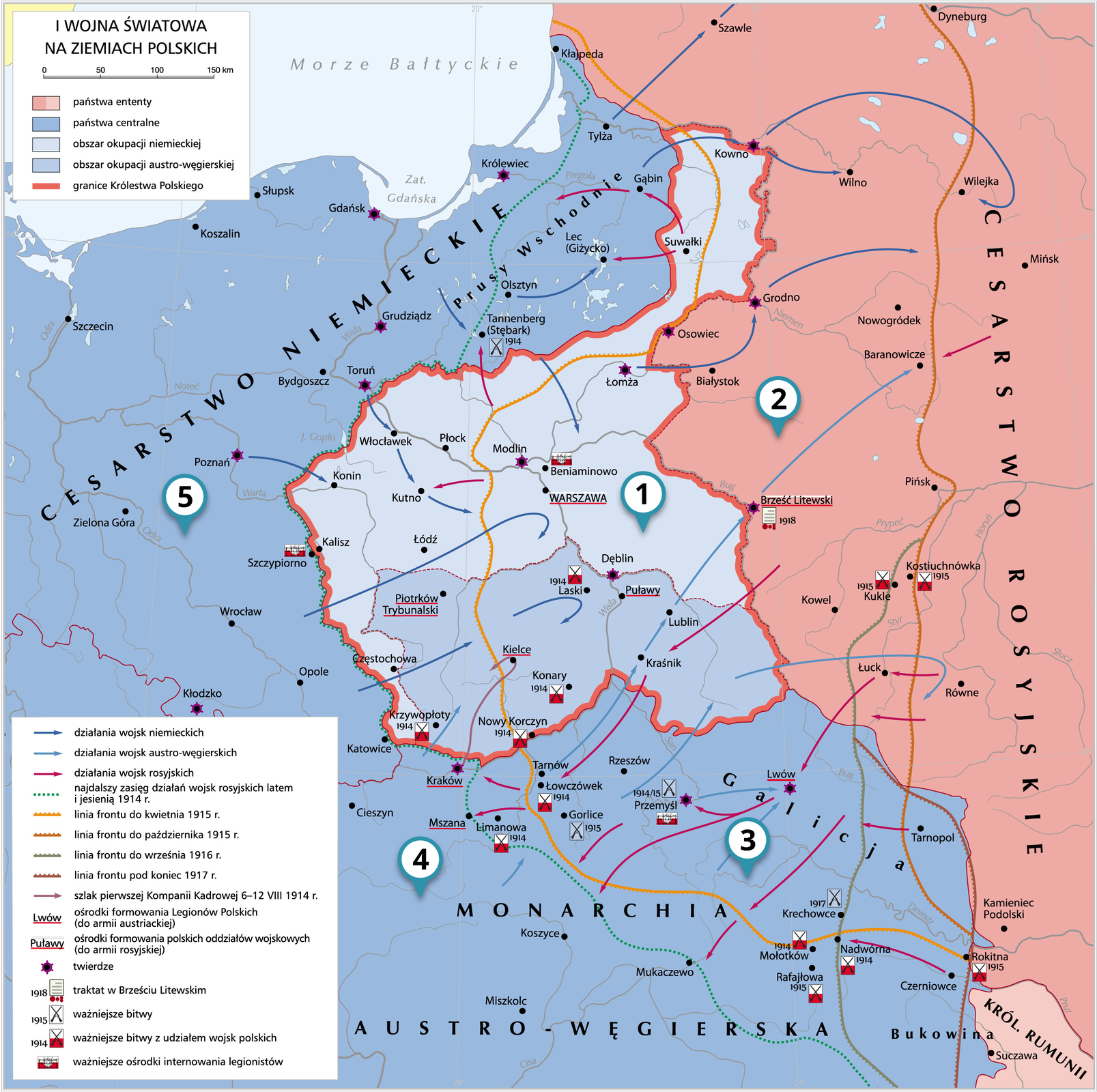
Take a close look at the map and solve the exercise.
RAJqbWUIkjvKc
Infografika mapy przedstawiającej I wojnę światową na ziemiach polskich.
World War I on the Polish lands
Source: Krystian Chariza i zespół.
RGlXcDwGt57RS
Wykonaj polecenie.
Wykonaj polecenie.
Read the information detailed in the table. Locate the described areas on the map. Put correct answers in the table using Arabic numerals. If there is more than one correct answer, put the numbers in ascending order and separate them by commas, for example: 1, 2, 3.
During World War I, it was the Prussian Partition and Eastern Galicia that suffered the least.
Congress Poland, Eastern Galicia and Kresy Wschodnie (Eastern Borderlands) were the main combat zone during the war, and that’s why they suffered more than other areas of Polish territory.
In Galicia, military actions caused the biggest damage. Also, the retreat of Russian army from the temporarily occupied areas played a significant role.
In Russian Partition, only 5% of damage was a direct consequence of the war. The evacuation carried out by Russians in 1915 was much more responsible.
The industry in Congress Poland was greatly harmed as a result of plundering effected by German and Austrian occupying powers. German authorities took advantage of the war to eliminate Reich’s competition.
Kresy Wschodnie (Eastern Borderlands) were the most destroyed rural area.
Task 1
Review the information detailed in the table.
Social classes
% of population in 1921
Working class
26,6
Peasantry
53,3
Intelligentsia
5,1
Bourgeoisie
1,1
Petite bourgeoisie
11
Landed gentry
0,4
Other
1,5
Task 2
Which of the social classes was the most numerous one, and what does that tell you?
Task 3
Could this particular social structure affect the political life during first years of independence?
Try to assign the religion to the corresponding nation. Do you expect any difficulties? If yes, please specify.
Task 6
Listen to the broadcast. Visit the common school for boys at Krucza Street in Warsaw. Find out how the educational system was being established in the inter‑war period in the independent Poland. Do you know if it was really common for children to go to the common school?
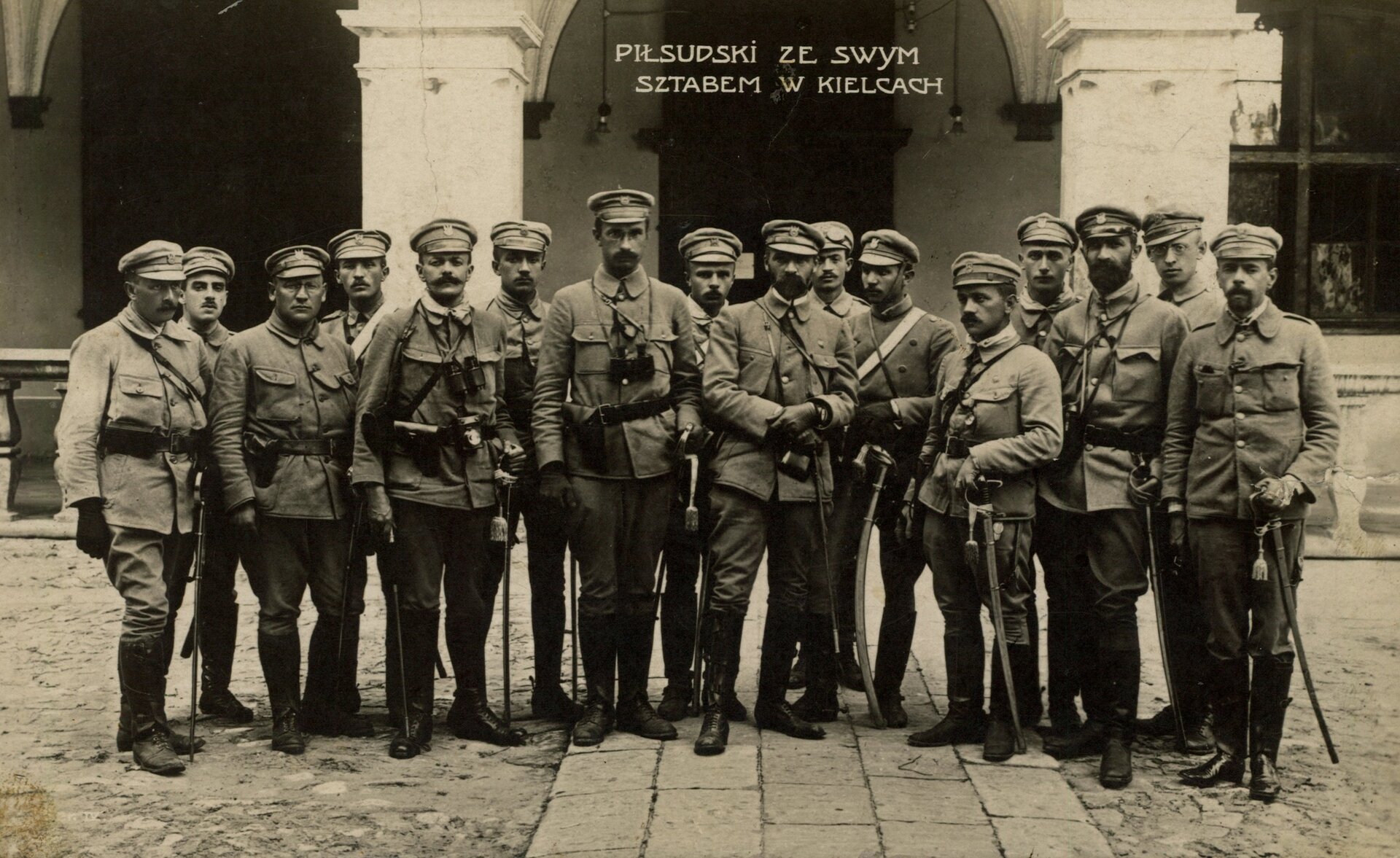
Ilustracja przedstawia Józefa Piłsudskiego ze swoim sztabem w Kielcach, sierpień 1914
Józef Piłsudski and his staff in Kielce, August 1914
Source: domena publiczna.
„Sometimes there was like 3 degrees inside in the wintertime. Not all of the students had greatcoats, so how could I be wearing warm clothes while they were freezing”. Those are the words of Zofia Gruszczyńska. She was looking back at the reality of education in 1918, when she was a teacher in the so called „powszechniak” (public common school) for boys at Krucza Street in Warsaw. The classroom “was littered with damaged black school desks, and instead of the teacher’s lectern, there was a little desk squeezed in the corner”, there was no chair for the teacher and “boys, in order to get to theirs seats, had to jump over desks”. The teachers almost all over the country had to deal with the same problems concerning classrooms. In 1918, only 6 % of schools had at their disposal rooms suitable for educational purposes. However, the most important thing, both for teachers and students, was that the Polish school actually existed.
R105ebGKhzr6B1
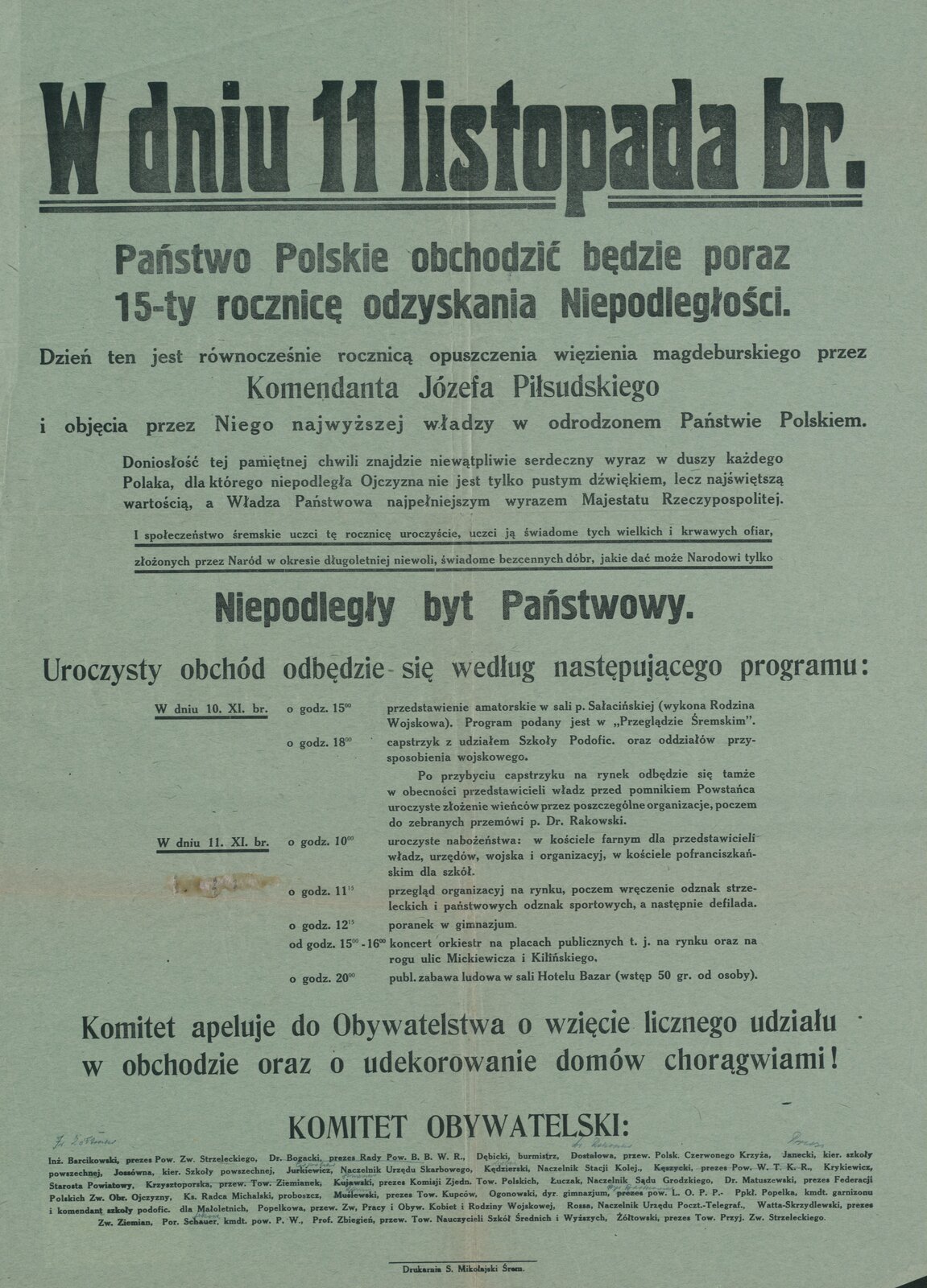
Ilustracja przedstawia afisz z okazji 15-tej rocznicy odzyskania niepodległości przez Polskę.
Poster commemorating the 15th anniversary of Poland regaining independence.
Source: Archiwum Państwowe w Poznaniu, licencja: CC 0.
The regaining of independence in 1918 brought hope to Poles. They wanted to provide proper education for their children in their own country, education which was lacking in the times of partitions. Abolition of compulsory education in central Poland, being until recently under the Russian regime, was followed by the plague of illiteracy. The Second Polish Republic “began its existence as an independent country with the majority of its population not able to read patriotic proclamations or to sign electoral lists”, writes Magdalena Micińska in her book entitled “Inteligencja na rozdrożach 1864‑1918”. The illiteracy was foreign only to western parts of the country (Greater Poland, Pomerania and Silesia). Further to the east, the number of people using a cross as their signature instead of their surname rose. It was a common problem not only for the Polish people from small cities or villages, but also for the representatives of national minorities. It’s no wonder that the society was craving education and got involved in building foundations for educational system already during World War I. After the war, Józef Piłsudski, the Polish Chief of State, by Decree of February 1919, established the first seven‑year obligatory and gratuitous common school in the history of Poland for children from 7 to 14 years of age.
In the country devastated by years of war, there was a shortage of buildings, educational materials, and above all, teachers. A school that was meant to include all children, that is to say, a common school, became an unfulfilled dream of the Second Polish Republic. During the Polish‑Soviet War, less than half of children living in Poland was fulfilling compulsory school obligation. This means that over a million of them could not take advantage of any educational institution, especially in those inhabiting non‑Polish areas in the east. Not only legislation and poverty were to blame, but also contemporary mentality. For boys and landowners, the obligatory education was sort of a prejudicial novelty, as it was focusing the attention of children from rural areas on school and not on other, more profitable, activities. In 1929, one could read some alarming news in „Bluszcz”, women’s weekly magazine, that “hundreds and thousands of village children are growing up like piglets in the field: they laze around in the summertime where the cows graze, and in the winter – where the potatoes are peeled and firewood is cast. Town children, in turn, waste days on playing silly games and selling newspapers, and nights on selling illegal cigarettes, brewing cheap alcohol or, what’s worse, on prostitution”.
marchewa3 Source: M. Piotrowska-Marchewa.
Keywords
illiteracy, shortage, inflation, unification of law
analfabetyzm – brak umiejętności czytania, pisania i wykonywania 4 podstawowych działań arytmetycznych u osób, które przekroczyły już okres (wczesno)szkolny życia (np. mają 10‑15 lat); istnieje także wtórny analfabetyzm u osób, które wcześnie zakończyły edukację.
kościoły unickie – wspólnota chrześcijan obrządku bizantyńskiego uznająca papieża i dogmatykę katolicką, lecz zachowująca prawosławne odrębności liturgiczne i prawne.