Soap in the fight for cleanliness — obtaining and properties of soaps
the characteristics of polar and non‑polar substances;
the properties of water, which is a polar solvent;
physical and chemical properties of fats;
the properties of hydroxides and the characteristics of their aqueous solutions.
to describe soap properties;
to explain the fat saponification process;
Soaps properties and preparation
SoapsSoaps are substances capable of foaming in water and removing dirt. Hard soaps used in households are sodium soaps with added fragrances and dyes. While potassium soaps are normally used as ingredients in other products, such as shaving creams and liquid cleaning products.
Soaps are metal salts of groups 1 and 2 (mainly sodium, potassium and magnesium salts), as well as salts of higher carboxylic (fatty) acids – most commonly of palmitic, stearic and oleic acid, for example:
sodium palmitate ,
potassium stearate ,
sodium oleate .
Watch a movie. Pay attention to what happens to the needle in both beakers. What do you think is the reason?

Film dostępny na portalu epodreczniki.pl
Nagranie filmowe dotyczące eksperymentu. Film obrazujący napięcie powierzchniowe wody. Needle on the water surface. Potrzebne dwie igły, dwie zlewki z wodą, mydło w płynie i bagietka do mieszania. Na powierzchni wody w jednej ze zlewek kładziemy delikatnie igłę. Utrzymuje się na powierzchni. Do drugiej zlewki z wodą dodajemy mydło w płynie. Igła opada na dno.

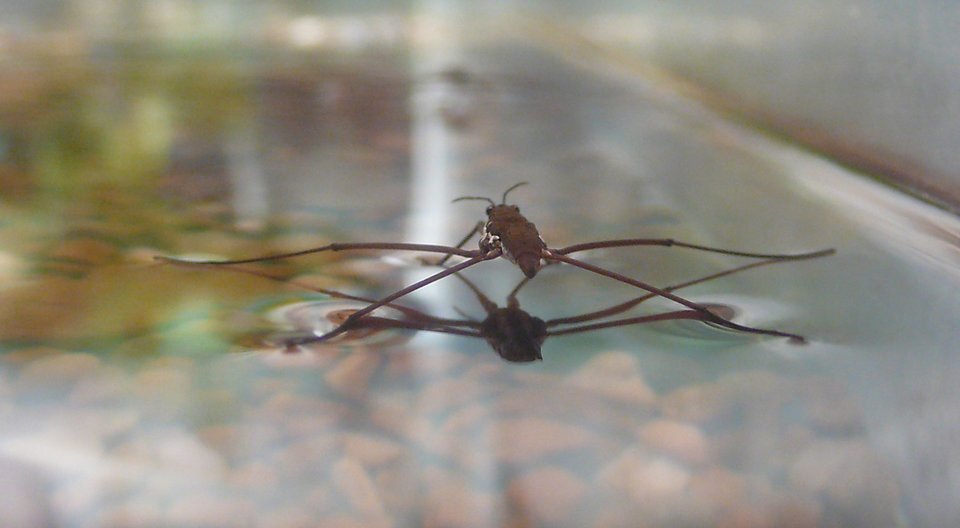

Soap is a surface active substance. It works by lowering the surface tensionsurface tension of water. Look at the pictures and tell what is the surface tension.
Since soaps are salts, can they be obtained in the reaction of acids with hydroxides?
Design your own experiment.
Now compare your experiment with the description below.
Like many other acids, higher fatty acids react with hydroxides forming salts. One of the reaction products of higher fatty acid with sodium (or potassium) hydroxide will be the sodium (or potassium) salt of this acid, i.e. soap.
concentrated sodium hydroxide solution,
stearic acid,
phenolphthalein,
test tube,
wooden pliers,
burner.
Add a few drops of phenolphthalein to the tube containing a small amount of concentrated sodium hydroxide solution.
Add small portions of stearic acid while heating the tube in the burner's flame.
Stop adding acid and heating when the solution starts to discolour.
Once the tube has cooled down, shake its contents and then test the properties of the resulting product.
The reaction of stearic acid with sodium hydroxide produces salt – sodium stearate (soap). The reaction proceeds according to the following equation:
The process of obtaining soap from fat, called fat saponification, can be presented as a following scheme:
The reaction of producing soap from fat proceeds according to the following equation:
Fat saponificationFat saponification is used on an industrial scale to produce soap, mainly from saturated fats. This process involves the long‑term cooking of fats with concentrated sodium hydroxide solution. Glycerin produced alongside soaps is removed from the final product or sometimes left behind as it has a greasing effect. Currently, fatty acids obtained during the processing of crude oil are also used in soap production. Often, natural oils and fats, or a mixture of them, are used instead of pure fatty acids in soap production, which in the saponification process produce directly salts of the corresponding fatty acids.
Toilet soaps manufactured today are enriched with various additives – moisturizers, acidifying substances, antibacterial agents, fragrances, colouring agents, in order to enhance their skin care properties and make them more attractive to users.
Match the formula with the substance.
C<sub>17</sub>H<sub>33</sub>COONa, C<sub>15</sub>H<sub>31</sub>COONa, C<sub>17</sub>H<sub>35</sub>COOK
| sodium pamitate | |
| potassium stearate | |
| sodium oleate |
Complete the saponification reaction of fat.
,
+→+
Saponification of fats is ...
- a reaction of fats and bases to the formation of carboxylic acids and soaps.
- chemical reaction of basic ester hydrolysis, resulting in the formation of alcohols and salts of acids forming a given ester.
- esterification of fats occurring in the presence of bases and leading to the formation of soap and glycerol.
- chemical reaction of acid hydrolysis of esters resulting in the formation of glycerol and soap.
Conclusion
Soaps are obtained by neutralization of higher fatty acids with metal hydroxides of groups 1 and 2 (mainly sodium, potassium and magnesium hydroxides) and – on an industrial scale – by saponification of fats.
Soaps are surface‑active substancessurface‑active substances. Their specific structure – the presence of hydrophilic head and hydrophobic tail – reduces the surface tension of water.
Key words
soaps, surface tension, surface‑active substance, hard water, fat saponification
Glossary
mydła – sole metali z grup 1. i 2. (głównie sodu, potasu, magnezu) i wyższych kwasów tłuszczowych
napięcie powierzchniowe – zjawisko spowodowane siłami spójności występującymi w cieczach; dzięki temu zjawisku powierzchnia cieczy zachowuje się jak sprężysta błona; woda charakteryzuje się największym napięciem powierzchniowym ze wszystkich cieczy
substancja powierzchniowo czynna – substancja, która powoduje zmniejszenie napięcia powierzchniowego wody
zmydlanie tłuszczów – proces otrzymywania mydła w reakcji tłuszczu z zasadą sodową lub potasową; drugim produktem tej reakcji jest glicerol