1
Show exercises:
1
Exercise 1

Study the sentences and write the words or phrases in the correct places.

R7LxCYtubipdb
Źródło: GroMar Sp. z o.o., licencja: CC BY-SA 3.0.
1
Exercise 1

Drag the words to complete the sentences.

Rli62wjdJ36vF
Źródło: GroMar Sp. z o.o., licencja: CC BY 3.0.
1
Exercise 2

Match the definitions with the correct words/expressions.

RkjUNaFsSwr56
The day on which you choose your future president. Możliwe odpowiedzi: 1. amendment, 2. cast one’s ballot for, 3. ballot paper, 4. convince, 5. requirement, 6. election day, 7. assassinate To try to make people believe what you say. Możliwe odpowiedzi: 1. amendment, 2. cast one’s ballot for, 3. ballot paper, 4. convince, 5. requirement, 6. election day, 7. assassinate To vote for. Możliwe odpowiedzi: 1. amendment, 2. cast one’s ballot for, 3. ballot paper, 4. convince, 5. requirement, 6. election day, 7. assassinate A piece of paper where citizens mark their votes. Możliwe odpowiedzi: 1. amendment, 2. cast one’s ballot for, 3. ballot paper, 4. convince, 5. requirement, 6. election day, 7. assassinate To kill an important person, especially a politician. Możliwe odpowiedzi: 1. amendment, 2. cast one’s ballot for, 3. ballot paper, 4. convince, 5. requirement, 6. election day, 7. assassinate A change which is made to a law or a document Możliwe odpowiedzi: 1. amendment, 2. cast one’s ballot for, 3. ballot paper, 4. convince, 5. requirement, 6. election day, 7. assassinate Something that must be done due to a law. Możliwe odpowiedzi: 1. amendment, 2. cast one’s ballot for, 3. ballot paper, 4. convince, 5. requirement, 6. election day, 7. assassinate
Źródło: GroMar Sp. z o.o., licencja: CC BY-SA 3.0.
1
Exercise 2
R1XESqGGhD3ki
Match the definitions with the correct recordings of words/expressions. Możliwe odpowiedzi: 1. A change which is made to a law or a document, 2. The day on which you choose your future president., 3. To try to encourage people to believe what you say., 4. Something that must be done due to a law., 5. To vote for., 6. To kill an important person, especially a politician., 7. A piece of paper where citizens mark their votes.
Źródło: GroMar Sp. z o.o., licencja: CC BY-SA 3.0.
TRANSCRIPTazurewhite
2
Exercise 3
RVA8dN9nf6SV1
Analyse the sentences below and choose the correct words. 1. There have been two US presidents serving more than two terms. TRUEFALSE
2. Afro-Americans could not vote in elections until the Twenty-Second Amendment was introduced. TRUEFALSE
3. American citizens vote once again if no candidate gets at least 270 electoral votes. TRUEFALSE
4. Hilary Clinton would have won the election against Donald Trump if the US citizens could decide directly. TRUEFALSE
5. James Garfield was one of the four US presidents who were assassinated. TRUEFALSE
6. The date of the US presidential election was fixed for November by chance. TRUEFALSE
7. During their campaign candidates for the presidential office pay special attention to battleground states. TRUEFALSE
Źródło: GroMar Sp. z o.o., licencja: CC BY-SA 3.0.
2
Exercise 4
R3ak7eGUTKip0
Odpowiedz na pytania lub uzupełnij tekst. 1. George Washington was the only American president who was _____ unanimously., 2. Secure _____ (special encrypted email) is the only way for American astronauts to vote in elections., 3. There are two main political _____ that most American presidents come from., 4. _____ debates are the meetings politicians running for offices organise with ordinary people to discuss their visions of the future in their area., 5. Although most American citizens _____ for Hilary Clinton, it was Donald Trump who won the election., 6. The _____ bout is probably the most important debate, that is the last one before the election takes place., 7. In many elections the results presented in _____ polls were almost the same as the actual results., 8. Quite often, US presidential candidates focus their campaign mainly on _____ states.
Źródło: GroMar Sp. z o.o., licencja: CC BY-SA 3.0.
2
Exercise 5

Drag the words to create correct sentences with interesting facts about the US presidential election.

R16h7fd4KZsiV
Źródło: GroMar Sp. z o.o., licencja: CC BY-SA 3.0.
2
Exercise 5
R1SpeCYTCSACv
Drag the words to create correct sentences with interesting facts about the US presidential election. 1. 1. a new president, 2. of office, 3. plays, 4. takes the oath, 5. The U.S. Marine band, 6. every time 1. a new president, 2. of office, 3. plays, 4. takes the oath, 5. The U.S. Marine band, 6. every time 1. a new president, 2. of office, 3. plays, 4. takes the oath, 5. The U.S. Marine band, 6. every time 1. a new president, 2. of office, 3. plays, 4. takes the oath, 5. The U.S. Marine band, 6. every time 1. a new president, 2. of office, 3. plays, 4. takes the oath, 5. The U.S. Marine band, 6. every time 1. a new president, 2. of office, 3. plays, 4. takes the oath, 5. The U.S. Marine band, 6. every time.
Źródło: GroMar Sp. z o.o., licencja: CC BY-SA 3.0.
Rh1sDdKOe1qGE
2. 1. were not, 2. The first seven, 3. U.S. presidents, 4. natural-born Americans 1. were not, 2. The first seven, 3. U.S. presidents, 4. natural-born Americans 1. were not, 2. The first seven, 3. U.S. presidents, 4. natural-born Americans 1. were not, 2. The first seven, 3. U.S. presidents, 4. natural-born Americans.
Źródło: GroMar Sp. z o.o., licencja: CC BY-SA 3.0.
RTJJ5z23z1HP6
3. 1. James Monroe, 2. got all electoral votes, 3. in the US presidential election, 4. but one, 5. in 1820 1. James Monroe, 2. got all electoral votes, 3. in the US presidential election, 4. but one, 5. in 1820 1. James Monroe, 2. got all electoral votes, 3. in the US presidential election, 4. but one, 5. in 1820 1. James Monroe, 2. got all electoral votes, 3. in the US presidential election, 4. but one, 5. in 1820 1. James Monroe, 2. got all electoral votes, 3. in the US presidential election, 4. but one, 5. in 1820.
Źródło: GroMar Sp. z o.o., licencja: CC BY-SA 3.0.
R1Imjt8TQDarc
4. 1. the election, 2. In 1872, 3. compete with anybody, 4. as his opponent died, 5. did not have to, 6. Ulysses S. Grant, 7. just before 1. the election, 2. In 1872, 3. compete with anybody, 4. as his opponent died, 5. did not have to, 6. Ulysses S. Grant, 7. just before 1. the election, 2. In 1872, 3. compete with anybody, 4. as his opponent died, 5. did not have to, 6. Ulysses S. Grant, 7. just before 1. the election, 2. In 1872, 3. compete with anybody, 4. as his opponent died, 5. did not have to, 6. Ulysses S. Grant, 7. just before 1. the election, 2. In 1872, 3. compete with anybody, 4. as his opponent died, 5. did not have to, 6. Ulysses S. Grant, 7. just before 1. the election, 2. In 1872, 3. compete with anybody, 4. as his opponent died, 5. did not have to, 6. Ulysses S. Grant, 7. just before 1. the election, 2. In 1872, 3. compete with anybody, 4. as his opponent died, 5. did not have to, 6. Ulysses S. Grant, 7. just before.
Źródło: GroMar Sp. z o.o., licencja: CC BY-SA 3.0.
RdsVTI0XnXfXN
5. 1. 135 words long, 2. inauguration speech, 3. was the shortest, 4. of all, 5. as it was just, 6. George Washington’s 1. 135 words long, 2. inauguration speech, 3. was the shortest, 4. of all, 5. as it was just, 6. George Washington’s 1. 135 words long, 2. inauguration speech, 3. was the shortest, 4. of all, 5. as it was just, 6. George Washington’s 1. 135 words long, 2. inauguration speech, 3. was the shortest, 4. of all, 5. as it was just, 6. George Washington’s 1. 135 words long, 2. inauguration speech, 3. was the shortest, 4. of all, 5. as it was just, 6. George Washington’s 1. 135 words long, 2. inauguration speech, 3. was the shortest, 4. of all, 5. as it was just, 6. George Washington’s.
Źródło: GroMar Sp. z o.o., licencja: CC BY-SA 3.0.
RgLO3EBAJIkRy
6. 1. four years later, 2. American president, 3. Grover Cleveland, 4. the first election,, 5. lost the second one, 6. was the only, 7. and was elected, 8. who won 1. four years later, 2. American president, 3. Grover Cleveland, 4. the first election,, 5. lost the second one, 6. was the only, 7. and was elected, 8. who won 1. four years later, 2. American president, 3. Grover Cleveland, 4. the first election,, 5. lost the second one, 6. was the only, 7. and was elected, 8. who won 1. four years later, 2. American president, 3. Grover Cleveland, 4. the first election,, 5. lost the second one, 6. was the only, 7. and was elected, 8. who won 1. four years later, 2. American president, 3. Grover Cleveland, 4. the first election,, 5. lost the second one, 6. was the only, 7. and was elected, 8. who won 1. four years later, 2. American president, 3. Grover Cleveland, 4. the first election,, 5. lost the second one, 6. was the only, 7. and was elected, 8. who won 1. four years later, 2. American president, 3. Grover Cleveland, 4. the first election,, 5. lost the second one, 6. was the only, 7. and was elected, 8. who won 1. four years later, 2. American president, 3. Grover Cleveland, 4. the first election,, 5. lost the second one, 6. was the only, 7. and was elected, 8. who won.
Źródło: GroMar Sp. z o.o., licencja: CC BY-SA 3.0.
3
Exercise 6
R1Ys3tYR4MiPF
Change the given words to complete the sentences. Spelling correctness required. 1. By the time Congress decided to start the Tu uzupełnij procedure, Nixon had resigned from office. IMPEACH 2. There are many people criticising the procedure used for the US Tu uzupełnij election. PRESIDENT 3. James Garfield’s Tu uzupełnij happened in Washington D.C. on July 2nd, 1881. ASSASSINATE 4. The Tu uzupełnij College was established because politicians could not decide whether the US president should be chosen by popular vote or by Congress. ELECT
Źródło: GroMar Sp. z o.o., licencja: CC BY-SA 3.0.
3
Exercise 7

Study and complete the description of the photograph. Use the words given and change them so that they make a logical and grammatically correct text.

RlJNoltAz9Iwn
Źródło: GroMar Sp. z o.o., licencja: CC BY-SA 3.0.
3
Exercise 7

Complete the description of the picture. Use the words given and change them so that they make a logical and grammatically correct text.
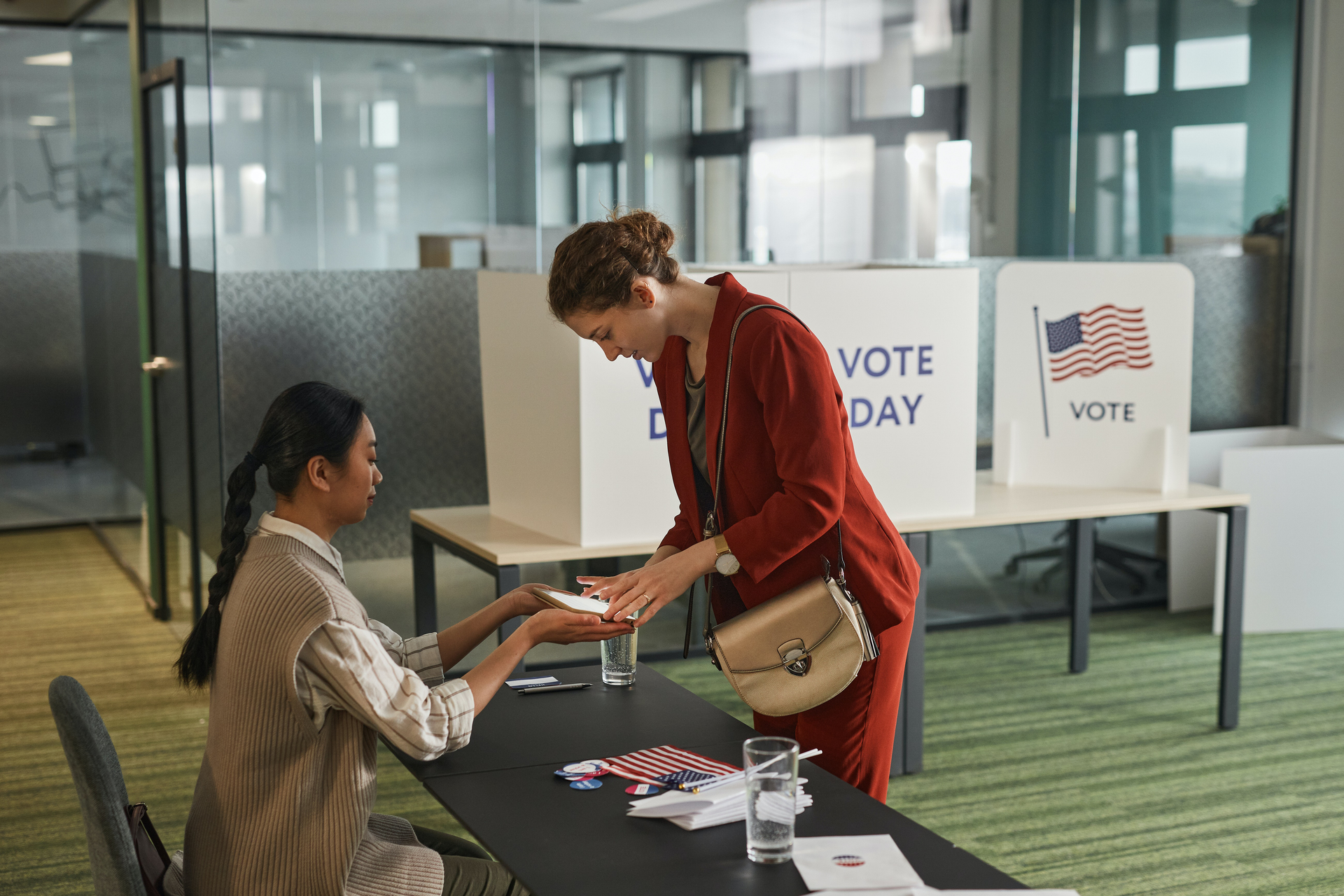
RIwl3WTlK7065
Źródło: dostępny w internecie: www.pexels.com [dostęp 27.09.2022], domena publiczna.
R1TeL9EsSt0Aq
The picture (portray/elect/day) Tu uzupełnij. This might (be/presidential/election) Tu uzupełnij in the USA, as I can see the American flag in the background. There (be/two/woman) Tu uzupełnij in the picture. (One/they/sit) Tu uzupełnij and (give/ballot paper/woman) Tu uzupełnij who is standing in front of her. I believe the woman in the red suit is going (cast/she/ballot/candidate) Tu uzupełnij that in her opinion should become the president of the USA. A big white box next to a smaller one with an emblem of the American flag is probably a ballot box. The woman should insert her ballot paper into it. It (be/important/moment) Tu uzupełnij so the women (seem/be) Tu uzupełnij serious.
Źródło: GroMar Sp. z o.o., licencja: CC BY-SA 3.0.
3
Exercise 8

You are opposed to the formula for electing the US President. Write an article for the school newspaper in which you describe what this system is about and justify why you think it is less fair than in other democratic countries.

Your letter should be 200–250 words long.

Exam tipazurewhite
R1GahIXFGzXVc
(Uzupełnij).
Źródło: GroMar Sp. z o.o., licencja: CC BY-SA 3.0.