Give the relationship between work and the change of mechanical energy.
What are simple machines for?
R7mEXd4q1h3gs
Prezentacja slajdów – co wiemy o pracy, mocy i energii. Głównym celem jest przypomnienie podstawowych wiadomości o pracy, mocy i energii. Instrukcja obsługi z poziomu klawiatury: 1. Uruchomienie aplikacji - ENTER, 2. Na każdym ze slajdów czytany jest automatycznie tekst alternatywny po polsku, 3. Przy pierwszym uruchomieniu na pierwszym slajdzie, czytanie tekstu po angielsku - TAB, 4. Przejście między slajdami: do następnego slajdu - TAB, do poprzedniego slajdu - TAB + SHIFT, 5. Przejście do czytania napisu po angielsku - strzałka w górę + strzałka w dół (czyta tekst po angielsku widoczny na slajdzie).
Prezentacja slajdów – co wiemy o pracy, mocy i energii. Głównym celem jest przypomnienie podstawowych wiadomości o pracy, mocy i energii. Instrukcja obsługi z poziomu klawiatury: 1. Uruchomienie aplikacji - ENTER, 2. Na każdym ze slajdów czytany jest automatycznie tekst alternatywny po polsku, 3. Przy pierwszym uruchomieniu na pierwszym slajdzie, czytanie tekstu po angielsku - TAB, 4. Przejście między slajdami: do następnego slajdu - TAB, do poprzedniego slajdu - TAB + SHIFT, 5. Przejście do czytania napisu po angielsku - strzałka w górę + strzałka w dół (czyta tekst po angielsku widoczny na slajdzie).
Work is a physical quantity, which is a product of the force value and the value of the body displacement in the direction parallel to the direction of the force action.
where: F - the value of force along the direction of the movement, s – the displacement of the body.
A double‑sided leverdouble‑sided leverdouble‑sided lever is a rigid rod supported at one point to which forces are applied on both sides of the fulcrum.
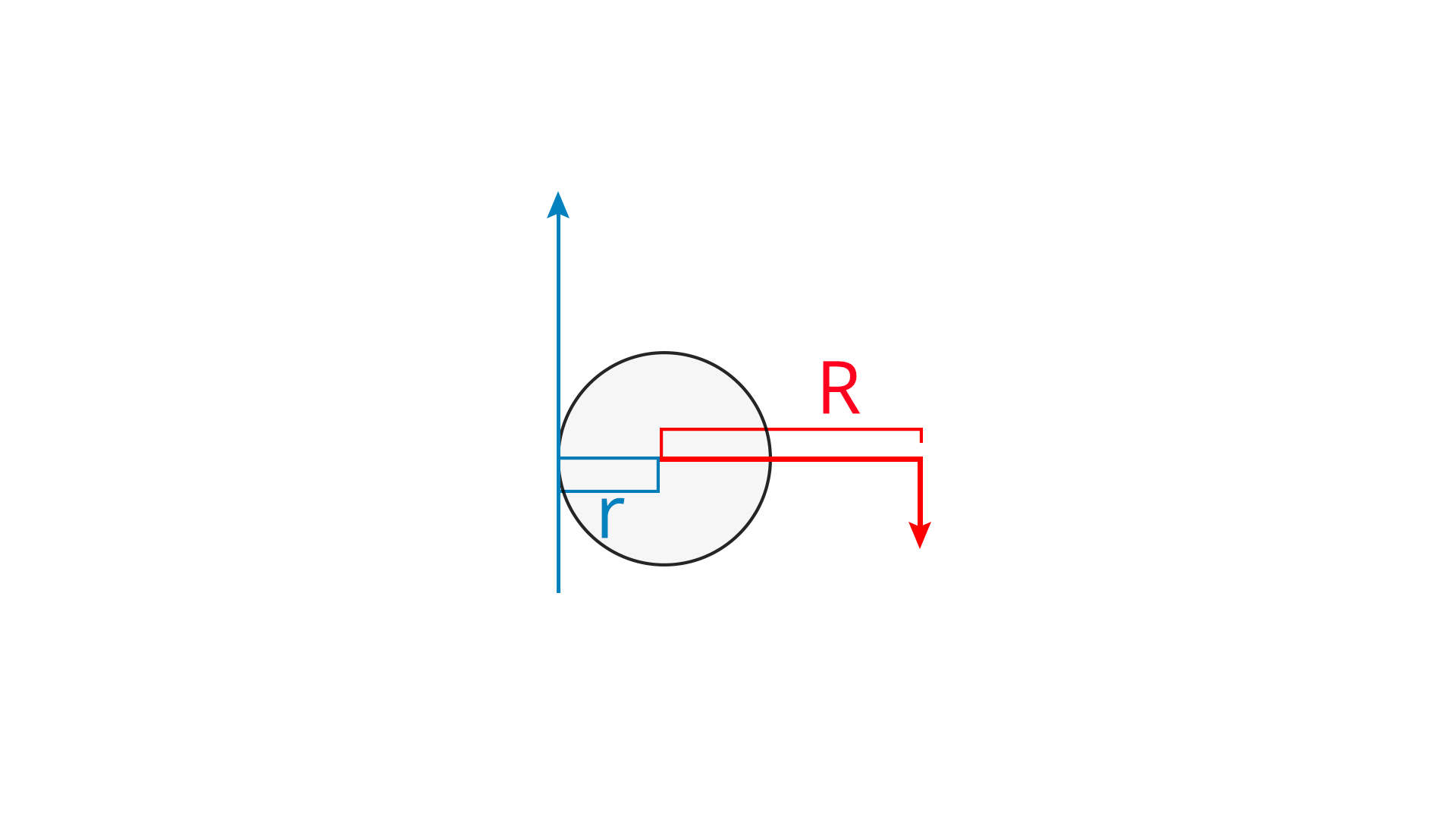
The windlasswindlasswindlass usually consists of a shaft with a radius r and a handle. The length of the handle arm R is greater than the radius r of the cylinder.
RxZhEOyFr7t9h
Na ilustracji przedstawiono model kołowrotu, który jeżeli długość korby jest większa od promienia wału, kołowrót umożliwia podnoszenie ciężkiego ciała przy użyciu mniejszej siły. Na środku narysowane jest koło symbolizujące wał. Od środka wału poprowadzono poziomy odcinek oznaczony wielkie R, symbolizujący długość ramienia korby. Od jego końca znajdującego się poza kołowrotem poprowadzono wektor długości promienia koła skierowany w dół. Od środka wału poprowadzono poziomy odcinek oznaczony małe r, symbolizujący długość promień wału. Od jego końca znajdującego się na obwodzie koła poprowadzono wektor długości ramienia korby skierowany w górę.
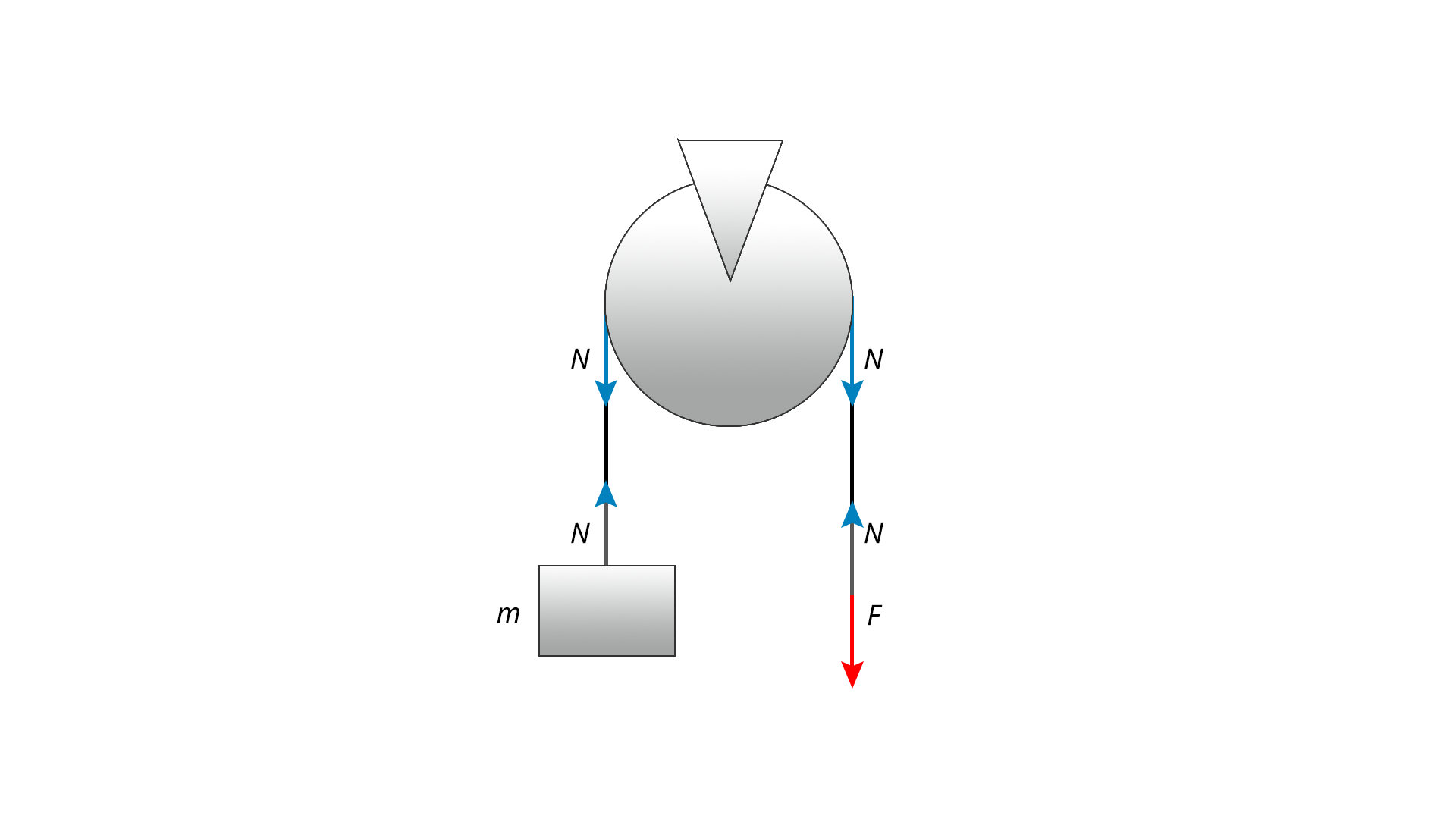
The stationary blockstationary blockstationary block is a disc that can rotate around a fixed axis. A rope is thrown through the disc, and it does not slip on the surface of the disc.
R1CEdkvTCmqSO
Na ilustracji przedstawiono model bloczka nieruchomego, czyli krążka który może wykonywać obrót wokół nieruchomej osi. Przez krążek jest przerzucona lina, która nie ślizga się względem powierzchni krążka. Narysowany jest krążek, który zaczepiony jest w środku do belki. Po lewej, jak i po prawej stronie krążka zwisa lina. Po lewej stronie krążka do liny zaczepiony jest kwadratowy blok oznaczony m. Od niego do bloczka oraz od środka bloczka do bloku zaznaczono na linie wektory N. Po prawej stronie od końca liny do bloczka oraz od środka bloczka do końca liny zaznaczono na linie wektory N oraz na końcu liny widnieje wektor F skierowany w dół.
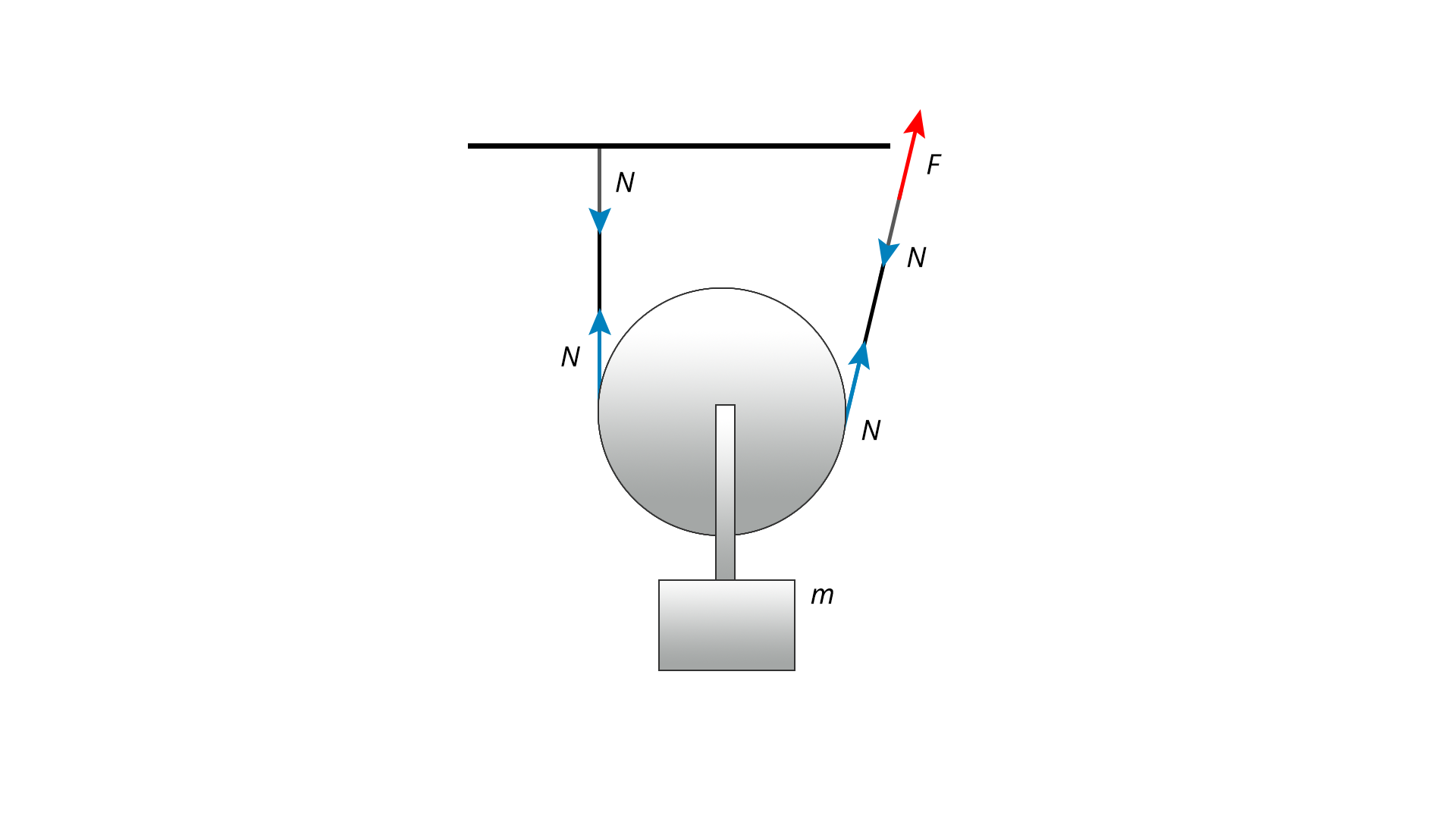
The movable blockmovable blockmovable block is a disc with a rope thrown around it that does not slide on the surface of the block, but it can move in the vertical direction and perform rotation.
RBzwH6DCf5spc
Na ilustracji przedstawiono model bloczka ruchomego, czyli krążka z przerzuconą liną nieślizgającą się po powierzchni bloczka, mogącego przemieszczać się w kierunku pionowym oraz wykonywać obrót. Narysowany jest krążek owinięty po lewej stronie liną, przyczepioną do poziomej belki. Na linie od belki do bloczka i od środka bloczka do belki zaznaczono wektory N skierowane do siebie. Do bloczku przyczepiony w środku został kwadratowy blok oznaczony m. Na linie, która idzie w prawą stronę do góry zaznaczono wektory N skierowane do siebie od środka bloczka i od końca liny, który znajduje się na wysokości belki. Od końca lin posiada dwa wektory skierowane w swoją stronę N. Na końcu liny zaznaczono wektor F skierowany w przeciwnym kierunku do bloczka.
EnergyenergyEnergy can only change its form, but it cannot be created or destroyed (the principle of energy conservationprinciple of energy conservationprinciple of energy conservation). For example, „energy production” in a coal‑fired powerpowerpower plant only means the transformation of chemical energyenergyenergy into electricity.
The kinetic energy of the body is associated with a motion. The body with mass m moving at speed v has kinetic energy, which is calculated from the formula:
An accelerating passenger car certainly has kinetic energyenergyenergy. A large truck moving at a slightly lower speed can have even greater kinetic energyenergyenergy because its weight is much greater than the weight of the passenger car.
This energy is related to the gravitational interaction between the body with mass m and the Earth (planet). This energy depends on the weight and height of the body and is expressed by the formula:
The constant g is called gravitational acceleration (acceleration of freefall) and its value for the Earth is .
The sum of the kinetic energyenergyenergy and the potential energy of a body is called mechanical energyenergyenergy.
The principle of mechanical energy conservation is one of the most important principles in physics. It says that in the case of a system of bodies on which no external forces and no resistance forces act, the total mechanical energy of the system remains constant.
1. Most phenomena in nature are associated with energy changes. Energy can be transferred from one body to another (e.g. in the form of thermal energy) or change from one form to another (e.g. kinetic energy into potential energy, electricity into heat energy).
2. The force acting on the body performs work when: during the operation of this force, the body is displaced or deformed.
3. The power of the device is the quotient of the work and the time when it was made.
4. We say that the body system is capable of performing work if it has mechanical energy. The increase of the mechanical energy of the system is equal to the external forces exerted over this system .
Returning to the previous state, the system can (at the expense of its energy) perform work of the same value.
5. The energy unit is joule [J] and watts power [W].
6. We divide mechanical energy into: potential energy (gravity and elasticity) and kinetic energy. The potential energy of the body depends on its position relative to the other body with which it interacts. Potential energy of gravity changes when the distance of the body from the Earth changes. The potential energy of elasticity is related to the elastic deformation of the body.
7. If the bodies of the system interact only with gravitational forces or elasticity, and the external force does not work on it, then the total mechanical energy, i.e. the sum of the potential and kinetic energy of this system, does not change.
Exercises
RKXWvCDnzlf1V
Exercise 1
Wersja alternatywna ćwiczenia: A truck has twice the mass of a car, but its speed is twice lower that that of the car. What are their energies? Możliwe odpowiedzi: 1. The vehicles have the same mechanical energies., 2. The truck has twice as much mechanical energy as the car., 3. The passenger car has twice as much mechanical energy as the truck., 4. The car has four times greater mechanical energy than the truck.
Wersja alternatywna ćwiczenia: A truck has twice the mass of a car, but its speed is twice lower that that of the car. What are their energies? Możliwe odpowiedzi: 1. The vehicles have the same mechanical energies., 2. The truck has twice as much mechanical energy as the car., 3. The passenger car has twice as much mechanical energy as the truck., 4. The car has four times greater mechanical energy than the truck.
A truck has twice the mass of a car, but its speed is twice lower that that of the car. What are their energies?
The vehicles have the same mechanical energies.
The truck has twice as much mechanical energy as the car.
The passenger car has twice as much mechanical energy as the truck.
The car has four times greater mechanical energy than the truck.
zadanie
Source: GroMar, licencja: CC BY 3.0.
Exercise 2
Karol lifted a rucksack weighing 4 kg to the height of 90 cm in 3 seconds. What kind of work did Karol do and what was the average power of his muscles while he was lifting the rucksack?
12 W.
Exercise 3
Some electrical devices work at your home every day. Specify the rated power of these devices and the electricity consumption per day. Write a short note in English about how to reduce the consumption of energy.
Student's own activity.
RCYsvrgiRTGDi
Exercise 4
Wersja alternatywna ćwiczenia: Indicate which pairs of expressions or words are translated correctly. Możliwe odpowiedzi: 1. praca - work, 2. moc - power, 3. energia - energy, 4. maszyny proste - simple machines, 5. zasada zachowania energii - one-sided lever, 6. dźwignia jednostronna - principle of energy conservation, 7. dźwignia dwustronna - windlass, 8. kołowrót - double-sided lever
Wersja alternatywna ćwiczenia: Indicate which pairs of expressions or words are translated correctly. Możliwe odpowiedzi: 1. praca - work, 2. moc - power, 3. energia - energy, 4. maszyny proste - simple machines, 5. zasada zachowania energii - one-sided lever, 6. dźwignia jednostronna - principle of energy conservation, 7. dźwignia dwustronna - windlass, 8. kołowrót - double-sided lever
Indicate which pairs of expressions or words are translated correctly.
praca - work
moc - power
energia - energy
maszyny proste - simple machines
zasada zachowania energii - one-sided lever
dźwignia jednostronna - principle of energy conservation
dźwignia dwustronna - windlass
kołowrót - double-sided lever
zadanie
Source: GroMar, licencja: CC BY 3.0.
RQxgYsPZlPjpS1
Interaktywna gra, polegająca na łączeniu wyrazów w pary w ciągu jednej minuty. Czas zaczyna upływać wraz z rozpoczęciem gry. Jeden ruch to odkrywanie najpierw jednej potem drugiej karty z wyrazem. Każdy wyraz jest odczytywany. Kolejny ruch to odkrywanie trzeciej i czwartej karty. W ten sposób odsłuchasz wszystkie wyrazy. Nawigacja z poziomu klawiatury za pomocą strzałek, odsłuchiwanie wyrazów enterem lub spacją. Znajdź wszystkie pary wyrazów.
Interaktywna gra, polegająca na łączeniu wyrazów w pary w ciągu jednej minuty. Czas zaczyna upływać wraz z rozpoczęciem gry. Jeden ruch to odkrywanie najpierw jednej potem drugiej karty z wyrazem. Każdy wyraz jest odczytywany. Kolejny ruch to odkrywanie trzeciej i czwartej karty. W ten sposób odsłuchasz wszystkie wyrazy. Nawigacja z poziomu klawiatury za pomocą strzałek, odsłuchiwanie wyrazów enterem lub spacją. Znajdź wszystkie pary wyrazów.
Match Polish terms with their English equivalents.
praca
moc
power
principle of energy conservation
zasada zachowania energii
simple machines
maszyny proste
energy
energia
work
Source: Zespół autorski Politechniki Łódzkiej, licencja: CC BY 3.0.