The circulation of matter and flow of energy in nature
the basic life functions of organisms;
the known links of the food chainfood chain.
to describe the circulation of matter in nature;
to describe the flow of energy in nature.
The circulation of matter in nature
Matter is the term that encompasses all known substances. Matter is what plants, animals, humans and the environment are made of. Matter in nature doesn’t increase or decrease. Instead, it is in constant circulation. As you already know, simple compounds (e.g. water, carbon dioxide or mineral salts) are assimilated by primary producersproducers in the photosynthesis process. They are used to produce protein, sugars and fats that make up a plant. When a plant is eaten, these compounds are used by herbivores – first‑order consumers – to sustain their bodies. A part of matter is excreted, e.g. in the form of simple inorganic compounds, such as water and carbon dioxide in the breathing process. Predators – second‑order consumers – eat herbivores and assimilate that matter in turn. After the death of each organism, its body is eaten by decomposersdecomposers who decompose it into simple compounds. These in turn are used by primary producers and the circle is closed.
Flow of energy in nature
Energy flows in parallel to the circulation of matter in ecosystemsecosystems. The volume of matter in circulation is constant and after various transformations still remains in the ecosystem. Energy, on the other hand, must be introduced into the system from outside and gradually dissipates. The vast majority of energy comes from the Sun.
Plants use luminous energy and store it in chemical compounds. They use a considerable part of this energy to grow their bodies, produce flowers, fruit and seeds. That’s why only part of the energy is transferred to first‑order consumersconsumers. Herbivores also use a considerable part of energy from food to sustain their own life functions (movement, body heat, food acquisition, breathing, breeding, etc.). Only a part of that energy is stored and transferred to predators. When the remains and excrements of primary producers and consumers are finally decomposed by decomposers, the rest of energy contained in chemical compounds is released. Once energy has been used, it cannot be re‑used. That’s why it’s said that, in nature, matter circulates while energy flows. The primary source of energy for all life processes on Earth is the Sun.
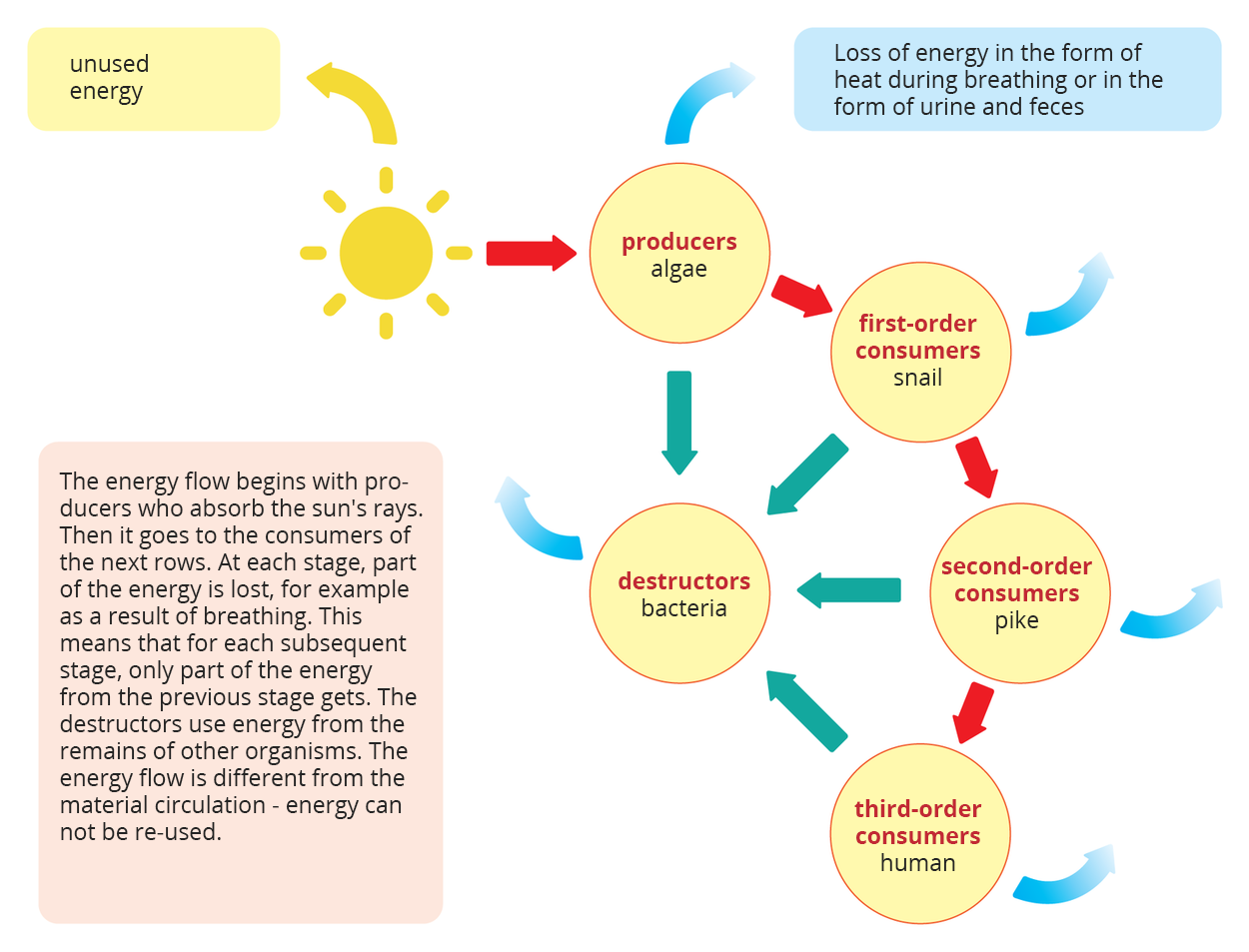
Complete the sentence.
The above illustration shows the ............................ in nature.
Match the pairs: English words with Polish definition.
organizm samożywny wytwarzający samodzielnie pokarm, szereg organizmów uporządkowanych w taki sposób, że organizm będący wcześniejszym ogniwem jest pożywieniem następnego; na samym szczycie łańcucha pokarmowego stoi drapieżnik, na którego już nikt nie poluje, odniosi się do dowolnego układu składającego się z elementów żywych lub żywych i nieożywionych, pozostających ze sobą w rozmaitych relacjach., organizm rozkładający martwą materię organiczną (np. liście, ścięte pnie, martwe zwierzęta, odchody) na związki nieorganiczne, które są pobierane przez rośliny, organizm cudzożywny odżywiający się materią organiczną pochodzącą od innych organizmów
| food chain | |
| ecosystem | |
| decomposers | |
| consumers | |
| producers |
Summary
The matter of inorganic form (water, carbon dioxide, mineral salts) changes into an organic form (sugars, proteins, fats - present in the bodies of plants and animals), finally becomes inorganic matter oncle again (result of destructors on organic compounds).
The energy flows from the sun, through the bodies of plants, animals and people, and at each stage is partly used and partly dispersed.
The circulation of matter is often drawn as a circle, as chemical compounds used at the beginning of the process may be re‑used. Propose a way in which to draw the flow of energy through the ecosystem in order to demonstrate that there’s less and less energy at each subsequent stage.
Keywords
food chain, circulation of matter, flow of energy
Glossary
łańcuch pokarmowy – szereg organizmów uporządkowanych w taki sposób, że organizm będący wcześniejszym ogniwem jest pożywieniem następnego; na samym szczycie łańcucha pokarmowego stoi drapieżnik, na którego już nikt nie poluje
ekosystem – odniosi się do dowolnego układu składającego się z elementów żywych lub żywych i nieożywionych, pozostających ze sobą w rozmaitych relacjach.
destruent – organizm rozkładający martwą materię organiczną (np. liście, ścięte pnie, martwe zwierzęta, odchody) na związki nieorganiczne, które są pobierane przez rośliny
konsument – organizm cudzożywny odżywiający się materią organiczną pochodzącą od innych organizmów
producent – organizm samożywny wytwarzający samodzielnie pokarm