The division of the history of Earth
where Earth’s place is in the Universe;
what layers Earth is made of;
how the lithosphere is built and what processes shape it.
explain the concepts of relative age and absolute age of rocks;
list methods to determine the relative age and absolute age of the researched sample;
according to the table or chart, describe the division of the history of Earth into several chronological periods.
Current calculations show that Earth is about 4.6 billion years old. Analysis of rock layering and their subsequent deformations allows us to determine which rocks or processes are the oldest. During the research, it is difficult to determine how many years old a given rock is, but you can tell from which rock it is older, and from which it is younger. The type of rock provides information about the conditions in which it was created. If there are remains of old plants or animals in it, or fossilsfossils, then its age is limited to the period when these organisms lived on Earth. This is how we determine the relative agerelative age of rocks. When examining the content of radioactive elements using (radiometric datingradiometric dating), it is possible to calculate how many years has passed since the rock was formed, i.e. determine its absolute ageabsolute age.
Thanks to the simultaneous application of all methods of determining the age of rocks, it was possible to create a geologic time scalegeologic time scale covering the entire history of Earth. The most important events helped to distinguish the so‑called geochronological units. For determining the geological time, the most often used units are eraseras lasting tens and hundreds of millions of years. They are part of eonseons – the longest units lasting from half a billion to several billion years. Less significant but still very important geological events visible in the rocks enabled the division of an era into geological periodsgeological periods.
Geology knows and applies much more detailed divisions of the history of Earth. After the invention of radiometric dating, it was possible to supplement the geologic time scale with the duration of individual eras, periods and their parts.

Film dostępny na portalu epodreczniki.pl
Nagranie filmowe wyjaśniające, na czym polega datowanie izotopowe na przykładzie czasu rozpadu atomów potasu i argonu.
How can a bunch of old newspapers be a model of rock layers?
Understanding what relative and absolute age is.
a few or a dozen of old newspapers,
a pencil and crayon.
Arrange a pile of newspapers. At the very bottom, place the oldest one, and the newest one at the top.
After arranging four newspapers, put a pencil on them, leave a pencil on the next five.
Mark the remaining newspapers according to the recommended order. Let the model created this way help you in answering the following questions.

Answer these questions:
If the newspapers were put on the stack on the day of publication, the pencil would be stuck in this pile longer than the crayon, or the other way around?
Check the dates on the newspapers. When exactly (enter the date) was the pencil placed, and when is the pencil in the stack?
Imagine the newspapers are layers of sedimentary rocks, and the pencil and crayon are fossils. What can you say about the “age” of the crayon and pencil before checking the dates of publication of individual newspapers?
Summary: When analysing the arrangement of rock layers, we can conclude which rocks are older and which ones are younger, i.e. we can determine their relative age. If we know the specific age of a rock in which the fossilized organisms remained, we can determine the absolute age of these fossils.
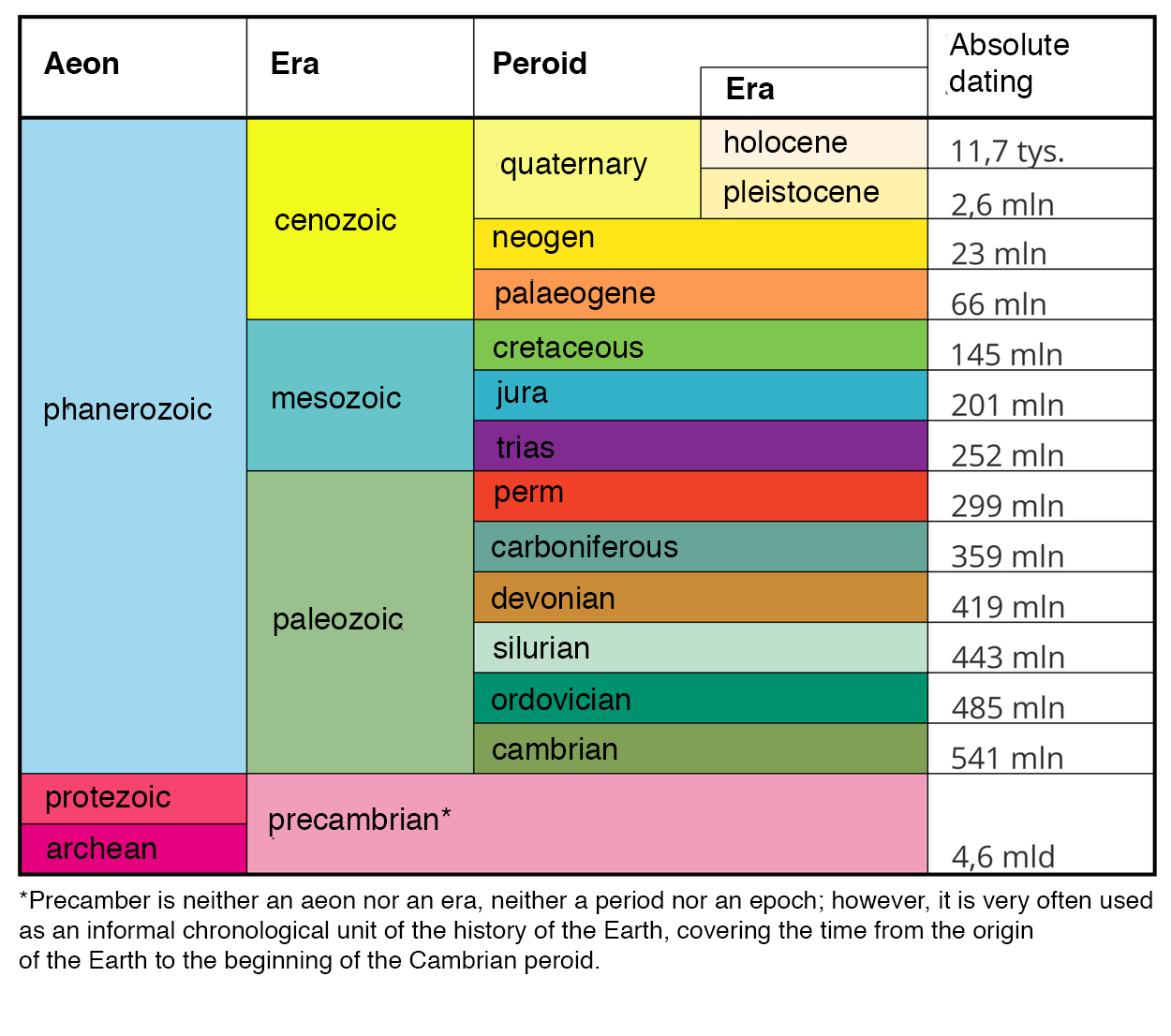
Events that shaped the geological history of Earth.
The further into the geological past, the less we know about the environment, processes and phenomena that occurred then. Thanks to many years of researches and improved methods, scientists managed to get to know the main events of the geological history of Earth.
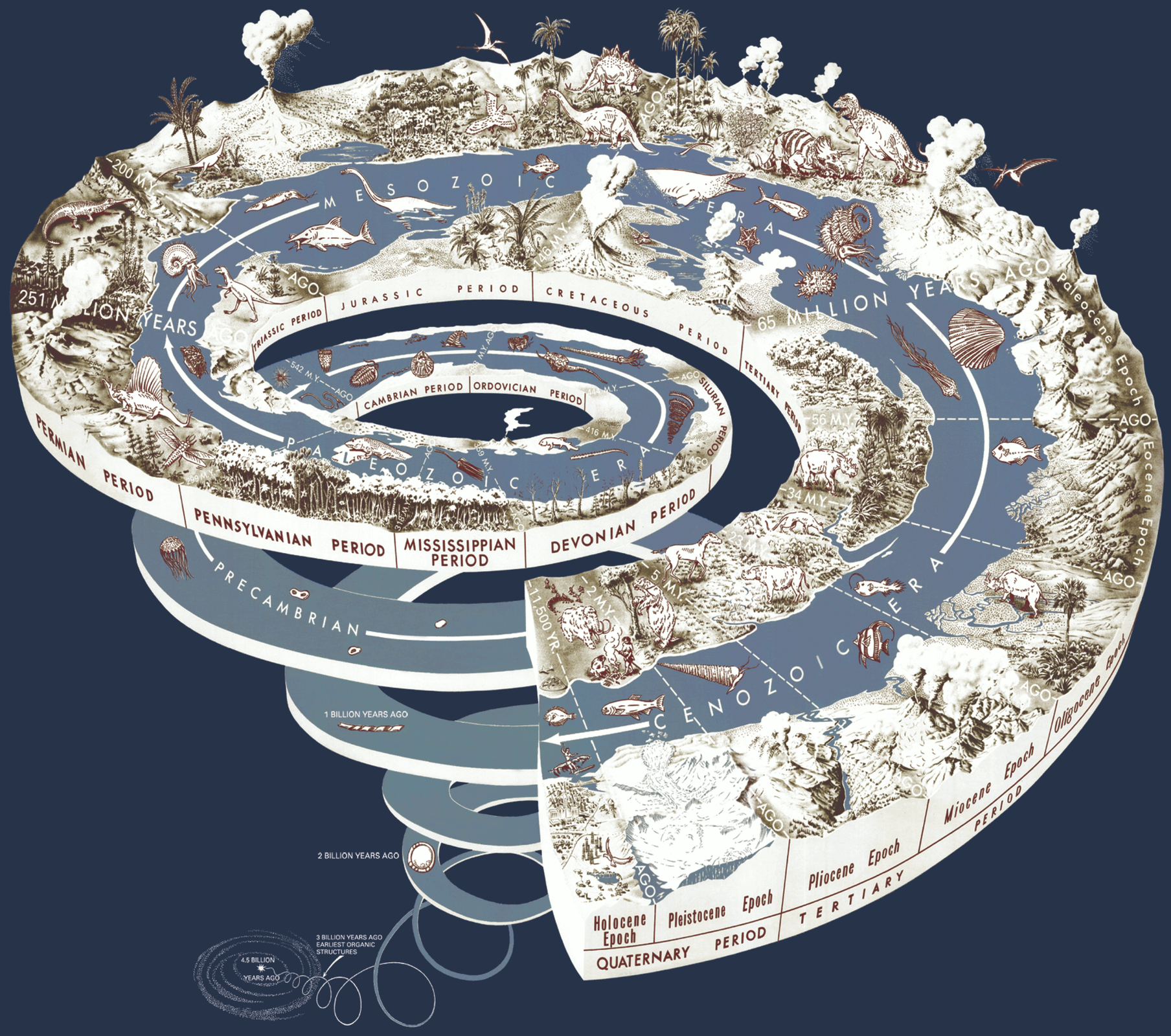
In the earliest unit of geological time – Archean lasting up to 2.5 billion years ago – Earth's crust, atmosphere and hydrosphere were formed. The foundations of all continents also appeared.
In the Proterozoic, lasting from 2.5 billion to approx. 540 million years ago, the first primitive forms of life in the oceans appeared.
In both of these eras, there were many orogenies, or mountain‑forming movements. Mountain chains, that were elevated as a result, were destroyed due to erosion processes.
In the Palaeozoic era, lasting from about 540 million years ago to about 250 million years ago, there were two orogenies, which left traces visible to this day in the form old, highly eroded mountain chains. The end of Silurian and the beginning of Devonian were marked by the Caledonian orogenesis, thanks to which there was, among other things, the uplift of some regions of the Świętokrzyskie Mountains. In Carbon and Permian, the Hercynian orogenesis occurred, which in Poland is responsible for the geological formation of the Sudetes, but also the folding of the previously created Świętokrzyskie Mountains. In Palaeozoic, organisms evolved. Fish appeared as well as the first amphibians that came out of the oceans. They quickly developed into reptiles. Between the Palaeozoic and Mesozoic eras, over 90% of all organisms have died out due to a gigantic volcanic eruption and numerous climate changes.
In the Mesozoic era, lasting from about 250 million years ago to 66 million years ago, the process of lithospheric plate movement intensified and the original land masses broke down. The reptiles had mastered all environments, and the first birds and mammals appeared. It is possible the impact of a huge asteroid 66 million years ago caused the destruction of 75% of all organisms, including great dinosaurs, marine reptiles, ammonites and many other species.
The Cenozoic era, lasting 66 million years ago to this day, is dominated by the mountain‑forming movements of the Alpine orogenesis (Carpathians are formed in Poland). During this era, mammals and birds dominate. Serious and repeated climatic changes have greatly modified the image of our planet. In the youngest period of the Cenozoic, Quaternary, there are glacial and interglacial periods in succession, humans Homo sapiens appeared.
Using the knowledge you gained, solve the exercises
According to the present state of knowledge, a Neanderthal appeared in Europe about 350‑400 thousand years ago. Among the people living in Europe, typical Neanderthal features disappeared about 25,000 years ago, which is the basis for the hypothesis that Neanderthals become extinct.
Present radiometric dating methods suitable for determining the absolute age of the Neanderthal remains found in Europe. solve the exercise using the available sources of information, e.g. from the Internet.
- radiocarbon dating
- uranium–thorium dating
- potassium–argon dating
- rubidium–strontium dating
Summary
There are many methods for determining the relative age of rocks; one of them is to analyse the rock layering in relation to each other.
Radiometric dating allows to determine the absolute age of rocks and fossils.
A geologic time scale shows the history of Earth in a concise way.
Palaeontology is based on the study of fossils, especially index fossils.
The history of Earth is a string of repeated orogenies, lithosphere movements, climate change and the continuous development of life interrupted by short periods of mass extinction.
Keywords
geologic time scale, radiometric dating, palaeontology
Glossary
eon – najwyższa jednostka podziału czasu geologicznego; dzieli się na ery
era – jednostka czasu geologicznego; jest częścią eonu i dzieli się na okresy
metody radiometryczne – stosowane są do wyznaczania bezwzględnego wieku skał, skamieniałości i minerałów; do analiz wykorzystują zjawisko rozpadu promieniotwórczego niektórych pierwiastków
okres geologiczny – jednostka czasu geologicznego niższa rangą od ery
paleontologia – nauka zajmująca się badaniem szczątków organicznych zachowanych w postaci skamieniałości oraz śladów działalności życiowej organizmów zawartych w osadach skorupy ziemskiej
skamieniałości – szczątki kopalnych organizmów zachowane w osadach skorupy ziemskiej; pierwotne tkanki organiczne oraz części twarde ciał (muszle, skorupy, szkielety) często ulegają skamienieniu wskutek procesów fosylizacji
skamieniałości przewodnie – skamieniałości charakteryzujące się krótkim czasem występowania (a więc małym zasięgiem stratygraficznym) i szerokim rozprzestrzenieniem geograficznym; na ich podstawie wyznacza się wiek względny
skala czasu geologicznego – tabela prezentująca dzieje Ziemi na podstawie następstwa procesów i warstw skalnych w podziale na eony, ery, okresy, a często także krótsze jednostki czasu geologicznego; skonstruowana jest tak, że na górze są najmłodsze jednostki czasu, a na dole najstarsze; takie ułożenie naśladuje ułożenie warstw skalnych oraz liniową kolejność dziejów Ziemi, czyli od najstarszych do najmłodszych
wiek bezwzględny – wiek obiektu geologicznego lub wydarzenia liczony w latach (tysiącach, milionach i miliardach) od momentu powstania obiektu lub zjawiska do dzisiaj
wiek względny – ustala wiek obiektów lub wydarzeń geologicznych w odniesieniu do innych; pozwala na określenie, które elementy są starsze, a które młodsze, lecz nie pozwala na precyzyjne określenie ich wieku w latach