a) When is the body moving and when is at rest relative to another body? b) Divide the motions due to trajectorytrajectorytrajectory, velocity and acceleration. c) Give the characteristics of rectilinear motion. d) What should be done to set the body in motion? e) When are the forces acting on the body balanced?
a) If the body changes its position relative to the motionless reference frame (another body), then it is in motion. b) Due to trajectory, motion can be divided into rectilinear and curvilinear motion. Motion with constant velocity in a straight line is called uniform rectilinear motion. Motion in which the speed increases is called accelerated. Motion having a constant acceleration, moving in a straight line is called uniformly accelerated rectilinear motion. Motion in which uniform rectilinear and uniformly accelerated rectilinear motion phases occur is called a complex motion. c) The trajectory of rectilinear motion is a straight line. d) In order to set the body in motion, it is necessary to throw it off equilibrium state by applying an unbalanced force. e) Forces acting on the body are balanced when the resultant force is zero.
View the drawings below and follow the instructions given below.
R1LHxiQoY34oH1
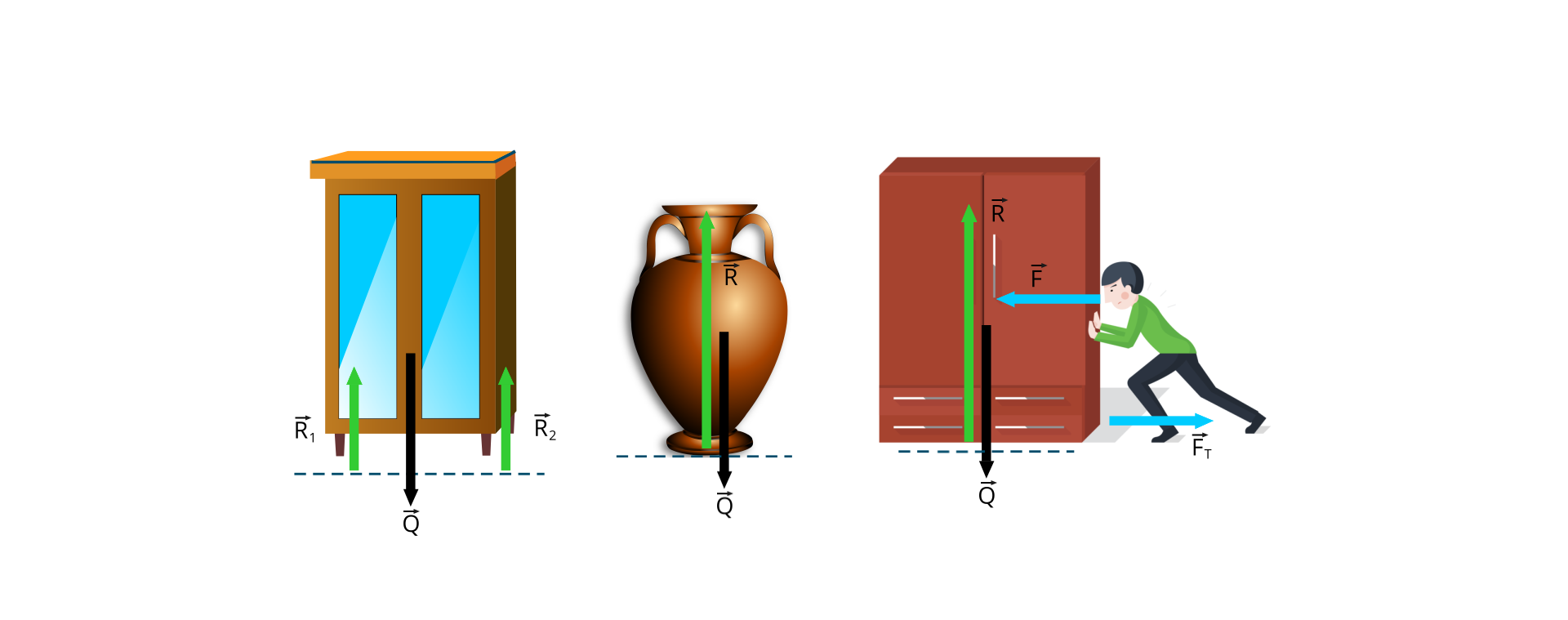
Na ilustracji znajduje się od lewej: stojąca szafa na nóżkach z przeszklonymi drzwiami, stojący dzban, chłopiec pchający szafę, oparty o prawy bok szafy.
a) Draw forces acting on the objects shown in Fig. 1, 2, 3. b) Give the magnitude of the resultant force acting on these bodies shown in Fig. 1, 2. c) When will the body be at rest?
RZ7oCaONPRw1S
Na ilustracji znajduje się pozioma linia przerywana, styczne do niej są od lewej: stojąca szafa na nóżkach z przeszklonymi drzwiami, stojący dzban, chłopiec pchający szafę, oparty o prawy bok szafy. Zaznaczone zostały działające siły. Od środka szafy z nóżkami narysowana jest pionowa strzałka skierowana do dołu opisana Q. Od linii przerywanej, w miejscu styku z lewą nóżką szafy narysowana jest pionowa strzałka skierowana do góry opisana R z indeksem dolnym 1. Od linii przerywanej, w miejscu styku z lewą nóżką szafy narysowana jest pionowa strzałka skierowana do góry opisana R z indeksem dolnym 2. Od środka dzbana narysowana jest pionowa strzałka skierowana do dołu opisana Q. Od linii przerywanej, w miejscu jej styku z podstawą dzbana narysowana jest pionowa strzałka skierowana do góry opisana R. Od środka szafy narysowana jest pionowa strzałka skierowana do dołu opisana Q. Od linii przerywanej, w miejscu jej styku z podstawą dzbana narysowana jest pionowa strzałka skierowana do góry opisana R. W miejscu styku dłoni chłopca z bokiem szafy narysowana jest pozioma strzałka skierowana w lewo opisana F. W miejscu styku podstawy szafy z podłożem, od prawego boku szafy narysowana jest pozioma strzałka skierowana w prawo opisana F. Nad literami opisującymi siły narysowane strzałki poziome skierowane w prawo.
a) Forces acting on the body are the gravitational force , the reaction force of the surface (against the normal force ). In the case of a wardrobe, the boy applies the force on the wardrobe, and the floor applies the friction force on the wardrobe. b) Since the wardrobe and the jug are at rest, the resulting force must be equal to zero. In the case of a standing cabinet, . In the case of a standing jug, . c) The body is at rest when the forces acting on this body are balanced.
Provide conclusions resulting from the presented pictures regarding the inertia of bodies.
R1UcCYEXGJbVW
Pokaz slajdów - Bezwładność ciał. Instrukcja obsługi z poziomu klawiatury: 1. Uruchomienie aplikacji - ENTER, 2. Na każdym ze slajdów czytany jest automatycznie tekst alternatywny po polsku, 3. Przy pierwszym uruchomieniu na pierwszym slajdzie, czytanie tekstu po angielsku - TAB, 4. Przejście między slajdami: do następnego slajdu - TAB, do poprzedniego slajdu - TAB + SHIFT, 5. Przejście do czytania napisu po angielsku - strzałka w górę + strzałka w dół (czyta tekst po angielsku widoczny na slajdzie).
Pokaz slajdów - Bezwładność ciał. Instrukcja obsługi z poziomu klawiatury: 1. Uruchomienie aplikacji - ENTER, 2. Na każdym ze slajdów czytany jest automatycznie tekst alternatywny po polsku, 3. Przy pierwszym uruchomieniu na pierwszym slajdzie, czytanie tekstu po angielsku - TAB, 4. Przejście między slajdami: do następnego slajdu - TAB, do poprzedniego slajdu - TAB + SHIFT, 5. Przejście do czytania napisu po angielsku - strzałka w górę + strzałka w dół (czyta tekst po angielsku widoczny na slajdzie).
If the forces acting on the body are balanced and the body has no initial speed, it remains at rest.
If the forces acting on the body are balanced, but the body has an initial speed then the body will move at the same velocity.
If the body had an initial speed, but the forces stopped acting on it, the body would continue to move at the same velocity.
If the forces acting on the body moving in a circle stopped acting, the body will continue the motion at the same speed, but in uniform rectilinear motion.
If there is no force acting on a body or the forces acting on the body are balanced, the body remains at rest or moves in uniform rectilinear motion. The reference frame, in which the first Newton’s law is met is called the inertial reference frame.
RERZ9Td81CwDF1
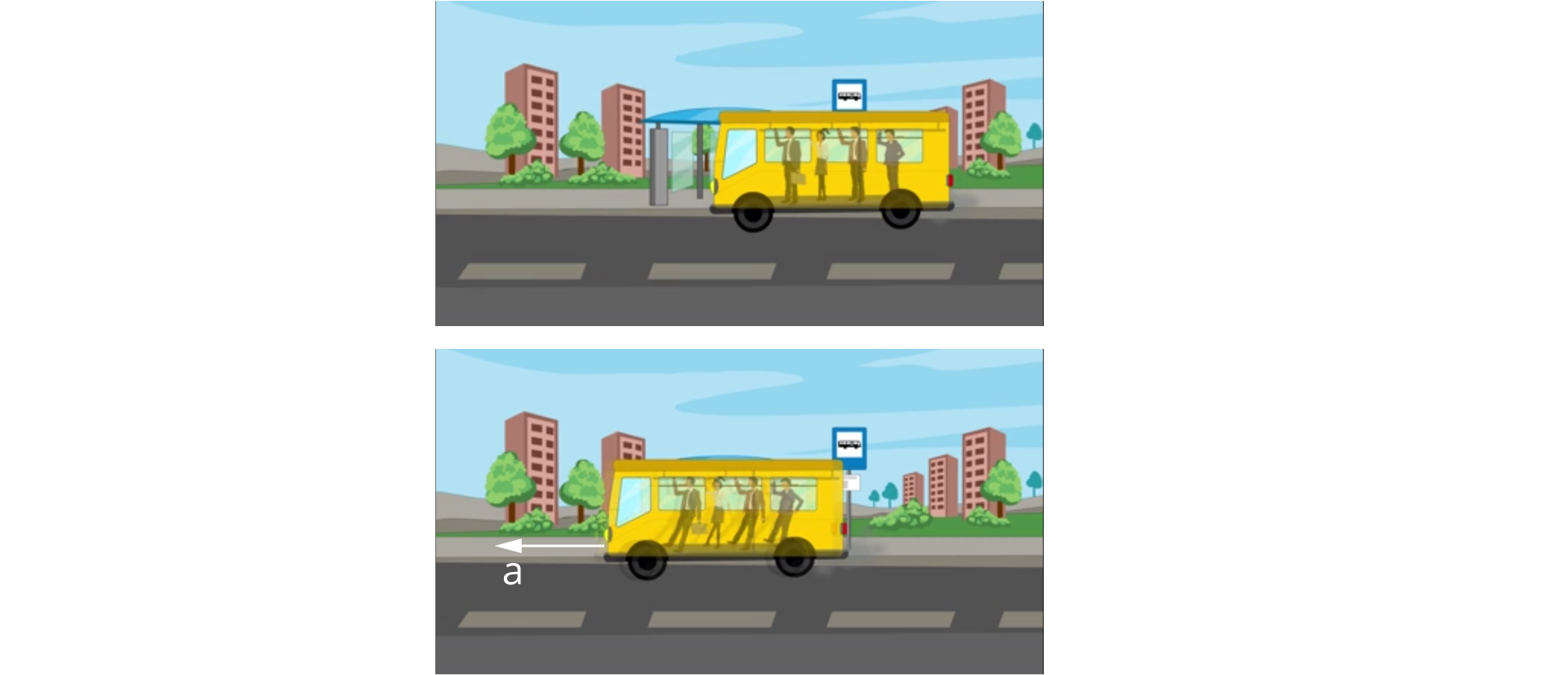
Ilustracja górna przedstawia autobus na ulicy, w tle przystanek autobusowy, za nim trawnik, drzewa i bloki. W autobusie narysowane są półprzezroczyste sylwetki stojących osób, trzymających się uchwytów na górze. Ilustracja dolna przedstawia autobus na ulicy, w tle po prawej stronie przystanek autobusowy, za nim trawnik, drzewa i bloki. W autobusie narysowane są półprzezroczyste sylwetki stojących osób, trzymających się uchwytów na górze. Tułów sylwetek odchylony jest w prawą stronę, uniesione lekko stopy i ręka trzymająca uchwyt znajdują się w tym samym miejscu. Od przodu autobusu narysowana pozioma strzałka skierowana w lewo opisana a.
We encounter the inertia of bodies every day in different circumstances. Most often in starting from a stop or braking tram or other vehicle. When the tram starts then it „throws” us back, as if some force, opposite to the direction of motion, acted. Our body behaves as if it wanted to be at rest, at the bus stop. When the tram brakes, passengers feel pushed forward as if they wanted to continue to move at their current speed.
In conclusion, the physical body has a characteristic that causes the body to maintain its state of motion - rest or uniform motionuniform motionuniform motion in a straight line. This characteristic is called inertia. The body mass is the measure of inertia.
Inertia of the body occurs in non‑inertial reference frames, i.e. those that move with acceleration.
R1Xb9OFmKK3XK
W punkcie a ilustracji interaktywnej narysowany jest po lewej stronie płaski wózek oznaczony numerem 5. Z jego prawej strony narysowana jest strzałka pozioma w prawo, Platform acceleration, opisana a. Nad a strzałka pozioma w prawo. Po prawej stronie strzałki narysowana jest sylwetka stojącego mężczyzny, oznaczona numerem 1. W miejscu stóp znajduje się układ współrzędnych, oznaczony numerem 3, z osiami opisanymi: pozioma x, prostopadła y, pionowa z. Od sylwetki narysowana ramka z napisem: There are no inertial forces in my reference frame. W punkcie b ilustracji interaktywnej narysowany jest po lewej stronie płaski wózek oznaczony numerem 6. Z jego lewej strony strzałka pozioma skierowana w prawo opisana F z indeksem dolnym b. Nad F strzałka pozioma skierowana w prawo. Z jego prawej strony narysowana jest strzałka pozioma w prawo, Platform acceleration, opisana a. Nad a strzałka pozioma w prawo. Na wózku narysowana jest sylwetka stojącego mężczyzny, oznaczona numerem 2. W miejscu stóp znajduje się układ współrzędnych, oznaczony numerem 4, z osiami opisanymi: pozioma x z indeksem dolnym b, prostopadła y z indeksem dolnym b, pionowa z z indeksem dolnym b. Od sylwetki narysowana ramka z napisem: There are inertial forces in my reference frame. Na ilustracji widoczne są numery, a na nich podpisy. 1. observer in the inertial reference frame (x, y, z) {audio}, 2. observer in non-inertial reference frame (x, y, z) {audio}, 3. inertial reference frame (x, y, z) {audio}, 4. non-inertial reference frame (x, y, z) {audio}, 5. the body in accelerated motion {audio}, 6. the body in accelerated motion {audio}.
W punkcie a ilustracji interaktywnej narysowany jest po lewej stronie płaski wózek oznaczony numerem 5. Z jego prawej strony narysowana jest strzałka pozioma w prawo, Platform acceleration, opisana a. Nad a strzałka pozioma w prawo. Po prawej stronie strzałki narysowana jest sylwetka stojącego mężczyzny, oznaczona numerem 1. W miejscu stóp znajduje się układ współrzędnych, oznaczony numerem 3, z osiami opisanymi: pozioma x, prostopadła y, pionowa z. Od sylwetki narysowana ramka z napisem: There are no inertial forces in my reference frame. W punkcie b ilustracji interaktywnej narysowany jest po lewej stronie płaski wózek oznaczony numerem 6. Z jego lewej strony strzałka pozioma skierowana w prawo opisana F z indeksem dolnym b. Nad F strzałka pozioma skierowana w prawo. Z jego prawej strony narysowana jest strzałka pozioma w prawo, Platform acceleration, opisana a. Nad a strzałka pozioma w prawo. Na wózku narysowana jest sylwetka stojącego mężczyzny, oznaczona numerem 2. W miejscu stóp znajduje się układ współrzędnych, oznaczony numerem 4, z osiami opisanymi: pozioma x z indeksem dolnym b, prostopadła y z indeksem dolnym b, pionowa z z indeksem dolnym b. Od sylwetki narysowana ramka z napisem: There are inertial forces in my reference frame. Na ilustracji widoczne są numery, a na nich podpisy. 1. observer in the inertial reference frame (x, y, z) {audio}, 2. observer in non-inertial reference frame (x, y, z) {audio}, 3. inertial reference frame (x, y, z) {audio}, 4. non-inertial reference frame (x, y, z) {audio}, 5. the body in accelerated motion {audio}, 6. the body in accelerated motion {audio}.
Observer in an inertial and non-inertial reference frame
Inertial reference frameinertial reference frameInertial reference frame - a reference frame in which the first Newton's lawfirst Newton’s law first Newton's law is met.
1. We cover the glass with a sheet of paper on which we place the coin. 2. We move the sheet slowly. 3. We pull the sheet quickly. 4. We place the glass on a sheet of paper lying on the table. We move the sheet slowly. 5. We pull out the sheet from under the glass. 6. We repeat points 4 and 5 for a glass filled with water.
Summary
RH5WicRS45Xbb1
Ilustracja przedstawia dwie szklanki. Szklanka po lewej stronie wypełniona jest wodą, na szklance leży kartka papieru, na jej środku moneta. Szklanka po prawej jest pusta, pod nią leży kartka papieru.
1. When we pull the sheet slowly, the coin moves with it. 2. When we pull the sheet quickly, the coin falls into the glass. 3. When we pull the sheet out from under the glass slowly, the glass moves with the sheet. 4. When we pull the sheet out from under the glass with quickly, the glass stays at the same place as it was. 5. It is easier to pull a sheet of paper from under a glass filled with water.
Conclusion
The physical body, in this case the coin and the glass, wants to keep its state of motion, in this case state of rest. This characteristic is called inertia. The measure of inertia of the body is its mass.
Exercise 3
RZSxUcalPu5tD
Wersja alternatywna ćwiczenia: Determine which sentences are true. Możliwe odpowiedzi: 1. There are no forces acting on the book lying on the table., 2. Only gravitational force acts on the book lying on the table., 3. Balanced forces act on the book lying on the table., 4. The resultant of all forces acting on the book lying on the table is 0 N.
Wersja alternatywna ćwiczenia: Determine which sentences are true. Możliwe odpowiedzi: 1. There are no forces acting on the book lying on the table., 2. Only gravitational force acts on the book lying on the table., 3. Balanced forces act on the book lying on the table., 4. The resultant of all forces acting on the book lying on the table is 0 N.
Determine which sentences are true.
There are no forces acting on the book lying on the table.
Only gravitational force acts on the book lying on the table.
Balanced forces act on the book lying on the table.
The resultant of all forces acting on the book lying on the table is 0 N.
The cause of changes in a speed of the body relative to the motionless reference frame is the existence/acting of unbalanced force on this body.
Bodies at rest tend to be at rest, bodies moving - to maintain its motion without changing the speed. This resistance of bodies to changes of the state of motion is called inertia. Inertia is evident in reference frame that accelerate, decelerate or change the direction of motion.
Mass is a measure of the amount of matter in a given object. It is a measure of inertia - resistance which this object puts when we want to move it, stop it or change its motion in some way.
The first Newton's law is that if no force or balanced forces act on the body, the body remains at rest or moves in uniform rectilinear motion.
Exercises
RinR1UAVD55vB
Exercise 4
Wersja alternatywna ćwiczenia: If a sledge goes downhill from the hill in uniform rectilinear motion, then: Możliwe odpowiedzi: 1. the downhill force acting on the sled is greater than its weight., 2. the downhill force acting on the sled is greater than the friction force., 3. all forces acting on the sledge are balanced., 4. only the normal force acts on it.
Wersja alternatywna ćwiczenia: If a sledge goes downhill from the hill in uniform rectilinear motion, then: Możliwe odpowiedzi: 1. the downhill force acting on the sled is greater than its weight., 2. the downhill force acting on the sled is greater than the friction force., 3. all forces acting on the sledge are balanced., 4. only the normal force acts on it.
If a sledge goes downhill from the hill in uniform rectilinear motion, then:
the downhill force acting on the sled is greater than its weight.
the downhill force acting on the sled is greater than the friction force.
all forces acting on the sledge are balanced.
only the normal force acts on it.
zadanie
Source: GroMar, licencja: CC BY 3.0.
Exercise 5
Perform the experiment according to the instructions given below and present the record of observations and conclusions in the notebook.
1. On a flat table, put a thin slat, part of which (about 1/4 of the length) protrudes beyond the edge of the table. 2. Cover the slat with a newspaper. The newspaper must adhere exactly to the slat and table. 3. Press slowly on the slat. 4. Hit the slat strongly and quickly catch.
R1TRctEQujn991
Ilustracja przedstawia stół, na którym leży listewka drewniana, która wystaje poza krawędź stołu. Na stole na listewce leży gazeta.
Source: GroMar, licencja: CC BY 3.0.
Observation:
a) With a slow pressing on the slat the newspaper rises without much resistance.
b) With a quick pressing on the slat the newspaper strongly counteracts its lifting. The slat may even break if the impact is strong.
Conclusions:
a) With the slow lifting of the newspaper, important is only the newspaper weight. The presence of atmospheric gas does not affect the lifting of the newspaper. This is because during the slow detachment of the newspaper from the table, air flows in and equalizes the atmospheric pressure acting on the lower surface of the newspaper with the atmospheric pressure acting on the upper surface of the newspaper.
b) When lifting the newspaper, the inertia of the newspaper itself and the gas layer (atmosphere) above it is revealed. Gas pressure under the newspaper is much lower than above it.
Exercise 6
Describe in English, examples of practical application of the first Newton’s law.
a) While riding a bicycle, you can stop pedalling for a moment, and yet the bicycle will continue to move at its current speed thanks to its inertia.
b) When riding on roller skates on the pavement, you can stop to push off the ground for a while, and the movement will continue.
R7YtBZbZEIXUN
Exercise 7
Wersja alternatywna ćwiczenia: Indicate which pairs of expressions or words are translated correctly. Możliwe odpowiedzi: 1. bezwładność ciał - inertia of bodies, 2. równoważenie się sił - balancing of forces, 3. układ odniesienia - reference frame, 4. tor ruchu - trajectory, 5. ruch złożony - uniform motion, 6. ruch jednostajny - complex motion
Wersja alternatywna ćwiczenia: Indicate which pairs of expressions or words are translated correctly. Możliwe odpowiedzi: 1. bezwładność ciał - inertia of bodies, 2. równoważenie się sił - balancing of forces, 3. układ odniesienia - reference frame, 4. tor ruchu - trajectory, 5. ruch złożony - uniform motion, 6. ruch jednostajny - complex motion
Indicate which pairs of expressions or words are translated correctly.
bezwładność ciał - inertia of bodies
równoważenie się sił - balancing of forces
układ odniesienia - reference frame
tor ruchu - trajectory
ruch złożony - uniform motion
ruch jednostajny - complex motion
zadanie
Source: GroMar, licencja: CC BY 3.0.
R16XaZHrRYvwc1
Interaktywna gra, polegająca na łączeniu wyrazów w pary w ciągu jednej minuty. Czas zaczyna upływać wraz z rozpoczęciem gry. Jeden ruch to odkrywanie najpierw jednej potem drugiej karty z wyrazem. Każdy wyraz jest odczytywany. Kolejny ruch to odkrywanie trzeciej i czwartej karty. W ten sposób odsłuchasz wszystkie wyrazy. Nawigacja z poziomu klawiatury za pomocą strzałek, odsłuchiwanie wyrazów enterem lub spacją. Znajdź wszystkie pary wyrazów.
Interaktywna gra, polegająca na łączeniu wyrazów w pary w ciągu jednej minuty. Czas zaczyna upływać wraz z rozpoczęciem gry. Jeden ruch to odkrywanie najpierw jednej potem drugiej karty z wyrazem. Każdy wyraz jest odczytywany. Kolejny ruch to odkrywanie trzeciej i czwartej karty. W ten sposób odsłuchasz wszystkie wyrazy. Nawigacja z poziomu klawiatury za pomocą strzałek, odsłuchiwanie wyrazów enterem lub spacją. Znajdź wszystkie pary wyrazów.
Match Polish terms with their English equivalents.
bezwładność ciał
first Newton’s law
I zasada dynamiki Newtona
układ nieinercjalny
inertial frame
równoważenie się sił
układ inercjalny
non-inertial frame
balancing of forces
inertia of bodies
Source: Zespół autorski Politechniki Łódzkiej, licencja: CC BY 3.0.