The government of experts and the first economic reforms
to explain what were the factors hindering the process of integration of the reborn Polish state;
to describe the objectives and the consequences of Władysław Grabski's reform;
to characterize the aims of the agricultural reform and the construction of the port in Gdynia.
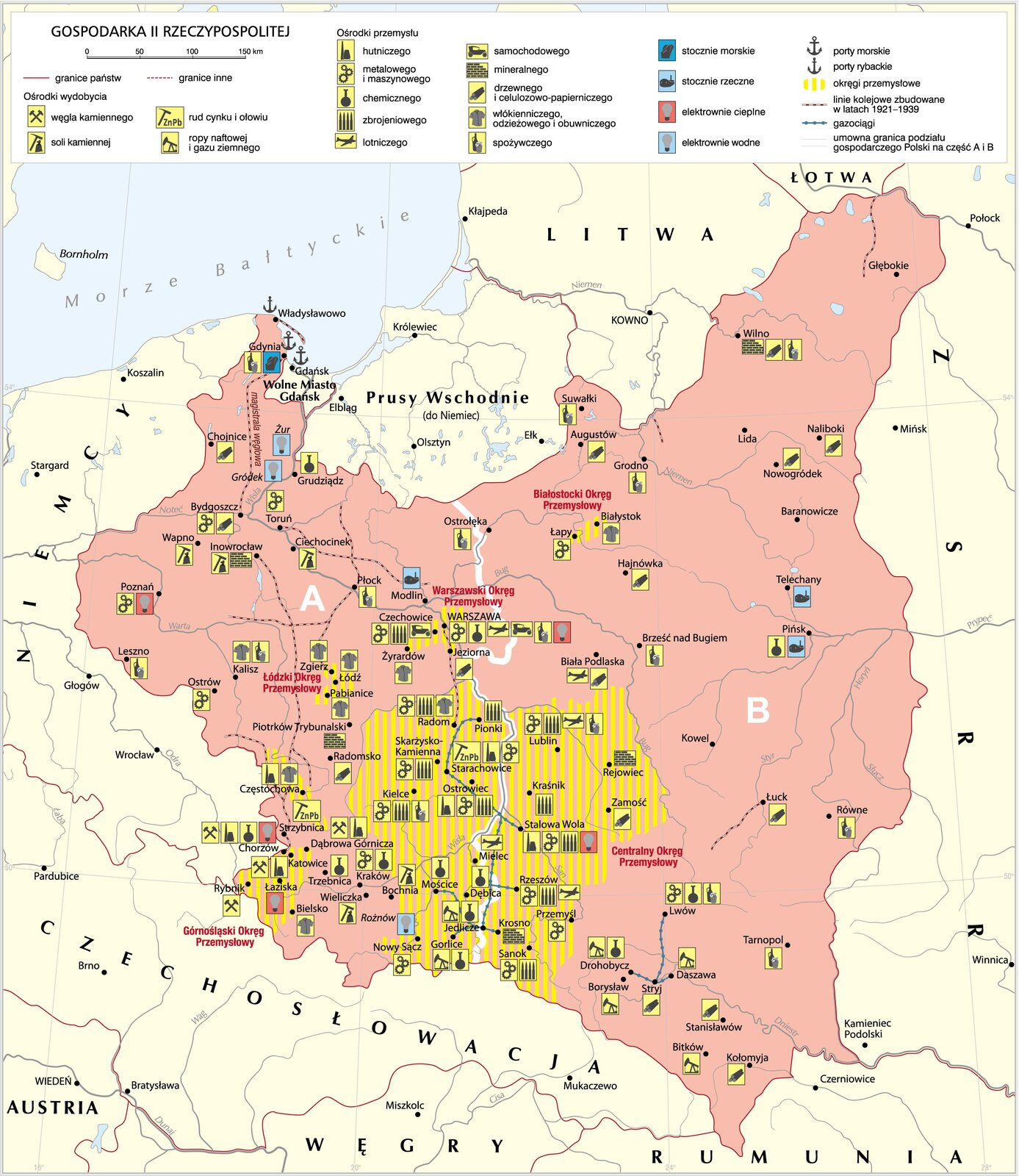
Subsequent governmental cabinets tried to stabilize the country's economic life. They managed to unify the taxation and revenue system only partially. In March of 1920, a uniform Polish mark was introduced across almost the entire area of the Second Polish Republic. The fiscal system was also unified. The government, trying to meet all obligations, printed money without having the funds to back it. This led to a collapse of the value of the Polish mark, and eventually the hiperinflationhiperinflation. On December 19th, 1923 the President decided to establish the so‑called government of experts equipped with special powers of attorney to undertake extra‑parliamentary activities. Władysław Grabski stood at the head of this government. He began the reforms with the introduction of budget savings. Taxation issues were also stabilized. A new issuing institution was established, i.e. a private Bank of Poland, which was responsible for the issuance of currency. In 1924, a new currency was introduced, which was zloty. One of the most important achievements of the Grabski government was the implementation of agricultural reform. In 1924, the Polish economy suffered losses as a result of the so‑called customs war with Germany. This motivated the Polish government to seek new markets for Polish goods and new trading partners. As a result of this, Poland managed to become economically independent from Germany. the customs warthe customs war It also had an impact on the deterioration of relations with Gdansk. Due to this, the construction of the port in Gdynia was accelerated. At the end of April 1923, temporary naval base, temporary harbor and shelter for fishermen were opened. The initiator and instigator of the undertaking was engineer Tadeusz Wenda. Nevertheless, tremendous credit for the obtaining of funds for the construction of the port and the expansion of Gdynia goes to Eugeniusz Kwiatkowski. In 1926, Gdynia received the status of municipality.
Study the list of losses (values estimated in francs) and tell in which areas the losses were the greatest. Which of them could have impeded the economic recovery of the Second Republic of Poland the most?
List of Polish war losses presented to the Compensation Committee - Paris, March 1919Mamy zaszczyt przedstawić listę strat wojennych poniesionych przez Rzeczpospolitą Polską. Lista jest tylko prowizoryczna. Oparta jest ona częściowo na danych urzędowych, częściowo na metodzie statystycznej. […]
Własność rolna (z wyjątkiem budynków):
a) Zniszczenie i obniżenie wartości ziemi przez okopy, bombardowanie itd. fr. 3 127 000 000
b) Zabrane bydło 5 400 000 000
c) Inwentarz martwy (maszyny, narzędzia, środki transportu zabrane i zniszczone) 2 400 000 000
d) Produkty rolne zabrane i zniszczone (zbiory na pniu, ziarno, zboże, różne produkty) 302 100 000
e) Strata w dochodzie z gruntów znajdujących się na terenie operacji wojennych 3 300 000 000Przemysł 10 123 000 000
Handel 1 167 000 000
Kontrybucje wojenne, kwaterunki, utrzymanie garnizonów fr. 634 000 000
Złoto wywiezione z kraju 494 000 000
Emisja polskich marek 110 000 000
Koleje żelazne 4 764 000 000
Source: K. Olszewski, List of Polish war losses presented to the Compensation Committee - Paris, March 1919, [w:] K. Juszczyk, T. Maresz, Historia w tekstach źródłowych, t. 3, Rzeszów 1999, s. 79–80.
The illustration shows the building of the Bank of Poland., 1925 Beginning of the customs war between Poland and Germany Suspension of trading relations. Trade with Germany accounted for nearly half of Polish export. The customs war with our western neighbour led to deepening of the economic crisis in Poland, decline in the value of zloty and in industrial production. Unemployment and inflation increased throughout the country, as did the budget deficit.
In the same year, the Agricultural Reform Act in the form proposed by the Grabski government was passed.
The illustration shows the Minister of Foreign Affairs of the Weimar Republic, Gustav Stresemann.

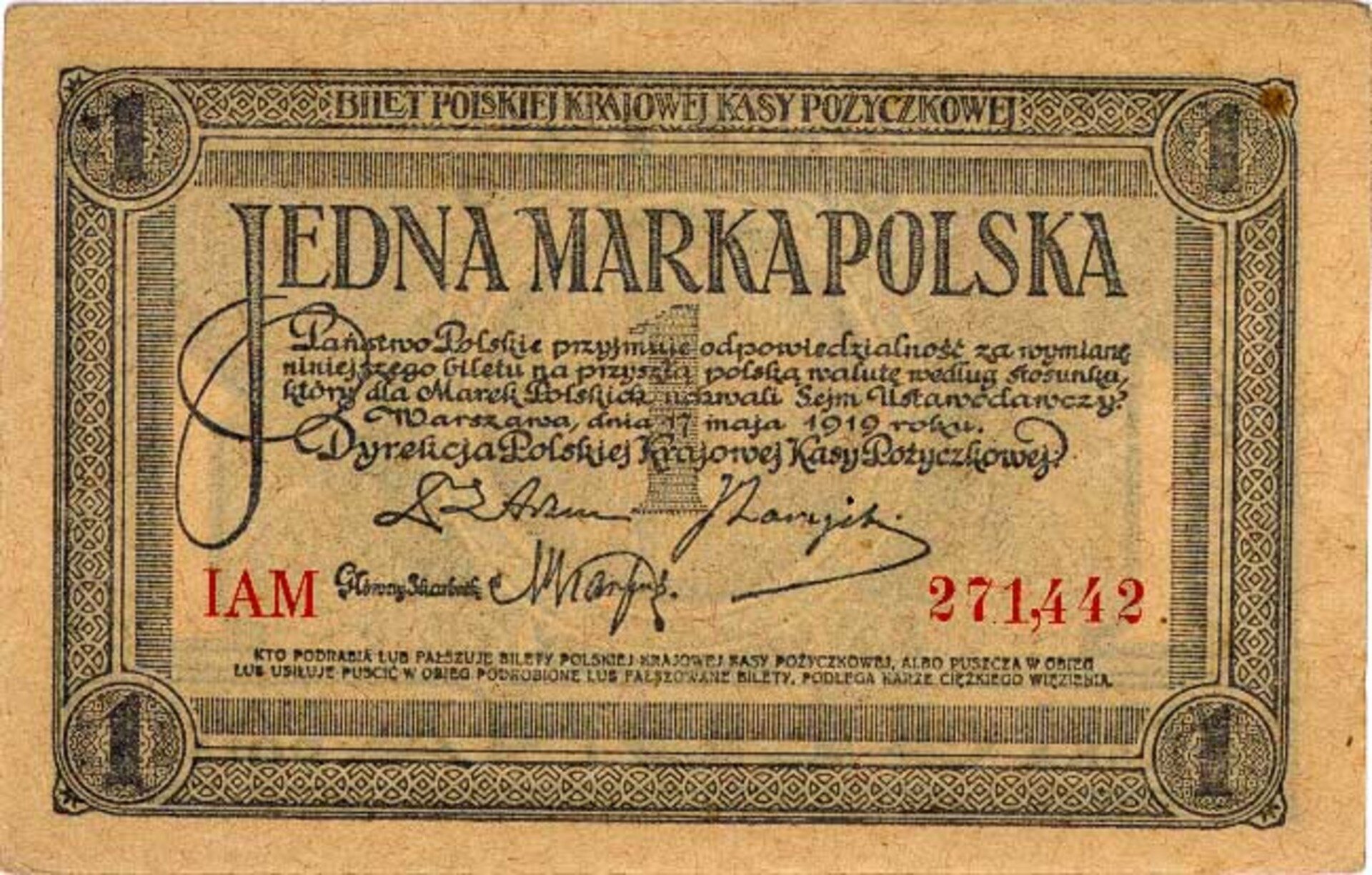
Select the correct answer.
- Declaration of exchange of the note for "future Polish currency".
- Missing signature of the Prime Minister.
- The bank note was issued by the Management of the Polish National Loan Fund.
Using the data in the table, complete the exercise.
Inflation and hyperinflation in Poland in the years 1918–1923 | ||
Year | Nominal value of the money circulation [in millions] | S dollar exchange rate [in Polish marks] |
1919 | 5316 | 110 |
1920 | 49 361 | 590 |
1921 | 229 538 | 2922 |
1923 | 125 317 955 | 637 000 |
Indicate the false statement.
- As can be seen, in the indicated period, the value of zloty to dollar remained at the same level.
- In the indicated period, the value of zloty in relation to dollar dropped over 200%.
- In the given period both inflation and hyperinflation are evident.
In your opinion, why was Grabski's government equipped with special powers of attorney allowing for undertaking extra-parliamentary activities?
- It made the government independent of the politically divided and unstable parliament, and thus allowed for quick decision making.
- Members of the parliament shed their responsibility for conducting economic policy.
- Grabski agreed to manage the cabinet only under this condition.
Read the text below and answer the question.
Expose of Prime Minister Władysław Grabski at the session of the Sejm and the Senate on December 20, 1923Doszliśmy bowiem do takiego stanu, że żaden postęp w żadnej dziedzinie, nawet szkolnictwie, nie mówiąc o reformie rolnej lub udoskonaleniach socjalnych, stają się niemożliwe, jeśli najpierw i to wkrótce, nie uporamy się z trudnościami finansowymi, które nie tylko paraliżują wszelkie porywy do udoskonalania naszego stanu wewnętrznego, ale wytwarzają niebezpieczeństwo zarówno utrzymania pokoju wewnętrznego, jak i stanu obronności naszego kraju, wymagających znacznych nakładów pieniężnych.
Source: Expose of Prime Minister Władysław Grabski at the session of the Sejm and the Senate on December 20, 1923, [w:] Wiek XX w źródłach. Wybór tekstów źródłowych z propozycjami metodycznymi dla nauczycieli historii, studentów i uczniów, red. S. B. Lenard, M. Sobańska-Bondaruk, Warszawa 1998, s. 157.
Why, according to Grabski, was the recovery of the state's financial economy the most important objective?
- Because these were the public expectations.
- Without a stable financial situation it was impossible to reform other fields.
- Grabski was economist and, therefore, he was seeking monetary reform.
What amount of coal from Upper Silesia did Germany have to import every year?
- 10 million tons
- 6 million tons
- 2 million tons
Budget draft for 1925 (presented in April of 1925)
Specification | Revenue (in millions of Polish zlotys) | Expenses (in millions of Polish zlotys) |
Administration | 1617.1 | 2019.6 |
President | 0.1 | 2.1 |
the Sejm and the Senate | 0.0 | 9.2 |
State control | 0.1 | 4.6 |
Bureau of the Council of Ministers | 0.0 | 1.7 |
Ministry of Foreign Affairs | 8.8 | 20.8 |
Ministry of Military Affairs | 16.2 | 712.1 |
Ministry of Internal Affairs | 26.0 | 206.9 |
Ministry of Treasury | 1337.8 | 332.9 |
Ministry of Justice | 36.2 | 91.9 |
Ministry of Industry and Trade | 121.2 | 113.8 |
Ministry of Railways | 0.1 | 2.9 |
Ministry of Agriculture and State Property | 22.0 | 36.4 |
Ministry of Religious Denominations and Public Education | 8.8 | 323.7 |
Ministry of Public Works | 27.9 | 82.4 |
Ministry of Labor and Social Welfare | 0.9 | 34.3 |
Ministry of Agricultural Reform | 11.0 | 43.9 |
Enterprises | 140.5 | 111.9 |
Polish National Railways | 90.8 | 90.8 |
Military manufacturers | 0.0 | 15.0 |
Mining and metallurgical enterprises | 6.2 | 0.4 |
National Forrests | 41.4 | 3.4 |
Other | 2.1 | 2.3 |
Monopolies | 397.6 | 44.8 |
Saccharin | 0,0 | 0.0 |
Salt | 28.8 | 0.0 |
Tobacco | 167.3 | 7.3 |
Rectified Spirit | 197.5 | 37.5 |
State Lottery | 4.0 | 0.0 |
TOTAL | 2155.2 | 2176.3 |
Source: Wojciech Morawski, Wojciech Morawski, Od marki do złotego. Historia finansów II Rzeczypospolitej (From the mark to the zloty. A history of finance of the Second Polish Republic), Warsaw 2008, p. 112.
Match the posts of the people depicted in the picture to the appropriate institution and section in the budget.
Head of state high school, Cavalry Captain, Tobacco Monopoly official, Official of the Polish State Railways, Tobacco, Administration
| Post | Institution | Budget section |
|---|---|---|
| Head of state high school | Administration | |
| Cavalry Captain | ||
| Tobacco Monopoly official | Tobacco | |
| Official of the Polish State Railways |
People appearing in these photographs work in institutions which, according to the budget plans for 1925, ...
Tobacco Monopoly official, Cavalry Captain, Employee of the Polish State Railways, Head of state high school
| Require more financial investments than they bring in revenue | |
|---|---|
| Their income and expenses are balanced | |
| They bring in large revenue with minimal budget expenses |
Check which ministries, in the left column of the table, were allocated more funds from the budget? Why do you think that is?
Check the Internet to see if the government succeeded in implementing the budget for 1925.
Keywords
HectareHectare, hyperinflation, subdivisionsubdivision
Glossary
Hektar – jednostka powierzchni gruntu równa 100 arom; też: grunt o takiej powierzchni (1 ar = jednostka powierzchni gruntu równa 100 m2).
Hiperinflacja – bardzo wysoka inflacja, przekraczająca zazwyczaj 50 proc. miesięcznie, powodowana zwykle przez całkowite załamanie systemu finansowego kraju i ogromny deficyt budżetowy finansowany przez dodruk pieniędzy.
Marka polska – waluta obowiązująca od grudnia 1916 roku na okupowanych przez Cesarstwo Niemieckie terenach Królestwa Polskiego, a następnie w Rzeczypospolitej Polskiej, do 1924 roku.
Parcelacja – podział gruntów (też: proces podziału) większych gospodarstw rolnych na mniejsze działki sprzedawane lub przekazywane komuś w użytkowanie.
Wojna celna – stan, w którym dwa państwa (lub bloki państw) podnoszą obowiązujące w wymianie handlowej stawki celne, celem wywarcia nacisku na stronę przeciwną lub zachwiania podstaw gospodarki oponenta.