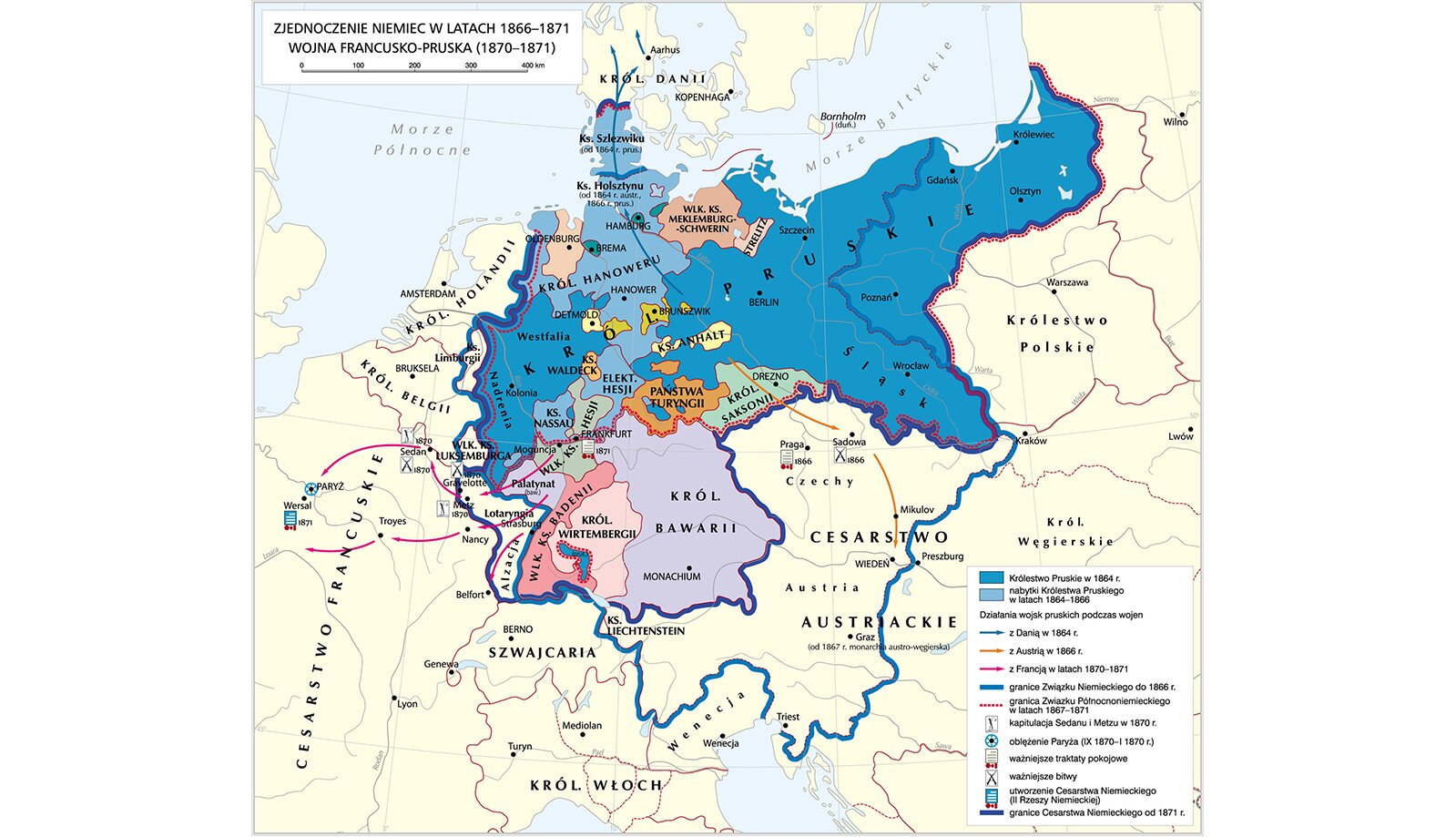
Rivalry for leadership among the German states existed between Austria and Prussia. Both states sought to unify Germany under their hegemony. After the Prussian victory over Denmark (1864) and Austria (1866), the unification of part of the German states as the North German ConfederationNorth German ConfederationNorth German Confederation under the leadership of Prussia took place (1866‑1867). In 1870, the French‑Prussian war erupted, resulting in Prussian victory and the unification of all German lands. In 1871, the German EmpireGerman EmpireGerman Empire was proclaimed. Wilhelm I became the Emperor, and Otto von Bismarck became the first ChancellorChancellorChancellor.
Task 1
Wybierz jedno zagadnienie opisane w abstrakcie. Poszerz swoją wiedzę na jego temat, szukając dodatkowych informacji w dostępnych ci źródłach (np. w internecie, encyklopedii lub specjalistycznych publikacjach).
Wybierz jedno zagadnienie opisane w abstrakcie. Poszerz swoją wiedzę na jego temat, szukając dodatkowych informacji w dostępnych ci źródłach (np. w internecie, encyklopedii lub specjalistycznych publikacjach).
Find the borders of the German Confederation in 1815. List the territories absorbed into the Kingdom of Prussia in 1864‑1866. Show the Southern border of the in 1866. List the states that did not become part of it.
Rp1ocwmVTRvNg
Wersja alternatywna. Zjednoczenie Niemiec w latach 1866-1871. W zakres Związku Niemieckiego do 1866 roku wchodziły między innymi tereny Królestwa Prus, Cesarstwa Austriackiego, Królestwo Saksonii, Królestwo Bawarii, Królestwo Wirtembergii, Wielkie Księstwo Badenii, Państwa Turyngii. Ziemie, które nabyło Królestwo Pruskie w latach 1864-1866: Królestwo Hanoweru, Księstwo Holsztynu, Landgrafostwo Hesji-Homburg, Księstwo Nassau. Granice związku Północnoniemieckiego w latach 1867-1871 obejmują północne tereny Związku Niemieckiego do 1866 roku, między innymi Królestwo Pruskie, Królestwo Hanoweru, Królestwo Saksonii.
The unification of Germany in 1866-1871 The Franco-Prussian war (1870-1871)
Source: Krystian Chariza i zespół.
Exercise 1
Study the fragment of Bismarck’s speech before the Prussian Parliament’s Budget Commission on 30 September 1862. Though it did not survive in its entirety – what survived was, in fact, its brief summary from the press of the time – it made history. In it, Bismarck delineated the direction of Prussia’s future policies.
Jeśli chodzi o nasz naród: mamy za gorącą krew, mamy upodobanie do zakładania na wątłe ciało zbyt ciężkiego rynsztunku, teraz powinniśmy go użyć. Niemcy nie patrzą na liberalizm Prus, lecz na ich potęgę. Być może Bawaria, Wirtembergia, Badenia tolerują liberalizm, ale nikt im z tego powodu nie przypisze roli Prus; Prusy zaś muszą skupić swoje siły i trzymać je na dogodny moment, kilkakrotnie już przegapiony. Granice Prus po kongresie wiedeńskim nie sprzyjają zdrowej egzystencji państwa; problemów współczesności nie rozstrzyga się przemówieniami i uchwałami większości — to był wielki błąd lat 1848 i 1849 — tylko żelazem i krwią.
RXUQqb9PUUbRJ
Describe the direction of Prussia’s future policies, marking the correct sentences below. Możliwe odpowiedzi: 1. Change to the Prussian borders established during the Congress of Vienna., 2. The liberalism of Prussia will allow her to unify Germany., 3. Return to the liberal project of unifying Germany, as postulated by the Frankfurt Parliament in 1848-1849., 4. The best way to achieve one’s political goals in acting in accordance with the Constitution., 5. Rejection of the liberal project from the Spring of Nations period, i.e. 1848-1849., 6. The might of Prussia will let her unify Germany., 7. The best means to achieve one’s political goals is war (“with iron and blood”)., 8. Keep Prussia’s 1815 borders.
Describe the direction of Prussia’s future policies, marking the correct sentences below. Możliwe odpowiedzi: 1. Change to the Prussian borders established during the Congress of Vienna., 2. The liberalism of Prussia will allow her to unify Germany., 3. Return to the liberal project of unifying Germany, as postulated by the Frankfurt Parliament in 1848-1849., 4. The best way to achieve one’s political goals in acting in accordance with the Constitution., 5. Rejection of the liberal project from the Spring of Nations period, i.e. 1848-1849., 6. The might of Prussia will let her unify Germany., 7. The best means to achieve one’s political goals is war (“with iron and blood”)., 8. Keep Prussia’s 1815 borders.
Describe the direction of Prussia’s future policies, marking the correct sentences below.
Change to the Prussian borders established during the Congress of Vienna.
The liberalism of Prussia will allow her to unify Germany.
Return to the liberal project of unifying Germany, as postulated by the Frankfurt Parliament in 1848-1849.
The best way to achieve one’s political goals in acting in accordance with the Constitution.
Rejection of the liberal project from the Spring of Nations period, i.e. 1848-1849.
The might of Prussia will let her unify Germany.
The best means to achieve one’s political goals is war (“with iron and blood”).
Keep Prussia’s 1815 borders.
Task 2
Analyze the size of the armies of the great powers in the years 1816‑1880 and on this basis formulate conclusions regarding the military potential of Prussia on the eve and after the reunification of Germany.
1816
1830
1860
1880
Great Britain
255
140
347
248
France
132
259
608
544
Russia
800
826
862
909
Prussia/Germany
130
130
201
430
Habsburg Empire
220
273
306
273
United States
16
11
26
36
* Data expressed in thousands.
R12i1NJlfT18l
Wykonaj zadanie zgodnie z poleceniem.
Wykonaj zadanie zgodnie z poleceniem.
R1JUmdSJSxMrx
Exercise 2
What was the political significance of the facts listed below? Combine the parts of sentences into correct pairs. The war with Denmark was... Możliwe odpowiedzi: 1. an excuse for the future war against the Habsburgs in order to push them out of the German Confederation’s structures., 2. the removal of the last obstacle to the unification of Germany., 3. the withdrawal of Austria from the sphere of German affairs. The French defeat in the Battle of Sedan was... Możliwe odpowiedzi: 1. an excuse for the future war against the Habsburgs in order to push them out of the German Confederation’s structures., 2. the removal of the last obstacle to the unification of Germany., 3. the withdrawal of Austria from the sphere of German affairs. The victory of Prussia in the Battle of Königgrätz meant... Możliwe odpowiedzi: 1. an excuse for the future war against the Habsburgs in order to push them out of the German Confederation’s structures., 2. the removal of the last obstacle to the unification of Germany., 3. the withdrawal of Austria from the sphere of German affairs.
What was the political significance of the facts listed below? Combine the parts of sentences into correct pairs. The war with Denmark was... Możliwe odpowiedzi: 1. an excuse for the future war against the Habsburgs in order to push them out of the German Confederation’s structures., 2. the removal of the last obstacle to the unification of Germany., 3. the withdrawal of Austria from the sphere of German affairs. The French defeat in the Battle of Sedan was... Możliwe odpowiedzi: 1. an excuse for the future war against the Habsburgs in order to push them out of the German Confederation’s structures., 2. the removal of the last obstacle to the unification of Germany., 3. the withdrawal of Austria from the sphere of German affairs. The victory of Prussia in the Battle of Königgrätz meant... Możliwe odpowiedzi: 1. an excuse for the future war against the Habsburgs in order to push them out of the German Confederation’s structures., 2. the removal of the last obstacle to the unification of Germany., 3. the withdrawal of Austria from the sphere of German affairs.
What was the political significance of the facts listed below? Combine the parts of sentences into correct pairs.
an excuse for the future war against the Habsburgs in order to push them out of the German Confederation’s structures., the withdrawal of Austria from the sphere of German affairs., the removal of the last obstacle to the unification of Germany.
The war with Denmark was...
The French defeat in the Battle of Sedan was...
The victory of Prussia in the Battle of Königgrätz meant...
R8jImSWoJD7i3
Exercise 3
Ceremonia proklamacji Cesarstwa Niemieckiego odbyła się w słynnej Sali Luster w Wersalu. Jak myślisz, dlaczego Bismarck i Wilhelm wybrali to miejsce na wydarzenie?
Ceremonia proklamacji Cesarstwa Niemieckiego odbyła się w słynnej Sali Luster w Wersalu. Jak myślisz, dlaczego Bismarck i Wilhelm wybrali to miejsce na wydarzenie?
Task 3
Listen to the recording and either write down or remember what were the aims of Bismarck’s policies before and after the unification of Germany, as well as the principles that guided him. Show the strong and weak sides of his concept and its implementation.
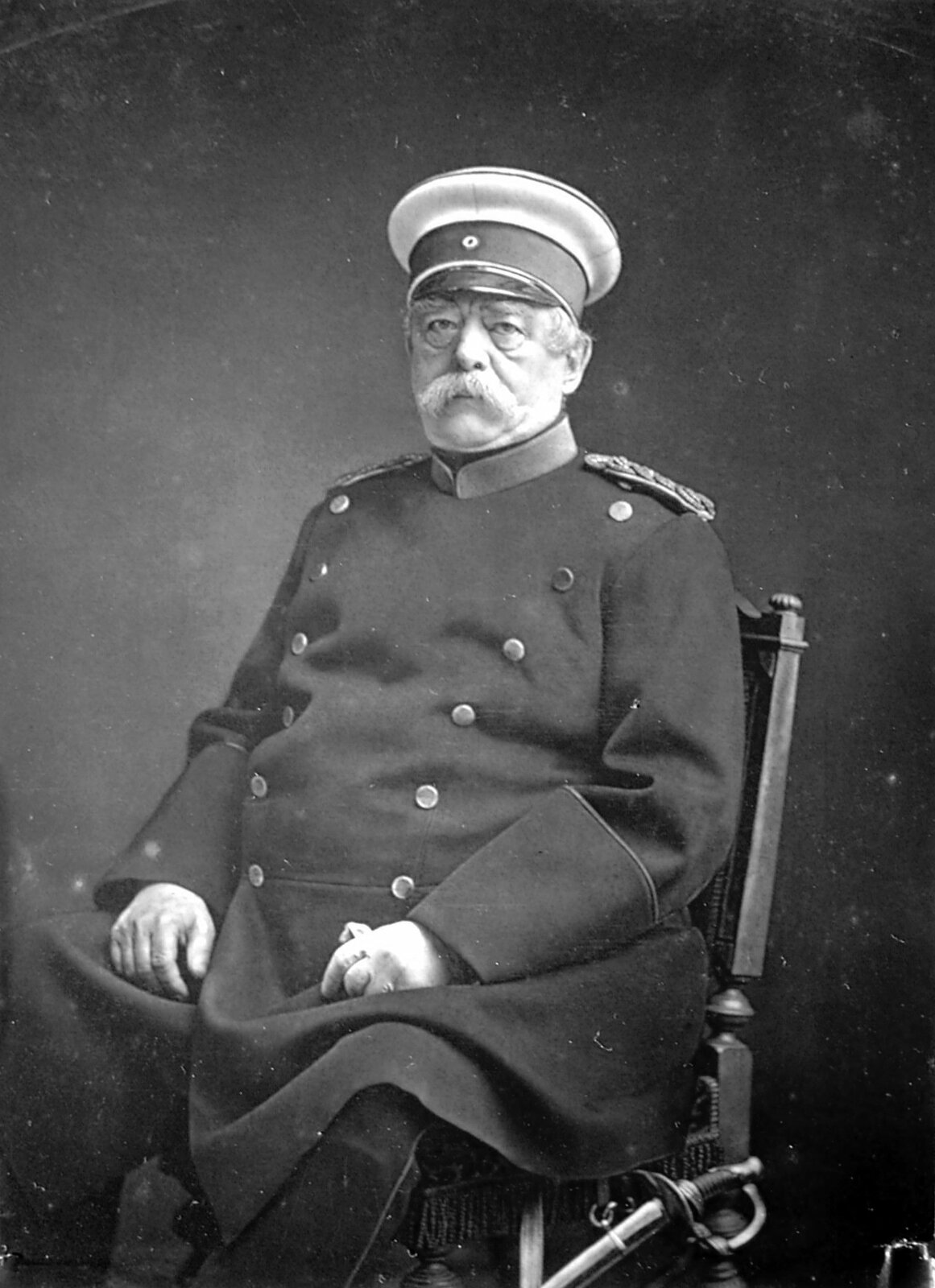
Fotografia czarno-biała przedstawiająca portret Otto von Bismarck'a. Postać siedzi na krześle ubrana w mundur, na głowie ma kapelusz. Spod nakrycia głowy można dostrzec siwe włosy.
Otto von Bismarck
Source: D.BRAUN & Cie Dornach, domena publiczna.
If Bismarck, like many other political strategists, had a doctrine of his own, it was a doctrine of circumstances. However, before we take a closer look at it, let’s start at the beginning. Bismarck came from a family of noble Prussian landowners. His family, however, did not belong to the aristocracy. He was born in 1815 – in the same year that the decisions of the Congress of Vienna on the prevention of political and social changes that could undermine Europe’s stability. The implementation of those decisions was not entirely successful. Its second task, however – the creation of an European balance of power – remained unchanged.
Bismarck entered politics at the age of 32. He became a deputy to his state Parliament. He became known as an extreme conservative. Bismarck was an opponent of the Revolutions of 1848 so radical that the Prussian King was reluctant to make him a Minister even after the revolution was quelled in Prussia. However, he managed to gradually earn the King’s trust. In 1851, he became a delegate of the Prussian side in the Bundestag – the convention of the representatives of the German rulers or governments. He stayed in this office for eight years, then he spent three years in Petersburg and a few months in Paris as an envoy. Having been called back by the King, he was appointed Prime Minister and Minister of Foreign Affairs in 1862. He was at the helm of Prussian politics during the wars with Austria and France, which in turn led to the unification of Germany. Bismarck became the head of the new German government – the Chancellor.
Bismarck treated national emotions instrumentally. He created a state of the German nation, but excluded the Austrians from it, even though they were hitherto (and for many decades to come) considered part of it. He fought against the Poles, as they were an obstacle to the Prussian, and later German statehood. “Their situation invokes my pity, but if we are to survive them, we have no choice but to eliminate them”. Those words are not to be taken literally. Bismarck did not want to exterminate the Poles – he merely sought to germanize them. His attitude was far from ethnic hatred‑fueled nationalism.
He saw two principal tasks ahead of him. In his foreign policy, he sought stabilization and the prevention of France’s revenge by coming to an agreement between Germany, Austria and Russia. In domestic policy, he attempted to uphold the authority of the Emperor, while maintaining the advantage of the conservative forces. He fought against decentralizing tendencies, as well as those veering towards the introduction of elements of social struggle. He saw the former in the Catholic circles, and the latter in the growing influence of the social democrats. Hence the years of culture struggle (KulturkampfKulturkampfKulturkampf) against the Catholics, followed by anti‑socialist laws. Bismarck lost both of the campaigns. In 1890, he was dismissed by the young Emperor, Wilhelm II, who got rid of the Chancellor to rule all by himself. The lone reign of the Emperor ended with World War One, Germany’s defeat, and the Emperor’s abdication.
What were Bismarck’s principles? The first of them was the saying: “The only sane foundation of a strong state is egoism, not sensitivity.” The second was elasticity. In the face of Prussian‑Austrian competition for dominance in Germany, Bismarck thought that: “It would be very unfortunate for Prussia to ally herself with France, but ever if we are not to act on this possibility, we should not clear the suspicions of our partners”. In his foreign policy, the most important principle was that of self‑containment. After Austria’s defeat, he was against imposing humiliating conditions on her in order to prevent revenge. This principle was amiss after the victory over France. The French considered their defeat humiliating already; the conditions imposed upon the state were supposed to weaken it. However, the Prussian self‑containment policy manifested in the state’s endeavors to peacefully stabilize the international situation, as it was Germany that possessed the greatest military power. “It is not about territorial gains, but rather about the concept of global politics in which every single powers except for France would need us”. Bismarck repeated that Germany had become a satiated state.
In the domestic policy department, Bismarck, a conservative, supported the idea of general parliamentary elections, as he wanted to mobilize the national forces and concentrate them around Prussia. In other words: Bismarck decided that, in the situation existing at the time, the mechanics of democracy could be favorable to conservatism. He was ahead of his times as well, having introduced social policies and various social securities. “Why should a disabled war veteran and an elderly state official receive pension, while a soldier of work does not?” This was merely an instrumental measure, as it was meant to block the influence of the socialists and bring an advantage to the conservatives, but, at the same time, created the foundations for the European welfare state policies.
bismarck Source: Jean-Paul Bled, Bismarck. The Iron Chancellor, Warszawa 2013.
Task 4
Imagine what could the dialogue between Bismarck and the captive Napoleon III look like. What could the two statesmen accuse each other of? Can you find some characteristics shared by them? Present the arguments of each of them.
Imagine what could the dialogue between Bismarck and the captive Napoleon III look like. What could the two statesmen accuse each other of? Can you find some characteristics shared by them? Present the arguments of each of them.
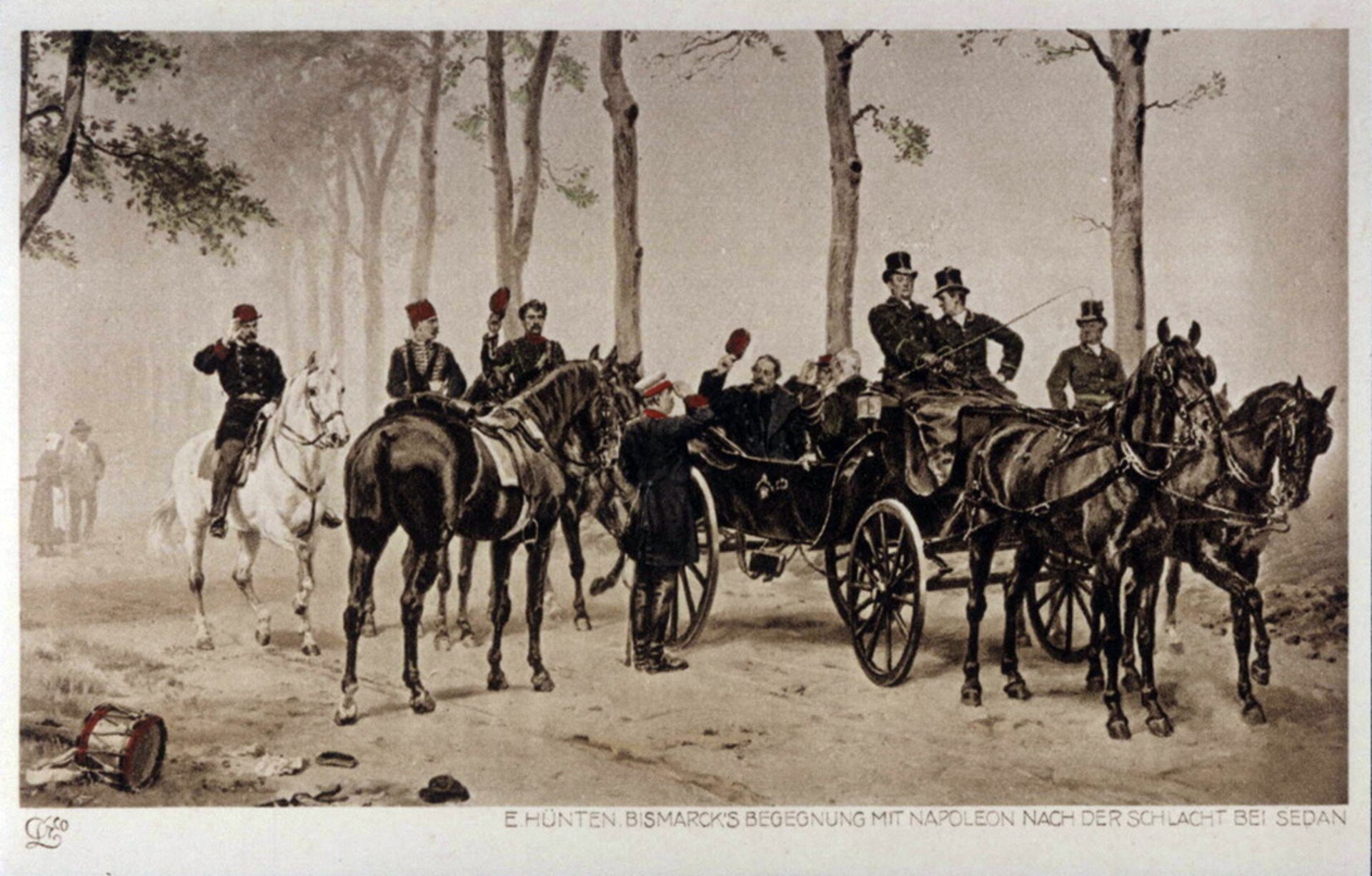
Look at the postcard from the era below. Based on it, imagine what could the dialogue between Bismarck and the captive Napoleon III look like. What could the two statesmen accuse each other of? Can you find some characteristics shared by them? Present the arguments of each of them.
RuBGUzN8pGnAQ
Pocztówka przedstawiająca scenę spotkania Bismarka i Napoleona III po bitwie pod Sedan. Przywódcy zdejmują w tym celu czapki z głów. Salutują, widać zaprzęże konne i powóz, którym jeden z władców przyjechał na spotkanie.
Bismarck meets Napoleon III after the Battle of Sedan. Postcard based on the painting by Emil Hünten
II Rzesza Niemiecka – historyczne określenie cesarstwa Hohenzollernów (1871–1918). II Rzesza była państwem związkowym (22 państwa, 3 wolne miasta i Alzacja‑Lotaryngia — jako „kraj Rzeszy”). Na czele państwa stał król Prus z tytułem cesarza niemieckiego. Austria pozostała poza zjednoczonymi Niemcami