The machine The scientific and technical revolution
to exchange the most important discoveries and inventions of the 19th century;
to indicate the economic and social consequences of their use;
to characterize the most important explorers and inventors of the 19th century.
In the second half of the 19th century electricity became a generally available good, and the costs of its obtaining were gradually decreasing. In 1882 in New York, under the direction of Thomas Edison, the first municipal power plant in the world was built. The light bulb, improved by Edison in 1879, became the symbol of this epochal transformation. Since the 30s/40s of the 19th century the growing network of railway began to cover Europe and the United States. Technical innovations contributed to the steam technology development. In 1840 the first electric motor was constructed. The peak achievement of this era was Rudolf Diesel’s compression‑ignition engine (diesel) from 1895. It could work on virtually any fuel. This invention had a significant impact on the automotive industry development – creating a car. The car was born in Europe in 1886, when the German constructors Karl Benz and Gotlieb Daimler constructed their prototype motor vehicles. The field of aviation was revolutionised by the Wright brothers. The first flight of their engine‑powered aeroplane took place in 1903. Six years later, the French aviation pioneer Louis Blériot set off on a plane to travel over the English Channel. The beginning of the aviation era dates from this year. In 1837, an American, Samuel Morse constructed the telegraph. The telephone that allowed distance communication, was constructed by Graham Bell in 1876. Thanks to the research on the crude oil extraction and processing conducted by the Lviv pharmacist Ignacy Łukasiewicz, that had been conducted since 1854, the crude oil became the basic fuel used in internal combustion engines. In the second half of the 19th century the chemistry developed. In 1869, a Russian chemist, Dmitry Mendeleev, developed the periodic table of elements. Also, the phenomenon of radioactivity was studied. The ground‑breaking research in this field was conducted by the Polish scholar Maria Skłodowska‑Curie and her husband Pierre Curie. In 1988 they discovered two radioactive elements: polonium and radium, and later they received the Nobel Prize for their research
Arrange the information from this lesson
airship, radio, a gramophone, a municipal power plant, a car, a light bulb, cinematograph, electric engine, electric telegraph, an engine, kerosene lamp, daguerrotography apparatus, a photograph, an electric tram, hand film camera, a telephone, biplane
| Before 1850 | |
|---|---|
| Before 1890 | |
| Before 1914 |
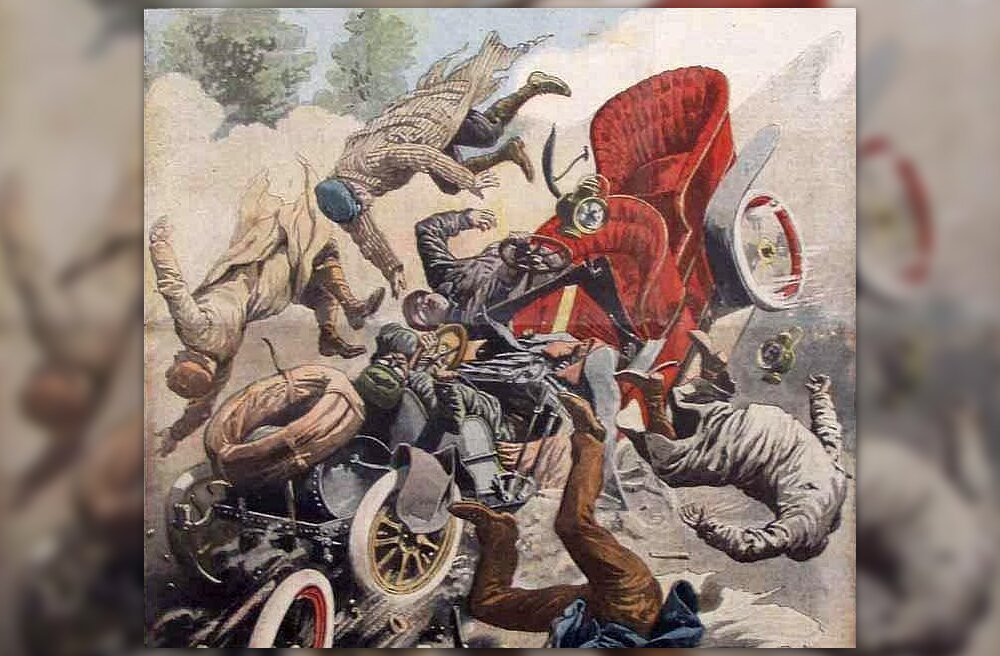
The illustration shows a traffic accident from the turn of the 19th and 20th century. How was this vehicle called?
- a steam carriage
- a chaise
- a stagecoach
- a car
- an automobile
Listen to the fragment of the diary report. Explain how did the telephone conversations look like at the end of the 19th century? Why did Father Kruszka decide to set up a telephone in his presbytery in America
Seven times seven years, so half a century old. Diary and contribution to Polish history in America, Poznań-Milwaukee 1924“From the inventions of the 19th century, steamers, steam locomotives, railways, telegraphs, velocipedes - with one large and one small wheel, and bicycles - with two equal wheels, were already widespread at the end of the century. Telephones, automobiles, aeroplanes, and other flying machines, were still in their infancy. When I was in Galicia, I knew the telephone from hearsay only. I saw the telephone for the first time when I arrived in America at the end of 1893. It was at my brother Michael’s editorial office. In 1896, when I moved from Milwaukee to Ripon, there were no telephones at the parsonages yet. [...] At the end of the 19th century the telephone station was set in Ripon, however, it was a station without any branches in the city. The telephone station worked just like the telegraphic station. When I had a phone call from Milwaukee, a messenger on his bicycle arrived to my place and asked me to go to the telephone station. So, I also sat on my bicycle and rushed to the station. Finally, with a great effort, the telephone started to be set up in the warehouses and houses. Once, an agent knocked to my door and started convincing me. Installing a phone line doesn't cost you at all, he said, and then, the monthly payment is only one dollar. –OK – I replied – but how many people in Ripon have the telephone? – Eleven, so far. – So, it is not much use to me. But, will I be able to call Milwaukee directly from my home, and will they be able to call me directly to my home? When he said: “yes”, I immediately ordered the phone to be installed at my presbytery. The reason was that I was already bored with going so far to the station every time someone phoned me. At the beginning of the 20th century, I used my phone to talk to people from Milwaukee only, because in Ripon I didn’t have anyone to talk to on the phone.
During the last five years of the 19th century, bicycling was very popular and widespread. Old and young people, old and young maids, a priest and an editor, a reporter and a doctor, an attorney and a professor - they all rode a bicycle. The highly regarded priests, like the priest Szukalski - the parish priest of the St. Cyril and Methodius, and father Decker, the senior pastor of the Saint Antoni parish in Milwaukee, trampled the pedals of their bicycles, and their tailcoats played with the wind. This pedalling looked very funny, as the rider seemed to be walking and yet he rode...].
When the man had basked in the fast bicycle ride, he wished for even greater speed. And after the bicycles followed the automobiles. The bicycle was the herald of the automobile. The bicycle prepared the way for the automobile”.
Source: Ks. Wacław Kruszka, Seven times seven years, so half a century old. Diary and contribution to Polish history in America, Poznań-Milwaukee 1924, [w:] Wiek XIX w źródlach. Wybór tekstów źródłowych, oprac. B.B. Lenard, M. Sobańska-Bondaruk, Warszawa 1998, s. 468.
Which sentences are true?
- Waiting for the phone was connected with waiting for the messenger with the information.
- Setting up a telephone was expensive.
- It was harder to reach someone who did not have a bicycle, than someone who did not have a telephone.
Look at the data in the table and answer the question.
Approximate amount of the telephone sets (in thousands) and the telephone calls made (in millions) in 1897.
European country | Telephone sets | Telephone calls |
England | 80 | 150 |
France> | 35 | 80 |
Germany | 150 | 450 |
Russia | 20 | 32 |
Source: I. Ihantowicz, Człowiek, informacja, społeczeństwo, Warsaw, 1989, p. 80.
In which of the European countries the American invention, the telephone, became the most popular at the end of the 19th century?
- England
- France
- Germany
- Russia
Keywords
aeroscopeaeroscope, automobileautomobile, Morse codeMorse code
Glossary
aeroskop – ręczna kamera filmowa
aerostat – statek powietrzny latający dzięki wypełnieniu gazem lżejszym od powietrza
alfabet Morse’a – alfabet, którego znaki kodowano specjalnymi zestawami kropek i kresek, stosowany w komunikacji telegraficznej i radiowej.
aeroplan – dawna nazwa samolotu
automobil – dawna nazwa samochodu
dagerotyp – nazwa pierwszych fotografii, uzyskiwanych na posrebrzanych miedzianych płytkach pod wpływem oparów jodu, po naświetlaniu przez dłuższy czas.
kinematograf – dawniej aparat filmowy, jak również kino
sterowiec – areostat z napędem sinikowym
Telektroskop – prototyp telewizji