The natural environment and economy of Russia
the location of the border between Europe and Asia;
what the Soviet Union (USSR) was;
what time zones are;
what climate and vegetation zones exist in the world.
to discuss Russia’s location on the map of Europe;
to describe Russia’s natural environment;
to name the main branches of the Russian economy.
Write down the connotations with Russia

Russia’s location
The Russian Federation lies on two continents – in Europe and Asia. The country covers an area of more than 17 million kmIndeks górny 22, or more than the entire Europe (10.5 million kmIndeks górny 22). Our continent accounts for „merely” 4.3 million kmIndeks górny 22 of Russia’s territory, which covers nearly the entire Eastern Europe.
Russia borders with thirteen countries, most of which are in Europe. In Asia, Russia has land borders only with five countries – China, Mongolia, Kazakhstan, Georgia, and Azerbaijan.
The vast area of Russia is divided into several dozen administrative units – republics, territories, and districts. Many of them have the word „autonomous” in their names, which suggests that a given unit should have some level of independence and autonomy. In practice, however, all the republics, territories and districts are heavily dependent on the central government in the country’s capital – Moscow.
Natural conditions
Russia’s coastline is more than 37,000 km, almost that of the equator. It is very diverse, in particular on the Arctic Ocean and Pacific Ocean. Russia includes numerous islands and archipelagos, e.g. Novaya Zemlya (New Land), Severnaya Zemlya (Northern Land), Francis Joseph’s Land, New Siberian Islands on the Arctic Ocean, or Sakhalin and Kuril Islands on the Pacific Ocean. There are also many large peninsulas, e.g. Kamchatka, Taymyr, Yamal, Gydan, Kola, and Chukchi. The archipelagos, islands and peninsulas mark smaller water areas on the oceans – seas, gulfs and straits.
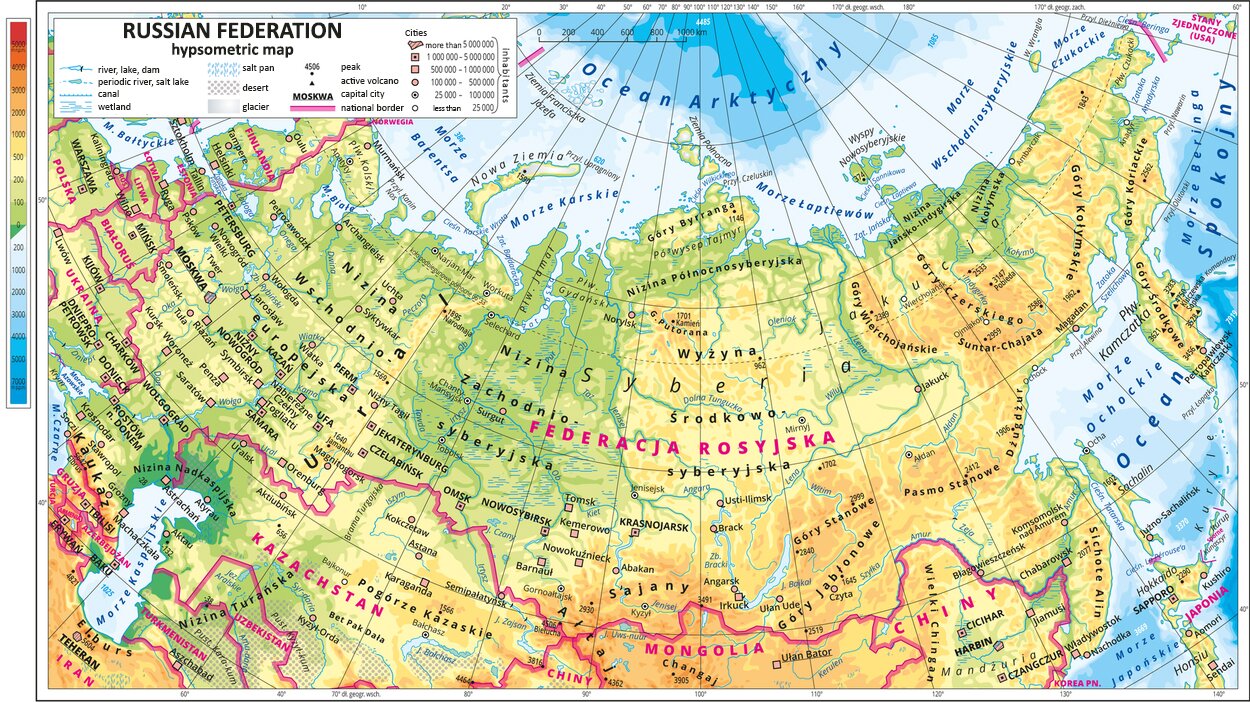
The vertical landform of Russia is considerably diversified. Great plains dominate the European part and western Asia – East European Plain and West Siberian Plain. By the Caspian Sea there is the Caspian Depression, which is the world’s biggest depression area. One third of the plain belongs to Russia and the rest to Kazakhstan. In the north of Asia, by the Arctic Ocean, there are smaller lowlands – North Siberian, Yakutsk‑Indigirka, and Kolyma.
Great and wide rivers flow through the lowlands and highlands of Russia. The continent’s longest river, the Volga (3690 km), flows through the European part.
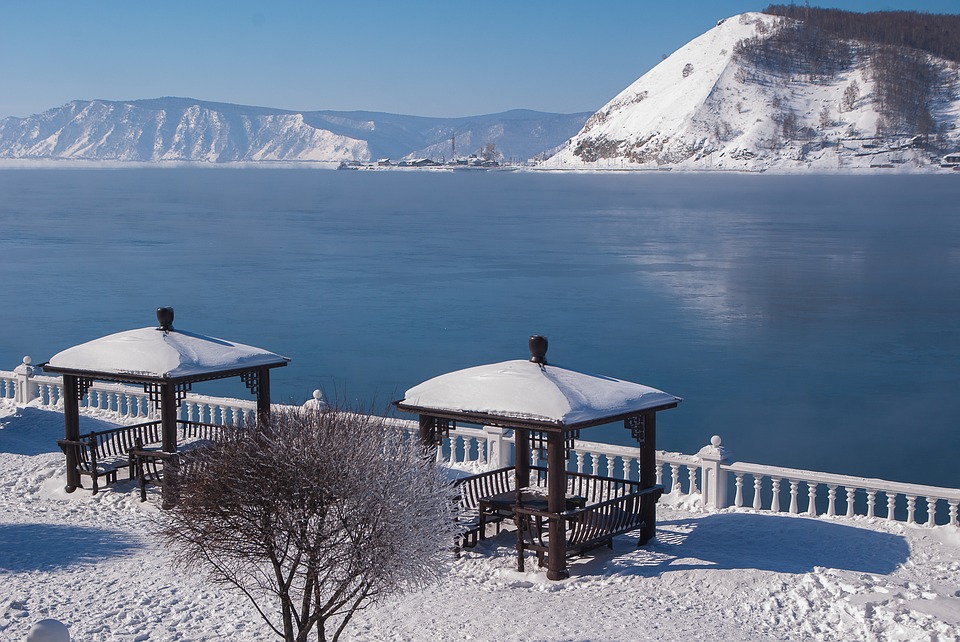
There are also great lakes in Russia, with one in particular – Baikal. It is the seventh largest and the deepest lake in the world.
Russia’s population
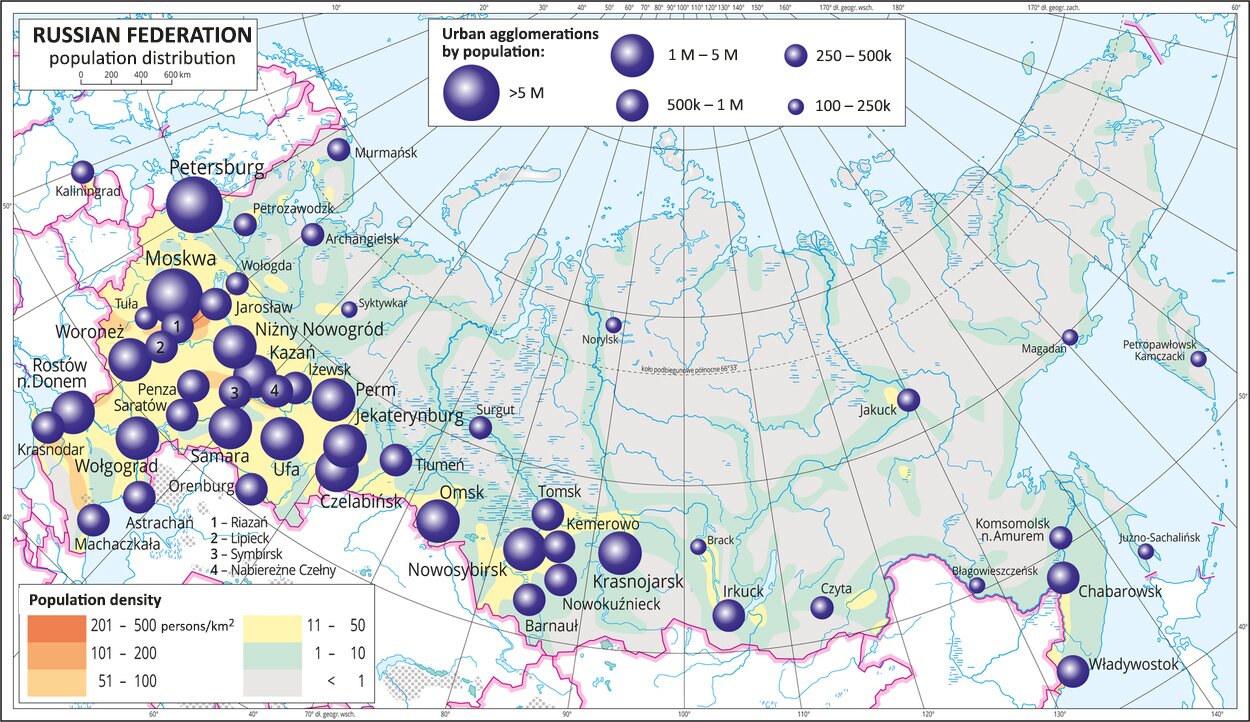
Russia has more than 140 million people, of which 100 million live in the European part. Russia is the most populous country on our continent – the next one is Germany with only slightly more than 80 million people.
The fact that more Russians live in the European part of the country results from better natural, social and economic conditions there. In Eastern Europe there is a slightly milder climate with more oceanic influences than in Siberia. In addition, forest and marshy areas, which hinder settlement, are smaller. The vicinity of southern and western European civilisations is also of importance. Despite that, the average population density for the European part of Russia is very low and amounts to 28 persons per 1 kmIndeks górny 22 – it is almost three times lower than, for example, in the neighbouring Ukraine. In the Asian part, the figure drops to 2 persons per 1 kmIndeks górny 22, but in practice the vast areas of Siberian taiga remain completely unpopulated, with people concentrated in cities and villages sometimes scattered even several hundred kilometres from one another. The average population density for the entire Russia is merely 8 persons per 1 kmIndeks górny 22. In general, the population has settled in the southern stretch of the country, due to a milder climate.
Nearly three‑fourths of the population live in cities, of which two are most important:
Moscow – the current capital and one of the world’s largest agglomerations with more than 10 million inhabitants;
Saint Petersburg (formerly Leningrad, Petrograd) – the former capital of Tsar Russia and today an agglomeration of 5 million people.
Moreover, Russia has more than a dozen cities of around 1 million inhabitants. Interestingly, as many as 5 of them – Novosibirsk, Omsk, Yekaterinburg, Chelyabinsk and Krasnoyarsk – developed in the poorly populated Asian part.
In terms of demographics, Russians are similar to the peoples of other countries of Eastern Europe – Belarus, Ukraine, or even Lithuania. For years Russia has had negative population growth caused by a low birth rate (due to difficult economic conditions) and high mortality (due to an unhealthy lifestyle, especially among men). Therefore Russia’s population is constantly decreasing, although, for example, the net migration rate remains positive. Many immigrants continue to flow into Russia from the former Soviet republics, especially Asian ones – Kazakhstan, Uzbekistan, Kyrgyzstan, Georgia, and Azerbaijan.
Russians account for around 80% of the Russian population. The remaining 20% is a real cultural mix of different nations and ethnic groups. These include persons from the former Soviet Union republics and also Tatars, Bashkirs, Chechens, Chuvash, Chukchi, Ingush, Yakuts, Mongols, Udmurt, Jews, and many more. There is also a group of 75,000 Poles, who live mainly in the European part. In Siberia, you can still meet the descendants of Poles who were sent there during the Russian partition of Poland as well as few of the remaining exiles from the communist times in Poland.
Russia’s economy
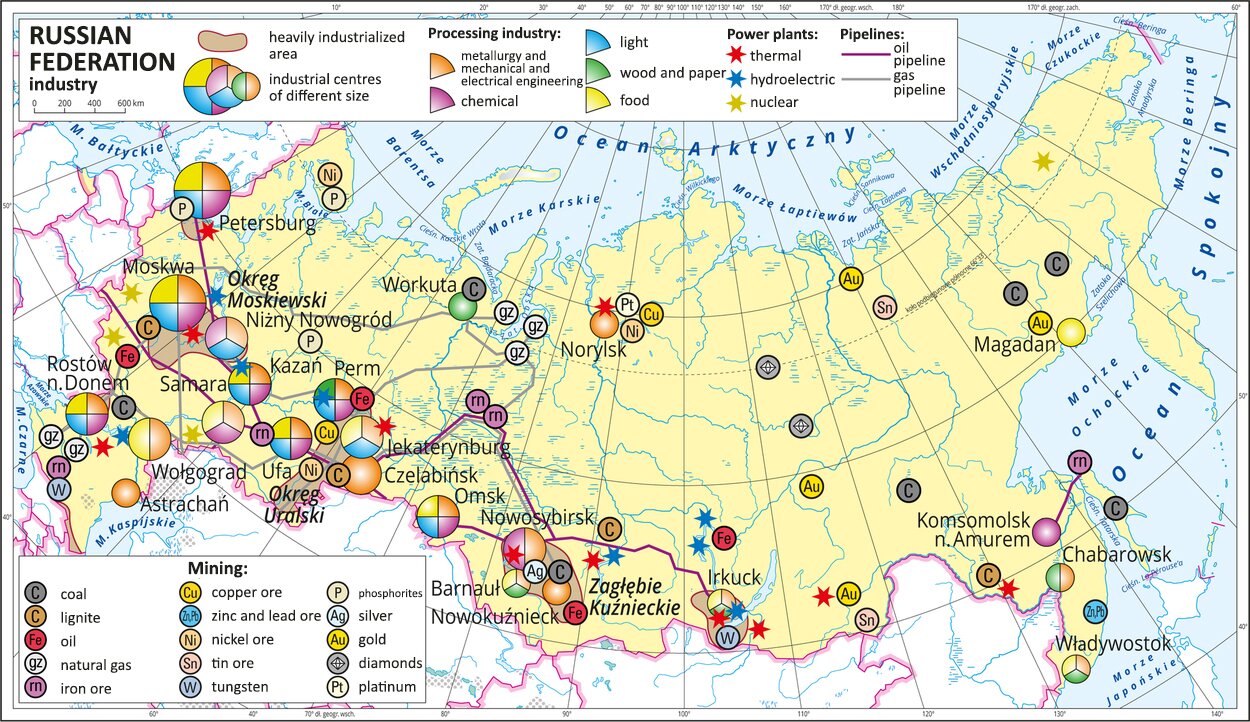
The foundation of Russian economy is mining and export of natural resources. Within its vast territory, Russia has deposits of virtually all the major natural resources. Energy resources (oil, natural gas, coal, uranium) and metal ores (among others, iron, copper, nickel, chromium) are of greatest importance to the economy. Also important are precious metals and stones (gold, silver, platinum, diamonds) and chemical resources (phosphorites, sylvinite, baryte). These resources are scattered across the country, with the following key mining areas:
Kola Peninsula – metal ores and phosphorites;
Moscow Coal Basin – lignite;
Kursk region – iron ores;
Ciscaucasia – oil and natural gas;
Ural Mountains – metal ores, coal, oil, gas;
West Siberian Plain – oil and gas;
Novosibirsk region and Kuznetsk Basin – coal and metal ores;
Siberian taiga – precious metals and stones, coal.
Apart from mineral resources, other natural resources are exploited in Russia. These include forests, which cover nearly a half of the country’s surface and are almost an infinite source of wood.
Also big rivers (Volga, Irtysh, Yenisei, Angara) are used for economic purposes, with numerous hydroelectric power plants built on them (among others, in Bratsk, Krasnoyarsk, Volgograd).
The processing industry of the Russian Federation is not very modern. During the Soviet times, due to the abundance of natural resources, mostly heavy industries developed – metallurgy, thermal power engineering, mechanical and electrical engineering, and chemical industry. Currently the most robust industry is the arms industry, the products of which are one of Russia’s key export products.
The food industry has also developed on a large scale, mainly due to the need to feed the millions of people. However, the growth has been insufficient and Russia now has to import large quantities of processed food, e.g. meat. On the other hand, non‑processed food, such as crops, is often exported.
Russian agriculture is not modern, either. In order to obtain high yield, vast arable land is used. The yield per 1 ha is much lower than, for example, in Poland or Belarus. In Russia, there are still large farms called kolkhozes or sovkhozes, in which work organisation as well as agricultural techniques and culture are rather poor.
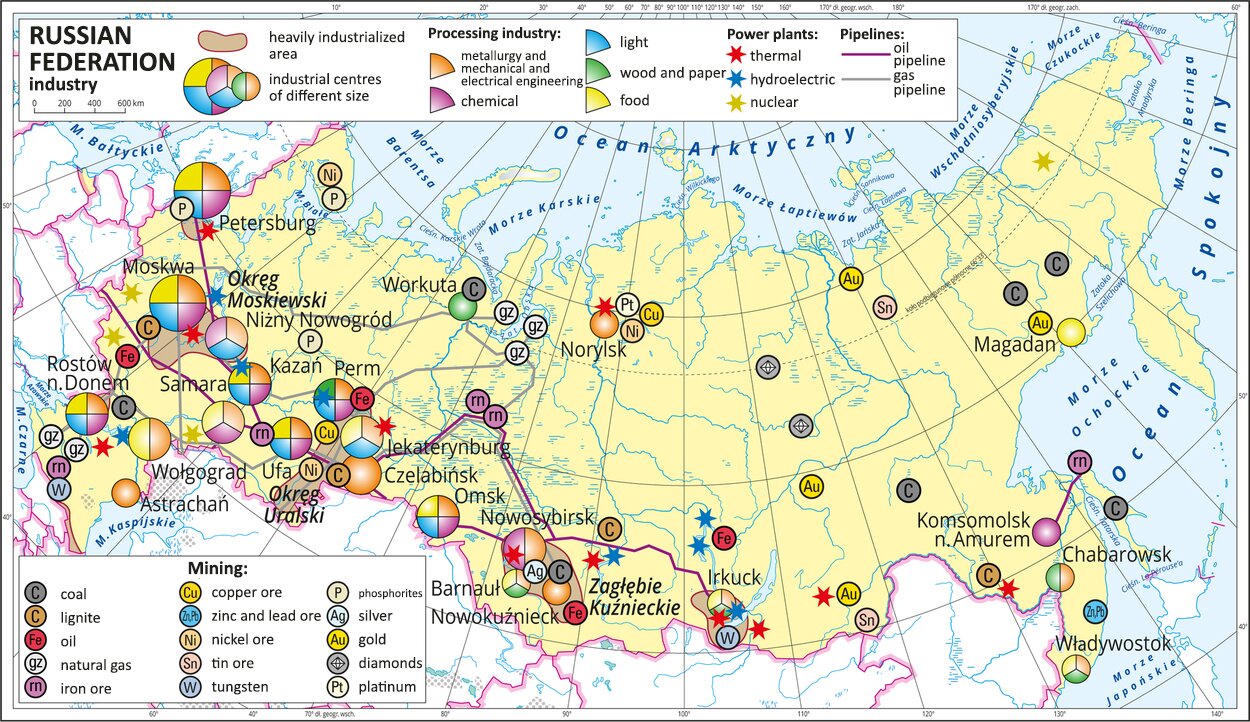
As regards services, the key ones for the Russian economy include transport. The rise of transport was necessitated by the vast area of the country and the resulting long distances between cities. Today air and rail transport is relatively well developed. Long‑distance connections between the east and the west of the country have been established, including two train connections – Baikal‑Amur Mainline (BAM) and Trans‑Siberian Railway. The plane is a much faster means of transport, but more expensive. Train travel is cheaper, but it takes a lot more time. For example, the journey from Moscow to Vladivostok takes more than 6 days, whereas the flight is a matter of around 8 hours.
Water transport in Russia is also relatively well developed, both sea and inland. Access to three oceans is used, among others, by large ports in Saint Petersburg, Murmansk, and Vladivostok. Inland navigation is ensured mostly via the large European and Asian rivers. In the European part, a dense network of canals has been established, connecting, among others, the Volga with other rivers. Thanks to these canals, Moscow is referred to as the “port of five seas”.
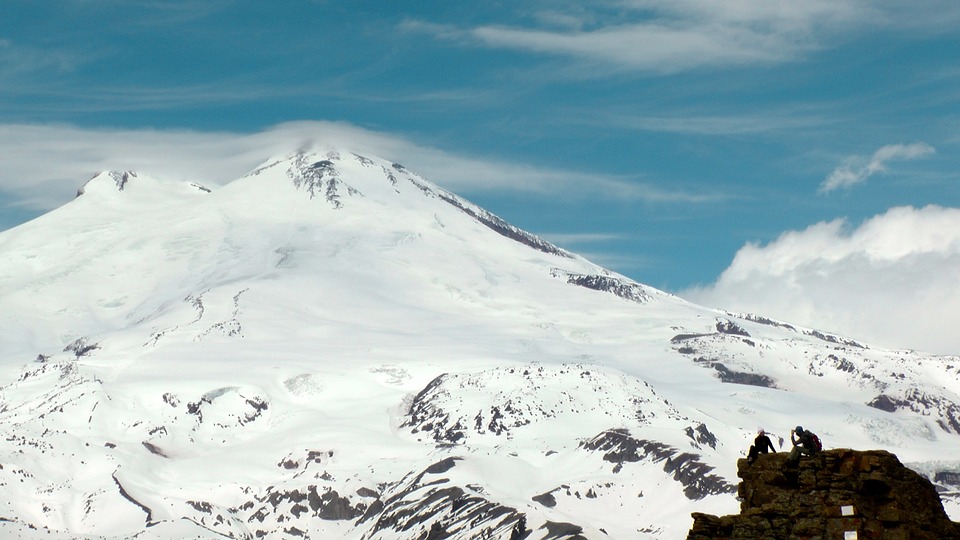
What is the highest mountain in Russia?
- Elbrus
- Alaid
- Opala
- Ruruj
What is the deepest lake in Russia?
- Baikal
- Baskunchak
- Kaspla
- Khasan
How much do you know about Russia? Check your knowledge. If you do not remember something, flip the flashcard.
| Capital of the Russian Federation | Moscow |
| Currency | Ruble |
| The second largest city is | Saint Petersburg |
| Russian population is | 140 million |
| Russian Federation’s exclave is | Kaliningrad Region |
| The longest river in the European part of Russia is | Volga |
Part of the territory of a country or other administrative unit, located in a separate area from the main area, but in the same land area (mostly the continent) is called:
- exclave
- enclave
Keywords
Russian Federation, Volga, exclave
Glossary
eksklawa - część terytorium państwa lub innej jednostki administracyjnej, położona w oddzieleniu od głównego jego obszaru, lecz na tym samym obszarze lądowym (przeważnie kontynent).