Some soil microorganisms have a natural ability to use petroleum substances as a source of food and energy. They break down pollutants into non‑toxic compounds, sometimes into carbon dioxide and water. The effectiveness of this mechanism depends on the pace of the processes carried out by the organisms and on the conditions in which they live, such as humidity, temperature, pH of the substrate. The technology of removing contaminants with the use of microorganisms is called bioremediationbioremediationbioremediation.
R1OBSfye7W42P
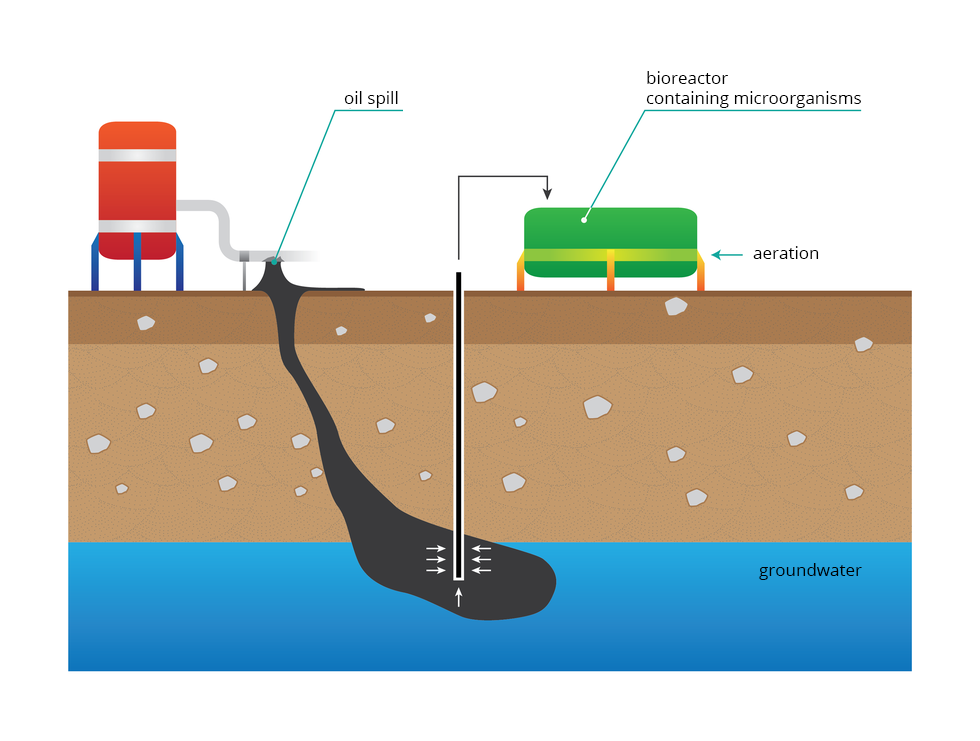
Ilustracja przestawia prostokąt, podzielony poziomo na trzy pasy, od dołu: niebieski – woda gruntowa, groundwater, jasno brązowy - gleba, brązowy – powierzchnia. Z lewej stoi zbiornik w kształcie beczki. Od niego w dół spływa duża, czarna plama, oznaczająca wyciek ropy naftowej, oil spill do ziemi i wód gruntowych. W centralnej części ilustracji pionowa, cienka rurka obrazuje wysysanie ropy z wody na powierzchnię do bioreaktora, bioreactor containing microorganisms. Strzałka wskazuje, że ropa trafia do zielonego kontenera, bioreaktora, gdzie jest napowietrzana, aeration.
Decontamination of oil-polluted water
Source: Dariusz Adryan, licencja: CC BY 3.0.
Vascular plants, such as brown mustard, which has the ability to accumulate lead, or field pennycress, which can accumulate zinc and nickel, are used for a biological decontamination of the soil. With the use of genetic engineering, the bacteria genes which are engaged in detoxification of particular elements and transferred to plants genomes. This allows for the creation of plants that collect specific elements, intended for sowing on contaminated soils.
Biological wastewater treatment plants
Biological wastewater treatment plants use microorganisms that release into the environment enzymes that break down organic matter. The wastewater treatment process takes place under aerobic or anaerobic conditions. Aerobic bacteria consume part of the pollution degradation products and oxidize the rest.
Biogas
Some microorganisms break down organic macromolecules (proteins, fats, carbohydrates) under anaerobic conditions in a process called the methane fermentationmethane fermentationmethane fermentation. Its products are methane, carbon dioxide and other compounds.
Methane has a high calorific value, therefore it is used for the production of heat, electricity and for vehicle propulsion. It can be obtained from sewage, organic waste deposited on landfills, biological fertilizers and biomass. The European Parliament Directive of 2009 on the promotion and use of energy from renewable sources stipulates that 20% of energy produced in the EU in 2020 is to come from renewable energy sources (15% in Poland).
Biogas plantsbiogasBiogas plants are used for the production of fuel gases from biological waste. They must provide the right conditions for a given type of bacteria, and the process should be constantly monitored. Post‑fermentation residues are stored and then, after liming, used as a fertilizer. The biogas consists of methane (40‑80%), carbon dioxide (20‑55%), hydrogen sulfide and a small amount of other gases. Purified biogas, in which the methane content reaches approx. 90%, is used to power natural gas installations or for the production of electricity.
Task 1
Before you watch the „Biogas plant” animation, write down the research question and the hypothesis. While watching the movie, write down your observations and finally – conclusions.
RgGawDTF9kidR
Analysis of the show:. Research question (Uzupełnij). Hypotesis (Uzupełnij). Observations (Uzupełnij). Conclusions (Uzupełnij).
Analysis of the show:. Research question (Uzupełnij). Hypotesis (Uzupełnij). Observations (Uzupełnij). Conclusions (Uzupełnij).
Analysis of the show:
R121jRjKD6zyP
Film przedstawia elektrownię na biogaz (biogas plant). Taka elektrownia, wraz ze zbiornikami, które ją tworzą w większości mieści się poniżej poziomu ziemi (ground level). Biomasa dostarczana jest do zbirnika mieszajacego (mixing tank), a następnie spływa do zbiornika wlotowego (inlet tank), gdzie dalej przesuwana jest do fermentatora biogazu (bio-gas digester). Na tym etapie do biomasy dodawana jest woda. Z biomasy w zbiorniku wydziela się gaz, który przesuwa się do góry ku zaworowi kontroli gazu (gas control valve). Ten gaz to energia, która powoduje rozświetlenie żarówki. W dalszym etapie biomasa wpływa do zbiornika wylotowego (outlet tank) i zbiornika przelewowego (overflow tank).
Film przedstawia elektrownię na biogaz (biogas plant). Taka elektrownia, wraz ze zbiornikami, które ją tworzą w większości mieści się poniżej poziomu ziemi (ground level). Biomasa dostarczana jest do zbirnika mieszajacego (mixing tank), a następnie spływa do zbiornika wlotowego (inlet tank), gdzie dalej przesuwana jest do fermentatora biogazu (bio-gas digester). Na tym etapie do biomasy dodawana jest woda. Z biomasy w zbiorniku wydziela się gaz, który przesuwa się do góry ku zaworowi kontroli gazu (gas control valve). Ten gaz to energia, która powoduje rozświetlenie żarówki. W dalszym etapie biomasa wpływa do zbiornika wylotowego (outlet tank) i zbiornika przelewowego (overflow tank).
Film przedstawia elektrownię na biogaz (biogas plant). Taka elektrownia, wraz ze zbiornikami, które ją tworzą w większości mieści się poniżej poziomu ziemi (ground level). Biomasa dostarczana jest do zbirnika mieszajacego (mixing tank), a następnie spływa do zbiornika wlotowego (inlet tank), gdzie dalej przesuwana jest do fermentatora biogazu (bio-gas digester). Na tym etapie do biomasy dodawana jest woda. Z biomasy w zbiorniku wydziela się gaz, który przesuwa się do góry ku zaworowi kontroli gazu (gas control valve). Ten gaz to energia, która powoduje rozświetlenie żarówki. W dalszym etapie biomasa wpływa do zbiornika wylotowego (outlet tank) i zbiornika przelewowego (overflow tank).
Biofuels
BiofuelsbiofuelBiofuels are renewable energy sources obtained from the biomass.
The production of biofuels is a chance to become independent from fossil fuels. In addition, plants that are seeded specifically for the purpose of production of biofuels or of its raw materials absorb carbon dioxide from the atmosphere. Unfortunately, the use of plants also has some negative sides. For example, biomass production requires utilization of large areas that could be used for other purposes (e.g. food production). Combustion of some biofuels causes the emission of harmful substances, eg nitrogen oxides, but it does not pollute the atmosphere with sulfur compounds. The use of this type of fuel in the automotive industry is associated with the need for changes in the design of engines, as those used nowadays are prone to be damaged in low temperature combustion. Another obstacle is the production cost, which is 2‑3 times greater than the cost of production of traditional fuels.
Biosensors
BiosensorsbiosensorBiosensors are measuring devices that, for example, detect contamination thanks to biological receptors, such as microorganisms, nucleic acids, enzymes. They consist of a converter that changes the biological signal into an electrical signal. The converter enables its registration and measurement of intensity. The detector is a biological layer made up of live microorganisms. Biosensors are used, for example, in determining the level of pollutants in the environment, e.g. quantities of heavy metals, pesticides, carcinogens or toxic substances.
R1DM9EoPs5qT3
Exercise 1
Match the following terms with their definitions. bioremediation Możliwe odpowiedzi: 1. fuel produced from processed products derived from living organisms, 2. the process of anaerobic decomposition of organic compounds into methane and carbon dioxide, carried out by microorganisms, 3. technology for removing certain pollutants from soil and groundwater with the use of living microorganisms, 4. installation for the production of fuel gases from biological waste biofuel Możliwe odpowiedzi: 1. fuel produced from processed products derived from living organisms, 2. the process of anaerobic decomposition of organic compounds into methane and carbon dioxide, carried out by microorganisms, 3. technology for removing certain pollutants from soil and groundwater with the use of living microorganisms, 4. installation for the production of fuel gases from biological waste biogas plant Możliwe odpowiedzi: 1. fuel produced from processed products derived from living organisms, 2. the process of anaerobic decomposition of organic compounds into methane and carbon dioxide, carried out by microorganisms, 3. technology for removing certain pollutants from soil and groundwater with the use of living microorganisms, 4. installation for the production of fuel gases from biological waste methane fermentation Możliwe odpowiedzi: 1. fuel produced from processed products derived from living organisms, 2. the process of anaerobic decomposition of organic compounds into methane and carbon dioxide, carried out by microorganisms, 3. technology for removing certain pollutants from soil and groundwater with the use of living microorganisms, 4. installation for the production of fuel gases from biological waste
Match the following terms with their definitions. bioremediation Możliwe odpowiedzi: 1. fuel produced from processed products derived from living organisms, 2. the process of anaerobic decomposition of organic compounds into methane and carbon dioxide, carried out by microorganisms, 3. technology for removing certain pollutants from soil and groundwater with the use of living microorganisms, 4. installation for the production of fuel gases from biological waste biofuel Możliwe odpowiedzi: 1. fuel produced from processed products derived from living organisms, 2. the process of anaerobic decomposition of organic compounds into methane and carbon dioxide, carried out by microorganisms, 3. technology for removing certain pollutants from soil and groundwater with the use of living microorganisms, 4. installation for the production of fuel gases from biological waste biogas plant Możliwe odpowiedzi: 1. fuel produced from processed products derived from living organisms, 2. the process of anaerobic decomposition of organic compounds into methane and carbon dioxide, carried out by microorganisms, 3. technology for removing certain pollutants from soil and groundwater with the use of living microorganisms, 4. installation for the production of fuel gases from biological waste methane fermentation Możliwe odpowiedzi: 1. fuel produced from processed products derived from living organisms, 2. the process of anaerobic decomposition of organic compounds into methane and carbon dioxide, carried out by microorganisms, 3. technology for removing certain pollutants from soil and groundwater with the use of living microorganisms, 4. installation for the production of fuel gases from biological waste
Match the following terms with their definitions.
the process of anaerobic decomposition of organic compounds into methane and carbon dioxide, carried out by microorganisms, installation for the production of fuel gases from biological waste, technology for removing certain pollutants from soil and groundwater with the use of living microorganisms, fuel produced from processed products derived from living organisms
bioremediation
biofuel
biogas plant
methane fermentation
Rd9LQJot9lT2F
Exercise 2
In which of the below mentioned tasks we can use various types of microorganisms? Select all the correct answers. Możliwe odpowiedzi: 1. decontamination of oil-polluted soil, 2. degradation of harmful substances in sewage treatment plants, 3. biofuel production, 4. degradation of methane to inorganic substances
In which of the below mentioned tasks we can use various types of microorganisms? Select all the correct answers. Możliwe odpowiedzi: 1. decontamination of oil-polluted soil, 2. degradation of harmful substances in sewage treatment plants, 3. biofuel production, 4. degradation of methane to inorganic substances
In which of the below mentioned tasks we can use various types of microorganisms? Select all the correct answers.
decontamination of oil-polluted soil
degradation of harmful substances in sewage treatment plants
biofuel production
degradation of methane to inorganic substances
RM50X8QS0vFog
Exercise 3
Biogas plants are used for the production of fuel gases. Which substances can undergo methane fermentation to obtain biogases? Select the correct answer. Możliwe odpowiedzi: 1. all kinds of organic waste, 2. petroleum products that entered the soil, 3. only plant waste in the form of granules and briquettes, 4. inorganic carbon compounds
Biogas plants are used for the production of fuel gases. Which substances can undergo methane fermentation to obtain biogases? Select the correct answer. Możliwe odpowiedzi: 1. all kinds of organic waste, 2. petroleum products that entered the soil, 3. only plant waste in the form of granules and briquettes, 4. inorganic carbon compounds
Biogas plants are used for the production of fuel gases. Which substances can undergo methane fermentation to obtain biogases? Select the correct answer.
all kinds of organic waste
petroleum products that entered the soil
only plant waste in the form of granules and briquettes
inorganic carbon compounds
Summary
Microorganisms can be used to decontaminate soil and water.
Biomass utilization and methane production occur in the biogas plants.
Biofuels are produced from renewable natural resources.
Biosensors detect contamination thanks to biological microorganisms, nucleic acids, enzymes.
fermentacja metanowa – wieloetapowy proces beztlenowego rozkładu związków organicznych na metan i dwutlenek węgla prowadzony przez mikroorganizmy; zachodzi we wszystkich ekosystemach; wykorzystywany do utylizacji biomasy i produkcji biogazu