The similarity between humans and apes
biological evolution is a fact.
to indicate similarities and differences between the physique and behaviour of a human and a chimpanzee;
to name characteristics common only to humans;
to explain, why humans belong to the animal kingdom;
to describe Australopithecus, Homo habilis, Homo erectus, Neanderthal and their accomplishments;
to give examples of factors, which contributed to the appearance of bipedalism and rapid brain development in human ancestors.
Similarities between humans and apes
The species Homo sapiens is, together with apes and prosimians, classified as belonging to the order (taxonomic rank) of primates.primates. Humans are most closely related to apesapes, such as gorillas, chimpanzees, orangutans and gibbons. The degree of relationship is measured by the number of common genes. In the case of Homo sapiens and chimpanzee the degree of relationship is the highest: our DNA and the DNA of chimpanzees are 98% identical. This means that relatively recently (as compared to the age of the Earth), we and chimpanzees shared a common ancestor. Similarities between two species prove close relationship to each other. These similarities can be observed in:
physique – for instance, our eyes are pointed forwards, we have prehensile hands in which thumb can touch the pads of all other fingers, enabling us to make complex and precise movements and manipulate objects; like apes, we don't have an external tail;
protein structure – plasma proteins of humans and chimpanzees are nearly identical, and the hemoglobin in both species has the same sequence of amino acids;
social behaviour – we live in family groups, take care of our offspring for a long time, have many ways of expressing emotion and create strong bonds with the other members of our community.

Name characteristics classifying humans as animals, vertebrates and primates
Characteristics distinguishing humans from the animal world
Humans are characterised by their erect, bipedal posture. Their prehensile hands are extraordinarily agile, making using tools possible and allowing for very precise movements. Human body hair is defined as vestigial. It remains only in some places, and the rest of our skin surface is bare and has many sweat glands, which prevent overheating.
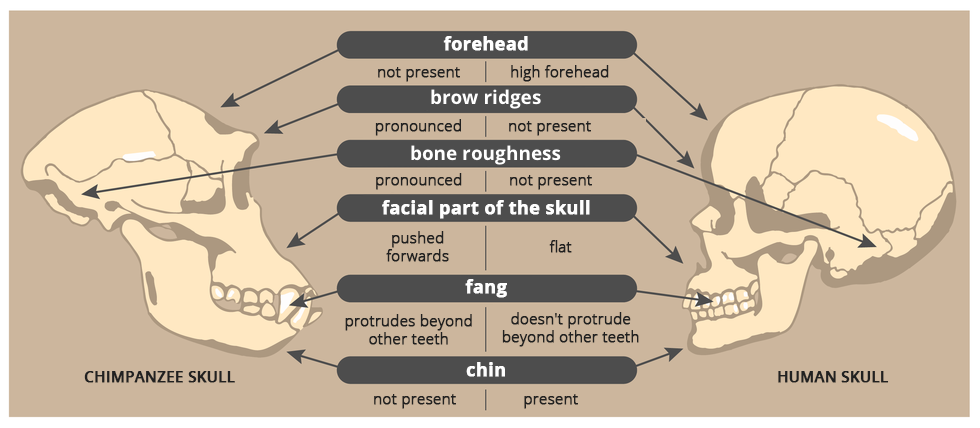
Human teeth are small, the fang doesn't protrude beyond other teeth. The last of molars often errupt late in a human's life and sometimes doesn't grow in at all. Such dentition allows for the intake of soft, pre‑processed (cooked) foods, it isn't, however, fit for feeding on raw meat and hard plant parts. Because of this, the facial part of human skull is, unlike ape skulls, flat. As human skull leans on the spine instead of hanging in front like in the case of present‑day quadruped apes, it doesn't require bone keels or visibly uneven parts, to which the powerful muscles necessary for raising and moving the skull would be attached.
Another essential feature of the human skull is its high forehead and large neurocraniumneurocranium volume. In humans, its volume is about 1350 cmIndeks górny 33 (1/40 of body mass) and in chimpanzees - 400 cmIndeks górny 33 (1/120).
Equally extraordinary is the human brain: large in comparison to the rest of the body, with a heavily folded cerebral cortex. Human brains contain a speech centre. A well‑developed brain allows us to gain self‑awareness (I am me, now I'm thinking about... I feel..., I can...). A large brain, self‑awareness and the growing‑up period lasting more than ten years, during which young humans require being taken care of by adults, all have allowed for the development of many forms of social life as well as the creation of tradition, science, culture, technology and led to us becoming independent from environmental factors.
Name three differences between human and chimpanzee physique that aren't mentioned in the text.
The appearance of bipedalism and upright posture
The history of our genus began in Africa. About 10 million years ago in the East side of the continent a gradual climate change occurred, leading to the disappearance of forests and the appearance of savannas. Our quadruped ancestors were gradually losing their tree‑dependent environment as well as the food sources, which best suited their needs.
Apart from seeds, grasses and insects, which were all difficult to digest, savannas also offered nutritious meat‑based food – small mammals and carrion. Observing the surroundings, which was necessary for spotting food sources, frequently required standing on two legs and raising the animal's head above the high grass. Bipedalism was advantageous in one more way: upright posture was better than quadruped posture at preventing overheating. When it comes to bipedal animals, sunlight directly heats a smaller body surface – only the head. To protect the brain against overheating, the skin of our heads is covered with hair to this very day. This hair layer (especially if the hair is very curly, woolly) serves as thermal insulation.
Two‑legged movement meant that arms no longer needed to support the body. From that point on, hands could be used for shelling seeds, carrying food, making tools as well as carrying newborns, which could no longer hold onto fur, as our ancestors no longer had it.
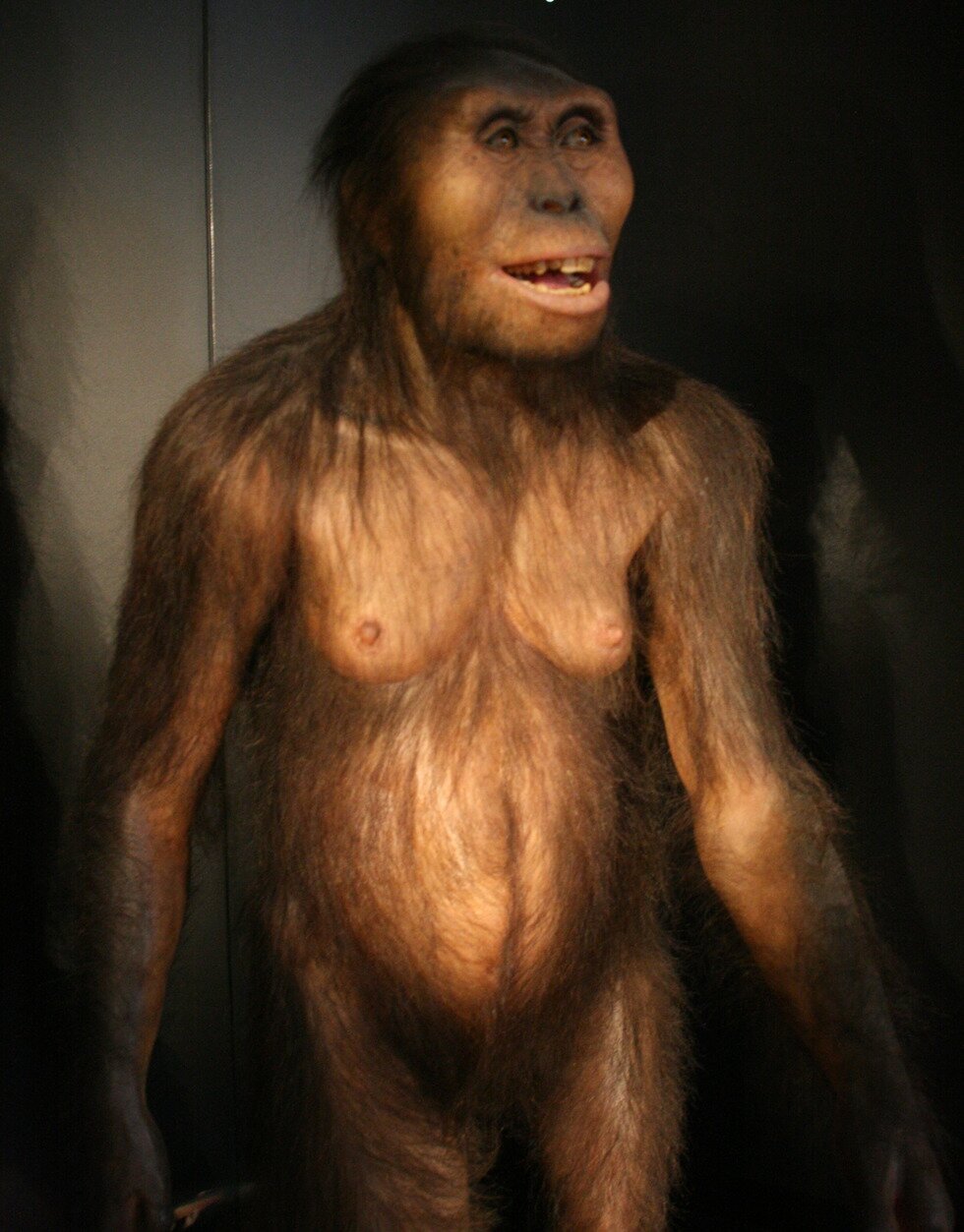
4 million years ago, natural selection led to the appearance of the bipedal Australopithecus, which was probably the ancestor of humans. Austrolopithecus' brain was approximately 20% larger than that of his ape ancestor. This meant longer pregnancy, more difficult birth and longer childhood, during which the offspring was helpless and the mother required assistance, e.g. being supplied with food. It is likely that the division of responsibilities that existed in later human forms was already present in Australopithecus communities: males acquired meat, while females were gatherers, toolmakers, and took care of the offspring.
Move these elements to the appropriate group
creation of science, culture and technology, expressing emotion using facial expressions, eyes positioned in front of the skull, high forehead and large neurocranium volume, creating social bonds, no external tail, bipedal posture, opposable thumb, exceptionally agile prehensile hands, becoming largely independent from environmental factors
| characteristics distinguishing humans from the animal world | |
|---|---|
| common features of humans and apes |
Which of these genus has so much in common with modern humans that it is regarded as a likely human ancestor?
- Australopithecus
- gorilla
- orangutan
- chimpanzee
Summary
Homo sapiens, like apes and prosimians, is a primate.
The first species in the Homo genus first appeared about 3 million years ago.
In the past there were several species of the Homo genus on the Earth e.g. Homo habilis, Homo erectus and at least two subspecies of Homo sapiens: Homo sapiens neanderthalensis and Homo sapiens sapiens.
Many factors contributed to the appearance of bipedalism and the increase in brain volume:
climate change led to the adaptation to life on a steppe, such as adopting upright posture;
because arms no longer had to support the body, they became better at making precise movements, for example useful when making tools;
carnivority, including scavenging, allowed for an increase in the body mass and brain volume; the loss of body hair helped in long hunts for hairy prey;
A well‑developed brain allowed for the creation of culture, art, science and technology and made it possible for our species to become largely independent from environmental factors.
Keywords
human, apes, bipedal posture
Glossary
małpy człekokształtne – małpy, które nie mają ogona, mają długie, bardzo ruchliwe kończyny górne i stosunkowo duży mózg w odniesieniu do masy ciała; należą do nich szympans, goryl, orangutan, gibon
mózgoczaszka – część czaszki otaczająca mózg
naczelne – jednostka systematyczna (rząd), do której należą ssaki na ogół wszystkożerne o chwytnych kończynach, stosunkowo dużym mózgu; żyją w stadach