The special role of blood
blood is a connective tissue;
blood vessels of the skin and blood that runs through them participate in the process of thermoregulation;
blood transports various substances from and to body cells.
to show the connection between the build of the elements of blood and their functions;
to explain the meaning of blood types;
to assess the social role of donating blood;
Blood ingredients and their importance
Blood is a connective tissue which transports nutrients, respiratory gases, products of metabolism and hormones, participates in thermoregulation and in defense mechanisms of the body. It consists of liquid plasma and morphotic elementsmorphotic elements suspended in it. Water is the main component of plasma. It transports the dissolved organic and inorganic compounds throughout the entire body. One of the substances transported by plasma is the carbon dioxide - gas which dissolves in water.
Blood transfers also morphotic elements of blood, that is cells: red blood cells – erythrocytes, white blood cells – leukocytes and cell fragments – platelets. Among blood cells, the highest in number are erythrocyteserythrocytes, which are characterized by a big surface for binding oxygen. Their shape resembles concavoconcave discs, which gives them elasticity and allows them to squeeze through really narrow spaces. Fully grown erythrocytes do not have a karyon, and that is why they can fit more haemoglobin particles. Haemoglobin is a protein which gives the red blood cells their colour and which can bind oxygen and carbon dioxide particles. Haemoglobin can also permanently connect with carbon monoxide, but then it loses the ability to transport oxygen. This is why carbon monoxide is a strong toxin.
LeukocytesLeukocytes, white blood cells, are the most diverse group of cells, where each type of cells has different function. Leukocytes have no colour, have karyon and are able to move in an amoebic way. PlateletsPlatelets, also known as thrombocytes, are fragments of cells that participate in blood clotting processes.
Blood types
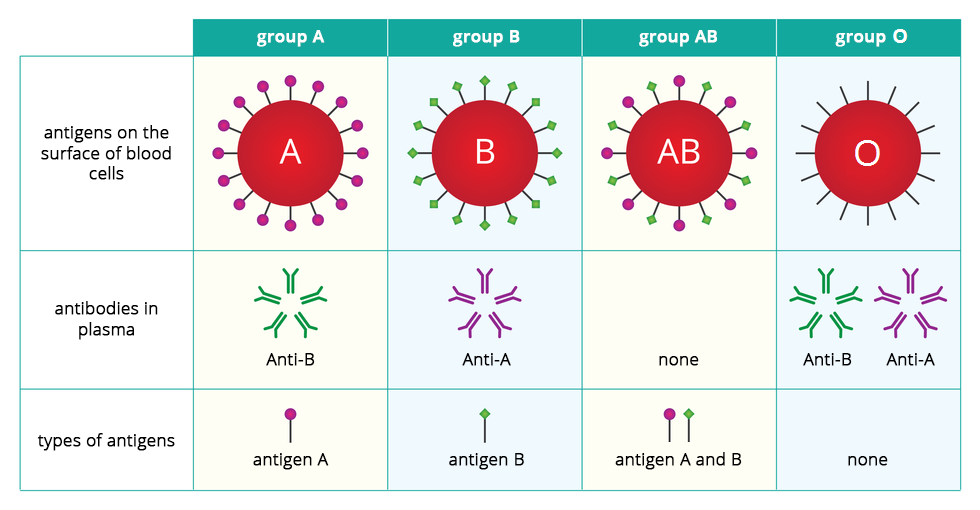
There are 4 main blood typesblood types among humans: A, B, AB, O. The presence of a particular blood type is decided by the presence of proteins – antigensantigens on the surface of the erythrocytes. A person with an A type blood has erythrocytes with antigens A. B type blood has antigens B on the surface of the erythrocytes, whereas erythrocytes of AB type blood have both types of antigens (A and B). Erythrocytes without antigens are in the case of an O type blood. In addition, in plasma there are 2 types of antibodiesantibodies: anti‑A and anti‑B. They cause the red blood cells to be glued together. Anti‑A antibodies bind erythrocytes that have A antigen, anti‑B antibodies bind erythrocyte that have B antigen. O type blood plasma has both types of antibodies, whereas in the plasma of an AB type blood there are no antibodies. In addition, on the surface of erythrocytes there may be rhesus factorrhesus factor. If it exists, we have RhIndeks górny ++ blood type, e.g. ORhIndeks górny ++(O+, positive), if there is no rhesus factor– the blood type is RhIndeks górny --, e.g. ORhIndeks górny -- (O-, negative). Around 85% of Polish people and nearly all Chinese and Japanese people have Rh+ blood.
Blood transfusion
Blood is a life‑giving liquid, called also the gift of life. It is given to the sick who lost some blood because of an accident or a surgery. Blood transfusiontransfusion is sometimes needed if a person has low red blood cell count, for example in case of anaemia. In order for a transfusion to be successful, both the donor’s and the recipient’s blood type have to match.

Lack of possibility to conduct a transfusion of a specific blood type when someone’s life is in danger can be a serious obstacle to fully help such person. This is why blood donation is crucial in saving people’s lives. Blood from a donor is processed, which allows for the blood to be stored in form that allows it to be used when needed. Blood donation points can be found in every city. The biggest blood donation events are organized by Polish Red Cross (PCK). One form of blood donation takes place in special ambulances that drive around cities and towns.
Explain what feature allows a person with an AB blood type to be called an universal recipient.
Select the correct sentences.
- Erythrocytes transport oxygen and carbon dioxide.
- Plasma transports glucose, carbon dioxide, products of the metabolism and morphological elements of blood.
- Leukocytes participate in fighting off microbes that cause illnesses.
- Platelets are responsible for transporting food to the cells.
Summary
Blood is composed of plasma and morphological elements of blood.
Plasma is a water solution which includes organic and inorganic compounds.
Morphological elements of the blood are composed of the blood cells: erythrocytes, leukocytes and platelets.
Platelets participate in the blood clotting process.
Antigens that are present on the surface of erythrocytes decide on which four blood types we belong to: A, B, AB, O.
Knowledge about the blood type and rhesus factor is important during blood trasfusion.
Donating blood saves lives of many people.
How was this lesson? Did you like it? Finish selected sentences.
Keywords
blood types, transfusion, agglutination
Glossary
antygeny – białka receptorowe na powierzchni błon komórek; odgrywają ważną rolę w rozpoznawaniu komórek, a antygeny związane z błonami erytrocytów warunkują wystąpienie grup krwi
czynnik Rh – układ antygenów występujących na powierzchni erytrocytów warunkujący obecność dodatkowego znacznika grup krwi
Nagranie dostępne na portalu epodreczniki.pl
Nagranie dźwiękowe słówka morphotic elements of the blood
elementy morfotyczne krwi – składniki krwi w postaci komórek: erytrocytów i leukocytów oraz fragmentów komórek – trombocytów
erytrocyty – krwinki czerwone; komórkowe elementy morfotyczne krwi w postaci dwuwklęsłych krążków, pozbawione organelli komórkowych, wypełnione hemoglobiną; uczestniczą w transporcie gazów oddechowych
grupy krwi – wyróżnia się je na podstawie zestawów antygenów znajdujących się na powierzchni błon erytrocytów; oznacza się je symbolani AB, A, B i 0
leukocyty – krwinki białe; komórkowe elementy morfotyczne krwi, które zawierają jądro komórkowe; mają zdolność do pełzakowatego ruchu, uczestniczą w reakcjach obronnych organizmu
przeciwciała – białka wytwarzane przez limfocyty B w odpowiedzi na obecność w organizmie antygenów; uczestniczą w reakcji obronnej organizmu
transfuzja – zabieg polegający na przetoczeniu krwi dawcy do organizmu biorcy
trombocyty – płytki krwi; elementy morfotyczne krwi w postaci fragmentów komórek; uczestniczą w procesie krzepnięcia krwi