The timbre - a characteristic sound that allows you to distinguish the sounds of different instruments or voice. The timbre of a given instrument may change slightly depending on:
the method of inducing vibrations (tugging stringstringstring with a bow, jerk or punch),
excitation force (and therefore the volume of the sound),
frequencyfrequencyfrequency (different strings can make sounds slightly different in timbre),
changes in time.
R9imxYqNywn3l
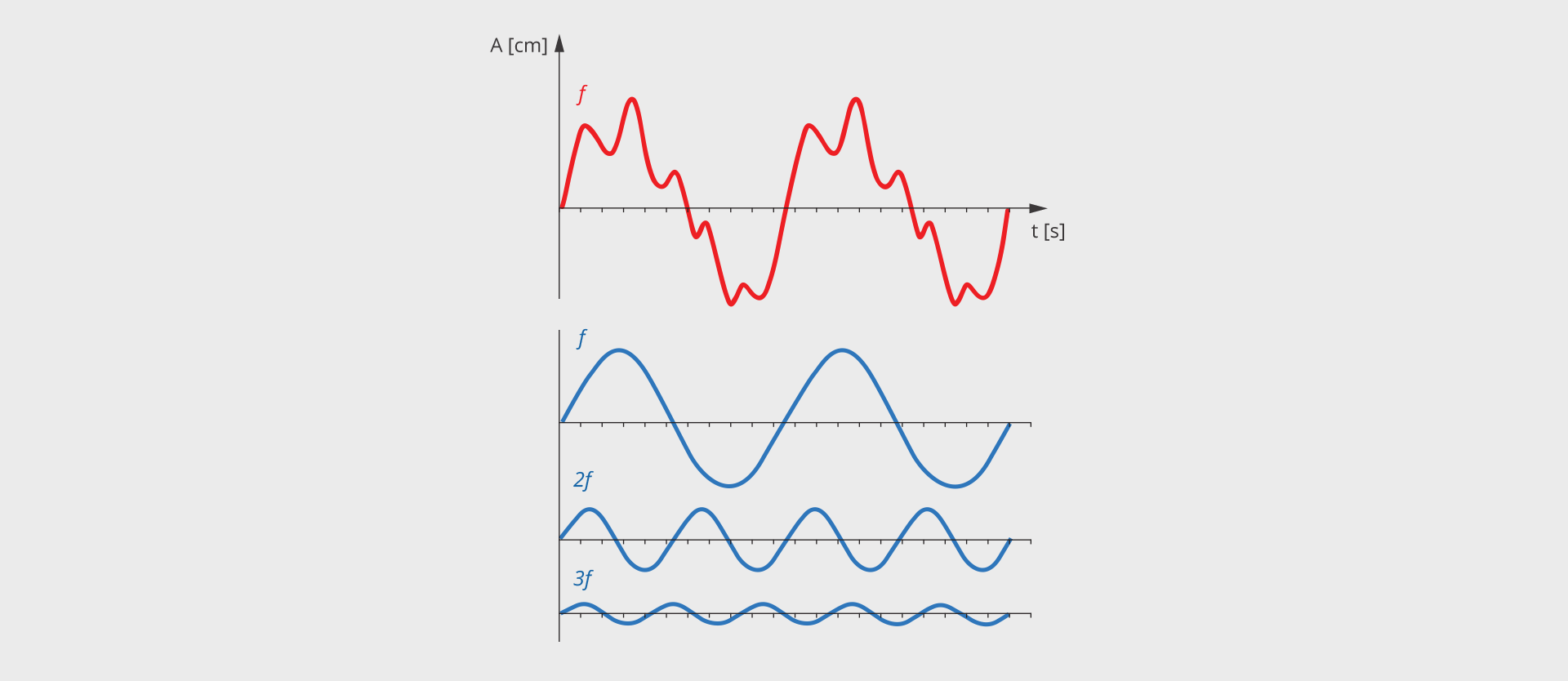
Ilustracja przedstawia wykres dźwięku złożonego z kilku innych dźwięków harmonicznych oraz wykresy trzech dźwięków harmonicznych. Od góry czerwony wykres pofalowanej sinusoidy opisany f - dźwięku złożonego, oś pozioma opisana t, w nawiasie kwadratowym s, oś pionowa opisana A, w nawiasie kwadratowym cm. Poniżej niebieski wykres sinusoidy opisany f, poniżej niebieski wykres sinusoidy opisany 2f (ściśnięty i niższy w stosunku do wykresu powyżej), poniżej niebieski wykres sinusoidy opisany 3f (ściśnięty i niższy w stosunku do wykresu powyżej). Prawie każdy dźwięk, który słyszymy jest sumą kilku dźwięków harmonicznych o innych częstotliwościach i amplitudach.
The sound produced by instruments is a sound composed of several other harmonic sounds
The red chart is a symbolic representation of the sound. Its shape includes, among others, the sounds presented in blue colors on the lower drawings. Almost every sound we hear is the sum of several harmonic sounds with different frequencies and amplitudes.
Speaking of the frequency of the sound is not as obvious as it seems because it is not clearly defined. However, it is not always sensible to talk about the sound frequency. In fact, only one type of sound has a well‑defined (precisely „single”) frequency. This sound is the harmonic wave (sinusoidal) and is called the tone.
Tones are like basic building blocks of sounds - no sounds are simpler than tones. Most of the complex sounds contain many tones, which affect the timbre of the sound.
The tone may be louder or quieter - but it remains the same tone all the time. The volume of each tone depends on its amplitudeamplitudeamplitude. The greater the amplitude of a given tone, the louder it is.
The tone itself does not sound very beautiful. It is simple and poor in timbre. Most common sounds are a mixture of many tones, with some tones lasting longer and other shorter; growing quickly or slowly; waving, intermitting, etc. All these together enable the musician to bring out wonderful mood from a good instrument, put us in a good mood, make us sad, touched, flurried, etc.
From the physical point of view, a better instrument usually produces more tones than the worse one. In addition, the instrument does not produce the so‑called „wolf tones”, i.e. unwanted tones in the spectrum of the sound. However, the impression of timbre depends not only on the presence of tones, but also on their „behavior”. It is important which the tones disappear faster and which disappear more slowly, how their disappearance proceeds, etc. We easily distinguish the sound of the piano from the sound of the violin; this is mainly due to the fact that stringstringstring instruments can play very „long” notes and the control of the duration of the sound is much greater here than in the case of the piano. After all, this last instrument requires a completely different method of producing sound.
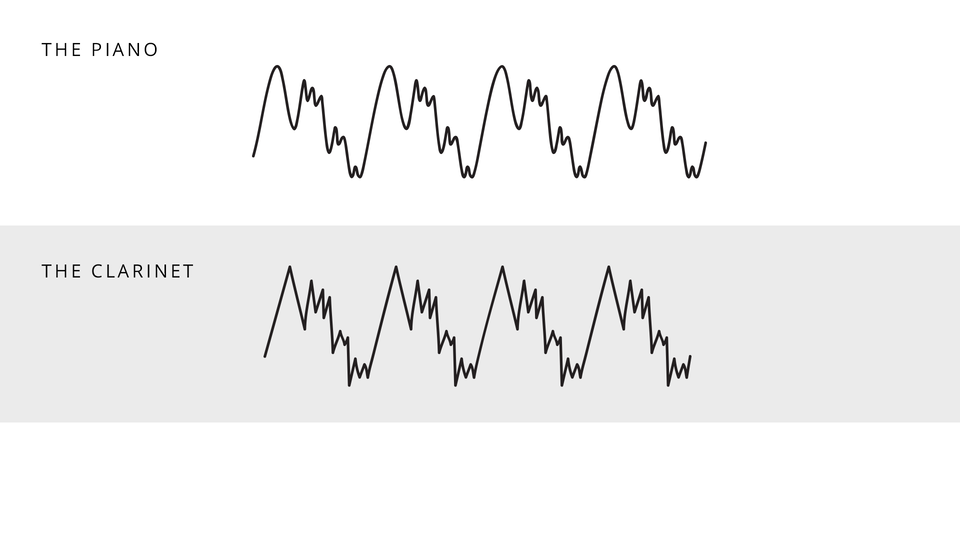
In the slides below sounds with the same basic tones produced by various instruments are presented.
R1TP3tnGNuoTz1
Prezentacja slajdów – barwa dźwięków różnych instrumentów. Instrukcja obsługi z poziomu klawiatury: 1. Uruchomienie aplikacji - ENTER, 2. Na każdym ze slajdów czytany jest automatycznie tekst alternatywny po polsku, 3. Przy pierwszym uruchomieniu na pierwszym slajdzie, czytanie tekstu po angielsku - TAB, 4. Przejście między slajdami: do następnego slajdu - TAB, do poprzedniego slajdu - TAB + SHIFT, 5. Przejście do czytania napisu po angielsku - strzałka w górę + strzałka w dół (czyta tekst po angielsku widoczny na slajdzie).
Prezentacja slajdów – barwa dźwięków różnych instrumentów. Instrukcja obsługi z poziomu klawiatury: 1. Uruchomienie aplikacji - ENTER, 2. Na każdym ze slajdów czytany jest automatycznie tekst alternatywny po polsku, 3. Przy pierwszym uruchomieniu na pierwszym slajdzie, czytanie tekstu po angielsku - TAB, 4. Przejście między slajdami: do następnego slajdu - TAB, do poprzedniego slajdu - TAB + SHIFT, 5. Przejście do czytania napisu po angielsku - strzałka w górę + strzałka w dół (czyta tekst po angielsku widoczny na slajdzie).
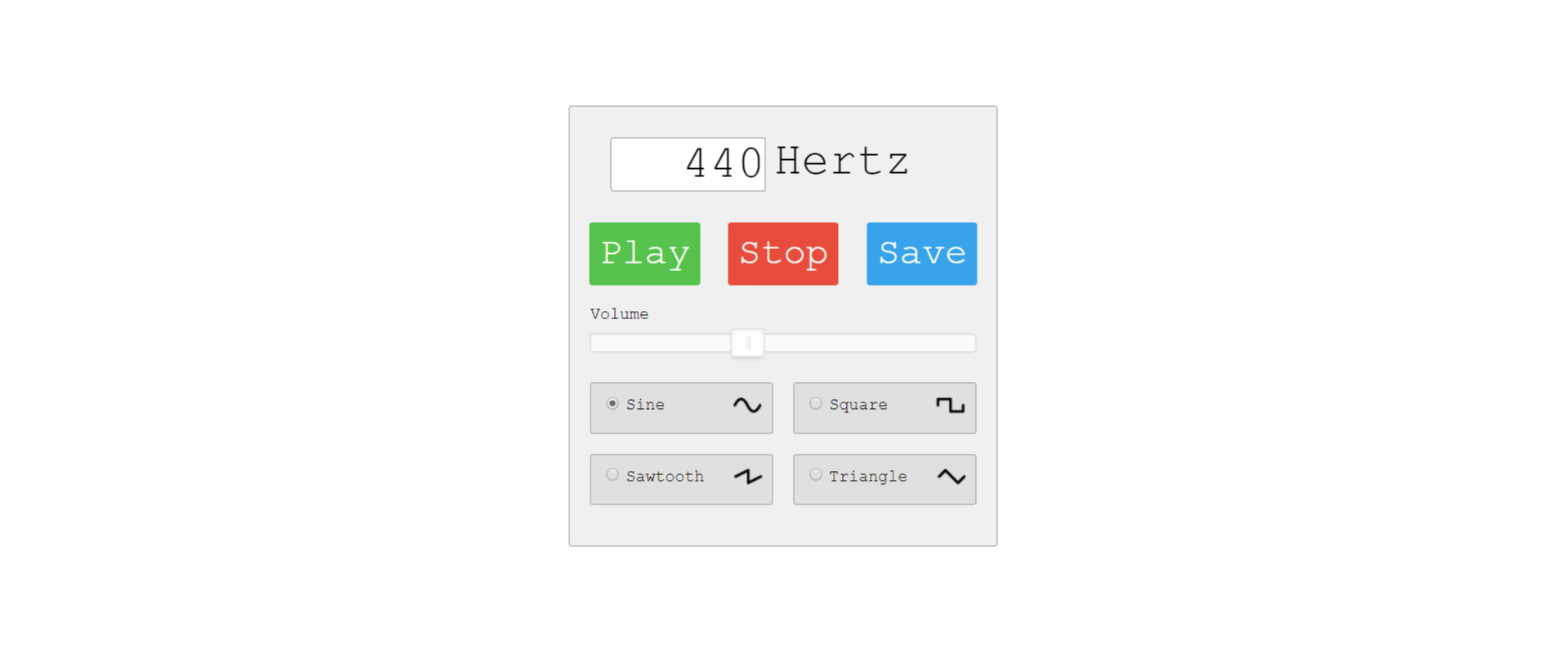
Find the sound generator on the Internet. e.g. as in the picture:
Rs8Ek1W8FqrtE1
Ilustracja przedstawia przykładowy internetowy generator dźwięków. Okno generatora od góry ma miejsce na wpisanie częstotliwości dźwięku w hercach, tutaj widoczne 440 Hertz. Poniżej przyciski do odtwarzania (play), zatrzymywania (stop) i zapisywania (save) dźwięku. Poniżej suwak umożliwiający zmianę głośności opisany volume. Poniżej przyciski wyboru rodzaju fali: sine (zaznaczone), square, sawtooth, triangle.
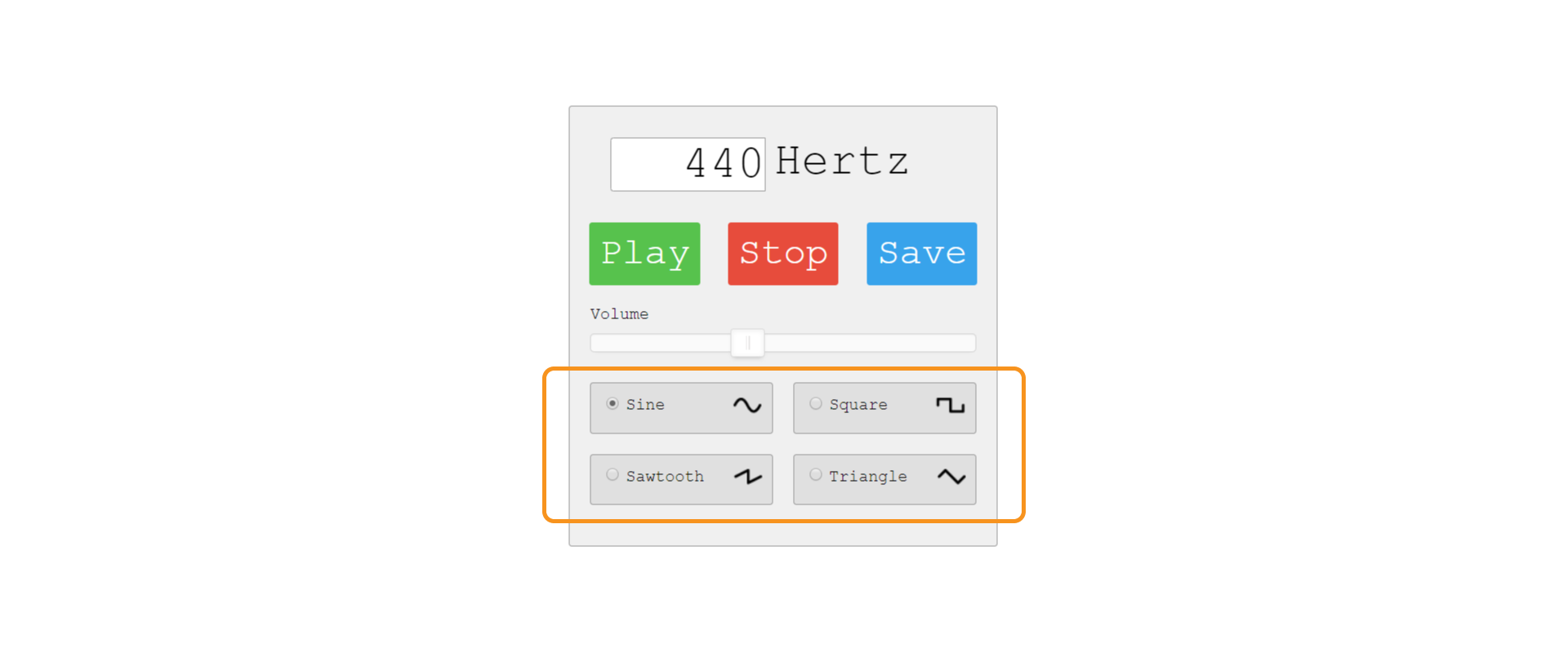
Notice the differences in timbre while changing the different types of sound.
R19BTgeaLziQO1
Ilustracja przedstawia przykładowy internetowy generator dźwięków. Okno generatora od góry ma miejsce na wpisanie częstotliwości dźwięku w hercach, tutaj widoczne 440 Hertz. Poniżej przyciski do odtwarzania (play), zatrzymywania (stop) i zapisywania (save) dźwięku. Poniżej suwak umożliwiający zmianę głośności opisany volume. Poniżej wyróżnione przyciski wyboru rodzaju fali: sine (zaznaczone), square, sawtooth, triangle.
The timbre - a characteristic sound that allows you to distinguish the sounds of different instruments or voice. The timbre of a given instrument may change slightly depending on:
the method of inducing vibrations (tugging stringstringstring with a bow, jerk or punch),
excitation force (and therefore the volume of the sound),
frequencyfrequencyfrequency (different strings can make sounds slightly different in timbre),
changes in time.
Exercises
R176RqOQDucAH
Exercise 1
A Stradivarius sounds [tu uzupełnij], a cheap violin from the bazaar sounds [tu uzupełnij]; however, it is possible to play for example Dvořák's "Humoresque" on both instruments and both instruments can also play the same sound, e.g. the upper "C". What distinguishes the [tu uzupełnij] of these instruments? Of course the [tu uzupełnij]. What does it depend on? From the physical point of view, a better instrument usually produces more [tu uzupełnij] than the worse one. In addition, the [tu uzupełnij] does not produce the so-called "wolf tones", i.e. unwanted tones in the [tu uzupełnij] of the sound. However, the impression of timbre depends not only on the presence of tones, but also on their "behavior". It is important which the tones disappear faster and which disappear more slowly, how their disappearance proceeds, etc. We easily distinguish the sound of the [tu uzupełnij] from the sound of the [tu uzupełnij] this is mainly due to the fact that [tu uzupełnij] instruments can play very "long" notes and the control of the duration of the sound is much greater here than in the case of the piano. After all, this last instrument requires a completely different [tu uzupełnij] of producing sound. Słowa do uzupełnienia: instrument, sound, timbre, method, piano, tones, violin, spectrum, string, terrible, wonderful.
A Stradivarius sounds [tu uzupełnij], a cheap violin from the bazaar sounds [tu uzupełnij]; however, it is possible to play for example Dvořák's "Humoresque" on both instruments and both instruments can also play the same sound, e.g. the upper "C". What distinguishes the [tu uzupełnij] of these instruments? Of course the [tu uzupełnij]. What does it depend on? From the physical point of view, a better instrument usually produces more [tu uzupełnij] than the worse one. In addition, the [tu uzupełnij] does not produce the so-called "wolf tones", i.e. unwanted tones in the [tu uzupełnij] of the sound. However, the impression of timbre depends not only on the presence of tones, but also on their "behavior". It is important which the tones disappear faster and which disappear more slowly, how their disappearance proceeds, etc. We easily distinguish the sound of the [tu uzupełnij] from the sound of the [tu uzupełnij] this is mainly due to the fact that [tu uzupełnij] instruments can play very "long" notes and the control of the duration of the sound is much greater here than in the case of the piano. After all, this last instrument requires a completely different [tu uzupełnij] of producing sound. Słowa do uzupełnienia: instrument, sound, timbre, method, piano, tones, violin, spectrum, string, terrible, wonderful.
A Stradivarius sounds ...................., a cheap violin from the bazaar sounds ....................; however, it is possible to play for example Dvořák's "Humoresque" on both instruments and both instruments can also play the same sound, e.g. the upper "C". What distinguishes the .................... of these instruments? Of course the ..................... What does it depend on?
From the physical point of view, a better instrument usually produces more .................... than the worse one. In addition, the .................... does not produce the so-called "wolf tones", i.e. unwanted tones in the .................... of the sound. However, the impression of timbre depends not only on the presence of tones, but also on their "behavior". It is important which the tones disappear faster and which disappear more slowly, how their disappearance proceeds, etc. We easily distinguish the sound of the .................... from the sound of the .................... this is mainly due to the fact that .................... instruments can play very "long" notes and the control of the duration of the sound is much greater here than in the case of the piano. After all, this last instrument requires a completely different .................... of producing sound.
Exercise 2
Submission of signals:
Use your phone and download a free application that generates signals with a determined frequency and signal shape. Usually such an application allows simultaneous generation of several signals.
1. Generate one frequency for several signals of different shapes. Each time, listen to the timbre of the resultant sound.
2. Generate several signals of the same shape but with such frequencies that are an integral multiple of one of them, e.g. 200 Hz, 400 Hz, ... etc. Each time, listen to the timbre of the resultant sound.
Exercise 3
Listen to the short musical piece played on the grand piano, the piano, the violin and the guitar. In English write briefly about the timbre of the sound produced by each instrument.
RYrUuwSjZe58a
Exercise 4
Wersja alternatywna ćwiczenia: Indicate which pairs of expressions or words are translated correctly. Możliwe odpowiedzi: 1. składowe harmoniczne - harmonic components, 2. fala akustyczna - acoustic wave, 3. wykres - graph, 4. struna - string, 5. ton podstawowy - timbre of sound, 6. barwa dźwięku - basic tone
Wersja alternatywna ćwiczenia: Indicate which pairs of expressions or words are translated correctly. Możliwe odpowiedzi: 1. składowe harmoniczne - harmonic components, 2. fala akustyczna - acoustic wave, 3. wykres - graph, 4. struna - string, 5. ton podstawowy - timbre of sound, 6. barwa dźwięku - basic tone
Indicate which pairs of expressions or words are translated correctly.
składowe harmoniczne - harmonic components
fala akustyczna - acoustic wave
wykres - graph
struna - string
ton podstawowy - timbre of sound
barwa dźwięku - basic tone
zadanie
Source: GroMar, licencja: CC BY 3.0.
R11fprB0jkOW91
Interaktywna gra, polegająca na łączeniu wyrazów w pary w ciągu jednej minuty. Czas zaczyna upływać wraz z rozpoczęciem gry. Jeden ruch to odkrywanie najpierw jednej potem drugiej karty z wyrazem. Każdy wyraz jest odczytywany. Kolejny ruch to odkrywanie trzeciej i czwartej karty. W ten sposób odsłuchasz wszystkie wyrazy. Nawigacja z poziomu klawiatury za pomocą strzałek, odsłuchiwanie wyrazów enterem lub spacją. Znajdź wszystkie pary wyrazów.
Interaktywna gra, polegająca na łączeniu wyrazów w pary w ciągu jednej minuty. Czas zaczyna upływać wraz z rozpoczęciem gry. Jeden ruch to odkrywanie najpierw jednej potem drugiej karty z wyrazem. Każdy wyraz jest odczytywany. Kolejny ruch to odkrywanie trzeciej i czwartej karty. W ten sposób odsłuchasz wszystkie wyrazy. Nawigacja z poziomu klawiatury za pomocą strzałek, odsłuchiwanie wyrazów enterem lub spacją. Znajdź wszystkie pary wyrazów.
Match Polish terms with their English equivalents.
wykres
składowe harmoniczne
graph
harmonic components
acoustic wave
ton podstawowy
basic tone
fala akustyczna
timbre of sound
barwa dźwięku
Source: Zespół autorski Politechniki Łódzkiej, licencja: CC BY 3.0.