The use of DNA research in science
It is possible to learn the nucleic acid sequence of an organism.
A nucleic acid sequence consists of the bases A, T, C and G.
A nucleic acid sequence contains information on the organism’s functioning and structure.
to name and describe examples of the DNA research use in science;
to evaluate the usefulness of knowledge gained from the Human Genome Project;
to explain the relation between phylogenetics and molecular biology.
Genome studies
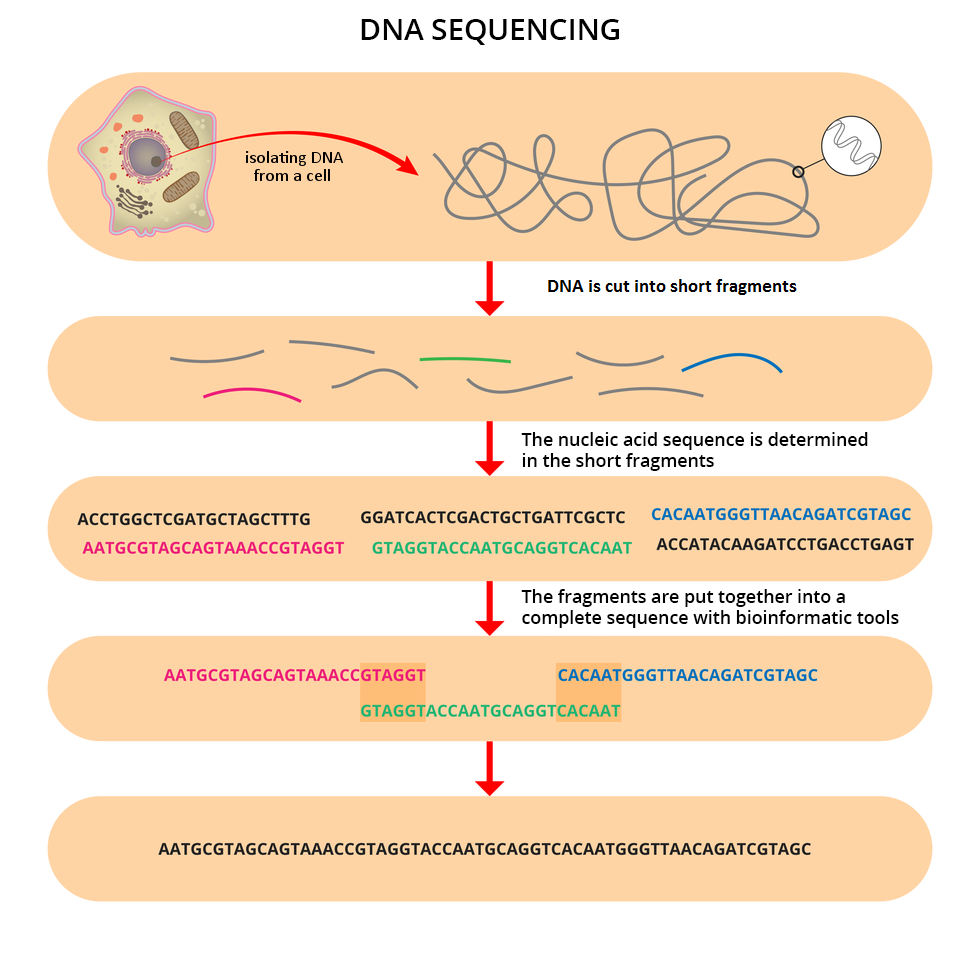
DNA sequencingDNA sequencing is a laboratory technique that plays a crucial part in genetic research, enabling for precise determination of the order of nucleotides—adenine, guanine, thymine, and cytosine—that constitute the genetic code: unique data and guidelines on cell structure and functioning.
Discovering the coding sequences is immensely significant as the functions of specific genes can be determined this way. DNA sequencing is one of the fastest and cheapest methods of understanding the genotype.
The Human Genome Project
The Human Genome ProjectHuman Genome Project (HGP) was launched in 1990, with the aim to determine the entire sequence of the human genomegenome and create maps of all chromosomes. The project was sponsored by the US Department of Energy and the National Institutes of Health.
The results have proved that:
there are around 30,000 human genes, which is less than previously estimated;
90% of a DNA strand and DNA strand is so‑called, non‑coding DNA—or contains information undiscovered as of yet;
a genome is composed of more than 3 billion nucleotide pairs;
some genetic information is coded RNA, which can carry out many biochemical reactions in organisms;
our knowledge of the human genome is still poor; it does not resemble a simple recipe for protein formation but rather a complex computer program.
The knowledge obtained from the project will contribute to the development more effective methods of diagnosing genetic diseases and detecting the risk of their occurrence, and perhaps of preventing some of them. The HGP also enabled the link between specific DNA sequences and skills and abilities to be proved, and helped discover new techniques of determining genetic sequences.

Phylogenetic application of bioinformatics
PhylogeneticsPhylogenetics is a subset of evolutionary biology concerned with determining the origin of organisms. Until recently, the origins of and relationships between organisms, also those that are extinct, used to be determined chiefly based on their structural, developmental, and functional similarities. Now, with databases of genetic sequences of many organisms (RNA and DNA sequences) and protein structures as well as advanced bioinformatic tools, the process of describing the history of the living world is both easier and more reliable.
The results of molecular research can sometimes contradict data collected by the anatomists. Differences in evaluating the validity of results obtained using traditional and bioinformatic methods have caused a divide in the scientific community.
Currently the most popular opinion says that it is indeed molecular research that both provides the most reliable results and is easier to carry out. They also enable for more remains to be studied. Anatomists often need bones or other well‑preserved body parts, preferably intact, while just the DNA is enough for genetic testing, and can be acquired from small fragments that are useless to anatomists. The isolated DNA is sequenced, and the strands obtained this way are then compared with the DNA of other organisms. If the similarity is significant, the organisms are closely related. This method also allows for comparing RNA and proteins of different organisms.
DNA barcoding
A barcode is a common sight in a shop, where it serves to identify items in a database. An analogous function for organisms is performed by the genetic sequence, a unique identifier of every living creature. By determining the sequence of nucleotides, the species of any given specimen can be determined with absolute certainty. Ideas have already been proposed and first attempts made to create a library of the genetic code of all organisms.
The Barcode of Life Data System (BOLD) is already in place. In 2005, it comprised 33,000 barcodesbarcodes (DNA markers) for 12,700 species. Within eight years, the database grew to more than 2.6 million markers for approximately 190,000 species. Each of them includes the species name, code sequence, date and place of finding the specimen, photographs and other information.
Arrange the DNA sequencing stages in the correct order.
- isolating DNA from a cell
- combining the fragments to form a complete sequence
- reading the nucleic acid sequence in the short DNA fragments
- cutting the DNA into short fragments
Match each term with its definition.
a tool for describing biodiversity, enabling for the creation of libraries of DNA sequences of different organisms, a subset of evolutionary biology that is concerned with reconstructing the origins of species, a molecular biology technique of determining the sequence of nucleotides in a nucleic acid fragment, a set of genes in a haploid (single) set of chromosomes
| genome | |
| phylogenetics | |
| DNA barcoding | |
| DNA sequencing |
Summary
Modern phylogenetics uses the methods of molecular biology.
Every organism has its own unique identifier:the nucleotide sequence.
How was this lesson? Did you like it? Finish selected sentences.

Keywords
DNA sequencing, Human Genome Project (HGP), phylogenetics
Glossary
bakording DNA – nowe narzędzie do opisu bioróżnorodności umożliwiające tworzenie bibliotek (zbiorów) sekwencji DNA występujących w organizmach
genom – zespół genów znajdujący sie w haploidalnym (pojedynczym) zestawie chromosomów
filogenetyka – dział biologii ewolucyjnej zajmujący się rekonstrukcją genealogii (pochodzenia) organizmów
projekt poznania ludzkiego genomu – HGP, z ang. Human Genome Project; projekt mający na celu poznanie kompletnej sekwencji par zasad w genomie człowieka
sekwencjonowanie DNA – technika biologii molekularnej pozwalająca poznać kolejność nukleotydów we fragmencie kwasu nukleinowego