Next to the process of nuclear fissionnuclear fissionnuclear fission, combining two light nuclei into one heavier one can also be a source of energy. Such a process is known as nuclear fusionnuclear fusionnuclear fusion.
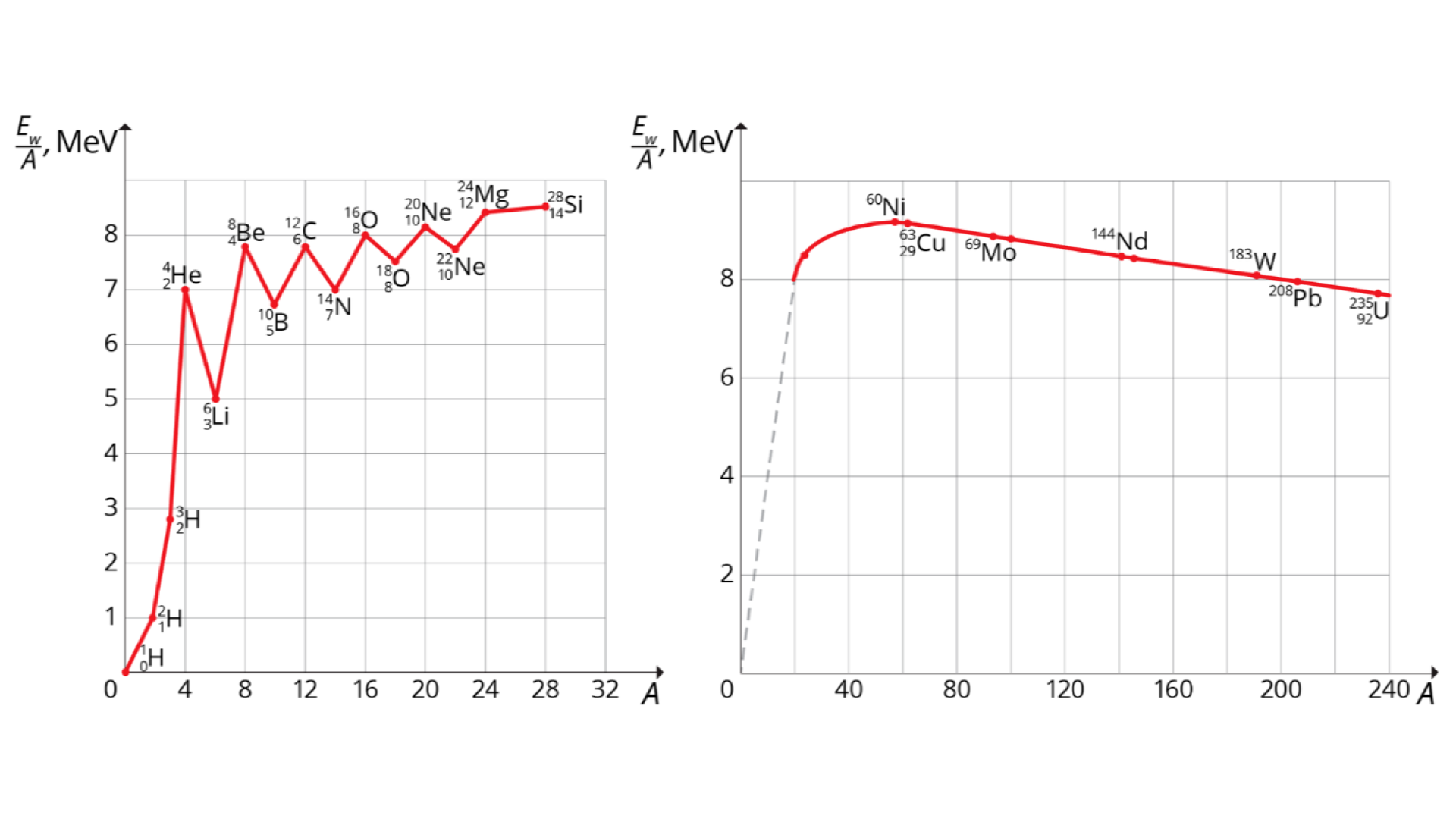
The following graphs show the binding energy per nucleon for various elements. Iron has a mass number of 56 and is one of the most stable of all the elements. Elements with lower and higher mass numbers are less stable.
For elements heavier than iron the fission process dominates while for elements lighter the iron the fusion occurs.
ROR8HzOjCGxST
6 serków ‘twój smak’ szpinak 1 paczka losos wedzony 300 g oliwki zielone kapary 3 kg maki 1 kg soli 30 jaj 4 masla szynka parmenska 4 kg kurczaka majeranek papryka bazylia koperek swiezy szczypiorek ogorki kiszone fasola ogorki zielone 3 kg majonez kuskus pomidory 2 kg sliwki jablka marchewka salatka roladki nalesnikowe ciasto ze sliwkami muffinki Rysunek przedstawia dwa wykresy opisujące energię wiązania przypadającą na jeden nukleon jako zależność od liczby masowej. Żelazo ma liczbę masową równą 56 i jest jednym z najbardziej stabilnych ze wszystkich pierwiastków. Elementy o mniejszej i większej liczbie masowej są mniej stabilne. W przypadku pierwiastków cięższych od żelaza dominuje proces rozszczepienia, natomiast w przypadku pierwiastków lżejszych występuje proces syntezy jądrowej. Najsilniej są wiązane nukleony w jądrach pierwiastków ze środkowej części układu okresowego.Po lewej stronie wykres przedstawia tę energię dla tzw. jąder lekkich. Oś pozioma podpisana A, ze skalą od 0 do 32, odcinek jednostkowy 4. Oś pionowa podpisana ułamek E z indeksem dolnym W przez A przecinek MeV, ze skalą od 0 do 8, odcinek jednostkowy 1. Łamana przechodzi przez punkty: w nawiasie 0, 0 - podpisany w indeksie górnym 1 w indeksie dolnym 0, H, wodór; w nawiasie 2, 1 - podpisany w indeksie górnym 2 w indeksie dolnym 1, H, wodór; w nawiasie 3, 2,8 - podpisany w indeksie górnym 3 w indeksie dolnym 2, H, wodór; w nawiasie 4, 7 - podpisany w indeksie górnym 4 w indeksie dolnym 2, H, wodór; w nawiasie 6, 5 - podpisany w indeksie górnym 6 w indeksie dolnym 3, Li, lit; w nawiasie 8, 7,8 - podpisany w indeksie górnym 8 w indeksie dolnym 4, Be, beryl; w nawiasie 10, 6,7 - podpisany w indeksie górnym 10 w indeksie dolnym 5, B, bor; w nawiasie 12, 7,8 - podpisany w indeksie górnym 12 w indeksie dolnym 6, C, węgiel; w nawiasie 14, 7 - podpisany w indeksie górnym 14 w indeksie dolnym 7, N, azot; w nawiasie 16, 8 - podpisany w indeksie górnym 16 w indeksie dolnym 8, O, tlen; w nawiasie 18, 7,5 - podpisany w indeksie górnym 18 w indeksie dolnym 8, O, tlen; w nawiasie 20, 8,2 - podpisany w indeksie górnym 20 w indeksie dolnym 10, Ne, neon; w nawiasie 22, 7,8 - podpisany w indeksie górnym 22 w indeksie dolnym 10, Ne, neon; w nawiasie 24, 8,4 - podpisany w indeksie górnym 24 w indeksie dolnym 12, Mg, magnez; w nawiasie 28, 8,6 - podpisany w indeksie górnym 28 w indeksie dolnym 14, Si, krzem. Po prawej stronie wykres pierwiastków cięższych od żelaza, gdzie dominuje proces rozszczepienia przedstawiony za pomocą krzywej. Oś pozioma podpisana A, ze skalą od 0 do 240, odcinek jednostkowy 40. Oś pionowa podpisana ułamek E z indeksem dolnym W przez A przecinek MeV, ze skalą od 0 do 8, odcinek jednostkowy 2. Krzywa przechodzi przez punkty (w przybliżeniu): w nawiasie 24, 8,4; w nawiasie 60, 9,2 - podpisany w indeksie górnym 60, Ni, nikiel; w nawiasie 63, 9 - podpisany w indeksie górnym 63 w indeksie dolnym 29, Cu, miedź; w nawiasie 92, 8,8 - podpisany w indeksie górnym 69, Mo, molibden; w nawiasie 144, 8,6 - podpisany w indeksie górnym 144, Nd, neodym; w nawiasie 183, 8,2 - podpisany w indeksie górnym 183, W, wolfram; w nawiasie 208, 8 - podpisany w indeksie górnym 208, Pb, ołów; w nawiasie 235, 7,6 - podpisany w indeksie górnym 235 w indeksie dolnym 92, U, uran. Odcinek od punktu w nawiasie 0, 0 do pierwszego punktu od lewej zaznaczony przerywaną linią.
Nuclear fusionnuclear fusionNuclear fusion is a type of nuclear reaction where two light nuclei collide together to form a single, heavier nucleus. This nucleus is unstable and decay into more stable daughter products. In this process, according to the principle of mass‑energy equivalence the energy is released because the mass of the new nucleus is less than the sum of the colliding masses.
Reaction between a deuterium and a tritium nucleus:
In the fusion process a helium nucleus (alpha particle) and a neutron are produced. The total mass of the products is lower than that of the colliding particles, and energy is released according to the mass‑energy equivalence principleequivalence principleequivalence principle.
It is nuclear reaction that takes place in the Sun and in other stars.
R1BDJcQSrIItx
Na ilustracji interaktywnej przedstawiona jest synteza deuteru i trytu, oznaczonych symbolicznie za pomocą zielonych i niebieskich kulek, odpowiadających liczbie neutronów i protonów. Na górze po lewej połączone kulki zielona i niebieska opisane w indeksie górnym 2, H. Na dole po lewej kulka niebieska opisana numerem 1. Od nich zostały poprowadzone strzałki wskazujące na gwiazdkę oznaczającą moment syntezy. Od niej prowadzą strzałki do produktów syntezy: neutronu i cząstki alfa. Na górze po prawej połączone dwie kulki niebieskie i jedna zielona opisane w indeksie górnym 3, H. Na dole po prawej połączone dwie kulki niebieskie i dwie zielone opisane numerem 2. W procesie syntezy powstaje jądro helu (cząstka alfa) i neutron. Całkowita masa produktów jest niższa niż masa zderzających się cząstek, stąd zgodnie z zasadą równoważności masy i energii uwalniana jest energia. Na ilustracji widoczne są numery, a na nich podpisy. 1. neutron carries energy of 14,1 MeV {audio}, 2. alpha particle carries energy of 3,5 MeV {audio}.
Na ilustracji interaktywnej przedstawiona jest synteza deuteru i trytu, oznaczonych symbolicznie za pomocą zielonych i niebieskich kulek, odpowiadających liczbie neutronów i protonów. Na górze po lewej połączone kulki zielona i niebieska opisane w indeksie górnym 2, H. Na dole po lewej kulka niebieska opisana numerem 1. Od nich zostały poprowadzone strzałki wskazujące na gwiazdkę oznaczającą moment syntezy. Od niej prowadzą strzałki do produktów syntezy: neutronu i cząstki alfa. Na górze po prawej połączone dwie kulki niebieskie i jedna zielona opisane w indeksie górnym 3, H. Na dole po prawej połączone dwie kulki niebieskie i dwie zielone opisane numerem 2. W procesie syntezy powstaje jądro helu (cząstka alfa) i neutron. Całkowita masa produktów jest niższa niż masa zderzających się cząstek, stąd zgodnie z zasadą równoważności masy i energii uwalniana jest energia. Na ilustracji widoczne są numery, a na nich podpisy. 1. neutron carries energy of 14,1 MeV {audio}, 2. alpha particle carries energy of 3,5 MeV {audio}.
Calculate the energy released in the deuterium‑tritium fusiondeuterium‑tritium fusiondeuterium‑tritium fusion. The deuterium mass is 3,34449 ∙ 10Indeks górny -27-27 kg, tritium 5,00826 ∙ 10Indeks górny -27-27 kg, helium 6,64648 ∙ 10Indeks górny -27-27 kg, and the mass of neutron is 1,67493 ∙ 10Indeks górny -27-27 kg. Use exact values of the speed of light c = 299792458 . The relation between electronovolt and joule is following: 1 eV = 1,6021766208 ∙ 10Indeks górny -19 Indeks górny koniec-19 J. Compare your result with the information you have already read.
An interactioninteractioninteraction between two nuclei can occur if they are at the distance of order of 10Indeks górny -15-15 m.
Then the nuclear forces are stronger than the electrostatic repulsion due to the positive charge of the nuclei. (The repulsion is inversely proportional to the square of the distance between the nuclei).
To get the two nuclei close together within a sufficiently short distance, their kinetic energy, hence the temperature has to be extremely high. In the high temperature the atoms ionize completely and are in the plasma state. Plasma is electrically conductive and its motion can be influenced by electric and magnetic fields.
In laboratory conditions the deuterium‑tritium samplesamplesample must be heated to very high temperature, similar to this on the Sun, of 10Indeks górny 77 K. The samplesamplesample should be also confine for a sufficiently long time to produce as many collisions as possible and increase the probability of generating fusion reactions.
During the deuterium‑tritium fusiondeuterium‑tritium fusiondeuterium‑tritium fusion to form 1 kg helium, energy of about 120 million kWh is released, what corresponds to the energy which could be obtained from 12 million kilograms of coal.
Many years of attempts to obtain a reasonable energy balance of thermonuclear fusion failed. So far nobody managed to produce more energy than the one that needed to be delivered in order to sustain the course of the reaction.
Remember
Nuclear fusion is a reaction in which two or more atomic nuclei are combined to form one or more different atomic nucleus and subatomic particles.
Exercises
RkS09gs3DpbgF
Exercise 1
Wersja alternatywna ćwiczenia: Determine which sentences are true. Możliwe odpowiedzi: 1. Nuclear fusion is the process of releasing the neutrons from atoms., 2. There is no fusion reactor to produce energy yet., 3. Nuclear fusion takes place on the Sun., 4. In nuclear fusion process the temperature must be of 10 000 000 K or higher.
Wersja alternatywna ćwiczenia: Determine which sentences are true. Możliwe odpowiedzi: 1. Nuclear fusion is the process of releasing the neutrons from atoms., 2. There is no fusion reactor to produce energy yet., 3. Nuclear fusion takes place on the Sun., 4. In nuclear fusion process the temperature must be of 10 000 000 K or higher.
Determine which sentences are true.
Nuclear fusion is the process of releasing the neutrons from atoms.
There is no fusion reactor to produce energy yet.
Nuclear fusion takes place on the Sun.
In nuclear fusion process the temperature must be of 10 000 000 K or higher.
Exercise 2
Given the following nuclear fusion reaction: What X stands for?
Deuterium.
Exercise 3
Explain in English what the nuclear fusion differs from the nuclear fissionnuclear fissionnuclear fission.
RX4D8E40UHaFn
Exercise 4
Wersja alternatywna ćwiczenia: Indicate which pairs of expressions or words are translated correctly. Możliwe odpowiedzi: 1. synteza jądrowa - nuclear fusion, 2. synteza jądrowa - nuclear fusion, 3. synteza jądrowa deuteru i trytu - deuterium-tritium fusion, 4. zasada równoważności - equivalence principle, 5. oddziaływanie - force, 6. siła - interaction
Wersja alternatywna ćwiczenia: Indicate which pairs of expressions or words are translated correctly. Możliwe odpowiedzi: 1. synteza jądrowa - nuclear fusion, 2. synteza jądrowa - nuclear fusion, 3. synteza jądrowa deuteru i trytu - deuterium-tritium fusion, 4. zasada równoważności - equivalence principle, 5. oddziaływanie - force, 6. siła - interaction
Indicate which pairs of expressions or words are translated correctly.
synteza jądrowa - nuclear fusion
synteza jądrowa - nuclear fusion
synteza jądrowa deuteru i trytu - deuterium-tritium fusion
zasada równoważności - equivalence principle
oddziaływanie - force
siła - interaction
zadanie
Source: GroMar, licencja: CC BY 3.0.
R1dyluiJRHQU01
Interaktywna gra, polegająca na łączeniu wyrazów w pary w ciągu jednej minuty. Czas zaczyna upływać wraz z rozpoczęciem gry. Jeden ruch to odkrywanie najpierw jednej potem drugiej karty z wyrazem. Każdy wyraz jest odczytywany. Kolejny ruch to odkrywanie trzeciej i czwartej karty. W ten sposób odsłuchasz wszystkie wyrazy. Nawigacja z poziomu klawiatury za pomocą strzałek, odsłuchiwanie wyrazów enterem lub spacją. Znajdź wszystkie pary wyrazów.
Interaktywna gra, polegająca na łączeniu wyrazów w pary w ciągu jednej minuty. Czas zaczyna upływać wraz z rozpoczęciem gry. Jeden ruch to odkrywanie najpierw jednej potem drugiej karty z wyrazem. Każdy wyraz jest odczytywany. Kolejny ruch to odkrywanie trzeciej i czwartej karty. W ten sposób odsłuchasz wszystkie wyrazy. Nawigacja z poziomu klawiatury za pomocą strzałek, odsłuchiwanie wyrazów enterem lub spacją. Znajdź wszystkie pary wyrazów.
Match Polish terms with their English equivalents.
sample
próbka
synteza jądrowa
thermonuclear reaction
reakcja termojądrowa
nuclear fission
rozszczepienie jądrowe
oddziaływanie
interaction
nuclear fusion
Source: Zespół autorski Politechniki Łódzkiej, licencja: CC BY 3.0.
Glossary
thermonuclear reaction
thermonuclear reaction
reakcja termojądrowa
R176bwi2hcFnb1
wymowa w języku angielskim: thermonuclear reaction
wymowa w języku angielskim: thermonuclear reaction