Threats to biodiversity
The consequences of human activity include acid rains and soil, air and water pollution.
Acid rains damage plant leaves and roots.
A strong competitor can cause a weaker population to go extinct.
to name and describe select anthropogenic factors that threaten biodiversity;
to describe how deforestation affects the environment;
to describe the impact of human activity on biodiversity;
to define and provide examples of biodiversity hotspots.
Nagranie dostępne na portalu epodreczniki.pl
Nagranie dźwiękowe dotyczące zagrożenia bioróżnorodności
Species extinction rate
The numbers of natural ecosystems, species and specimens of many populations are dwindling at an alarming rate. According to studies conducted by the International Union for Conservation of NatureInternational Union for Conservation of Nature (IUCN), 875 species on Earth have disappeared entirely from 1500 to 2009. However, this number seems greatly underestimated especially in relation to modern times, i.e. from the mid‑15th to the beginning of the 20th century. The state of knowledge at that time did not allow for a large number of species to be recognised and described. This only changed with scientific progress and the use of modern research methods, which took place in the 20th and 21st centuries.
The dramatic acceleration of the species extinction rate has been observed since the beginning of the 20th century, and it is only intensifying. Thus, it is sometimes said that we are witnessing a sixth mass extinction, also called the HoloceneHolocene extinction.
Humans as a threat to diversity
Several mass extinctions took place throughout the history of our planet. It is a natural process, often accompanied by the emergence of new species (speciation). Extinctions happened suddenly, following disasters, or slowly, as a result of antagonistic relations between populations. Humans are directly responsible for exterminating other species and transforming their living conditions.
The disappearance of habitats and ecosystems as a key factor for declining biodiversity
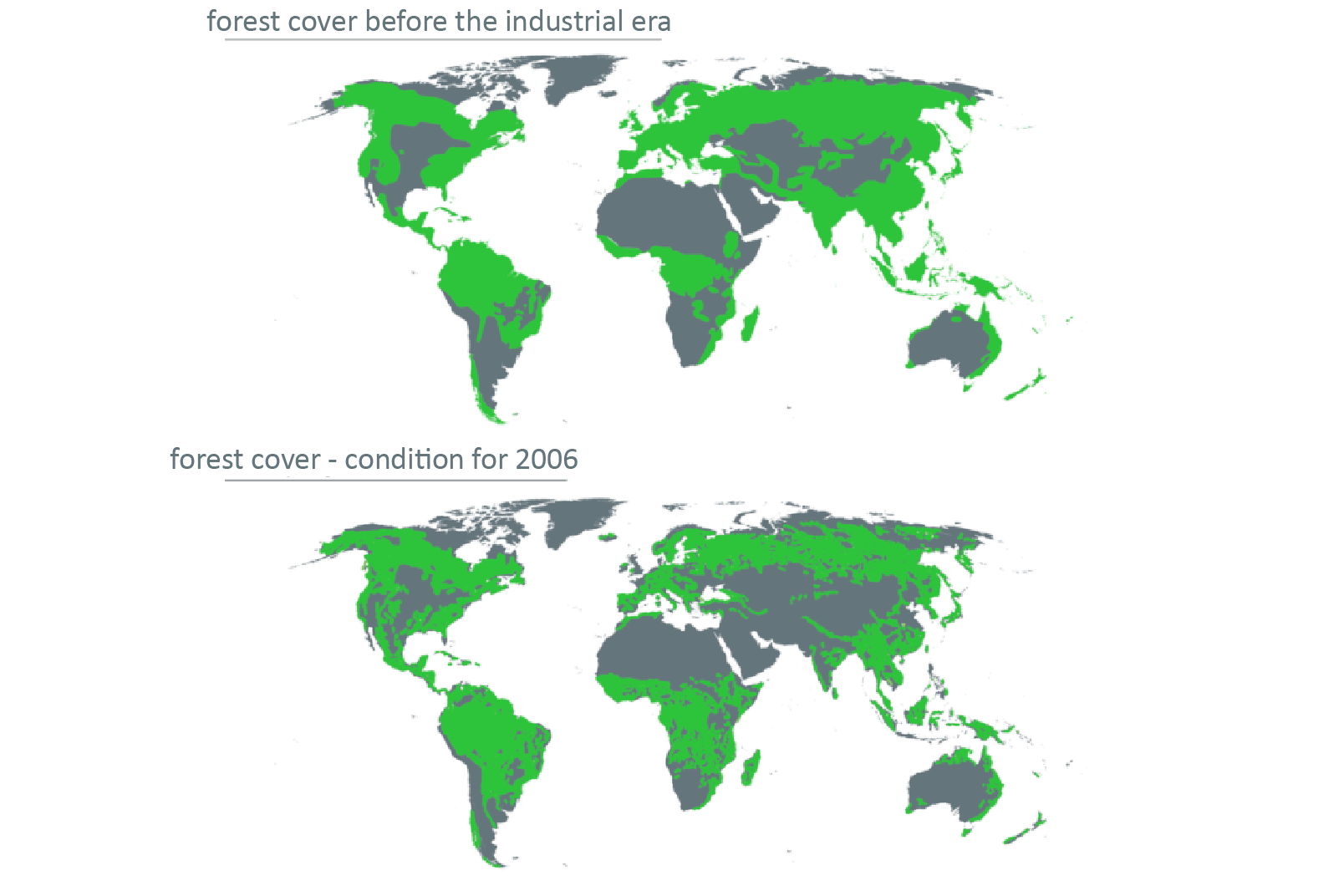
The primary reason for declining biodiversity is the diminishing area of natural ecosystems, with deforestation being the biggest problem. Forests are the most valuable ecosystems on Earth from the perspective of biodiversity. They are home to approximately 75 percent of Earth’s terrestrial species. Forests are the second largest global oxygen supplier (after the oceans) and a specific reservoir of drinking water. They also work as a natural air filter, prevent soil erosion, and stabilise the climate. Since they absorb large amounts of COIndeks dolny 22, they are a crucial inhibitor of global warming. Every tree is inhabited by numerous organisms that create a specific biocenosis. When forests are cut out, all these functions are lost, and so are large numbers of species and their interdependencies.
Forests are also logged and, more often, burnt to acquire fertile lands to grow crops or create meadows, which are necessary for grazing animals. Lands obtained this way erode quickly, and the millions of cubic metres of COIndeks dolny 22 released when burning forests are adding to the greenhouse effect. Acid rains and mass outbreaks of pests in monoculture forests also contribute to deforestation.
A considerable threat to biodiversity is also the disappearance of wetland, swampland and peatland ecosystems.
Invasive species and the consequences of introducing them into the environment
The second largest (after the disappearance of habitats) cause of declining global biodiversity is the introduction of foreign, highly invasive species into natural ecosystems. It is estimated that around half of native species were lost to invasive ones. Many of them are introduced by humans deliberately as they are thought to be beneficial for agriculture, forestry and horticulture. Others are brought in by accident, which is particularly intensified by the development of international and intercontinental transport and tourism.
Invasive speciesInvasive species are foreign species in a given ecosystem, usually originating from other climatic zones, for which the new environment is very beneficial for growth.
The impact of environment degradation and pollution on biodiversity
Pollution and environment degradationenvironment degradation have intensified with the development of industry, agriculture, municipal economy and transport. Water and soil contamination with industrial and municipal sewage poses a threat to many species, and cause a near‑extinction of all organisms living in rivers and lakes. Pollution from rivers is carried to the sea. Inland seas, such as the Baltic, where the exchange of water with the ocean is limited, are particularly at risk.
The impact of climate change on biodiversity
The impact of climate change on biodiversity is considered primarily in relation to global warming. Its causes are thought by many scientist to lie in natural climate processes rather than human activity.
Among other things, rising global temperature affects the distribution of organisms. It may also wipe them out if they cannot move to another habitat with optimal thermal conditions.
Prospects for biodiversity protection
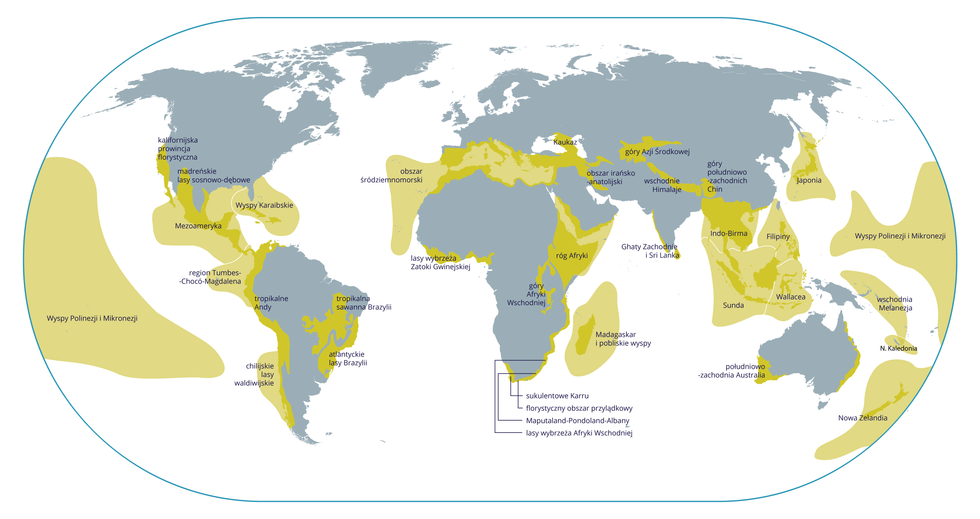
To prevent biodiversity from diminishing, it is necessary to focus on preserving those areas of the world that are at the same time the most valuable from the environmental standpoint and at the greatest risk. Scientists have designated 34 such places on Earth and called them biodiversity hotspotsbiodiversity hotspots. These are home to around 80% of terrestrial vertebrate species, over 40% of which are endemic. Every such areas has to meet two basic criteria. First, at least 1,500 endemic species of vascular plants must be located there. Second, these species must have lost at least 70% of their natural habitats due to human activity.
Why do invasive species pose a threat to indigenous species in a given ecosystem? Select all correct answers.
- Because they tend to fast establish their dominance in a new ecosystem.
- Because they can be a strong competitor for indigenous species when competing for natural resources.
- Because they are solely large and aggressive predators.
- Because they can infect the indigenous species with diseases and parasites.
What is a biodiversity hotspot?
- An area in which human activity resulted in an ecological disaster and the extinction of most species.
- A highly biodiverse area undergoing dynamic growth and protected by humans.
- A highly biodiverse area at risk of losing its level of biodiversity due to human activity.
- An area that retained its biodiversity despite significant degradation of natural environment.
Match each of the following examples of diminishing biodiversity with its cause.
land drainage, climate warming, acid rains, introduction of invasive species
| dying out of Alpine level lichen | |
| dying forests | |
| decimation of flightless birds in New Zealand | |
| disappearance of swampland ecosystems |
Summary
Human activity is a cause of the decline of biodiversity at all levels.
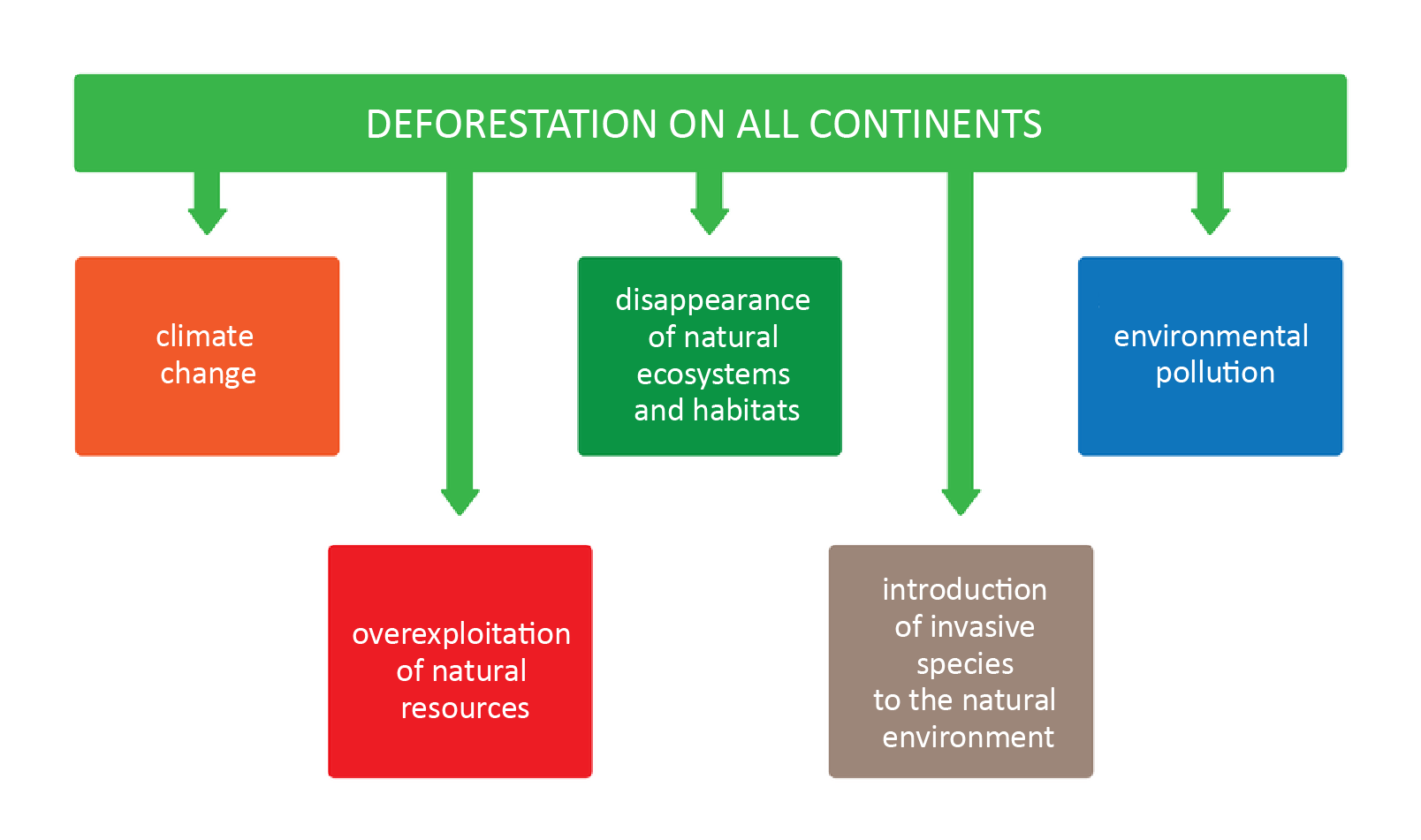
The main factors for declining biodiversity include the disappearance of natural habitats and ecosystems, the introduction of invasive species into the environment, environmental pollution, overexploitation of natural resources, and climate change.
1. Describe biotic and abiotic conditions that change as a result of cutting down a forest.
2. Provide and describe three examples of the negative impact of human activities on the diversity of ecosystems.
Keywords
climate warming, acid rains, environmental degradation
Glossary
degradacja środowiska – pogorszenie się stanu środowiska naturalnego pod wpływem działania człowieka; polega na zmniejszeniu różnorodności biologicznej i obniżeniu jakości takich składników, jak powietrze, woda, gleba; jej skutkiem jest zachwianie równowagi biologicznej
gatunki inwazyjne – gatunki obce (nierodzime) o znacznej ekspansywności; szybko się rozprzestrzeniają, stanowiąc zagrożenie dla gatunków rodzimych danego ekosystemu, z którymi konkurują o te same zasoby, często wypierając je i przyczyniając się do ich wyginięcia; są drugim po niszczeniu siedlisk największym zagrożeniem dla różnorodności biologicznej
gorący punkt bioróżnorodności – obszar biogeograficzny Ziemi charakteryzujący się bardzo wysoką różnorodnością biologiczną, jednocześnie zagrożony wskutek postępującej degradacji jego naturalnych siedlisk i ekosystemów, głównie w wyniku działalności człowieka
holocen – trwający obecnie okres geologiczny, który rozpoczął się po ustąpieniu ostatniego wielkiego zlodowacenia, co miało miejsce ok. 12 tysięcy lat temu
Nagranie dostępne na portalu epodreczniki.pl
Nagranie słówka international union for conservation of nature
Międzynarodowa Unia Ochrony Przyrody (IUCN) – międzynarodowa organizacja zajmująca się ochroną przyrody, założona w 1948 roku w Szwajcarii; pierwsza światowa organizacja skupiająca się na globalnych zagrożeniach środowiska naturalnego