The electric voltage generated at the powerpowerpower plant reaches 20000 volts at a current of thousands of amperes. In turn, the voltage in the home installations is only 230 V. During the distribution of electricity, the voltage increases many times, and the so‑called high voltage transmissiontransmissiontransmission lines are used. Lowering the voltage to 230 V occurs before the home installation. Also at home we find many devices that require different voltages, such as a telephone charger, computer circuits or a door bell, and all are powered by 230 V. A device that allows you to decrease or increase the voltage is called a transformertransformertransformer. It uses the phenomenon of electromagnetic inductioninductioninduction.
TransformertransformerTransformer is a device that allows to decrease or increase the alternating voltage and at the same time transfers electric energy of an alternating currentalternating currentalternating current (AC) due to the phenomenon of electromagnetic inductioninductioninduction from one electrical circuit to another.
Transformers not only decrease or increase the alternating current (AC) voltage, they also galvanically separate electrical circuits. This is used to protect against electric shock, e.g. in rooms with high humidity, in power tools.
R15UDiHohv1sd
Na ilustracji interaktywnej przedstawiony jest transformator. Transformator to urządzenie, które pozwala na podwyższanie lub obniżanie napięcia zmiennego i jednocześnie przenosi energię elektryczną prądu zmiennego dzięki zjawisku indukcji elektromagnetycznej z jednego obwodu elektrycznego do drugiego. Transformator zbudowany jest z prostokątnego rdzenia, na którym znajdują się uzwojenia: po lewej o dużej ilości zwojów, po prawej o małej. Na rdzeniu zaznaczony jest kierunek pola magnetycznego, na górze strzałka w prawo i podpis Magnetic Flux, symbol omega, na dole strzałka w lewo i podpis Transformer Core. Uzwojenia z lewej strony oznaczone numerem 1, opisane N z indeksem dolnym p turns. Wzdłuż długości wszystkich uzwojeń na tym boku opis Primary voltage V z indeksem dolnym p, od góry znak plus, na dole znak minus, na górze nad pierwszym uzwojeniem strzałka skierowana do rdzenia opisana Primary current I z indeksem dolnym p. Uzwojenia z prawej strony oznaczone numerem 2, opisane N z indeksem dolnym s turns. Wzdłuż długości wszystkich uzwojeń na tym boku opis Secondary voltage V z indeksem dolnym s, od góry znak plus, na dole znak minus, na górze nad pierwszym uzwojeniem strzałka skierowana od rdzenia opisana Secondary current I z indeksem dolnym s. Na ilustracji widoczne są numery, a na nich podpisy. 1. primary winding {audio}, 2. secondary winding {audio}.
Na ilustracji interaktywnej przedstawiony jest transformator. Transformator to urządzenie, które pozwala na podwyższanie lub obniżanie napięcia zmiennego i jednocześnie przenosi energię elektryczną prądu zmiennego dzięki zjawisku indukcji elektromagnetycznej z jednego obwodu elektrycznego do drugiego. Transformator zbudowany jest z prostokątnego rdzenia, na którym znajdują się uzwojenia: po lewej o dużej ilości zwojów, po prawej o małej. Na rdzeniu zaznaczony jest kierunek pola magnetycznego, na górze strzałka w prawo i podpis Magnetic Flux, symbol omega, na dole strzałka w lewo i podpis Transformer Core. Uzwojenia z lewej strony oznaczone numerem 1, opisane N z indeksem dolnym p turns. Wzdłuż długości wszystkich uzwojeń na tym boku opis Primary voltage V z indeksem dolnym p, od góry znak plus, na dole znak minus, na górze nad pierwszym uzwojeniem strzałka skierowana do rdzenia opisana Primary current I z indeksem dolnym p. Uzwojenia z prawej strony oznaczone numerem 2, opisane N z indeksem dolnym s turns. Wzdłuż długości wszystkich uzwojeń na tym boku opis Secondary voltage V z indeksem dolnym s, od góry znak plus, na dole znak minus, na górze nad pierwszym uzwojeniem strzałka skierowana od rdzenia opisana Secondary current I z indeksem dolnym s. Na ilustracji widoczne są numery, a na nich podpisy. 1. primary winding {audio}, 2. secondary winding {audio}.
The transformer consists of two windings wound on an iron corecorecore. An alternating currentalternating currentalternating current in one winding produces a variable magnetic field. This field induces voltage in the second winding.
If in the primary winding the number of windings is greater than in the secondary winding, then the induced voltage will be lower than the original one - i.e. we are dealing with a voltage‑reducing (step‑down) transformer.
If in the primary winding the number of windings is smaller than in the secondary winding, then the induced voltage will be greater than the original - it is a transformer that increases the voltage (step‑up transformerstep‑up transformerstep‑up transformer).
The relationship between the voltage and the number of windings describes the proportion:
A characteristic feature of the transformertransformertransformer is the rate of transferring the AC energy, called the transformer power. The power is represented by the letter P, and its unit is watt (W).
According to the principle of energy conservation, the power in the secondary winding should be equal to the power in the primary winding, assuming no energy losses.
The power is the product of the voltage and the current intensity, i.e.
The higher the voltage, the lower the current intensity must be.
The possibility of changing the voltage is the advantage of an alternating currentalternating currentalternating current. It is used when sending electricity over long distances.
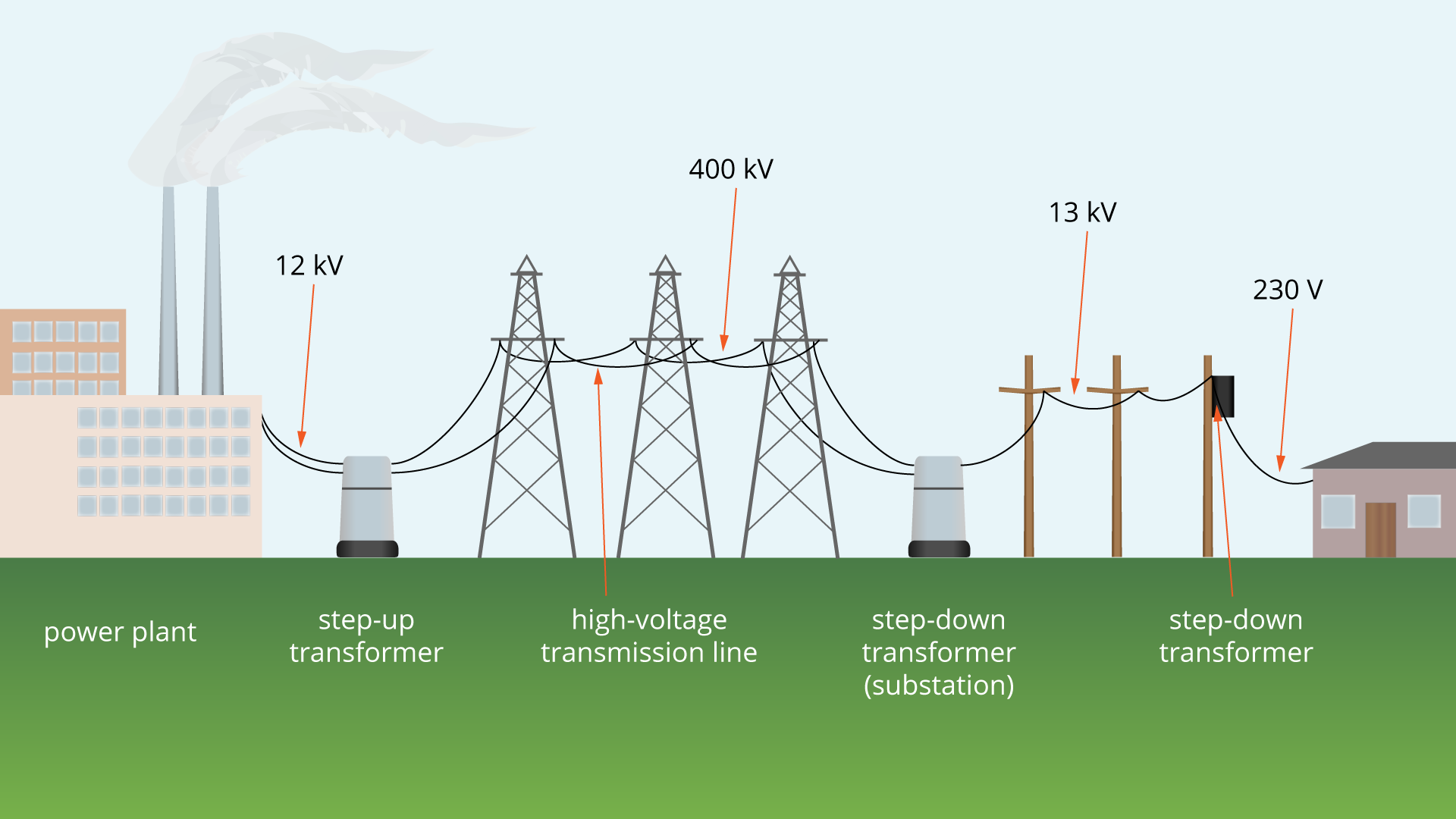
The energy transmissiontransmissiontransmission is affected by losses resulting from the fact that when a current flows in the conductor, heat is emitted to the surroundings. This is caused by the resistance of the conductor. Losses are undesirable, so to minimize them while transmitting current over long distances, high voltage and low current intensity are used. In power plants, the output voltage is around 20000 V and it is increased up to 440000 V. In local transformertransformertransformer stations, its value is gradually reduced until the necessary voltage is obtained.
RFFBzKVTW7Wj5
Na rysunku przedstawiony jest schematycznie przesył energii elektrycznej z elektrowni do zwykłego domu, wszystkie elementy połączone są liniami wysokiego napięcia (high-voltage transmission line). Od lewej strony widzimy kolejno: elektrownię (power plant) wytwarzającą prąd o napięciu 12 kV, stację transformatorową (step-up transformer), trzy słupy wysokiego napięcia, między którymi prąd ma 400 kV, kolejną stację transformatorową (step-up transformer, substation), słupy elektryczne, przez które płynie prąd o napięciu 13 kV, a na ostatnim z nich widnieje mała skrzynka transformatorowa (step-down transformer), dzięki której dom po prawej otrzymuje prąd o napięciu 230 V.
In addition to transformer stations, we can find transformers in virtually any electrical device used every day, e.g. powerpowerpower amplifiers, TV, power supply for a computer, charger for a telephone battery, etc.
TransformertransformerTransformer is a device that allows to decrease or increase the alternating voltage and at the same time transfers electric energy of an alternating currentalternating currentalternating current due to the phenomenon of electromagnetic inductioninductioninduction from one electrical circuit to another.
Exercises
R11D4hMiLRWz3
Exercise 2
Wersja alternatywna ćwiczenia: Determine which sentences are true. Możliwe odpowiedzi: 1. A step-up transformer is one where the voltage in the secondary winding is greater than the voltage in the primary winding., 2. Heat can be generated in the wires causing inefficiencies in transfer of electricity. , 3. The construction of a transformer includes a ferromagnetic core with multiple windings around., 4. Step up transformer is used for decrease the input voltage.
Wersja alternatywna ćwiczenia: Determine which sentences are true. Możliwe odpowiedzi: 1. A step-up transformer is one where the voltage in the secondary winding is greater than the voltage in the primary winding., 2. Heat can be generated in the wires causing inefficiencies in transfer of electricity. , 3. The construction of a transformer includes a ferromagnetic core with multiple windings around., 4. Step up transformer is used for decrease the input voltage.
Determine which sentences are true.
A step-up transformer is one where the voltage in the secondary winding is greater than the voltage in the primary winding.
Heat can be generated in the wires causing inefficiencies in transfer of electricity.
The construction of a transformer includes a ferromagnetic core with multiple windings around.
Step up transformer is used for decrease the input voltage.
zadanie
Source: GroMar, licencja: CC BY 3.0.
Exercise 3
What type of transformer is shown in the picture?
R95cefwY8itfa1
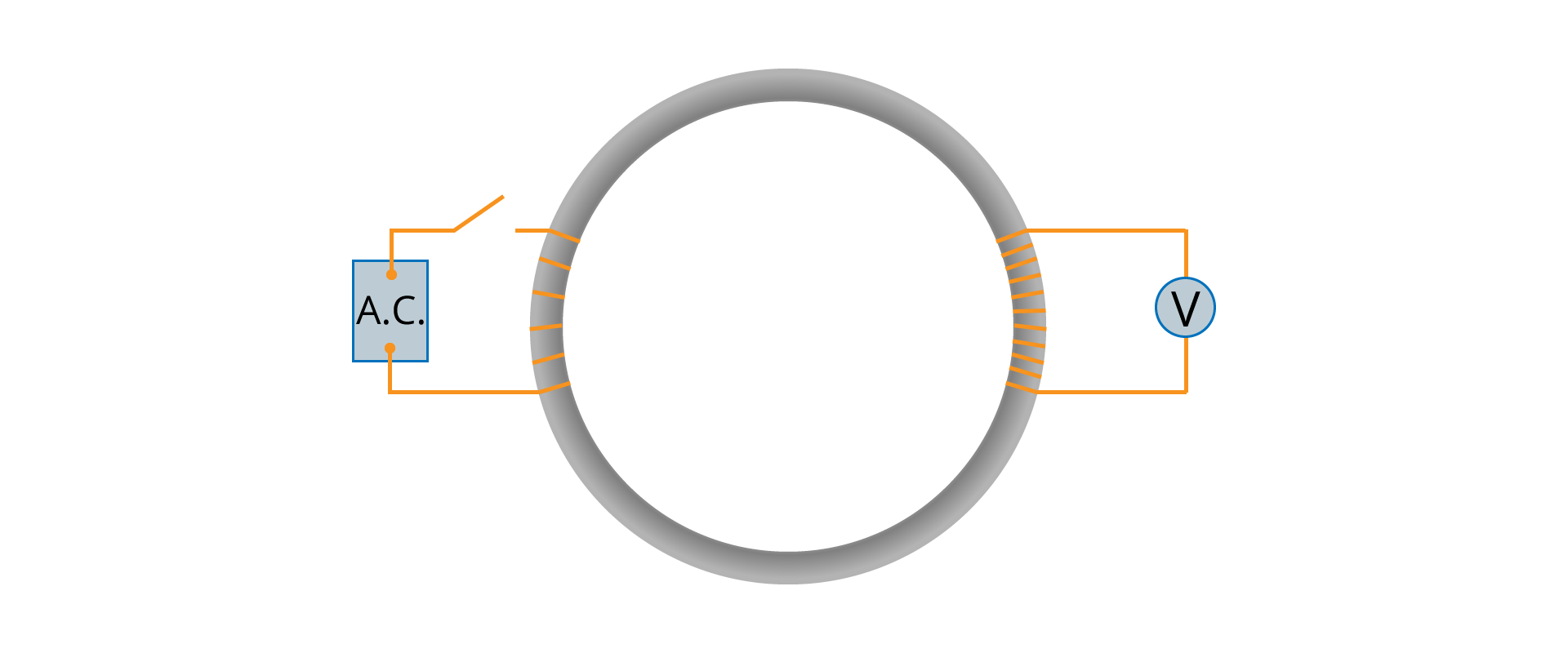
Na rysunku przedstawiony jest schemat transformatora o rdzeniu w kształcie okręgu. W lewej części rdzenia nawiniętych jest kilka zwojów, w prawej znacznie więcej. Lewe uzwojenie podpięte jest do źródła zasilania, prawe do miernika napięcia.
Source: GroMar, licencja: CC BY 3.0.
Step‑up transformer.
Exercise 4
Describe in English what function the transformer has.
R10tIPoASkmCM
Exercise 5
Wersja alternatywna ćwiczenia: Indicate which pairs of expressions or words are translated correctly. Możliwe odpowiedzi: 1. transformator - transformer, 2. moc - power, 3. indukcja - induction, 4. rdzeń - core, 5. przesył, transmisja - alternating current, 6. prąd zmienny - transmission
Wersja alternatywna ćwiczenia: Indicate which pairs of expressions or words are translated correctly. Możliwe odpowiedzi: 1. transformator - transformer, 2. moc - power, 3. indukcja - induction, 4. rdzeń - core, 5. przesył, transmisja - alternating current, 6. prąd zmienny - transmission
Indicate which pairs of expressions or words are translated correctly.
transformator - transformer
moc - power
indukcja - induction
rdzeń - core
przesył, transmisja - alternating current
prąd zmienny - transmission
zadanie
Source: GroMar, licencja: CC BY 3.0.
R8iYv4An2Lx1f1
Interaktywna gra, polegająca na łączeniu wyrazów w pary w ciągu jednej minuty. Czas zaczyna upływać wraz z rozpoczęciem gry. Jeden ruch to odkrywanie najpierw jednej potem drugiej karty z wyrazem. Każdy wyraz jest odczytywany. Kolejny ruch to odkrywanie trzeciej i czwartej karty. W ten sposób odsłuchasz wszystkie wyrazy. Nawigacja z poziomu klawiatury za pomocą strzałek, odsłuchiwanie wyrazów enterem lub spacją. Znajdź wszystkie pary wyrazów.
Interaktywna gra, polegająca na łączeniu wyrazów w pary w ciągu jednej minuty. Czas zaczyna upływać wraz z rozpoczęciem gry. Jeden ruch to odkrywanie najpierw jednej potem drugiej karty z wyrazem. Każdy wyraz jest odczytywany. Kolejny ruch to odkrywanie trzeciej i czwartej karty. W ten sposób odsłuchasz wszystkie wyrazy. Nawigacja z poziomu klawiatury za pomocą strzałek, odsłuchiwanie wyrazów enterem lub spacją. Znajdź wszystkie pary wyrazów.
Match Polish terms with their English equivalents.
core
step-up transformer
transformator
rdzeń
step-down transformer
transformator podwyższający napięcie
moc
power
transformator obniżający napięcie
transformer
Source: Zespół autorski Politechniki Łódzkiej, licencja: CC BY 3.0.