to present the phenomenon of convectionconvectionconvection in liquids and gases in English,
to describe the application of this phenomenon in practice.
Answer the questions.
You want to boil water in a pot using an electric heater. In which part of the pot should the heater be placed to boil all water as quickly as possible. Justify your answer.
Radiators in apartments are usually placed near the walls just above the floor. Explain the motivation for such solution. Would it be appropriate or not to put the radiators under the ceiling?
During cold winter, Janek lit up a fireplace in the middle of a large room. How the temperature in the heated room will change. Will the temperature be the same or not in the whole room? Justify your answer.
Name the phenomenon discussed in the answers to the above questions.
Explain what the phenomenon of convectionconvectionconvection in liquids or gases is.
Give examples of practical applications of convectionconvectionconvection in liquids and gases.
1. You want to boil water in a pot using an electric heater. In which part of the pot should be placed the heater to boil all water as soon as possible. Justify your answer.
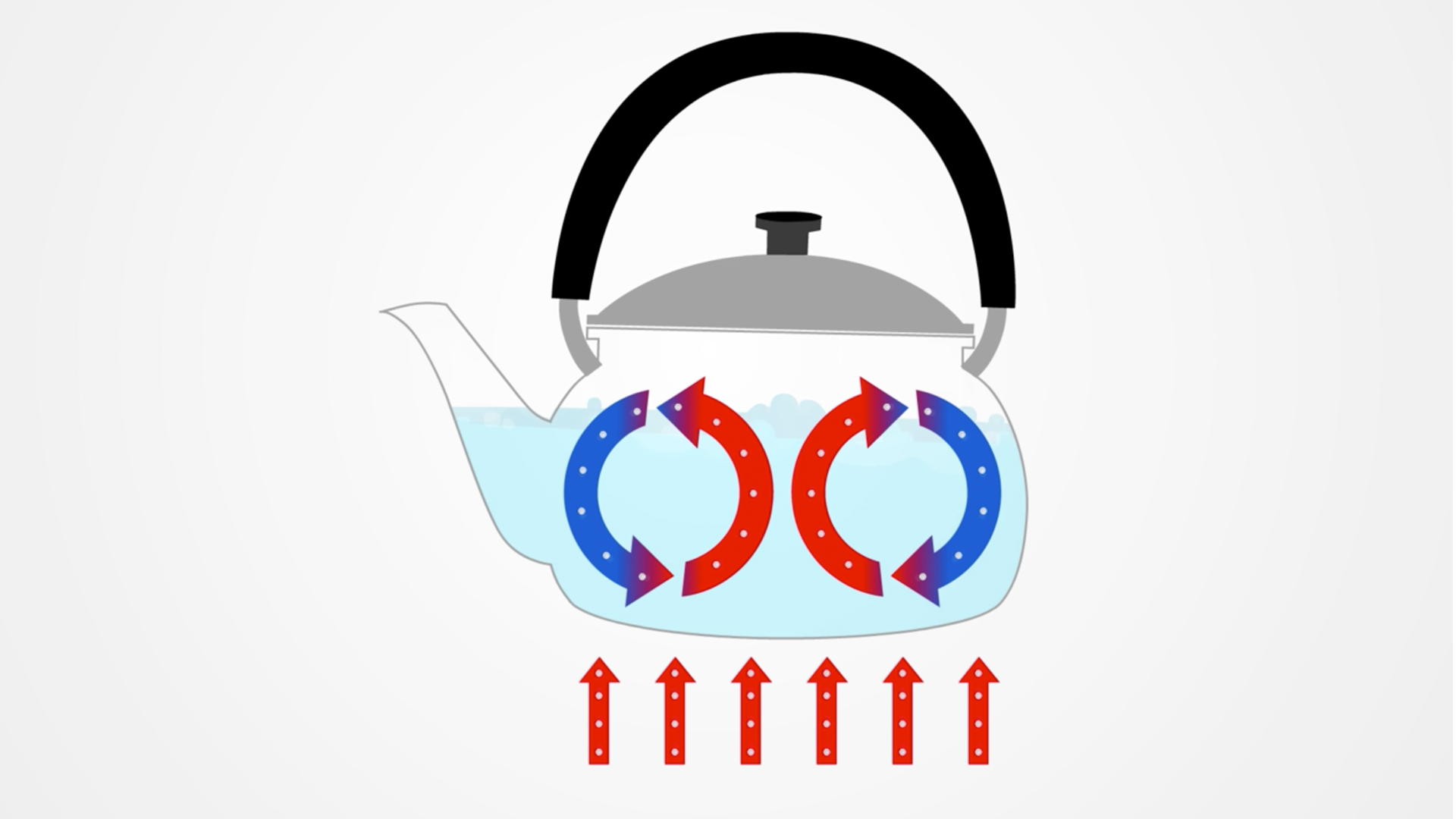
It is the best to put the heater at the very bottom of the pot. The heater radiates heat to water molecules in the immediate vicinity of the heater. These particles gain considerable kinetic energy and during the subsequent collisions with other molecules they transfer a significant part of their kinetic energy. As a result, the temperature of the water around the heater increases and the water densitydensitydensity decreases. The consequence of this is the macroscopic movement of hot water upwards and moving water with a lower temperature down into the vicinity of the heater. As a result, water warms up evenly. Placing the heater near its free surface may cause the water to boil at the top of the vessel and only a slight increase in the temperature of the water at the bottom of the vessel.
For the same reasons, the heater in the electric kettle is always placed at the bottom. This forces the circulation of heated water.
Rto7KKu8jrloM1
Ilustracja przedstawia czajnik wypełniony kolorem niebieskim symbolizującym wodę. Wewnątrz czajnika po lewej narysowane są dwie strzałki ułożone w okrąg. Początek jednej wskazuje koniec drugiej. Strzałka po lewej niebieska, strzałka po prawej czerwona. Wewnątrz czajnika po prawej narysowane są dwie strzałki ułożone w okrąg. Początek jednej wskazuje koniec drugiej. Strzałka po lewej czerwona, strzałka po prawej niebieska. Strzałki symbolizują obieg podgrzewanej wody w czajniku. Pod czajnikiem narysowane jest 6 czerwonych strzałek pionowych skierowanych do góry symbolizujących kierunek grzania.
Water heating in the kettle. Heat generated in the heater when electric current flows through the water at the bottom of the kettle. The heated water moves upwards and cold water falls to the bottom of the kettle.
2. Radiators in apartments are usually placed near the walls just above the floor. Explain the motivation for such solution. Would it be appropriate or not to put the radiators under the ceiling?
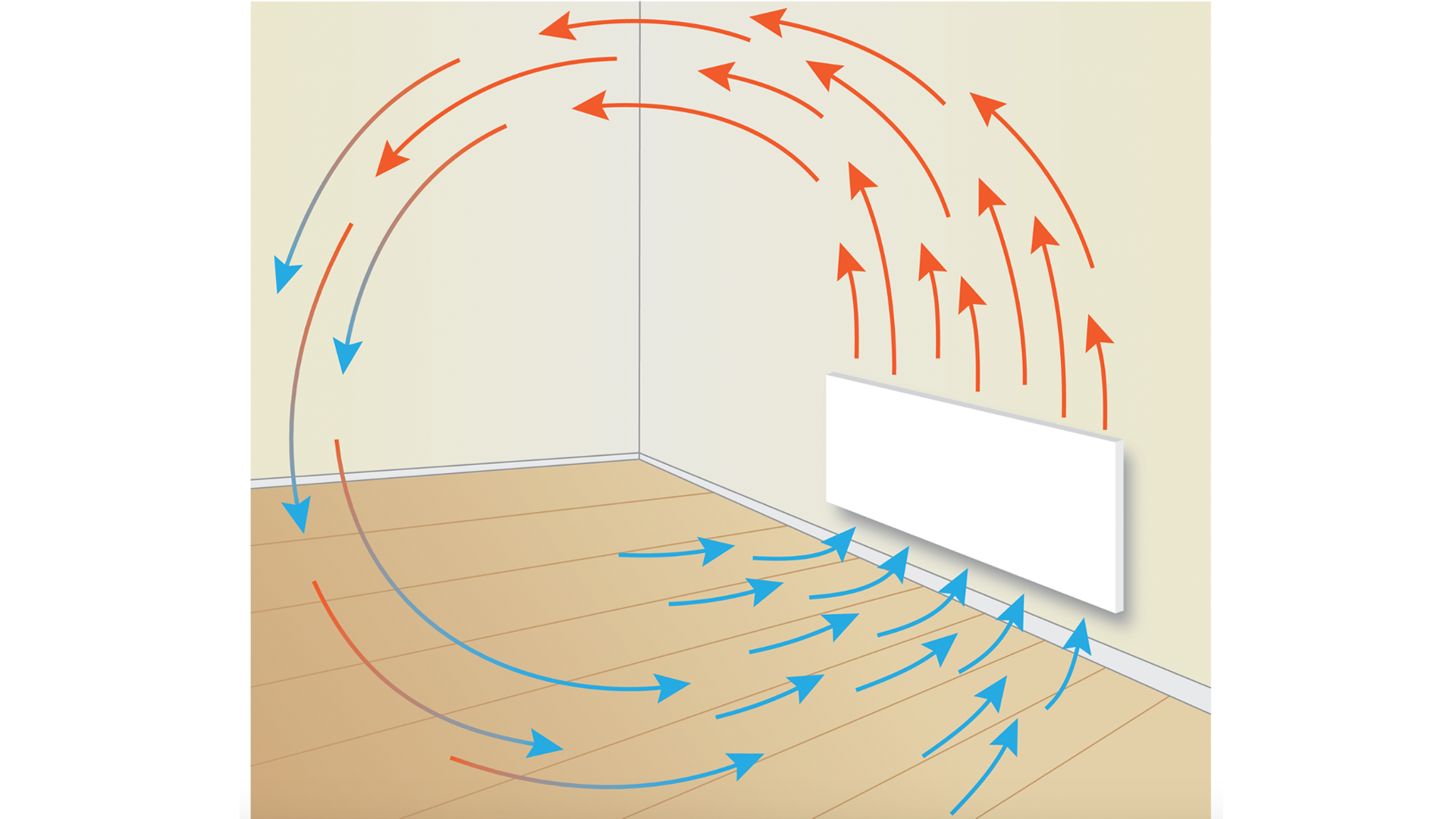
Radiators transmit the heat to the air molecules next to them. Due to the increase in the kinetic energy of these molecules, the temperature of the air around the radiator also increases. Thus, the densitydensitydensity of heated air is reduced. As a result, the air rises upward and the colder air falls down. It results in even warming of large air masses.
Placing the radiator under the ceiling considerably hampers the natural circulation of heat. Then the hot air would rise even more, and the cold air would be left by the floor. As a result, the temperature would be very high just at the ceiling, and very low next to the floor.
R4qHD6YhU6mxu1
Ilustracja przedstawia część pomieszczenia, dwie sąsiadujące ściany, podłogę drewnianą. Na ścianie po prawej stronie znajduje się grzejnik elektryczny. Od grzejnika narysowane jest dużo strzałek tworzących okrąg. Czerwone strzałki nad grzejnikiem skierowaną do góry, na górze obrazka czerwone strzałki poziome skierowane w lewo, po lewej stronie obrazka czerwono-niebieskie strzałki skierowane w dół, na dole niebieskie strzałki skierowane w prawo, pod grzejnikiem niebieskie strzałki skierowane do góry. Strzałki symbolizują ogrzewanie pokoju przez kaloryfer wiszący na ścianie i naturalny ruch powietrza ciepłego (czerwone strzałki) i zimnego (niebieskie strzałki).
Room heating by a radiator and natural movement of warm and cold air. Placing a radiator under the ceiling would disturb the heat transferheat transferheat transfer throughout the room.
3. During cold winter, Janek lit up a fireplace in the middle of a large room. Write how the temperature in the heated room will change. Will the temperature be the same or not in the whole room? Justify your answer.
The heat will be transferred first to the air molecules in the direct vicinity of the fireplace. Then, as a result of collisions between air molecules, the heat is transferred to the particles found in the entire room volume. But it takes time. It can happen that in one part of the room the temperature will be, for example, and in another one much less, e.g. .
The following figure illustrates the discussed issues.
R108bf2NyohAf
Ilustracja interaktywna przedstawia pokój. Na ścianie po lewej stronie znajduje się okno, na ścianie na wprost znajduje się kominek, na suficie narysowana lampa. Od kominka narysowane są czerwone strzałki skierowane do góry oznaczone numerem 3. Od kominka do lampy czerwona strzałka. Od lampy w kierunku okna dwie czerwone strzałki. Od okna do kominka na dole obrazka dwie niebieskie strzałki. Na suficie napis 25 stopni C oznaczony numerem 1. Na wysokości okna napis 20 stopni C. Na podłodze napis 17 stopni C oznaczony numerem 4. Pod lampą numer 2. Na ilustracji widoczne są numery, a na nich podpisy. 1. high temperature just under the ceiling {audio}, 2. the exchange of hot and cold air is very difficult {audio}, 3. hot air at a certain height {audio}, 4. low temperature just above the floor {audio}.
Ilustracja interaktywna przedstawia pokój. Na ścianie po lewej stronie znajduje się okno, na ścianie na wprost znajduje się kominek, na suficie narysowana lampa. Od kominka narysowane są czerwone strzałki skierowane do góry oznaczone numerem 3. Od kominka do lampy czerwona strzałka. Od lampy w kierunku okna dwie czerwone strzałki. Od okna do kominka na dole obrazka dwie niebieskie strzałki. Na suficie napis 25 stopni C oznaczony numerem 1. Na wysokości okna napis 20 stopni C. Na podłodze napis 17 stopni C oznaczony numerem 4. Pod lampą numer 2. Na ilustracji widoczne są numery, a na nich podpisy. 1. high temperature just under the ceiling {audio}, 2. the exchange of hot and cold air is very difficult {audio}, 3. hot air at a certain height {audio}, 4. low temperature just above the floor {audio}.
Heating the room with the fireplace takes a long time and causes uneven distribution of air temperature
The phenomenon of convectionconvectionconvection is presented in the above examples.
Sometimes convectionconvectionconvection also means the mere movement of matter associated with temperature differences that leads to heat transferheat transferheat transfer. This movement is more precisely called the convection currentconvection currentconvection current.
ConvectionconvectionConvection - the process of heat transferheat transferheat transfer as a result of macroscopic movements of matter in gases and liquids.
We observe the phenomenon of convectionconvectionconvection wherever there is a temperature difference between different places in the entire volumeentire volumeentire volume. At higher temperatures, molecules move faster, so the distances between them increase, and the volume increases and densitydensitydensity decreases. The area of gas or liquid with a higher temperature and lower density according to Archimedes's law begins to rise. During the movement it gives energy to contacting colder areas.
If this motion of gas or liquid areas is caused by a difference in densitydensitydensity, then convectionconvectionconvection is called free.
Sometimes it is possible to define forced convectionconvectionconvection, when the movement of air or liquid is caused by the effects of external forces, e.g. a fan. However, this time we will not discuss this phenomenon.
6. Give examples of practical applications of convection in liquids and gases.
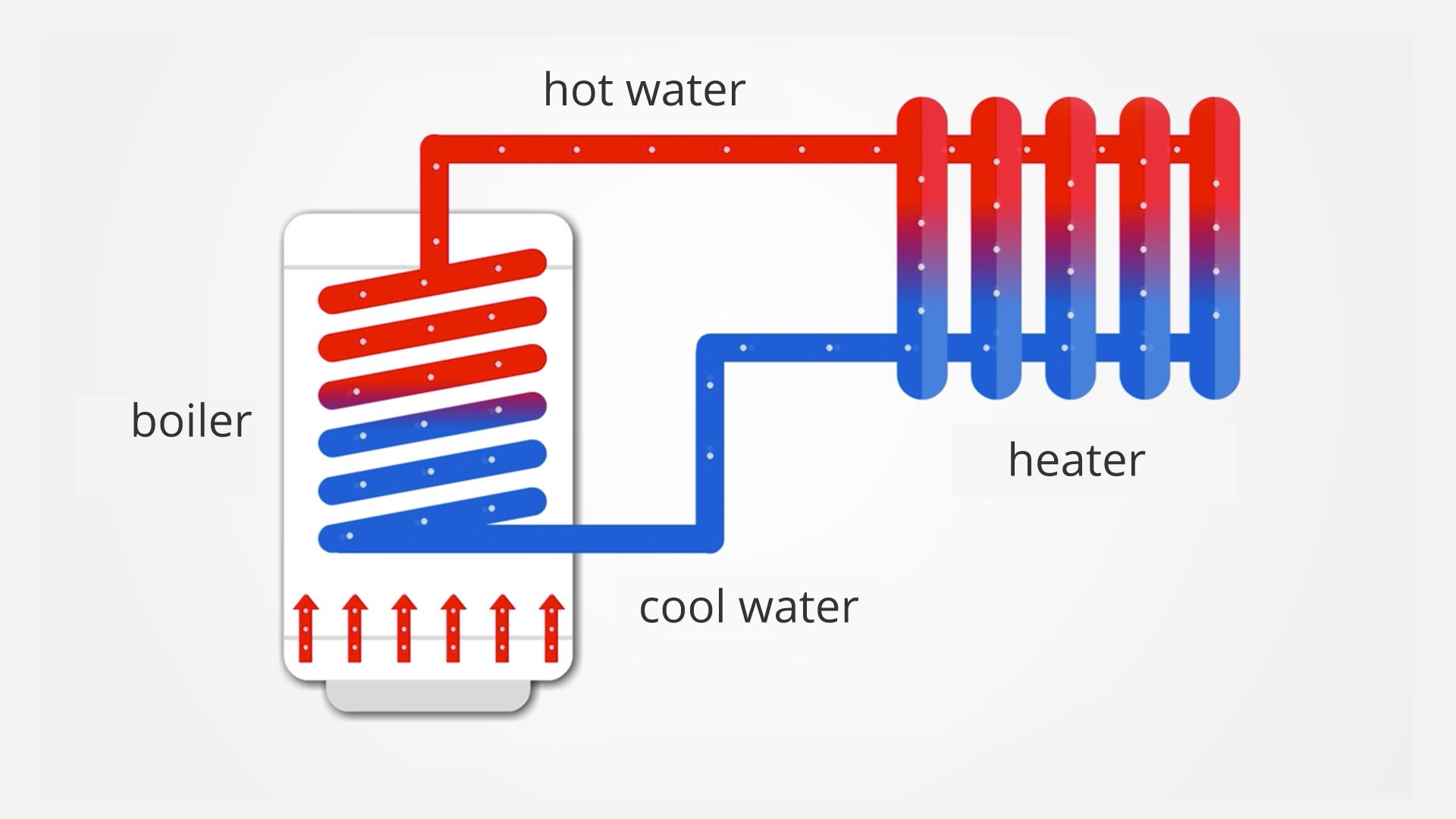
Convection of water in the central heating installation.
REUNiXgkqOF8C1
Ilustracja przedstawia po prawej prostokąt symbolizujący bojler, opisany boiler. W nim na dole sześć czerwonych strzałek skierowanych pionowo do góry. Po prawej stronie rysunku prostokąty z zaokrąglonymi rogami symbolizujące kaloryfer żeberkowy, w dolnej części pomalowane na niebiesko, w górnej na czerwono. Na dole linia niebieska pozioma łączy kaloryfer z bojlerem opisana cold water, na górze linia czerwona pozioma łączy kaloryfer z bojlerem opisana hot water. W bojlerze linie ukośne od góry czerwone przechodzące w niebieskie na dole.
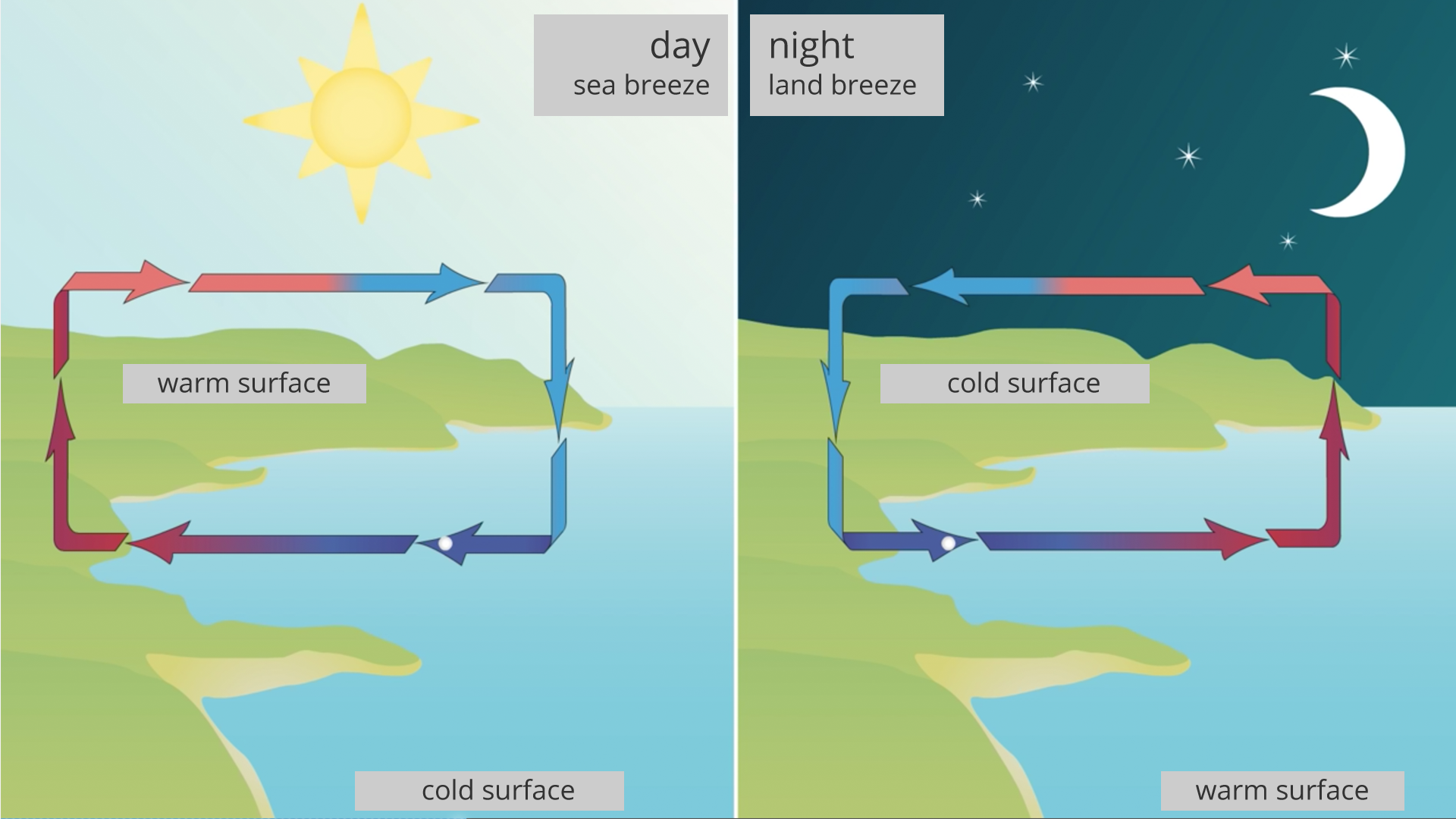
The phenomenon of sea and land breeze on the coastline of the sea.
RnKklcbSmOAPi1
Ilustracja po lewej stronie opisana day, sea breeze, przedstawia morze opisane cold surface, ląd opisany warm surface i słońce na niebie. Na środku narysowane strzałki ułożone w prostokąt, koniec jednej strzałki jest początkiem innej. Strzałki na górnym boku prostokąta skierowane w prawo, w stronę morza. Strzałki nad wodą w kolorze niebieskim, na granicy lądu i morza niebiesko-czerwone, na lądzie czerwone. Ilustracja po prawej stronie opisana night, land breeze, przedstawia morze opisane warm surface, ląd opisany cold surface i księżyc na niebie. Na środku narysowane strzałki ułożone w prostokąt, koniec jednej strzałki jest początkiem innej. Strzałki na górnym boku prostokąta skierowane w lewo, w stronę lądu. Strzałki nad wodą w kolorze czerwonym, na granicy lądu i morza czerwono-niebieskie, na lądzie niebieskie.
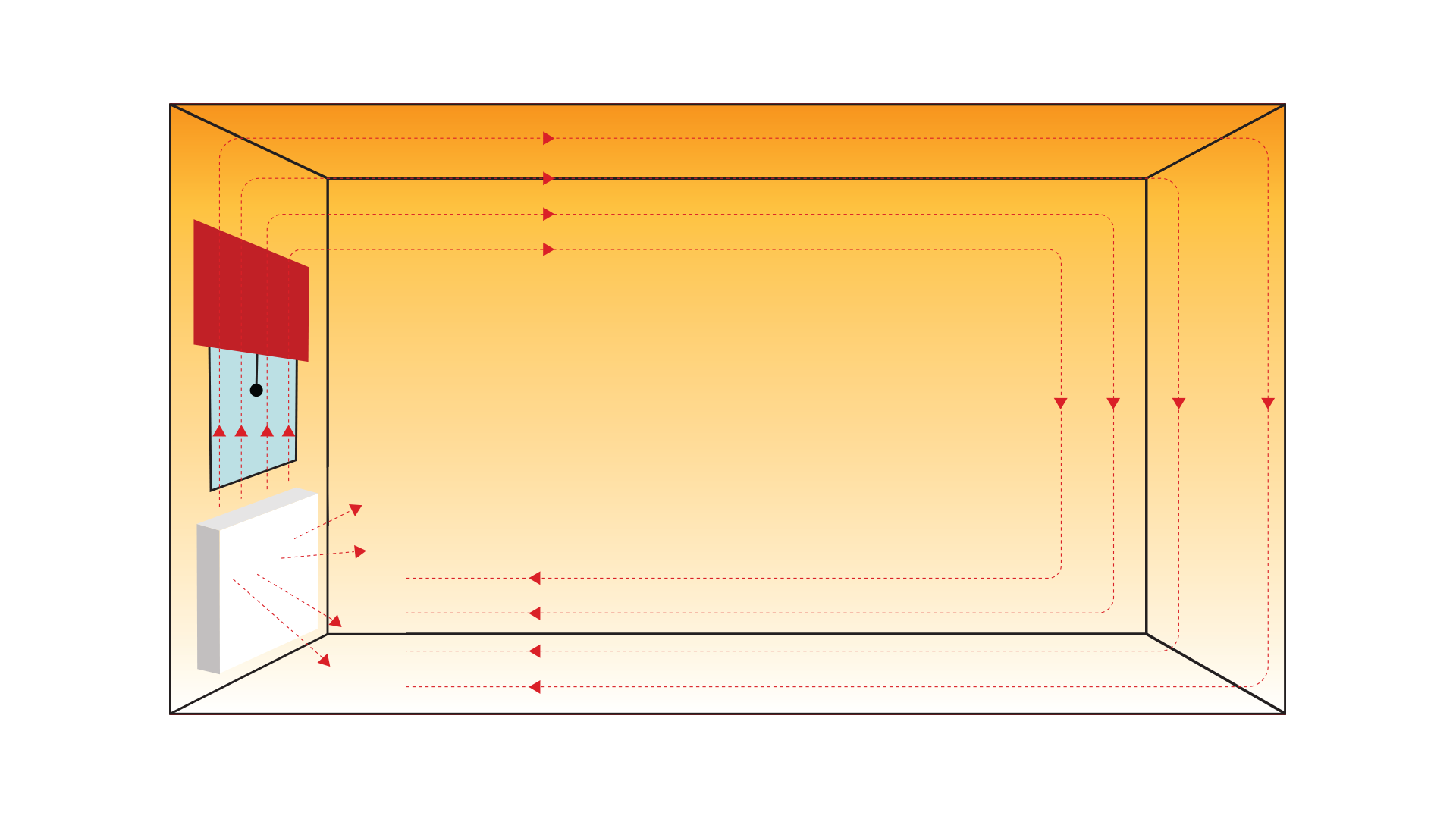
The purposeful location of the radiator under the window of the room.
R1ZU2ZfD5Evqh1
Ilustracja przedstawia pokój. Na ścianie po lewej stronie znajduje się okno, pod nim kaloryfer. Od kaloryfera narysowane ukośne strzałki w prawo oraz linie przerywane do góry wzdłuż lewej ściany, na nich strzałki skierowane do góry. Następnie linie przerywane narysowane dalej na suficie, na nich strzałki skierowane w prawo. Następnie linie przerywane narysowane dalej na prawej ścianie, na nich strzałki skierowane do dołu. Następnie linie przerywane narysowane dalej na podłodze, na nich strzałki skierowane w lewo.
Convection is the phenomenon of transferring heat by moving heated layers or areas of gases or liquids.
Free convection - movement of gas or liquid caused by differences in the densitydensitydensity of areas of different temperature.
We often meet the phenomenon of convectionconvectionconvection every day. The air with a higher temperature near the warm radiator rises to the top, where it cools and then drops.
We observe the phenomenon of convectionconvectionconvection wherever there is a temperature difference between different places in the entire volumeentire volumeentire volume. At higher temperatures, molecules move faster, so the distances between them increase, and the volume increases and densitydensitydensity decreases. The area of gas or liquid with a higher temperature and lower density according to Archimedes's law begins to rise. During the movement it gives energy to contacting colder areas.
Exercises
R1YQl72UMi13e
Exercise 1
Wersja alternatywna ćwiczenia: Determine which sentences are true. Możliwe odpowiedzi: 1. Convection only occurs in gases., 2. The phenomenon of convection is the result of different densities of liquid or gas depending on the temperature., 3. Convection takes place in gases and liquids., 4. Convection occurs only in summer., 5. The phenomenon of convection occurs only in winter.
Wersja alternatywna ćwiczenia: Determine which sentences are true. Możliwe odpowiedzi: 1. Convection only occurs in gases., 2. The phenomenon of convection is the result of different densities of liquid or gas depending on the temperature., 3. Convection takes place in gases and liquids., 4. Convection occurs only in summer., 5. The phenomenon of convection occurs only in winter.
Determine which sentences are true.
Convection only occurs in gases.
The phenomenon of convection is the result of different densities of liquid or gas depending on the temperature.
Convection takes place in gases and liquids.
Convection occurs only in summer.
The phenomenon of convection occurs only in winter.
Exercise 2
We want to install an air conditioner at home. Where is the best place to put it: on the top of the wall or just above the floor? Explain why.
On the top. It will improve the convection process and allow for the rapid exchange of hot and cold air.
Exercise 3
Using several thermometers, suggest a method for determining the temperature distribution in a room heated by a fireplace or an electric heater. Write a short manual instruction for this task in English.
RLUsuBPAb3fi1
Exercise 4
Wersja alternatywna ćwiczenia: Indicate which pairs of expressions or words are translated correctly. Możliwe odpowiedzi: 1. konwekcja swobodna - free convection, 2. rozkład temperatur - temperature distribution, 3. wymiana ciepła - heat transfer, 4. równomierny rozkład - even distribution, 5. konwekcja - density, 6. gęstość - convection
Wersja alternatywna ćwiczenia: Indicate which pairs of expressions or words are translated correctly. Możliwe odpowiedzi: 1. konwekcja swobodna - free convection, 2. rozkład temperatur - temperature distribution, 3. wymiana ciepła - heat transfer, 4. równomierny rozkład - even distribution, 5. konwekcja - density, 6. gęstość - convection
Indicate which pairs of expressions or words are translated correctly.
konwekcja swobodna - free convection
rozkład temperatur - temperature distribution
wymiana ciepła - heat transfer
równomierny rozkład - even distribution
konwekcja - density
gęstość - convection
zadanie
Source: GroMar, licencja: CC BY 3.0.
R19JEsfONu48j1
Interaktywna gra, polegająca na łączeniu wyrazów w pary w ciągu jednej minuty. Czas zaczyna upływać wraz z rozpoczęciem gry. Jeden ruch to odkrywanie najpierw jednej potem drugiej karty z wyrazem. Każdy wyraz jest odczytywany. Kolejny ruch to odkrywanie trzeciej i czwartej karty. W ten sposób odsłuchasz wszystkie wyrazy. Nawigacja z poziomu klawiatury za pomocą strzałek, odsłuchiwanie wyrazów enterem lub spacją. Znajdź wszystkie pary wyrazów.
Interaktywna gra, polegająca na łączeniu wyrazów w pary w ciągu jednej minuty. Czas zaczyna upływać wraz z rozpoczęciem gry. Jeden ruch to odkrywanie najpierw jednej potem drugiej karty z wyrazem. Każdy wyraz jest odczytywany. Kolejny ruch to odkrywanie trzeciej i czwartej karty. W ten sposób odsłuchasz wszystkie wyrazy. Nawigacja z poziomu klawiatury za pomocą strzałek, odsłuchiwanie wyrazów enterem lub spacją. Znajdź wszystkie pary wyrazów.
Match Polish terms with their English equivalents.
gęstość
wymiana ciepła
rozkład temperatur
density
temperature distribution
konwekcja swobodna
konwekcja
convection
heat transfer
free convection
Source: Zespół autorski Politechniki Łódzkiej, licencja: CC BY 3.0.