United in diversity - symbols of the EU
what are the symbols of the European UnionEuropean Union and where they came from;
what is the meaning of the symbols of the Community;
when Europe Day is celebrated and why it was established.
In the European integrationintegration project, the idea was initially to create transnational economic zones in which the free flow of people, services and capital would be possible, but with full respect for the independence and separateness of the member states (Europe of homelands). Then came ideas of closer integration towards the creation of a European superstate (Homeland Europe). The most important EU country is Germany. The symbols of the EU are the flag, anthemanthem and mottomotto. On the EU flag there are 12 golden stars arranged in a circle on a blue background. The anthem of the EU is „OdeOde to joy, a fragment of Ludwig van Beethoven's Symphony No. 9 with the text of Friedrich Schiller.” The EU motto is: „united in diversity”.
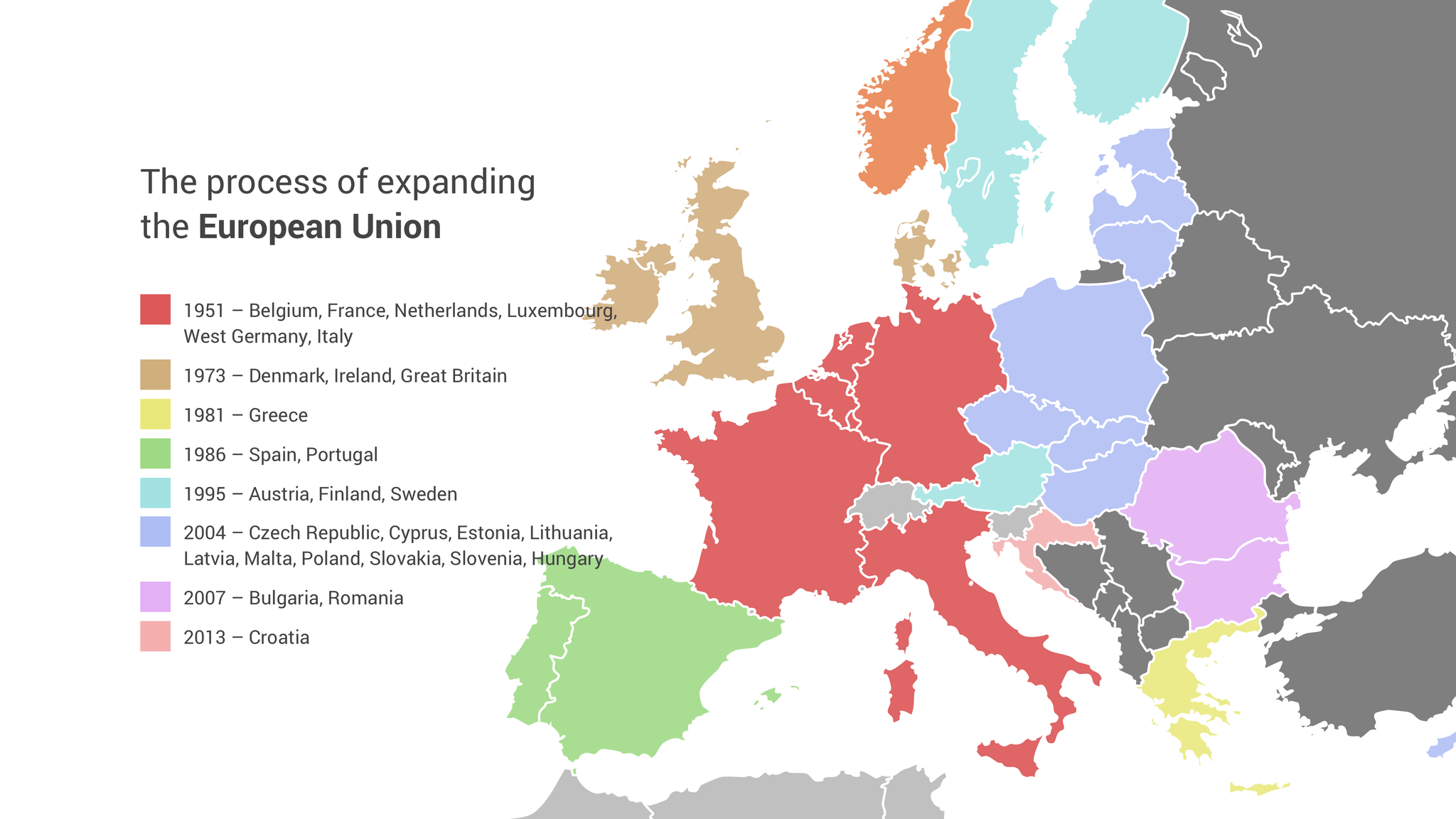
Select the 12 countries that were the earliest members of the European Union. If you do not remember, use the map in this lesson.
Earliest members of the EU
Germany;Belgium;Cyprus; Austria;Luxembourg;The Netherlands;Greece;Great Britain;Turkey;Denmark;Ireland;Italy;Malta; Czech Republic;France;Iceland;Spain;Finland;Portugal;Sweden
Select the correct statements.
- Ode to joy has been the anthem of the European Union from the beginning of its existence.
- The original text of Ode to joy was created in German.
- The EU anthem has no text, only music itself.
- The message of the hymn is the brotherhood of all Europeans.
- First, the music came into being, then the words of Ode to joy.
- Ode to joy replaces the national anthems of the member states.
„World peace cannot be safeguarded if constructive efforts are not made commensurate with the dangers that threaten it. (…)
Europe will not be made at once, nor according to a single master plan of construction. It will be built by concrete achievements, which create de facto dependence, mutual interests and the desire for common action. The gathering of the nations of Europe demands the elimination of the age-old antagonism of France and Germany. The first concern of any action undertaken must involve these two countries.
With this objective in mind, the French government proposes to direct its action on one limited but decisive point:
"The French government proposes to place Franco-German production of coal and steel under one common High Authority in an organisation open to the participation of other countries of Europe." The pooling of coal and steel production will immediately assure the establishment of common bases for economic development as a first step for the European Federation. It will change the destiny of regions that have long been devoted to manufacturing munitions of war, of which they have been most constantly the victims..
This merging of our interests in coal and steel production and our joint action will make it plain that any war between France and Germany becomes not only unthinkable but materially impossible. The establishment of this powerful unity for production, open to all countries willing to take part, and eventually capable of providing all the member countries with the basic elements of industrial production on the same terms, will cast the real foundation for their economic unification..
This production would be offered to the world as a whole, without distinction or exception, with the aim of raising living standards and promoting peace as well as fulfilling one of Europe’s essential tasks — the development of the African continent..
In this way, simply and speedily, the fusion of interests which is vital for the establishment of a common economic system will be realized. Thus the leaven will be introduced which will permeate and build a wider and deeper community between countries that had continually opposed each other in bloody divisions.
By pooling basic industrial production and setting-up a new High Authority whose decisions will be binding on France, Germany and other member countries, these proposals will bring to reality the first solid groundwork for a European Federation vital to the preservation of world peace. (…)”
Read the text carefully and select in it which goals in the economic cooperation between France and Germany did Robert Schuman see in it and how they were to be implemented.
goals implementation method
Declaration of Robert Schuman delivered in Paris on 9 May 1950:
„World peace cannot be safeguarded if constructive efforts are not made commensurate with the dangers that threaten it. (…)
Europe will not be made at once, nor according to a single master plan of construction. It will be built by concrete achievements, which create de facto dependence, mutual interests and the desire for common action. The gathering of the nations of Europe demands the elimination of the age-old antagonism of France and Germany. The first concern of any action undertaken must involve these two countries.
With this objective in mind, the French government proposes to direct its action on one limited but decisive point:
"The French government proposes to place Franco-German production of coal and steel under one common High Authority in an organisation open to the participation of other countries of Europe." The pooling of coal and steel production will immediately assure the establishment of common bases for economic development as a first step for the European Federation. It will change the destiny of regions that have long been devoted to manufacturing munitions of war, of which they have been most constantly the victims..
This merging of our interests in coal and steel production and our joint action will make it plain that any war between France and Germany becomes not only unthinkable but materially impossible. The establishment of this powerful unity for production, open to all countries willing to take part, and eventually capable of providing all the member countries with the basic elements of industrial production on the same terms, will cast the real foundation for their economic unification..
This production would be offered to the world as a whole, without distinction or exception, with the aim of raising living standards and promoting peace as well as fulfilling one of Europe’s essential tasks — the development of the African continent..
In this way, simply and speedily, the fusion of interests which is vital for the establishment of a common economic system will be realized. Thus the leaven will be introduced which will permeate and build a wider and deeper community between countries that had continually opposed each other in bloody divisions.
By pooling basic industrial production and setting-up a new High Authority whose decisions will be binding on France, Germany and other member countries, these proposals will bring to reality the first solid groundwork for a European Federation vital to the preservation of world peace. (…)”
Keywords
European Union, Schuman's plan, integration
Glossary
Unia – dobrowolny związek dwóch lub więcej państw, organizacji lub osób, które realizują cele przynoszące im korzyści.
Organizacja międzynarodowa – zrzeszenie państw lub osób pochodzących z różnych krajów, których zadaniem jest realizacja swoich wspólnych celów.
Integracja – proces polegający na tworzeniu się całości z jakiś części, połączenia ich w jedną całość. Może on dotyczyć różnych dziedzin życia, np. gospodarki, polityki itp.
EWWiS – Europejska Wspólnota Węgla i Stali, międzynarodowa organizacja gospodarcza istniejąca w latach 1952‑2002, która stała się początkiem integracji europejskiej. Została powołana traktatem paryskim przez 6 państw europejskich – RFN, Francję, Belgię, Holandię, Luksemburg i Włochy na 50 lat.
Motto – hasło, cytat poprzedzające treść utworu lub będące myślą przewodnią jakiejś grupy, instytucji lub organizacji. Jego celem jest ukazania przesłania, które ma wyrażać poglądy i stanowisko autora.
Symbol – znak, który oprócz znaczenia dosłownego ma różne ukryte znaczenia, np. symbol korony oznacza nie tylko przedmiot, ale również władzę, króla.
Hymn – uroczysta i podniosła pieśń o patetycznym podniosłym charakterze będąca jednym z symboli państwa lub organizacji.
Oda – utwór liryczny, o charakterystycznym podniosłym stylu sławiącym jakieś wydarzenie, osobę lub ideę. Była jedną z najpopularniejszych utworów w starożytności.