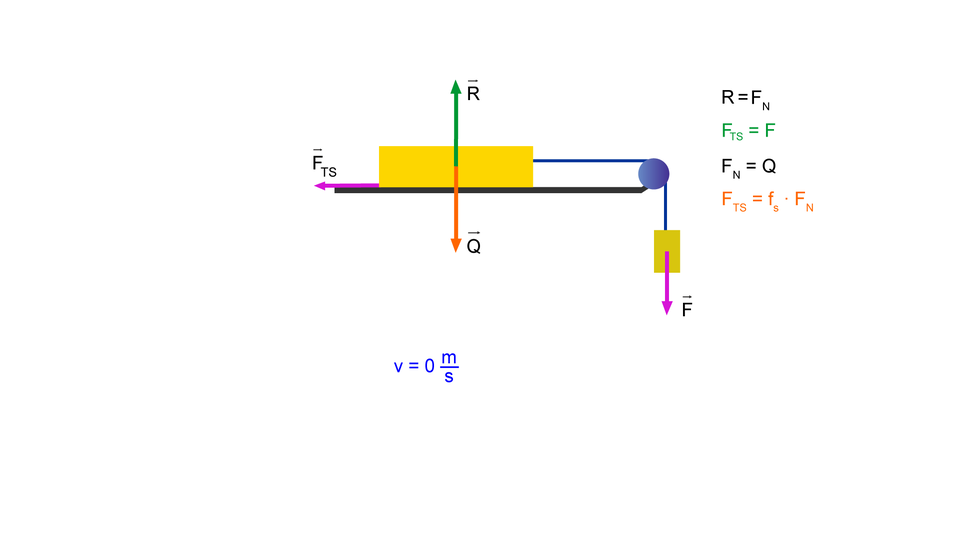
1. Two bodies come into contact with each other and move one over the other. Where does resistance of motion appear? 2. What methods of changing the resistance of motion in a bicycle wheel do you know? 3. Give an everyday example of a situation little resistance of motion is needed. 4. Give an everyday example of a situation that requires great resistance of motion. 5. Why do you think winter car tyres are narrower than the summer car tyres?
1. The resistance of motion appears in the places where the surfaces of the two moving bodies are in contact.
2. The resistance of turning bicycle wheels can be decreased by pumping them up, applying lubricated ball bearings and lubricating the chain. Similar to the car, where moving elements, mainly bearings, are lubricated.
3. Little resistance of motion is needed while pivots of the wheel rotate in a bearing. Little resistance of motion is needed in suspension of movable gates.
4. Great resistance of motion is needed while piling objects in a warehouse or while braking in vehicle brakes.
5. In winter when the road may be more slippery than in summer, narrower car tyres are used. A narrower tyre means a smaller surface of contact between the car and the road. The total mass of the vehicle is constant, not dependant on the width of the tyre, but it is spread out on a smaller surface. The contact force per cmIndeks górny 22 of the contact surface is greater thus the friction is greater, too.
Familiarize yourself with the force system shown in interactive illustration.
RVyIB7rRRq7gi
Ilustracja interaktywna przedstawia poziomą linię prostą oznaczoną numerem 1. Na jej środku narysowany jest prostokąt styczny dolnym dłuższym bokiem. Z lewego boku prostokąta narysowana jest pozioma strzałka skierowana w lewo oznaczona numerem 2. Z środka dłuższego boku prostokąta, stycznego do prostej, narysowana jest pionowa strzałka skierowana do dołu oznaczona numerem 3. Z środka dłuższego boku prostokąta, stycznego do prostej, narysowana jest pionowa strzałka skierowana do góry oznaczona numerem 5. Z prawego boku prostokąta narysowana jest pozioma strzałka skierowana w prawo oznaczona numerem 4. Na ilustracji widoczne są numery, a na nich podpisy. 1. surface {audio}, 2. static friction force {audio}, 3. normal force F_N is equal to the weight of the body Q {audio}, 4. force trying to set the body in motion {audio}, 5. ground reaction force {audio}.
Ilustracja interaktywna przedstawia poziomą linię prostą oznaczoną numerem 1. Na jej środku narysowany jest prostokąt styczny dolnym dłuższym bokiem. Z lewego boku prostokąta narysowana jest pozioma strzałka skierowana w lewo oznaczona numerem 2. Z środka dłuższego boku prostokąta, stycznego do prostej, narysowana jest pionowa strzałka skierowana do dołu oznaczona numerem 3. Z środka dłuższego boku prostokąta, stycznego do prostej, narysowana jest pionowa strzałka skierowana do góry oznaczona numerem 5. Z prawego boku prostokąta narysowana jest pozioma strzałka skierowana w prawo oznaczona numerem 4. Na ilustracji widoczne są numery, a na nich podpisy. 1. surface {audio}, 2. static friction force {audio}, 3. normal force F_N is equal to the weight of the body Q {audio}, 4. force trying to set the body in motion {audio}, 5. ground reaction force {audio}.
Let’s imagine that we want to move a wardrobe form one place in a room to another. We use the force of our muscles to do it. However, it isn’t easy.
The resistance that appears while trying to move the wardrobe is called static friction or stiction. Friction balances the force needed to move the wardrobe. It is happening until the value of static friction reaches the maximum value and the wardrobe starts moving. Both forces have the same initial point, direction and value but they are opposite.
When the body moves, the friction also occurs. However, it has a lower value than the maximum static friction force. The friction that occurs when you move the body is called kinetic frictionkinetic frictionkinetic friction.
We usually label the friction force with the symbol or and express it in force units - newton [N].
View the slideshow „Properties of the friction force” and draw conclusions resulting from the presented pictures.
RXYTusT0CmZAJ
Pokaz multimedialny - Własności siły tarcia. Instrukcja obsługi z poziomu klawiatury: 1. Uruchomienie aplikacji - ENTER, 2. Na każdym ze slajdów czytany jest automatycznie tekst alternatywny po polsku, 3. Przy pierwszym uruchomieniu na pierwszym slajdzie, czytanie tekstu po angielsku - TAB, 4. Przejście między slajdami: do następnego slajdu - TAB, do poprzedniego slajdu - TAB + SHIFT, 5. Przejście do czytania napisu po angielsku - strzałka w górę + strzałka w dół (czyta tekst po angielsku widoczny na slajdzie).
Pokaz multimedialny - Własności siły tarcia. Instrukcja obsługi z poziomu klawiatury: 1. Uruchomienie aplikacji - ENTER, 2. Na każdym ze slajdów czytany jest automatycznie tekst alternatywny po polsku, 3. Przy pierwszym uruchomieniu na pierwszym slajdzie, czytanie tekstu po angielsku - TAB, 4. Przejście między slajdami: do następnego slajdu - TAB, do poprzedniego slajdu - TAB + SHIFT, 5. Przejście do czytania napisu po angielsku - strzałka w górę + strzałka w dół (czyta tekst po angielsku widoczny na slajdzie).
The coefficient of kinetic friction depends on the type of surfaces rubbing each other. It does not have a unit - we can see it after we transform the formula:
Coefficient of frictioncoefficient of frictionCoefficient of friction is a quantity without a physical unit.
a) The magnitude of the skier's normal forcenormal forcenormal force on snow if the friction force is 32 N.
b) The magnitude of the friction force of a cyclist riding on a wet concrete, if the mass of the cyclist is 54 kg and the mass of the bicycle is 15 kg.
Interacting surfaces
Coefficient of static friction, fIndeks dolny s Indeks dolny koniecs
Coefficient of kinetic friction, fIndeks dolny kk
ice skates on ice
0,027
0,014
skis on the snow
0,1
0,04
wood on wood
0,65
0,4
tire on wet concrete
0,7
0,5
tire on dry concrete
1,0
0,7
a)
Analysis
Given:
Unknown:
Solution:
Answer:
The skier's normal force on snow is 800 N.
b)
Analysis
Given:
Unknown:
Solution:
The weight of the cyclist with the bicycle:
The weight of the cyclist with the bicycle is equal to the normal force FIndeks dolny NN:
Answer:
The friction force of a cyclist riding on a wet concrete is 345 N.
Friction – the force between the surfaces of two bodies in contact. The force of friction is always opposite to the direction of velocity that the body is moving with. Friction connected with sliding a body on a surface (sliding friction) is slightly greater while making a body move than when the body is already in this motion. For this reason we divide friction into static and kinetic.
Static frictionstatic frictionStatic friction force occurs with the appearance of a force trying to set the body in motion relative to the surface.
The kinetic friction force acts between the moving body and the surface. It has an orientation opposite to the velocity of the body.
The kinetic friction force depends on the normal forcenormal forcenormal force of the body on the surface and on the type of materials from which the contacting surfaces are made.
To calculate the friction forces we can use the following formula:
where: - normal force, - friction force, - coefficient of friction.
The coefficient of frictioncoefficient of frictioncoefficient of friction describes the type of surfaces rubbing each other and it has no unit.
We determine the coefficient of friction experimentally.
Exercises
RHVKgfsEebFKh
Exercise 3
Wersja alternatywna ćwiczenia: Determine which sentences are true. Możliwe odpowiedzi: 1. Kinetic friction occurs during body movement., 2. The normal force of the body is always perpendicular to the contact surface., 3. The magnitude of friction force does not depend on the type of surface on which the body moves., 4. Coefficient of friction has no unit., 5. In order to increase the friction while skiing, we lubricate the skis with a suitable lubricant.
Wersja alternatywna ćwiczenia: Determine which sentences are true. Możliwe odpowiedzi: 1. Kinetic friction occurs during body movement., 2. The normal force of the body is always perpendicular to the contact surface., 3. The magnitude of friction force does not depend on the type of surface on which the body moves., 4. Coefficient of friction has no unit., 5. In order to increase the friction while skiing, we lubricate the skis with a suitable lubricant.
Determine which sentences are true.
Kinetic friction occurs during body movement.
The normal force of the body is always perpendicular to the contact surface.
The magnitude of friction force does not depend on the type of surface on which the body moves.
Coefficient of friction has no unit.
In order to increase the friction while skiing, we lubricate the skis with a suitable lubricant.
zadanie
Source: GroMar, licencja: CC BY 3.0.
Exercise 4
Wyobraź sobie klocek w kształcie prostopadłościanu przesuwający się po płaskiej, poziomej powierzchni, np. na drodze. Opisz siły występujące podczas tego ruchu.
Wyobraź sobie klocek w kształcie prostopadłościanu przesuwający się po płaskiej, poziomej powierzchni, np. na drodze. Opisz siły występujące podczas tego ruchu.
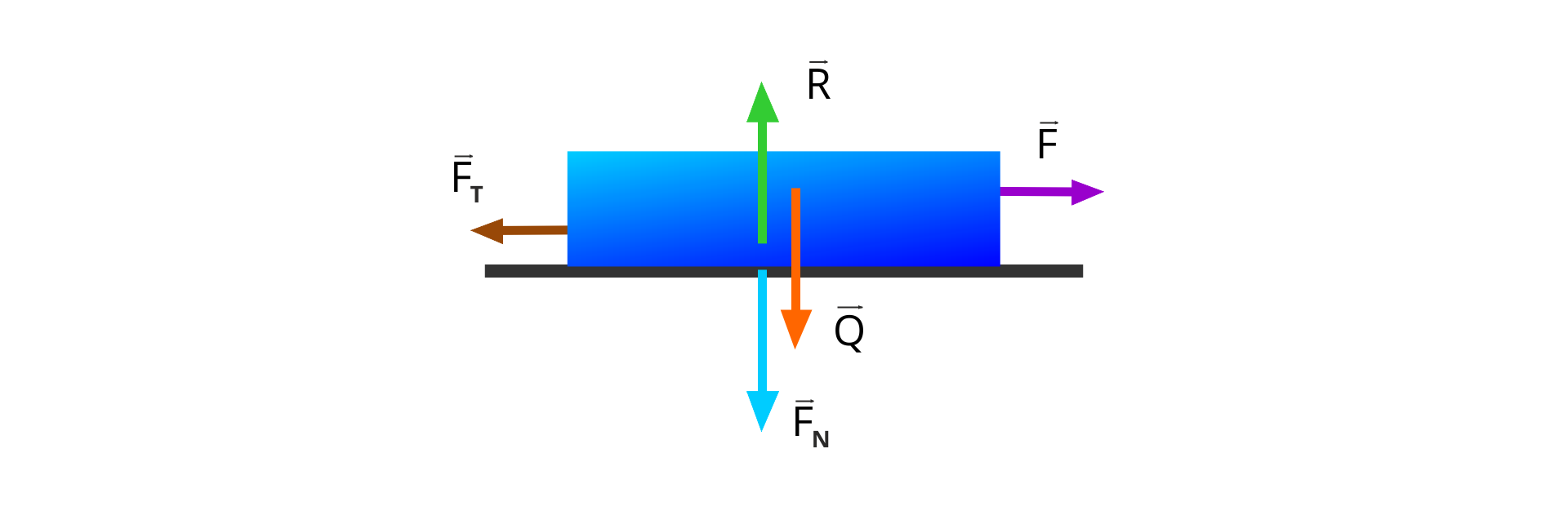
Draw and give names of all forces that occur during the movement of the block on a flat, horizontal surface, e.g. on a road.
R1I0VdUNvJqeh1
Ilustracja po lewej stronie przedstawia poziomą linię prostą symbolizującą podłoże. Na jej środku narysowany jest prostokąt styczny dolnym dłuższym bokiem.
Source: GroMar, licencja: CC BY 3.0.
R1IVma91ZX92q1
Ilustracja po lewej stronie przedstawia poziomą linię prostą symbolizującą podłoże. Na jej środku narysowany jest prostokąt styczny dolnym dłuższym bokiem. Z lewego boku prostokąta narysowana jest pozioma strzałka skierowana w lewo, opisana F z indeksem dolnym T. Nad F strzałka pozioma skierowana w prawo. Z środka dłuższego boku prostokąta, stycznego do prostej, narysowana jest pionowa strzałka skierowana do dołu, opisana F z indeksem dolnym N. Nad F strzałka pozioma skierowana w prawo. Z środka dłuższego boku prostokąta, stycznego do prostej, narysowana jest pionowa strzałka skierowana do góry, opisana R. Nad R strzałka pozioma skierowana w prawo. Z środka prostokąta narysowana pionowa strzałka skierowana do dołu, opisana Q. Nad Q strzałka pozioma skierowana w prawo. Z prawego boku prostokąta narysowana jest pozioma strzałka skierowana w prawo, opisana F. Nad F strzałka pozioma skierowana w prawo.
Source: GroMar, licencja: CC BY 3.0.
- body weight, - normal force of the body on the surface, - force of the reaction of the surface against normal force, - force setting in motion, - friction force.
Exercise 5
Give an example in English:
a) in which the occurrence of large friction in everyday life is useful, b) an example in which large friction is not recommended.
Explain your answer.
a) Large friction is needed when you want to place objects on top of each other, thanks to which the stack of objects will be stable. Large friction of the tires against the ground of the moving car enables safe driving.
b) Small friction is needed inside the mechanisms that rub each other because of limitations of heat dissipation of these parts. Small friction is needed when skiing on snow or sledding on snow, it allows you to cover long distances with less effort.
RB9SnsESRp6r1
Exercise 6
Wersja alternatywna ćwiczenia: Indicate which pairs of expressions or words are translated correctly. Możliwe odpowiedzi: 1. tarcie - friction, 2. tarcie statyczne - static friction, 3. tarcie kinetyczne - kinetic friction, 4. siła nacisku - coefficient of friction, 5. współczynnik tarcia - normal force
Wersja alternatywna ćwiczenia: Indicate which pairs of expressions or words are translated correctly. Możliwe odpowiedzi: 1. tarcie - friction, 2. tarcie statyczne - static friction, 3. tarcie kinetyczne - kinetic friction, 4. siła nacisku - coefficient of friction, 5. współczynnik tarcia - normal force
Indicate which pairs of expressions or words are translated correctly.
tarcie - friction
tarcie statyczne - static friction
tarcie kinetyczne - kinetic friction
siła nacisku - coefficient of friction
współczynnik tarcia - normal force
zadanie
Source: GroMar, licencja: CC BY 3.0.
RZyzt7bmMStqj1
Interaktywna gra, polegająca na łączeniu wyrazów w pary w ciągu jednej minuty. Czas zaczyna upływać wraz z rozpoczęciem gry. Jeden ruch to odkrywanie najpierw jednej potem drugiej karty z wyrazem. Każdy wyraz jest odczytywany. Kolejny ruch to odkrywanie trzeciej i czwartej karty. W ten sposób odsłuchasz wszystkie wyrazy. Nawigacja z poziomu klawiatury za pomocą strzałek, odsłuchiwanie wyrazów enterem lub spacją. Znajdź wszystkie pary wyrazów.
Interaktywna gra, polegająca na łączeniu wyrazów w pary w ciągu jednej minuty. Czas zaczyna upływać wraz z rozpoczęciem gry. Jeden ruch to odkrywanie najpierw jednej potem drugiej karty z wyrazem. Każdy wyraz jest odczytywany. Kolejny ruch to odkrywanie trzeciej i czwartej karty. W ten sposób odsłuchasz wszystkie wyrazy. Nawigacja z poziomu klawiatury za pomocą strzałek, odsłuchiwanie wyrazów enterem lub spacją. Znajdź wszystkie pary wyrazów.
Match Polish terms with their English equivalents.
friction
tarcie kinetyczne
static friction
normal force
współczynnik tarcia
kinetic friction
tarcie
siła nacisku
coefficient of friction
tarcie statyczne
Source: Zespół autorski Politechniki Łódzkiej, licencja: CC BY 3.0.
Glossary
coefficient of friction
coefficient of friction
współczynnik tarcia
R1NAVi9tVkp4A1
wymowa w języku angielskim: coefficient of friction
wymowa w języku angielskim: coefficient of friction