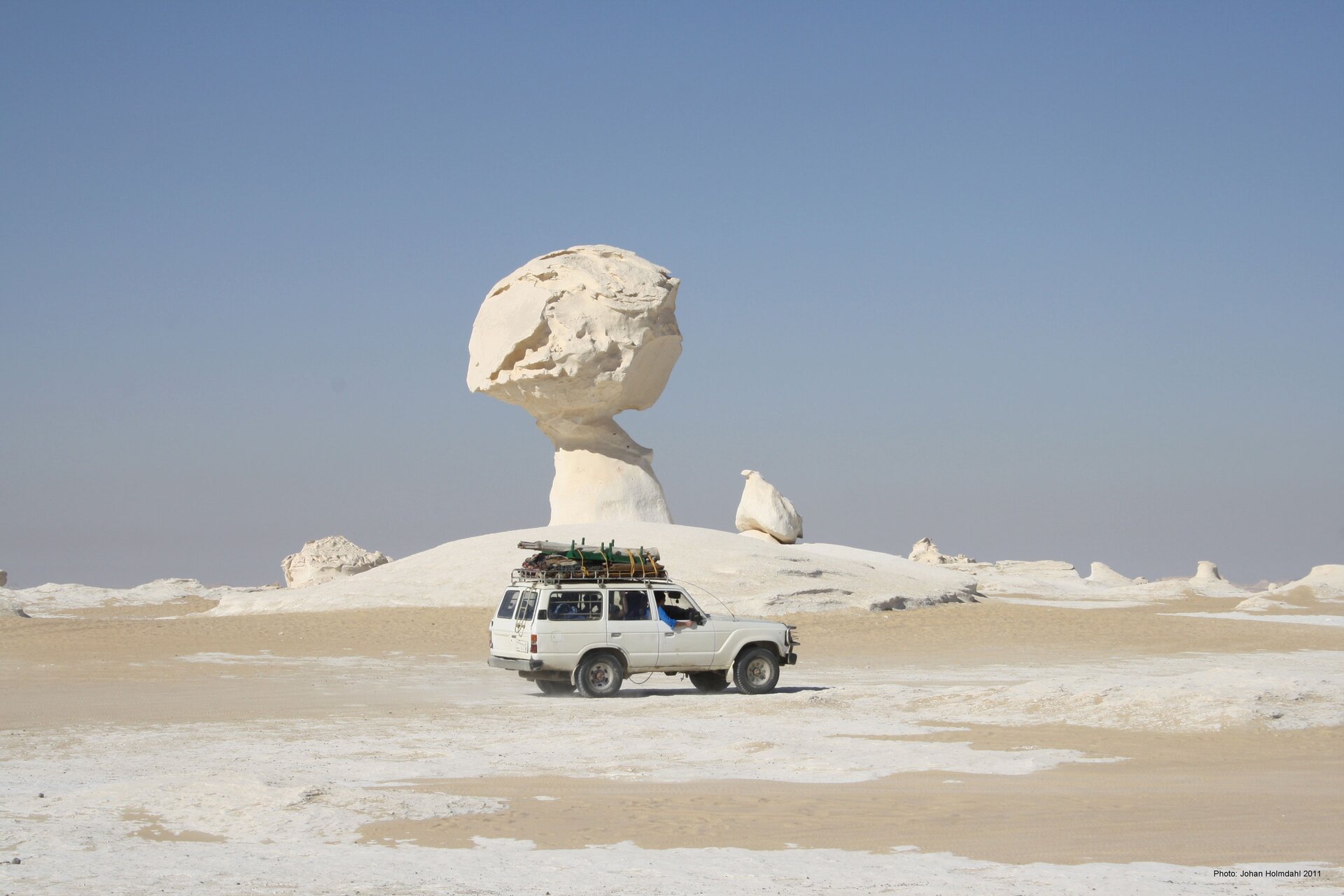
Depending on its speed, the wind can carry larger or smaller grains of sand and dust. It can hit rocks with these grains, thus slowly grinding, grooving, smoothing, or scratching them. Such a process is called corrasioncorrasioncorrasion. The closer to the Earth’s surface, the more sand is carried by the wind, making the corrasion process more intense. As a result, rocks protruding above the surface of the desert suffer the greatest damage to their lower part. As a result, various, sometimes very fancy, rock formations are created. The rocks that have a larger diameter in the upper part than in the lower part are called mushroom rocksmushroom rockmushroom rocks.
Apart from the formation of mushroom rocks, corrasion contributes to the creation of many other landforms, e.g.,
eolian grooveseolian grooveeolian grooves which can have a length of even hundreds of meters and a depth ranging from a few centimeters to a few meters;
eolian polisheseolian polisheolian polishes – forms with large, extremely smooth surfaces;
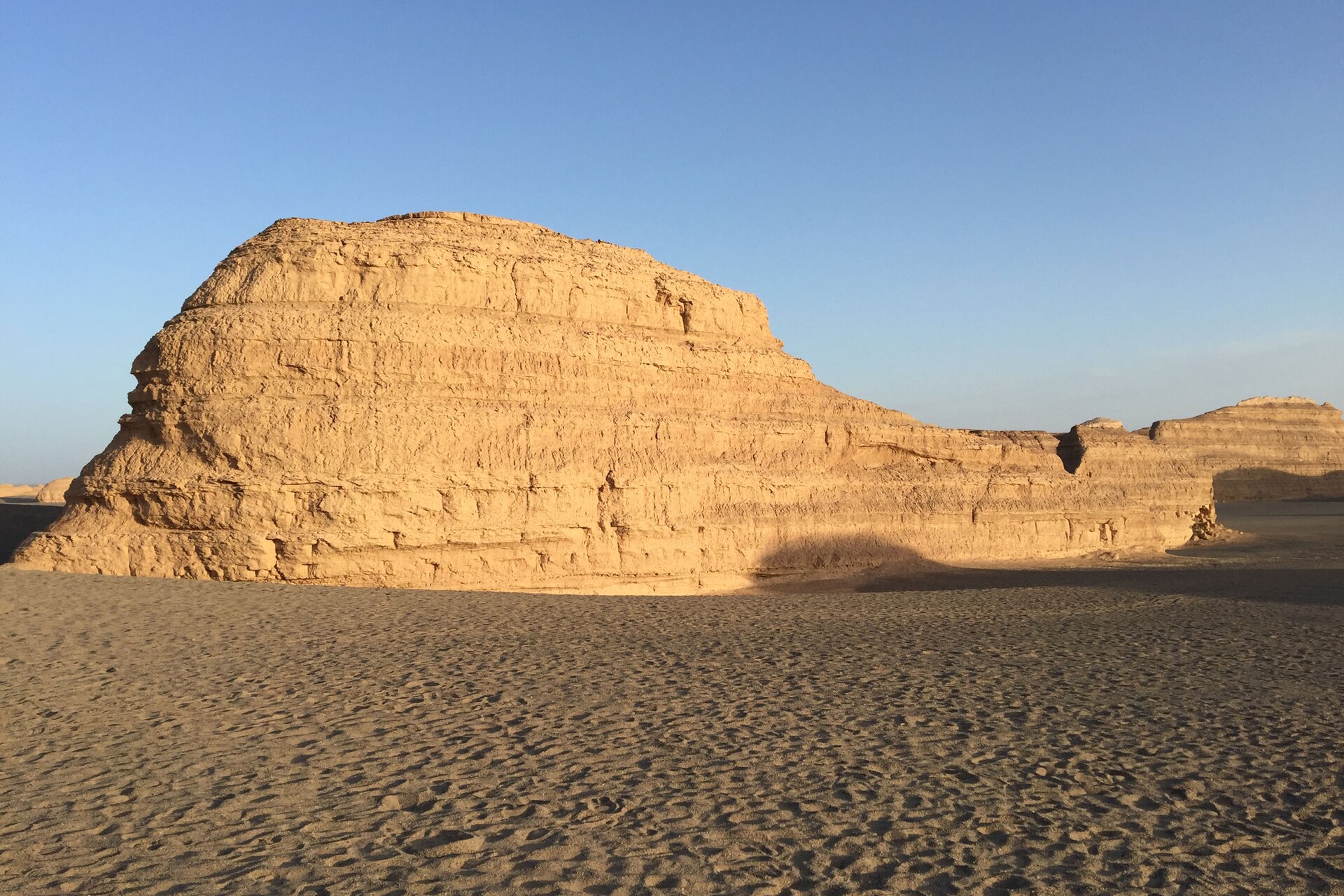
rock ridgesrock ridge (yardang)rock ridges – also called yardangsyardangyardangs, in the form of narrow but steep rocky ribs separated by grooves;
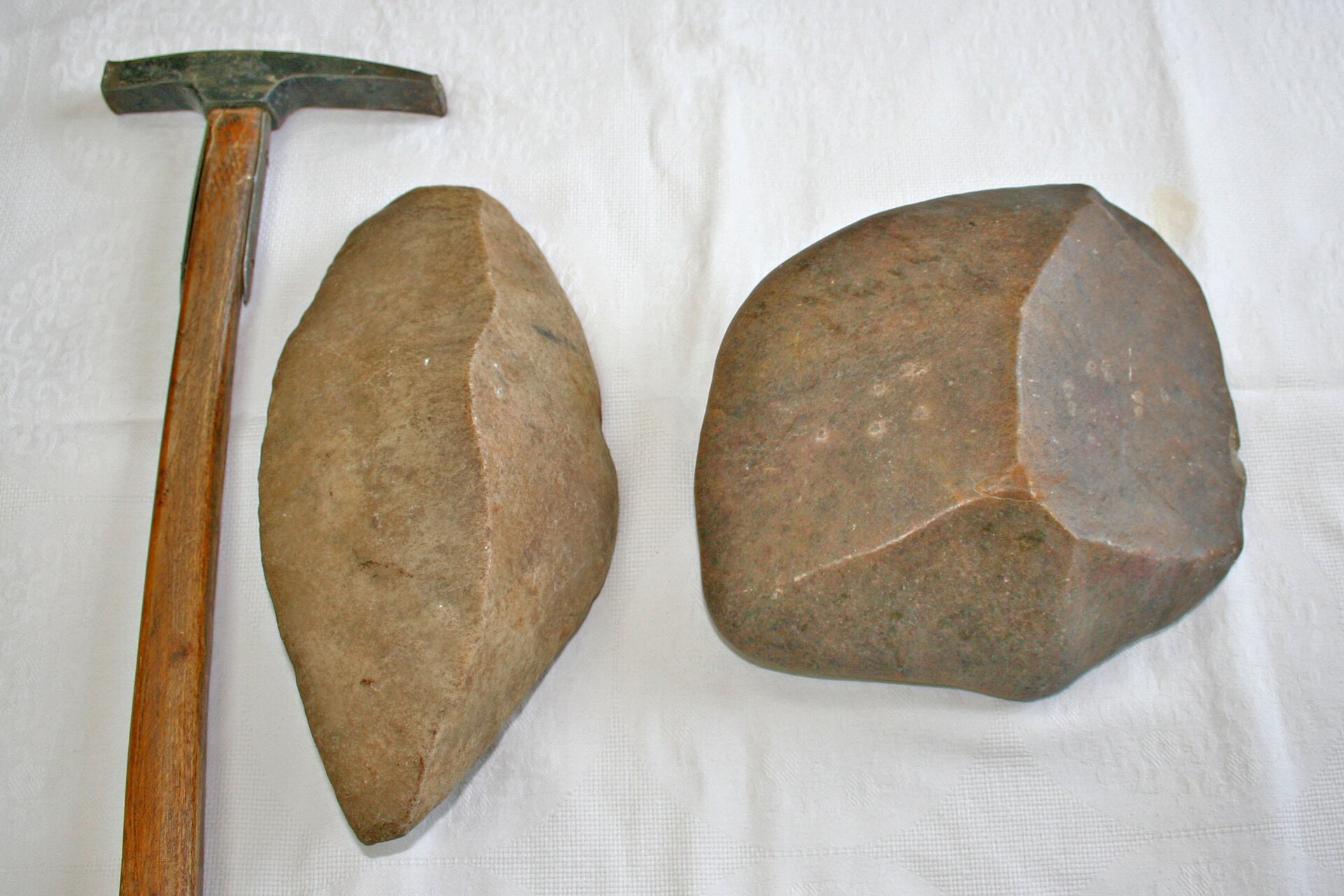
ventifactsventifactventifacts – rock fragments that have been polished by the sand carried by the wind
Examples of landforms - gallery
RI4bnHe6MFIXe
Na zdjęciu grzyb skalny na pustyni. Podstawa ma kształt walca, na jego czubku jest kula. Bardzo jasny kolor piasku. Na pierwszym planie płaski teren pustynny. Biały samochód terenowy, trzy razy mniejszy od grzyba.
Mushroom rock
Source: autor: Ysjyd (http://commons.wikimedia.org), edycja: Krzysztof Jaworski, licencja: CC 0.
R2JW19qeTAiRv
Na zdjęciu dwa graniaki. To fragmenty skał z powierzchnią wygładzoną przez wiatr i wyraźnymi krawędziami. Obok dla porównania wielkości leży młotek geologiczny. Graniaki są nieco mniejsze od młotka.
Ventifacts
Source: Edward Dudek (https://commons.wikimedia.org), licencja: CC BY-SA 4.0.
RWZXIxPMUPczU
Na zdjęciu Jardang. Szczyty spłaszczone, ściany strome. Na pierwszym planie płaski, piaszczysty teren. Powyżej bezchmurne niebo. Po lewej stronie, na ścianie Jardangu widoczne poziome żłobienia.
Yardangs in the Dunhuang National Park Yardang in western China.
Source: 张骐 (http://commons.wikimedia.org), edycja: Krzysztof Jaworski, licencja: CC BY-SA 3.0.
ROypNyr8m75xc
Exercise 1
Match the terms to their definitions. mushroom rock Możliwe odpowiedzi: 1. a rock formation with a wider upper part and narrower base, produced by corrasion, 2. rock fragments polished by the sand carried by the wind, 3. smooth rock surface, polished as a result of corrasion, 4. long rock ridges that separate the grooves created by corrasion eolian polish Możliwe odpowiedzi: 1. a rock formation with a wider upper part and narrower base, produced by corrasion, 2. rock fragments polished by the sand carried by the wind, 3. smooth rock surface, polished as a result of corrasion, 4. long rock ridges that separate the grooves created by corrasion ventifacts Możliwe odpowiedzi: 1. a rock formation with a wider upper part and narrower base, produced by corrasion, 2. rock fragments polished by the sand carried by the wind, 3. smooth rock surface, polished as a result of corrasion, 4. long rock ridges that separate the grooves created by corrasion yardangs Możliwe odpowiedzi: 1. a rock formation with a wider upper part and narrower base, produced by corrasion, 2. rock fragments polished by the sand carried by the wind, 3. smooth rock surface, polished as a result of corrasion, 4. long rock ridges that separate the grooves created by corrasion
Match the terms to their definitions. mushroom rock Możliwe odpowiedzi: 1. a rock formation with a wider upper part and narrower base, produced by corrasion, 2. rock fragments polished by the sand carried by the wind, 3. smooth rock surface, polished as a result of corrasion, 4. long rock ridges that separate the grooves created by corrasion eolian polish Możliwe odpowiedzi: 1. a rock formation with a wider upper part and narrower base, produced by corrasion, 2. rock fragments polished by the sand carried by the wind, 3. smooth rock surface, polished as a result of corrasion, 4. long rock ridges that separate the grooves created by corrasion ventifacts Możliwe odpowiedzi: 1. a rock formation with a wider upper part and narrower base, produced by corrasion, 2. rock fragments polished by the sand carried by the wind, 3. smooth rock surface, polished as a result of corrasion, 4. long rock ridges that separate the grooves created by corrasion yardangs Możliwe odpowiedzi: 1. a rock formation with a wider upper part and narrower base, produced by corrasion, 2. rock fragments polished by the sand carried by the wind, 3. smooth rock surface, polished as a result of corrasion, 4. long rock ridges that separate the grooves created by corrasion
Match the terms to their definitions.
a rock formation with a wider upper part and narrower base, produced by corrasion, smooth rock surface, polished as a result of corrasion, long rock ridges that separate the grooves created by corrasion, rock fragments polished by the sand carried by the wind
mushroom rock
eolian polish
ventifacts
yardangs
R1HH5MqRjBWdv
Grafika przedstawiająca tablicę szkolną, na której znajdują się zdania do dokończenia. Finish selected sentences. 1 It was easy for me (uzupełnij). 2 It was difficult for me (uzupełnij). 3 Today I learned (uzupełnij). 4 I understood that (uzupełnij). 5 It surprised me (uzupełnij).
Grafika przedstawiająca tablicę szkolną, na której znajdują się zdania do dokończenia. Finish selected sentences. 1 It was easy for me (uzupełnij). 2 It was difficult for me (uzupełnij). 3 Today I learned (uzupełnij). 4 I understood that (uzupełnij). 5 It surprised me (uzupełnij).
How was this lesson? Did you like it? Finish selected sentences.
bruzda eoliczna – podłużne zagłębienie w skałach podłoża o kierunku zgodnym z kierunkiem przeważających wiatrów, wywołane przez korazjęcorrasionkorazję
grzbiet skalny (jardang) – podłużny grzbiet skalny oddzielający bruzdy korazyjne o kierunku zgodnym z kierunkiem przeważających wiatrów, wytworzony w skutek korazjicorrasionkorazji
procesy eoliczne – wszystkie rodzaje oddziaływania wiatru na rzeźbę terenu; ich rozwój uwarunkowany jest obecnością wystarczająco silnych wiatrów, mocnym rozdrobnieniem skał podłoża, ubóstwem szaty roślinnej i suchym klimatem