The electrical voltagevoltagevoltage between the ends of a conductorconductorconductor is numerically equal to the amount of work that electric forceselectric forceselectric forces perform when moving the charge of one coulomb inside the conductor.
From the above formula it is easy to determine the work done by electric forces:
Usually, in practice, we rarely know what charge has flown through a given electricity receiver. However, in a fairly simple way we can measure the current flowing through it.
Using the definition of electric currentelectric currentelectric current:
we can directly determine the charge that has flown through the electricity receiver:
After inserting this to the formula for work, we will get the final formula:
where: W - work done by electric forceselectric forceselectric forces, U - voltagevoltagevoltage at the ends of the electricity receiver, I - the intensity of current flowing through the electricity receiver, t - duration of the current flowcurrent flowcurrent flow.
Electrons in a heating element of iron collide constantly with atoms, stimulating them to vibrate. Increased vibration of atoms is equivalent to increased temperature of the heating element of iron.
The current flowing in the engine forces the interaction between the magnets inside the engine and the moving parts of the engine, causing them to rotate.
The current flowcurrent flowcurrent flow through the aqueous sulfuric acid solution causes the disintegration of water molecules and the production of hydrogen and oxygen.
R1Y2e8mIla57v
Pokaz slajdów – skutki przepływu prądu. Instrukcja obsługi z poziomu klawiatury: 1. Uruchomienie aplikacji - ENTER, 2. Na każdym ze slajdów czytany jest automatycznie tekst alternatywny po polsku, 3. Przy pierwszym uruchomieniu na pierwszym slajdzie, czytanie tekstu po angielsku - TAB, 4. Przejście między slajdami: do następnego slajdu - TAB, do poprzedniego slajdu - TAB + SHIFT, 5. Przejście do czytania napisu po angielsku - strzałka w górę + strzałka w dół (czyta tekst po angielsku widoczny na slajdzie).
Pokaz slajdów – skutki przepływu prądu. Instrukcja obsługi z poziomu klawiatury: 1. Uruchomienie aplikacji - ENTER, 2. Na każdym ze slajdów czytany jest automatycznie tekst alternatywny po polsku, 3. Przy pierwszym uruchomieniu na pierwszym slajdzie, czytanie tekstu po angielsku - TAB, 4. Przejście między slajdami: do następnego slajdu - TAB, do poprzedniego slajdu - TAB + SHIFT, 5. Przejście do czytania napisu po angielsku - strzałka w górę + strzałka w dół (czyta tekst po angielsku widoczny na slajdzie).
All the above formulas for the work of electric currentelectric currentelectric current (DC current) are equivalent. We use them depending on the data we have.
RF7Ue6uKxRBgX
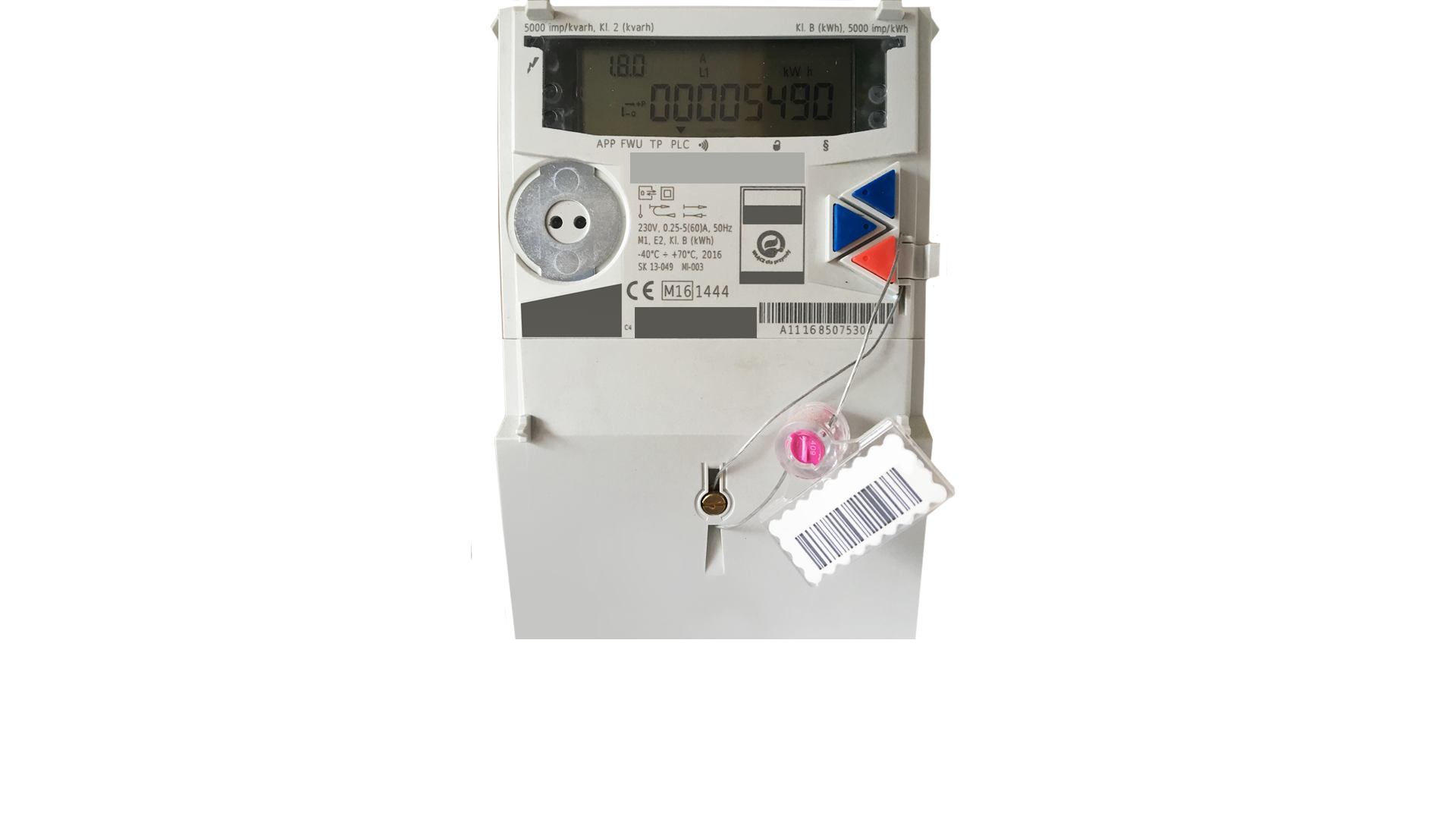
Zdjęcie prezentuje nowy licznik energii elektrycznej przygotowany do zainstalowania w mieszkaniu.
Electricity meter prepared for installation in our apartments
If we look closely at the above figure, we will discover the symbol [kWh]. This is called kilowatt‑hour. It is a unit of work done by electric current.
Whether we want it or not, we always pay for the work done, because we use large amounts of energy in domestic electrical installations, it is easier to express the energy consumed in [kWh].
The work of electric currentelectric currentelectric current is calculated from the formulas: or or .
The unit of electricity is Joule [J] but more often kilowatt‑hours [kWh] are used.
One kilowatt‑hour is equal to electricity consumed within 1 hour by a 1 kW receiver. It is equal to 3,6 megajoules: 1 kWh = 3,6 MJ.
Exercises
RWWBcMKP9CCeC
Exercise 1
Wersja alternatywna ćwiczenia: Determine which sentence is true. Możliwe odpowiedzi: 1. Resistors with different resistance are connected to the same voltage. The work done by the electric current on these resistors in the same time intervals is the same. , 2. A voltage of 10 V is applied to the resistor with a resistance of 20 Ω. Within 1 seconds, 5 J energy is dissipated in the resistor. , 3. On the bulb purchased in the store there is a label: 100 W, 200 V. When to this bulb the voltage of 200 V is applied for 1 minute, the energy of 100 J is dissipated in it. , 4. Within 1 second, a current of 10 A flows through the resistor. If 20 A would flow through this resistor at the same time, it would double the energy dissipated in the resistor.
Wersja alternatywna ćwiczenia: Determine which sentence is true. Możliwe odpowiedzi: 1. Resistors with different resistance are connected to the same voltage. The work done by the electric current on these resistors in the same time intervals is the same. , 2. A voltage of 10 V is applied to the resistor with a resistance of 20 Ω. Within 1 seconds, 5 J energy is dissipated in the resistor. , 3. On the bulb purchased in the store there is a label: 100 W, 200 V. When to this bulb the voltage of 200 V is applied for 1 minute, the energy of 100 J is dissipated in it. , 4. Within 1 second, a current of 10 A flows through the resistor. If 20 A would flow through this resistor at the same time, it would double the energy dissipated in the resistor.
Determine which sentence is true.
Resistors with different resistance are connected to the same voltage. The work done by the electric current on these resistors in the same time intervals is the same.
A voltage of 10 V is applied to the resistor with a resistance of 20 Ω. Within 1 seconds, 5 J energy is dissipated in the resistor.
On the bulb purchased in the store there is a label: 100 W, 200 V. When to this bulb the voltage of 200 V is applied for 1 minute, the energy of 100 J is dissipated in it.
Within 1 second, a current of 10 A flows through the resistor. If 20 A would flow through this resistor at the same time, it would double the energy dissipated in the resistor.
zadanie
Source: GroMar, licencja: CC BY 3.0.
Exercise 2
The electric motor was supplied with a voltage of 1000 V. A current of 10 A flows through it.
a) Calculate the resistance of the electric motor.
b) How long does it take to do 1 GJ of work?
a) R = 100 ohms. b) t = 100000 seconds.
a) R = 100 ohms. b) t = 100000 seconds.
a) R = 100 Ω.
b) t = 100000 s.
Exercise 3
Write in English shortly why using electric motors is more economical than internal combustion engines?
RdO8ZFyfbJJ8f
Exercise 4
Wersja alternatywna ćwiczenia: Indicate which pairs of expressions or words are translated correctly. Możliwe odpowiedzi: 1. prąd elektryczny - electric current, 2. napięcie - conductor, 3. przepływ prądu - current flow, 4. siły elektryczne - electric flows, 5. przewodnik - voltage
Wersja alternatywna ćwiczenia: Indicate which pairs of expressions or words are translated correctly. Możliwe odpowiedzi: 1. prąd elektryczny - electric current, 2. napięcie - conductor, 3. przepływ prądu - current flow, 4. siły elektryczne - electric flows, 5. przewodnik - voltage
Indicate which pairs of expressions or words are translated correctly.
prąd elektryczny - electric current
napięcie - conductor
przepływ prądu - current flow
siły elektryczne - electric flows
przewodnik - voltage
R19DpTyc7quKz1
Interaktywna gra, polegająca na łączeniu wyrazów w pary w ciągu jednej minuty. Czas zaczyna upływać wraz z rozpoczęciem gry. Jeden ruch to odkrywanie najpierw jednej potem drugiej karty z wyrazem. Każdy wyraz jest odczytywany. Kolejny ruch to odkrywanie trzeciej i czwartej karty. W ten sposób odsłuchasz wszystkie wyrazy. Nawigacja z poziomu klawiatury za pomocą strzałek, odsłuchiwanie wyrazów enterem lub spacją. Znajdź wszystkie pary wyrazów.
Interaktywna gra, polegająca na łączeniu wyrazów w pary w ciągu jednej minuty. Czas zaczyna upływać wraz z rozpoczęciem gry. Jeden ruch to odkrywanie najpierw jednej potem drugiej karty z wyrazem. Każdy wyraz jest odczytywany. Kolejny ruch to odkrywanie trzeciej i czwartej karty. W ten sposób odsłuchasz wszystkie wyrazy. Nawigacja z poziomu klawiatury za pomocą strzałek, odsłuchiwanie wyrazów enterem lub spacją. Znajdź wszystkie pary wyrazów.
Match Polish terms with their English equivalents.
prąd elektryczny
napięcie
voltage
przepływ prądu
siły elektryczne
electric current
electric forces
conductor
przewodnik
current flow
Source: Zespół autorski Politechniki Łódzkiej, licencja: CC BY 3.0.