You are not alone!
Living in society we are connected with others and we need to follow certain rules.
It would be very difficult, if not impossible to function outside of society.
In society there are various groups we belong to, that influence our identity.
You will be able to explain Aristotle’s words that “man is by nature a social animal”.
You will be able to define terms: society, social bonds, social norms, socialization (primary and secondary), social group, collective, community, social role, role conflict.
You will be able to explain the difference between various social bonds, social groups, and types of socialization.
You will be able to name a couple of institutions that prepare us for social life, and describe their role in the process.
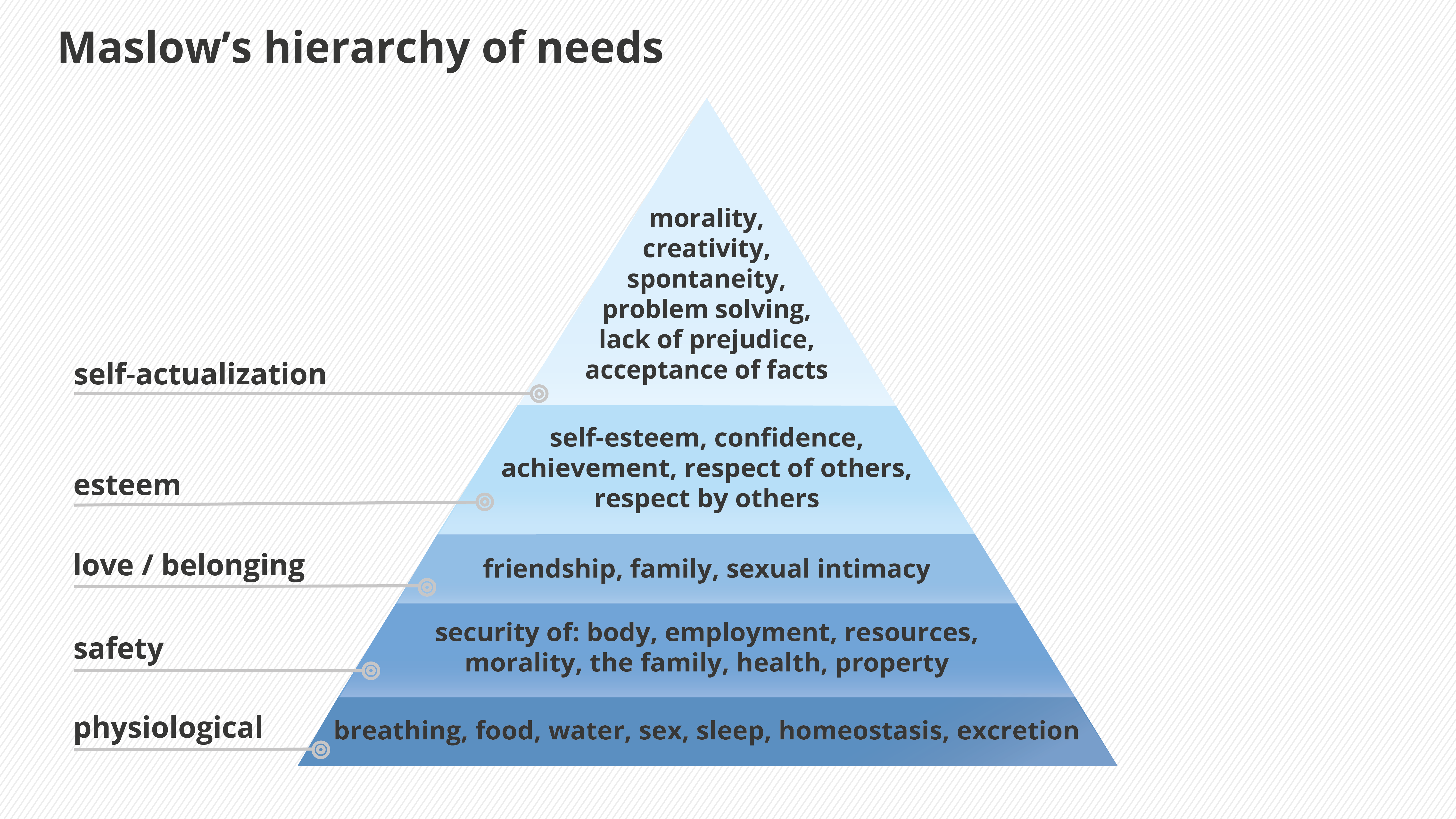
You will be able to explain Abraham Maslow’s hierarchy of needs, and how it is connected with the creation and existence of societies.
“Society” is a term we use every day, but rarely think of what it actually means. What is society? What influence does it have over us, and what kind of mechanisms and institutions does it use? What values does it instil intoinstil into us? What does it mean to be a member of society? Could we achieve our objectives outside of society? Could we be happy? Would we even know we have emotions, life goals?
You will learn a lot of definitions connected with society and its functioning.
Society – a large group of people inhabitinginhabiting a common territory, connected by a network of dependencies, e.g. common culture, religion, living conditions.
Social bonds – relations between people within society; there is a variety of social bonds: durabledurable/non‑durable, personal/formal, etc.; social groups may be divided according to the criterion of the type of social bonds that dominate within the group.
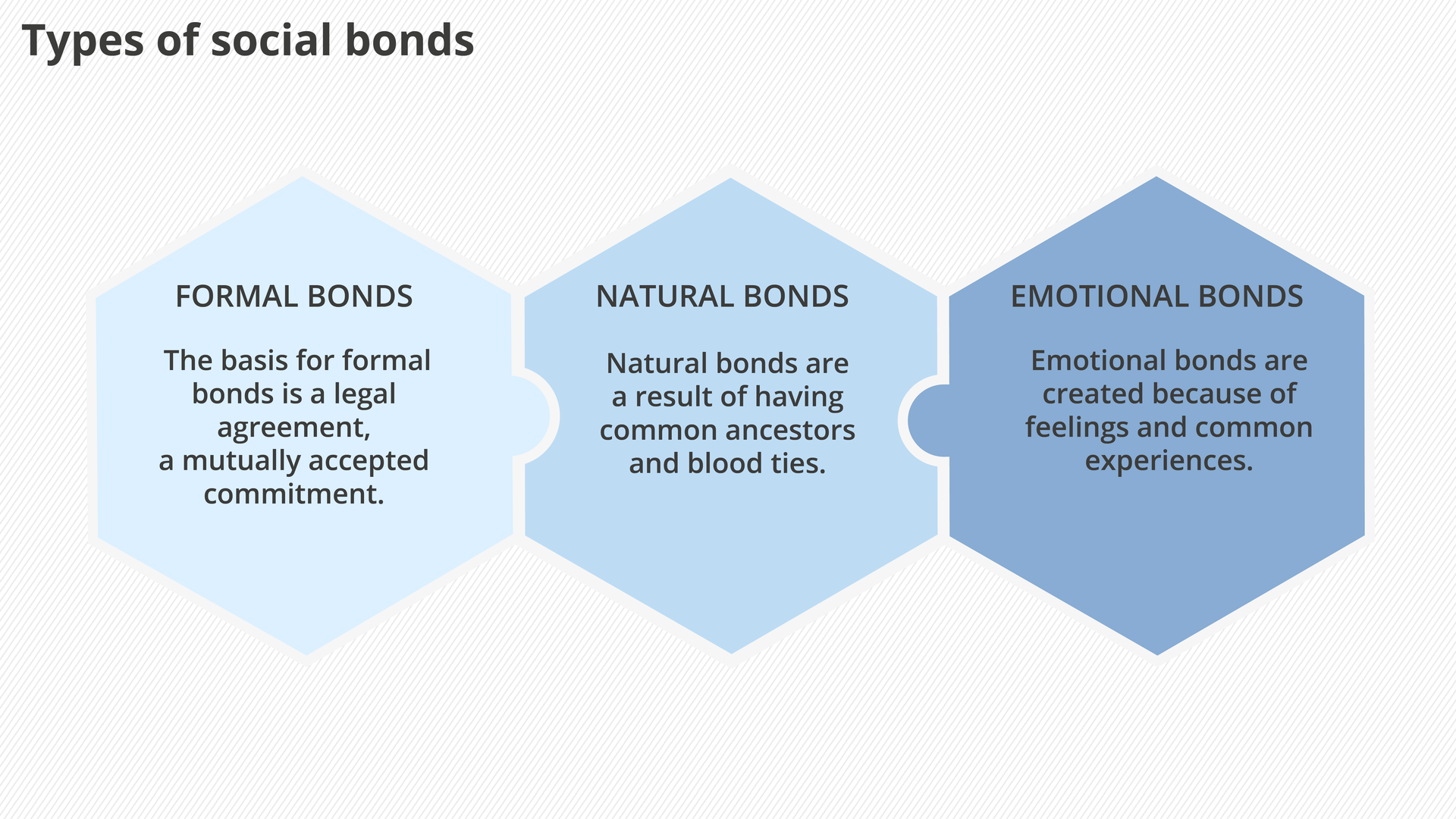
Match the social bonds described below with an appropriate category.
We attend the same school, We are friends, Our fathers are cousins, We play basketball at the same school team together, We are brothers
| Formal bonds | |
|---|---|
| Natural bonds | |
| Emotional bonds |
Social norms – rules of behaviourbehaviour accepted by the majority of the society.
The moment we are born, we start discovering the world around us, we become part of society.
Socialization is the process of internalizinginternalizing by an individual the social norms and the skills necessary to function in the society. There are two types of socialization: primary and secondary one. Primary socialization usually takes place in childhood when children mimicmimic the behaviours of the members of their family, and so they learn the most fundamental rules, relations, values, attitudes, actions. Secondary socialization happens later in life, and lasts throughout the lifetime. It involves the conscious process of learning and adapting to a new role in society.
Who prepares us for the social life?
Who prepares us for the social life?
Family
This is where we acquire the most fundamental social skills, for example we learn how to communicate. The family fulfills and shapes our cultural expectations. This is where our interests are born, where we learn to see beauty.
Peer groups
We meet them on every stage of our lives. Thanks to peer groups we learn how to negotiate between our own needs and the expectations of others, as well as find out ways to communicate with other people.
School
It’s an institution, in which we spend a huge part of our life. It teaches us to see our relations with others in terms of rights and obligations. It should guarantee the students the right to education, but also shape the attitude of honesty, self-reliance and responsibility.
Analyze the diagram. This is how Abraham Maslow presented the hierarchy of human needs. To each kind of needs specified on the diagram write down the institutions, social groups, and social bonds that help you satisfy them. Compare your answers with the ideas of your classmates.
Social group – three or more people connected with each other by various social bonds; there is a variety of social groups: durable/non‑durable, primary/secondary, small/large, formal/informal.
Types of social groups
Types of social groups
Size
Small groupLarge group
- a few to a dozen or so members; uniform nature of the group, no subgroups, all members are connected by similar social bonds (usually emotional ones)
- e.g. family, social circle
- more than a dozen members, but most importantly - diverse, with internal divisions resulting from a variety of social bonds between the members of the group
- e.g. society, nation, political party
Type of bond
Primary groupSecondary group
- emotional character of the social bond between the members of the group
- e.g. family, group of friends, nation
- impersonal, formal (often professional) character of the social bond between the members of the group; the group is chosen consciously or the membership is obligatory
- e.g. a class at school
Formalization
Formal groupInformal group
- formally organized: there is a list of members, some kind of internal law every member has to abide by
- e.g. political party
- there is no formal organization of the group, no list of members, no formal rules to abide by
- e.g. group of friends
Membership
Exclusive groupInclusive group
- it is almost impossible to become a member of the group; the group does not accept new members
- e.g. caste in India
- the group communicates easily with other groups and individuals, and it is open to new members; it is easy to become a member
- e.g. trade union, political party
Collective is a certain number of people connected by a non‑durable social bond (for example being at the same place and time); e.g. beachgoersbeachgoers, a crowd in the street.
Community is a group of people connected by a common goal, the will to pursue the goal, and a strong emotional bonding; e.g. family, group of friends, nation.
Social role expectations towards people occupying a certain social position or fulfilling a certain function in society
Role conflict occurs when there are incompatible demands placed upon a person such that compliance with both would be difficult; persons experience role conflict when they find themselves pulled in various directions as they try to respond to the many statuses they hold.
Listen to the abstract recording to review the material and new vocabulary. Then do the vocabulary exercise. Match the pairs: English and Polish words.
zdobywać, nabywać, zamieszkiwać, przestrzegać (prawa), wpajać komuś wartości, samodzielność, plażowicze, trwały, naśladować
| to instil values into somebody | |
| to inhabit | |
| durable | |
| to mimic | |
| to acquire | |
| self-reliance | |
| to abide by | |
| beachgoers |
Keywords
society, social group, social bond, social norms, primary/secondary socialization, hierarchy of needs, collective, community
Glossary
wpajać komuś wartości
zamieszkiwać
trwały
zachowanie
zinternalizować (przyjmować jako własne, przekonywać się do czegoś), przyswajać
naśladować
zdobywać, nabywać
samodzielność
przestrzegać (prawa)
kasta (w Indiach)
plażowicze