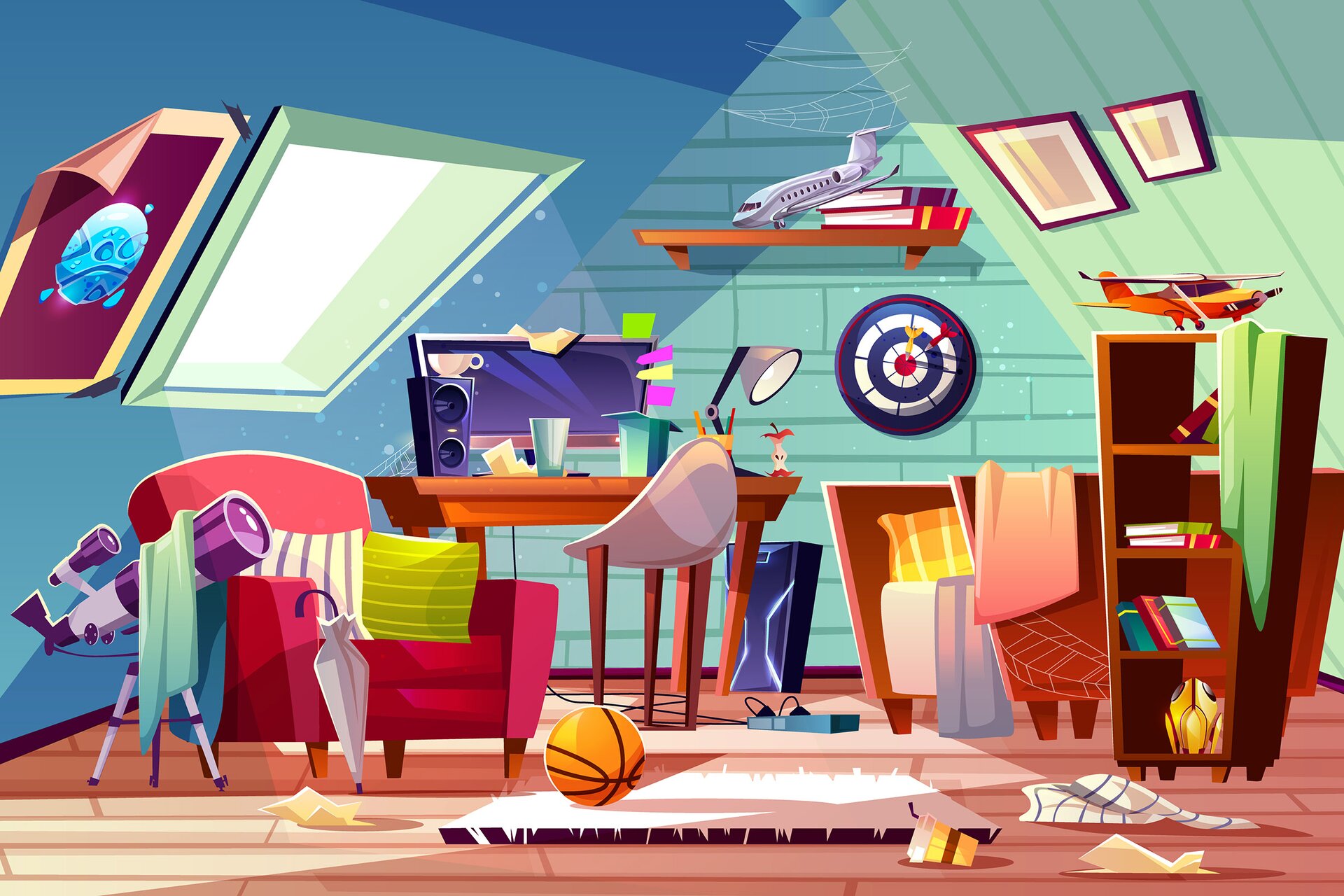
The picture below shows a very messy bedroom. You are going to read an article with some tips on how to keep your room neat and tidy.
Ilustracja przedstawia pokój, w którym panuje ogromny bałagan. Przeczytaj artykuł ze wskazówkami na temat utrzymania porządku w pokoju.
R1eXVXG8dwXK5
Grafika przedstawia pokój na poddaszu, w którym panuje bałagan. Na podłodze, fotelu i biurku leżą porozrzucane rzeczy. W kilku miejscach widać duże pajęczyny.
What a mess!
Ale bałagan!
Źródło: dostępny w internecie: https://freepik.com/ [dostęp 20.10.2021], domena publiczna.
Exercise1
Match the words and phrases below with their translations.
Połącz poniżesz wyrazy i wyrażenia z ich tłumaczeniami.
R10z0nvx4ozNB
hoover Możliwe odpowiedzi: 1. ścielić łóżko, 2. robić pranie, 3. odkurzać, 4. układać, 5. ścierać kurze dust Możliwe odpowiedzi: 1. ścielić łóżko, 2. robić pranie, 3. odkurzać, 4. układać, 5. ścierać kurze arrange Możliwe odpowiedzi: 1. ścielić łóżko, 2. robić pranie, 3. odkurzać, 4. układać, 5. ścierać kurze do the washing Możliwe odpowiedzi: 1. ścielić łóżko, 2. robić pranie, 3. odkurzać, 4. układać, 5. ścierać kurze make your bed Możliwe odpowiedzi: 1. ścielić łóżko, 2. robić pranie, 3. odkurzać, 4. układać, 5. ścierać kurze
hoover Możliwe odpowiedzi: 1. ścielić łóżko, 2. robić pranie, 3. odkurzać, 4. układać, 5. ścierać kurze dust Możliwe odpowiedzi: 1. ścielić łóżko, 2. robić pranie, 3. odkurzać, 4. układać, 5. ścierać kurze arrange Możliwe odpowiedzi: 1. ścielić łóżko, 2. robić pranie, 3. odkurzać, 4. układać, 5. ścierać kurze do the washing Możliwe odpowiedzi: 1. ścielić łóżko, 2. robić pranie, 3. odkurzać, 4. układać, 5. ścierać kurze make your bed Możliwe odpowiedzi: 1. ścielić łóżko, 2. robić pranie, 3. odkurzać, 4. układać, 5. ścierać kurze
Źródło: GroMar Sp. z o.o., licencja: CC BY-SA 3.0.
Drag the words and expressions to match them with the appropriate pictures.
Przeciągnij wyrażenia, aby połączyć je w pary z odpowiednimi ilustracjami.
R16QfvBEl4rpT
Źródło: dostępny w internecie: https://freepik.com/ [dostęp 20.10.2021], https://www.rawpixel.com/ [dostęp 20.10.2021], https://www.pexels.com/ [dostęp 23.10.2021], domena publiczna.
Read the text below and do the exercises.
Przeczytaj tekst i wykonaj poniższe ćwiczenia.
Six Tips for a Tidy Room
Anna LechSix Tips for a Tidy Room
Our parents always say we have to keep our bedrooms neatneatneat and tidytidy (adjective)tidy. Our teachers tell us that sitting at a cleanclean (adjective)clean desk helps us learn better. But how to do it? And who likes tidying uptidying uptidying up?
Here are some tipstips [tip]tips on how to keep your bedroom tidy and not to go crazygo crazygo crazy.
Tip no. 1. Use boxes to storestore (verb)store all the small objectsobjects [object]objects, for example toys, pens or balls. In this way they will no longer stay on the floor or under your bed. You will always know where they are. Boxes really help to keep your stuffstuffstuffin orderin orderin order.
Tip no. 2. Always make your bedmake your bedmake your bed after you wake up. You will see that this little change will make your bedroom look much better!
Tip no. 3. No clothes on the floor! If it’s difficult to take your dirty clothes to the laundry binlaundry binlaundry bin in the bathroom, ask your parents to buy one for you. Throw all your dirty clothes into your own laundry bin right awayright awayright away and when the bin is full, do the washingdo the washingdo the washing yourself.
Tip no 4. Have your own rubbish binrubbish binrubbish bin under your desk. When you want to throw something awaythrow something awaythrow something away, just put it in the bin. As simple as thatas simple as thatAs simple as that. No more rubbish on the floor!
Tip no 5. Dustdust (verb)Dust your deskdeskdesk and shelvesshelves [shelf]shelves every week – it will be easier if you keep all the unnecessary, small toys in boxes.
Tip no 6. HooverhooverHoover the floor every three or four days. In this way it will never look dirty. The best day to do it is when come home from school early.
Sounds difficult? Why don’t you make a posterposterposter to put on your bedroom wall? Look at your poster as often as you can. It’s also a good idea to set a reminderreminderreminder on your mobile. Then your phone, not your mum, will tell you it’s time to arrangearrangearrange the books and games. Just think how surprised and happy your parents will be. Maybe they will let you spend more time playing your favorite computer game?
Good luck!
1 Źródło: Anna Lech, licencja: CC BY-SA 3.0.
Exercise2
Read the sentences below and choose the correct answer. Only one answer is correct.
Przeczytaj poniższe zdania, a następnie wybierz poprawną odpowiedź. Tylko jedna odpowiedź jest prawidłowa.
R11m9NdjLxrQu
1. Boxes are good for Możliwe odpowiedzi: 1. laundry., 2. rubbish., 3. little objects.
Źródło: GroMar Sp. z o.o., licencja: CC BY-SA 3.0.
Rl1GYXrO66Gbn
2. You should do this every morning: Możliwe odpowiedzi: 1. do the washing., 2. dust., 3. make your bed.
Źródło: GroMar Sp. z o.o., licencja: CC BY-SA 3.0.
R7qPR2mcqJIPP
3. To keep your room clean you should ... every 3–4 days. Możliwe odpowiedzi: 1. do the washing, 2. hoover the floor, 3. dust the shelves
Źródło: GroMar Sp. z o.o., licencja: CC BY-SA 3.0.
R181ae6mQNLmf
4. When you want to throw something away, you put it in the Możliwe odpowiedzi: 1. laundry bin., 2. rubbish bin., 3. box.
Źródło: GroMar Sp. z o.o., licencja: CC BY-SA 3.0.
RCkx4FiU3lIow
5. You should do this every week: Możliwe odpowiedzi: 1. dust., 2. hoover., 3. arrange books.
Źródło: GroMar Sp. z o.o., licencja: CC BY-SA 3.0.
Exercise3
Read the text again and decide if the following sentences are true or false.
Przeczytaj tekst ponownie, a następnie zdecyduj, czy podane zdanie są prawdziwe (true), czy fałszywe (false).
R1GpVTvhXWj8K
Źródło: GroMar Sp. z o.o., licencja: CC BY-SA 3.0.
Exercise4
Drag the words and expressions into the correct places.
Przeciągnij wyrazy w odpowiednie miejsca.
R11prlNWdBZ4B
The text tells you to: 1. 1. make your bed, 2. put the laundry in the bin, 3. look at the poster, 4. hoover, 5. dust your shelves every morning
2. 1. make your bed, 2. put the laundry in the bin, 3. look at the poster, 4. hoover, 5. dust your shelves right away
3. 1. make your bed, 2. put the laundry in the bin, 3. look at the poster, 4. hoover, 5. dust your shelves every week
4. 1. make your bed, 2. put the laundry in the bin, 3. look at the poster, 4. hoover, 5. dust your shelves every 3–4 days
5. 1. make your bed, 2. put the laundry in the bin, 3. look at the poster, 4. hoover, 5. dust your shelves as often as you can
The text tells you to: 1. 1. make your bed, 2. put the laundry in the bin, 3. look at the poster, 4. hoover, 5. dust your shelves every morning
2. 1. make your bed, 2. put the laundry in the bin, 3. look at the poster, 4. hoover, 5. dust your shelves right away
3. 1. make your bed, 2. put the laundry in the bin, 3. look at the poster, 4. hoover, 5. dust your shelves every week
4. 1. make your bed, 2. put the laundry in the bin, 3. look at the poster, 4. hoover, 5. dust your shelves every 3–4 days
5. 1. make your bed, 2. put the laundry in the bin, 3. look at the poster, 4. hoover, 5. dust your shelves as often as you can
Źródło: GroMar Sp. z o.o., licencja: CC BY-SA 3.0.
GRAMATYKA
Konstrukcjahave to/ don’t have to; need to/ don’t need to
W języku angielskim konieczność czy przymus wykonania czegoś możemy wyrazić za pomocą konstrukcjihave to. Po tym wyrażeniu stosujemy czasownik w bezokoliczniku. Uwaga: forma tej konstrukcji jest inna dla trzeciej osoby liczby pojedynczej. Spójrz na poniższe przykłady zdań twierdzących, przeczeń i pytań.
I, you, we, they
he/she
I have to tidy up. – Muszę posprzątać.
My sister has to walk the dog. – Moja siostra musi wyprowadzić psa na spacer.
We don’t have to hoover the floor. – Nie musimy odkurzać podłogi.
She doesn’t have to do the washing. – Ona nie musi robić prania.
Do you have to iron the clothes? – Musisz prasować ubrania?
Does he have to dust the shelves? – Czy on musi ścierać kurz z półek?
Konstrukcjaneed to/ don’t need to
Innym sposobem wyrażenia konieczności czy przymusu jest konstrukcjaneed to. Jej forma i zastosowanie są podobne jak w przypadku wyrażeniahave to – również tutaj stosujemy czasownik w bezokoliczniku. Uwaga: forma tej konstrukcji jest inna dla trzeciej osoby liczby pojedynczej. Spójrz na poniższe przykłady zdań twierdzących, przeczeń i pytań.
I, you, we, they
he/she
I need to go to the doctor. – Muszę pójść do lekarza.
My sister needs to practice the guitar. – Moja siostra musi ćwiczyć grę na gitarze.
We don’t need to leave now. – Nie musimy teraz wychodzić.
She doesn’t need to work. – Ona nie musi pracować.
Do you need to eat something? – Musisz coś zjeść?
Does he need to study more? – Czy on musi więcej się uczyć?
Exercise5
Read the sentences below and choose all the correct answers.
Przeczytaj poniższe zdania, a następnie wybierz wszystkie poprawne odpowiedzi.
R4M1m94V1ISL3
1. He … study harder. Możliwe odpowiedzi: 1. need to, 2. needs to, 3. has to
Źródło: GroMar Sp. z o.o., licencja: CC BY-SA 3.0.
Rpkzy5fmzaCN6
2. I … go to the dentist. Możliwe odpowiedzi: 1. has to, 2. have to, 3. need to
Źródło: GroMar Sp. z o.o., licencja: CC BY-SA 3.0.
Rq3KsrQoMQBVu
3. Do you … charge your phone? Możliwe odpowiedzi: 1. need to, 2. have to, 3. don’t need to
Źródło: GroMar Sp. z o.o., licencja: CC BY-SA 3.0.
R1d83AceTEMyO
4. What time do we … leave? Możliwe odpowiedzi: 1. have to, 2. has to, 3. need to
Źródło: GroMar Sp. z o.o., licencja: CC BY-SA 3.0.
R3wxPcDYBpy9Y
5. She doesn’t … go there. Możliwe odpowiedzi: 1. have to, 2. has to, 3. need to
Źródło: GroMar Sp. z o.o., licencja: CC BY-SA 3.0.
Exercise6
Choose the correct options.
Wybierz właściwe odpowiedzi.
R12zJEA3KW7ke
We have tohas to do a lot of things in the house. I have tohas to make my bed every morning and my sister have tohas to tidy her room on the weekends. We have tohas to walk our dog Tricky as well. She have tohas to go out and run in the park three times a day. Our little brother Jimmy don’t have todoesn’t have to do many things. He’s only one year old. If he wants to get his bottle of milk he just have tohas to cry out. Luckily, tomorrow we don’t have todoesn’t have to get up early, it’s Saturday.
We have tohas to do a lot of things in the house. I have tohas to make my bed every morning and my sister have tohas to tidy her room on the weekends. We have tohas to walk our dog Tricky as well. She have tohas to go out and run in the park three times a day. Our little brother Jimmy don’t have todoesn’t have to do many things. He’s only one year old. If he wants to get his bottle of milk he just have tohas to cry out. Luckily, tomorrow we don’t have todoesn’t have to get up early, it’s Saturday.
Źródło: GroMar Sp. z o.o., licencja: CC BY-SA 3.0.
Exercise7
Read the sentences below and choose the correct answers.
Przeczytaj zdania i zaznacz prawidłowe odpowiedzi.
R2z9IX1Gd2SZi
1. Do Does he have to make so much noise?
2. Children don’t doesn’t have to go to work.
3. What do does you have to write in this form?
4. Susandon’t doesn’t have to study maths.
5. Do Does we have to do the homework now?
1. Do Does he have to make so much noise?
2. Children don’t doesn’t have to go to work.
3. What do does you have to write in this form?
4. Susandon’t doesn’t have to study maths.
5. Do Does we have to do the homework now?
Źródło: GroMar Sp. z o.o., licencja: CC BY-SA 3.0.
Exercise8
Type the missing words in the correct places. Use the correct positive or negative form of the construction „have to” .
Wpisz w luki brakujące wyrazy. Użyj odpowiedniej twierdzącej lub przeczącej formy konstrukcji have to.
RvOO2gFf9FkfS
1. It’s Monday morning, we Tu uzupełnij Tu uzupełnij catch the bus to school. 2. It’s Tuesday evening, Sally Tu uzupełnij Tu uzupełnij to her homework for the next day. 3. Where Tu uzupełnij you dog Tu uzupełnij Tu uzupełnij sleep? 4. It’s Sunday, we Tu uzupełnij Tu uzupełnij Tu uzupełnij go to school. 5. Do you Tu uzupełnij Tu uzupełnij get up early on the weekends?
1. It’s Monday morning, we Tu uzupełnij Tu uzupełnij catch the bus to school. 2. It’s Tuesday evening, Sally Tu uzupełnij Tu uzupełnij to her homework for the next day. 3. Where Tu uzupełnij you dog Tu uzupełnij Tu uzupełnij sleep? 4. It’s Sunday, we Tu uzupełnij Tu uzupełnij Tu uzupełnij go to school. 5. Do you Tu uzupełnij Tu uzupełnij get up early on the weekends?
Źródło: GroMar Sp. z o.o., licencja: CC BY-SA 3.0.
Exercise9
Drag the words and expressions below to the correct places.
Przeciągnij podane wyrażenia w odpowiednie luki.
RqPPap2S3AuSV
1. We 1. needs to, 2. need, 3. don’t need to, 4. need to, 5. Do, 6. doesn’t need to go now. It’s still early.
2. I’m tired, I 1. needs to, 2. need, 3. don’t need to, 4. need to, 5. Do, 6. doesn’t need to to sit down.
2. 1. needs to, 2. need, 3. don’t need to, 4. need to, 5. Do, 6. doesn’t need to you 1. needs to, 2. need, 3. don’t need to, 4. need to, 5. Do, 6. doesn’t need to buy anything?
4. Micky looks tired, he 1. needs to, 2. need, 3. don’t need to, 4. need to, 5. Do, 6. doesn’t need to go to bed.
5. Granny 1. needs to, 2. need, 3. don’t need to, 4. need to, 5. Do, 6. doesn’t need to work anymore.
1. We 1. needs to, 2. need, 3. don’t need to, 4. need to, 5. Do, 6. doesn’t need to go now. It’s still early.
2. I’m tired, I 1. needs to, 2. need, 3. don’t need to, 4. need to, 5. Do, 6. doesn’t need to to sit down.
2. 1. needs to, 2. need, 3. don’t need to, 4. need to, 5. Do, 6. doesn’t need to you 1. needs to, 2. need, 3. don’t need to, 4. need to, 5. Do, 6. doesn’t need to buy anything?
4. Micky looks tired, he 1. needs to, 2. need, 3. don’t need to, 4. need to, 5. Do, 6. doesn’t need to go to bed.
5. Granny 1. needs to, 2. need, 3. don’t need to, 4. need to, 5. Do, 6. doesn’t need to work anymore.
Źródło: GroMar Sp. z o.o., licencja: CC BY-SA 3.0.