What type of images are created in a concave mirrorconcave mirrorconcave mirror?
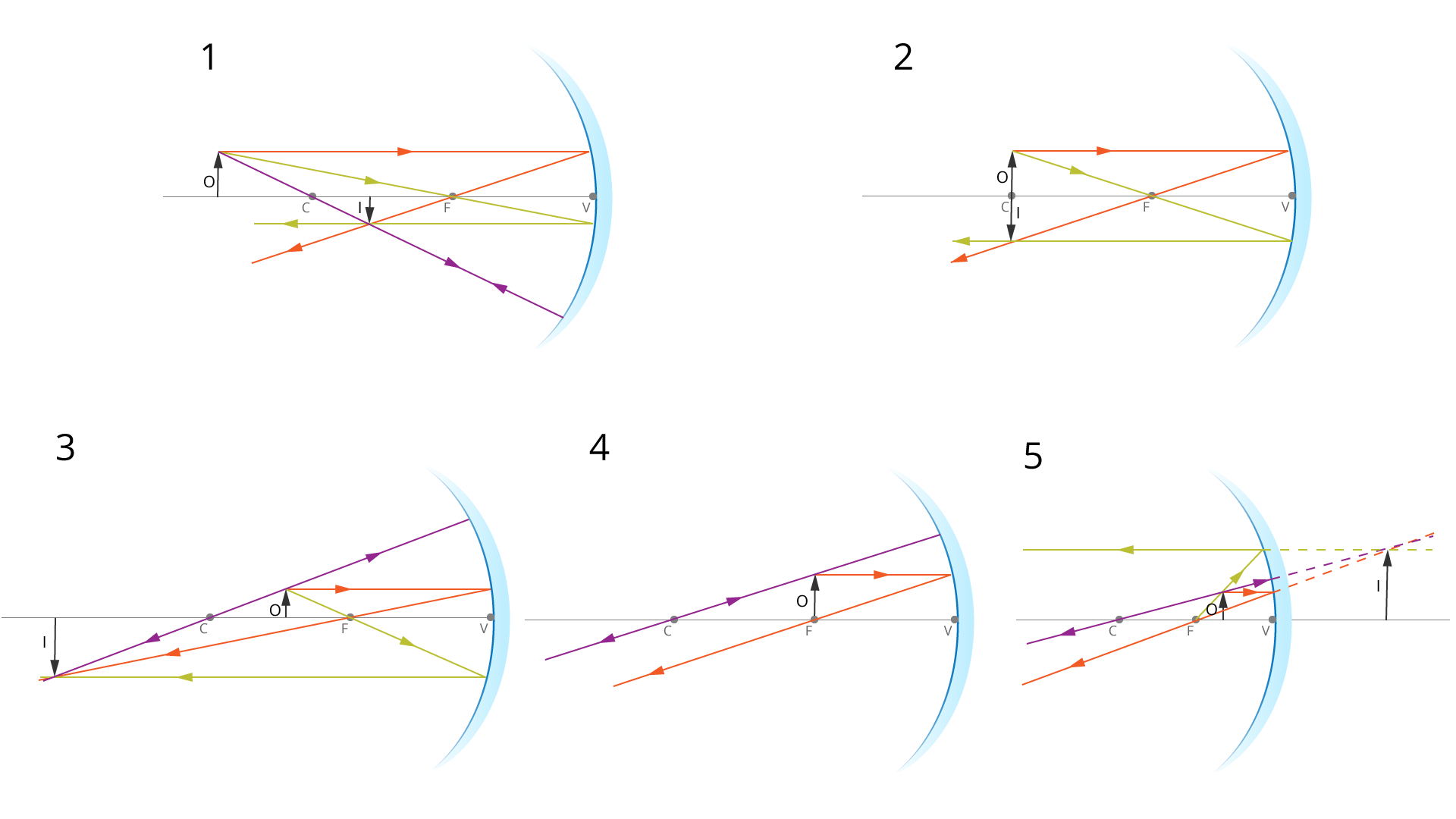
Make appropriate constructions and check the characteristics of an image formed by a spherical mirror with respect to the position of an object.
Consider the following positions y of the object.
Case 1 - the object is located beyond the centre of curvature C: x > 2f
Case 2 - the object is located at the centre of curvature C: x = 2f
Case 3 - the object is located between the centre of curvature C and the focal point F: 2f > x > f
Case 4 - the object is located at the focal point F: x = f
Case 5 - the object is located between the focal point F and the mirror vertex V: x < f
R1dYYEF34n3B8
Ilustracja interaktywna przedstawia zwierciadło wklęsłe z zaznaczoną osią optyczną. Na niej literą C zaznaczony jest środek krzywizny zwierciadła oraz literą F jego ognisko. Dodatkowo zaznaczonych jest pięć możliwych ustawień przedmiotu względem wierzchołka zwierciadła wklęsłego, w zależności od położenia przedmiotu, właściwości obrazu powstającego w zwierciadle kulistym są inne. 1 - odcinek zaznaczony za punktem C, 2 - punkt C, 3 - odcinek między punktami C i F, 4 - punkt F, 5 - odcinek między punktem F a zwierciadłem. Na ilustracji widoczne są numery, a na nich podpisy. 1. Case 1 - the object is located beyond the centre of curvature C {audio}, 2. Case 2 - the object is located at the centre of curvature C {audio}, 3. Case 3 - the object is located between the centre of curvature C and the focal point F {audio}, 4. Case 4 - the object is located at the focal point F {audio}, 5. Case 5 - the object is located between the focal point F and the mirror vertex V {audio}.
Ilustracja interaktywna przedstawia zwierciadło wklęsłe z zaznaczoną osią optyczną. Na niej literą C zaznaczony jest środek krzywizny zwierciadła oraz literą F jego ognisko. Dodatkowo zaznaczonych jest pięć możliwych ustawień przedmiotu względem wierzchołka zwierciadła wklęsłego, w zależności od położenia przedmiotu, właściwości obrazu powstającego w zwierciadle kulistym są inne. 1 - odcinek zaznaczony za punktem C, 2 - punkt C, 3 - odcinek między punktami C i F, 4 - punkt F, 5 - odcinek między punktem F a zwierciadłem. Na ilustracji widoczne są numery, a na nich podpisy. 1. Case 1 - the object is located beyond the centre of curvature C {audio}, 2. Case 2 - the object is located at the centre of curvature C {audio}, 3. Case 3 - the object is located between the centre of curvature C and the focal point F {audio}, 4. Case 4 - the object is located at the focal point F {audio}, 5. Case 5 - the object is located between the focal point F and the mirror vertex V {audio}.
Different locations of an object on the optical axis of a concave mirror
Prepare in your notebook the following table and fill it in.
Case
Position of the object x
Construction of the image
Characteristics of the image
1
x > 2f
2
x = 2f
3
2f > x > f
4
x = f
5
x < f
Answer
Case
Position of the object x
Construction of the image
Characteristics of the image
1
x > 2f
Image 1
Inverted, reduced in size, real
2
x = 2f
Image 2
Inverted, equal in size, real
3
2f > x > f
Image 3
Inverted, enlarged, real
4
x = f
Image 4
No image is formed
5
x < f
Image 5
Upright, enlarged, virtual
R1CJOHhcdXb6U
Na ilustracji przedstawione jest pięć konstrukcji obrazów przedmiotów wytworzonych przez zwierciadło wklęsłe. Konstrukcje ponumerowane są od 1 do 5 i odpowiadają przypadkom rozważanym w tabeli. Wynika z tego, że w zależności od położenia przedmiotu, właściwości obrazu powstającego w zwierciadle kulistym są różne.
In the image constructions you created before, measure in every case the object height and the image height. Calculate the magnificationmagnificationmagnification.
The characteristics of the image formed by concave mirrors are related to the position of the object with respect to the mirror. The image can be enlarged, reduced or the same size as the object. It can be upright (if virtual) or inverted (if real).
Exercises
RPqcUMSG4Om3p
Exercise 3
Wersja alternatywna ćwiczenia: Determine which sentences are true. Możliwe odpowiedzi: 1. To form a real image in a concave mirror the object should be located beyond the focal point., 2. When an object is located very close to the vertex of a concave mirror the image is enlarged and upright., 3. An object is placed at a distance of from a concave mirror of the focal length . The image distance is equal to ., 4. Concave mirrors always produce real images.
Wersja alternatywna ćwiczenia: Determine which sentences are true. Możliwe odpowiedzi: 1. To form a real image in a concave mirror the object should be located beyond the focal point., 2. When an object is located very close to the vertex of a concave mirror the image is enlarged and upright., 3. An object is placed at a distance of from a concave mirror of the focal length . The image distance is equal to ., 4. Concave mirrors always produce real images.
Determine which sentences are true.
To form a real image in a concave mirror the object should be located beyond the focal point.
When an object is located very close to the vertex of a concave mirror the image is enlarged and upright.
An object is placed at a distance of from a concave mirror of the focal length . The image distance is equal to .
Concave mirrors always produce real images.
zadanie
Source: GroMar, licencja: CC BY 3.0.
Exercise 4
Determine the magnification p when the object height is 10 cm and its image height is 22 cm.
The magnification p is 2,2.
Exercise 5
Compare the images formed by concave and plane mirrors.
The images produced by plane mirrors are virtual (located behind the mirror), upright and the same size as the object.
The images formed by concave mirrors can be real or virtual, upright or inverted, enlarged, reduced or the same size as an object.
RpiUC2mQU5NLF
Exercise 6
Wersja alternatywna ćwiczenia: Indicate which pairs of expressions or words are translated correctly. Możliwe odpowiedzi: 1. zwierciadło wklęsłe - concave mirror, 2. obraz prosty - upright image, 3. obraz pomniejszony - reduced image, 4. powiększenie - magnification, 5. obraz powiększony - inverted image, 6. obraz odwrócony - enlarged image
Wersja alternatywna ćwiczenia: Indicate which pairs of expressions or words are translated correctly. Możliwe odpowiedzi: 1. zwierciadło wklęsłe - concave mirror, 2. obraz prosty - upright image, 3. obraz pomniejszony - reduced image, 4. powiększenie - magnification, 5. obraz powiększony - inverted image, 6. obraz odwrócony - enlarged image
Indicate which pairs of expressions or words are translated correctly.
zwierciadło wklęsłe - concave mirror
obraz prosty - upright image
obraz pomniejszony - reduced image
powiększenie - magnification
obraz powiększony - inverted image
obraz odwrócony - enlarged image
zadanie
Source: GroMar, licencja: CC BY 3.0.
R10OxLeJYq5Mv1
Interaktywna gra, polegająca na łączeniu wyrazów w pary w ciągu jednej minuty. Czas zaczyna upływać wraz z rozpoczęciem gry. Jeden ruch to odkrywanie najpierw jednej potem drugiej karty z wyrazem. Każdy wyraz jest odczytywany. Kolejny ruch to odkrywanie trzeciej i czwartej karty. W ten sposób odsłuchasz wszystkie wyrazy. Nawigacja z poziomu klawiatury za pomocą strzałek, odsłuchiwanie wyrazów enterem lub spacją. Znajdź wszystkie pary wyrazów.
Interaktywna gra, polegająca na łączeniu wyrazów w pary w ciągu jednej minuty. Czas zaczyna upływać wraz z rozpoczęciem gry. Jeden ruch to odkrywanie najpierw jednej potem drugiej karty z wyrazem. Każdy wyraz jest odczytywany. Kolejny ruch to odkrywanie trzeciej i czwartej karty. W ten sposób odsłuchasz wszystkie wyrazy. Nawigacja z poziomu klawiatury za pomocą strzałek, odsłuchiwanie wyrazów enterem lub spacją. Znajdź wszystkie pary wyrazów.
Match Polish terms with their English equivalents.
real image
concave mirror
obraz rzeczywisty
inverted image
obraz pozorny
obraz odwrócony
upright image
obraz prosty
zwierciadło wklęsłe
virtual image
Source: Zespół autorski Politechniki Łódzkiej, licencja: CC BY 3.0.