what the composition and structure of the Earth’s atmosphere are;
the geographical causes of the variations in air temperature at the surface of the Earth;
what the Coriolis force is, which deviates freely‑moving objects from their movement path – to the right on the northern hemisphere, and to the left on the southern hemisphere.
Differences in atmospheric pressure and land level are very common on Earth. There are also winds everywhere. They may be permanent, seasonal, or local. Permanent winds are those resulting from global air circulation. Trade windstrade windsTrade winds – permanent winds in the intertropical zone, blowing from the tropical highs to the equatorial zone of silence, with a deviation caused by the rotational motion of the Earth. Under the influence of the Coriolis force, on the northern hemisphere they blow from the north‑east, and on the southern hemisphere from the south‑east. Antitrades – winds blowing from the equator to the tropics, but at an altitude of a few or a dozen or so kilometers. Under the influence of the Coriolis force, on the northern hemisphere they blow from the south‑west, and on the southern hemisphere from the north‑west. It should be added that, according to the latest descriptions of general atmospheric circulation, the term ‘antitrades’ is no longer used to describe the air that disperses from above the equator towards higher latitudes.
Trade‑wind circulation is shown in the figure below.
ROrF8KiBsfyBt
Ilustracja przedstawia cyrkulacje wiatru, Trade‑wind circulation. Chłodne masy powietrza unoszą się nad Zwrotnikiem Raka, Tropic of Cancer i przemieszczają w kierunku równika, equator. Następnie ogrzewają się, unoszą się nad równikiem i zawracając do Zwrotnika Raka ponownie się ochładzają. Analogicznie, chłodne masy powietrza unoszą się nad Zwrotnikiem Koziorożca, Tropic of Capricorn i przemieszczają w kierunku równika, equator. Następnie ogrzewają się, unoszą się nad równikiem i zawracając do Zwrotnika Raka ponownie się ochładzają. 1. The dry air flows north The dry air moves towards the Tropic of Cancer., 2. The dry air flows south The dry air moves towards the Tropic of Capricorn., 3. High Area of elevated atmospheric pressure., 4. trade-wind Permanent winds in the tropic zone, 5. Low A low atmospheric pressure area in which the pressure decreases towards the center of the area., 6. trade-wind Permanent winds in the tropic zone, 7. High Area of elevated atmospheric pressure at which the pressure at the same altitude grows from the periphery to the center of the area.
Ilustracja przedstawia cyrkulacje wiatru, Trade‑wind circulation. Chłodne masy powietrza unoszą się nad Zwrotnikiem Raka, Tropic of Cancer i przemieszczają w kierunku równika, equator. Następnie ogrzewają się, unoszą się nad równikiem i zawracając do Zwrotnika Raka ponownie się ochładzają. Analogicznie, chłodne masy powietrza unoszą się nad Zwrotnikiem Koziorożca, Tropic of Capricorn i przemieszczają w kierunku równika, equator. Następnie ogrzewają się, unoszą się nad równikiem i zawracając do Zwrotnika Raka ponownie się ochładzają. 1. The dry air flows north The dry air moves towards the Tropic of Cancer., 2. The dry air flows south The dry air moves towards the Tropic of Capricorn., 3. High Area of elevated atmospheric pressure., 4. trade-wind Permanent winds in the tropic zone, 5. Low A low atmospheric pressure area in which the pressure decreases towards the center of the area., 6. trade-wind Permanent winds in the tropic zone, 7. High Area of elevated atmospheric pressure at which the pressure at the same altitude grows from the periphery to the center of the area.
Blowing from the tropics towards the Arctic Circle in both hemispheres and eastern winds blowing from both poles to the Arctic Circle.
Source: Olga Mikos,, licencja: CC BY-SA 3.0.
Also permanent are the westerly winds, which blow from the tropics towards the polar circles on both hemispheres, as well as the easterly winds that blow from both poles to the polar circles.
RqQrO2W6C8r1n
Ilustracja interaktywna ukazująca model globalnej cyrkulacji powietrza atmosferycznego w dniach równonocy. Opisane są: 1. równikowy pas ciszy equatorial silence belt , 2. wiatry wschodnie eastern winds , 3. wiatry zachodnie western winds , 4. pasat północno-wschodni north-eastern trade wind , 5. pasat północno-zachodni south-eastern trade wind , 6. wiatry zachodnie western winds
Ilustracja interaktywna ukazująca model globalnej cyrkulacji powietrza atmosferycznego w dniach równonocy. Opisane są: 1. równikowy pas ciszy equatorial silence belt , 2. wiatry wschodnie eastern winds , 3. wiatry zachodnie western winds , 4. pasat północno-wschodni north-eastern trade wind , 5. pasat północno-zachodni south-eastern trade wind , 6. wiatry zachodnie western winds
Model of global atmospheric air circulation on the days of equinox
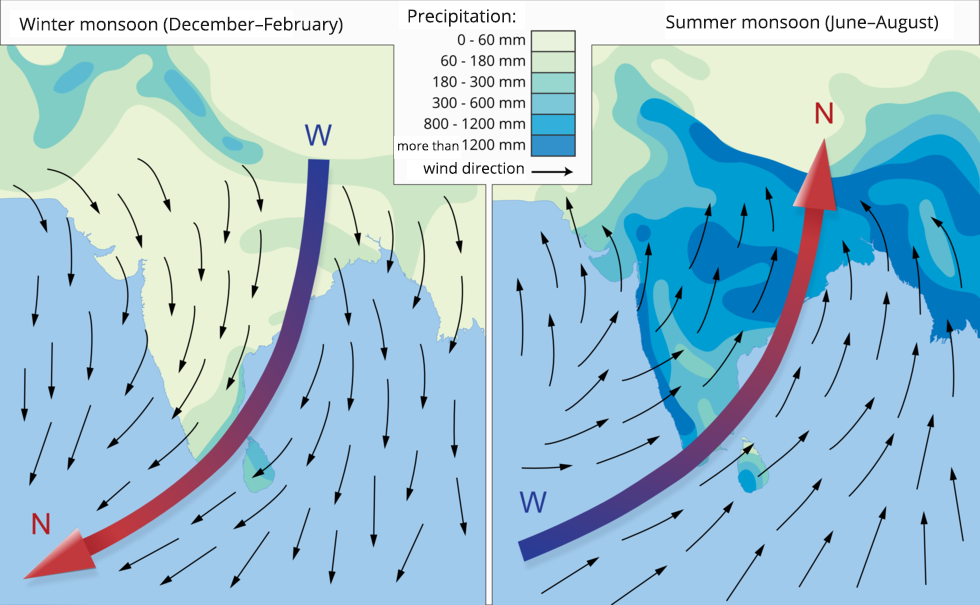
MonsoonmonsoonMonsoon is a seasonal wind. It is created mainly due to changes in the seasons and the accompanying differences in the intensity of heating the surfaces of lands and oceans. In summer, large continents (especially Asia) warm up much more than the neighboring oceans (especially the Indian and Pacific Oceans). It is much warmer over the land. The air rises and produces a powerful area of low barometric pressure, while over the colder ocean an area of high barometric pressure forms. The wind called summer monsoon blows from the ocean and brings rainfall. In winter, it is the land that is colder, because it loses heat faster than the oceans, so a dry winter monsoon blows from the land towards the ocean.
Task 1
Do the following exercise.
Exercise 1
RsbqGwZTOk5ax
Match the statements to the corresponding wind types. Trade wind 1. is a seasonal wind, 2. in winter, blows from the land to the ocean, 3. its creation is mainly due to changes in the seasons, 4. is created due to differences in the intensity of land and ocean surfaces, 5. is found in the intertropical zone, 6. blows from the ocean in the summer, and brings rainfall, 7. blows all year round from the tropics to the equator, 8. is a permanent wind, 9. blows in the direction opposite to the antitrade. Monsoon: Możliwe odpowiedzi: 1. is a seasonal wind, 2. in winter, blows from the land to the ocean, 3. its creation is mainly due to changes in the seasons, 4. is created due to differences in the intensity of land and ocean surfaces, 5. is found in the intertropical zone, 6. blows from the ocean in the summer, and brings rainfall, 7. blows all year round from the tropics to the equator, 8. is a permanent wind, 9. blows in the direction opposite to the antitrade
Match the statements to the corresponding wind types. Trade wind 1. is a seasonal wind, 2. in winter, blows from the land to the ocean, 3. its creation is mainly due to changes in the seasons, 4. is created due to differences in the intensity of land and ocean surfaces, 5. is found in the intertropical zone, 6. blows from the ocean in the summer, and brings rainfall, 7. blows all year round from the tropics to the equator, 8. is a permanent wind, 9. blows in the direction opposite to the antitrade. Monsoon: Możliwe odpowiedzi: 1. is a seasonal wind, 2. in winter, blows from the land to the ocean, 3. its creation is mainly due to changes in the seasons, 4. is created due to differences in the intensity of land and ocean surfaces, 5. is found in the intertropical zone, 6. blows from the ocean in the summer, and brings rainfall, 7. blows all year round from the tropics to the equator, 8. is a permanent wind, 9. blows in the direction opposite to the antitrade
Match the statements to the corresponding wind types.
blows from the ocean in the summer, and brings rainfall, blows all year round from the tropics to the equator, is a permanent wind, is created due to differences in the intensity of land and ocean surfaces, is a seasonal wind, blows in the direction opposite to the antitrade, its creation is mainly due to changes in the seasons, is found in the intertropical zone, in winter, blows from the land to the ocean
Trade wind
Monsoon
Task 2
Opowiedz jak powstają monsuny ?
Opowiedz jak powstają monsuny ?
Analyze the figure showing the how the winter and summer monsoons are created. Write down the conclusions below.
R1cTCxXHXMAXw
Ilustracja przedstawia cyrkulacje monsunów, monsoons. Wiejący w Azji Południowej i Południowo-Wschodniej monsun letni przynosi znad oceanu potężne opady, natomiast monsun zimowy powoduje napływ suchego i chłodnego powietrza z wnętrza kontynentu. Ilustracja przedstawia kierunki wiatru i wielkość opadów w rejonie Azji Południowej i Południowo-Wschodniej w zimie i w lecie. Z lewej strony przedstawiono monsun zimowy, the winter monsoon wiejący w okresie December–February. Małe opady wynoszą 60 - 180 milimetrów. Opisano wyż nad lądem, niż nad morzem. Wiatr wieje z lądu w kierunku morza co zaznaczono grubą strzałką i dużą ilością małych czarnych strzałek. Z prawej strony przedstawiono monsun letni, The summer monsoon, wiejący w okresie June–August. Duże opady zaznaczono kolorem ciemno niebieskim, more than 1200 milimetrów. Opisano niż nad lądem i wyż nad morzem. Wiatr od morza w kierunku lądu zaznaczono grubą strzałką i dużą ilością małych czarnych strzałek.
The summer monsoon, which blows in South and South-East Asia, brings heavy rainfall from above the ocean, whereas the winter monsoon causes the inflow of dry and cool air from inside the continent.
Source: Olga Mikos, Planemad, licencja: CC BY-SA 3.0.
R1e3Y82lPIizz
Winter monsoon creation process (Uzupełnij). Summer monsoon creation process (Uzupełnij).
Winter monsoon creation process (Uzupełnij). Summer monsoon creation process (Uzupełnij).
monsun – wiatr o zmieniającym się okresowo kierunku zależnym od pory roku; w lecie wieje od strony chłodniejszego oceanu, gdzie panuje wysokie ciśnienie, w stronę nagrzanego kontynentu, gdzie występuje niż; w zimie wieje od strony wychłodzonego kontynentu w stronę cieplejszego oceanu
pasaty – wiatry wiejące od zwrotników do równika; pod wpływem siły Coriolisa na półkuli północnej wieją z kierunku NE, a na półkuli południowej z kierunku SE
równikowa strefa ciszy – bezwietrzna (lub z bardzo słabymi wiatrami) strefa leżąca w pobliżu równika, w obszarze niskiego ciśnienia, pomiędzy pasatami półkuli północnej i południowej; w strefie tej panuje silna konwekcja termiczna