How does a compass work?
that magnets always have two poles - north and south;
that magnets can attract or repel other magnets.
to describe the structure of a compass and the principle of a compass;
to name the Earth’s magnetic poles;
to orientate the map using the compass.
What a compass is?
CompassCompass is a simple device used for navigation, i.e. to establish a route to a given destination and to find a way. The most important element of the compass is the rotating magnetic needle. It is used to determine the cardinal directions. Since the compass needle has the characteristics of a magnet, this also means that it has two poles: one north and one south. The needle rotates so that one end points to the north and the other to the south. How does this happen? Does the needle point exactly to these cardinal directions? We need to find out the principle of a compass to answer these questions.
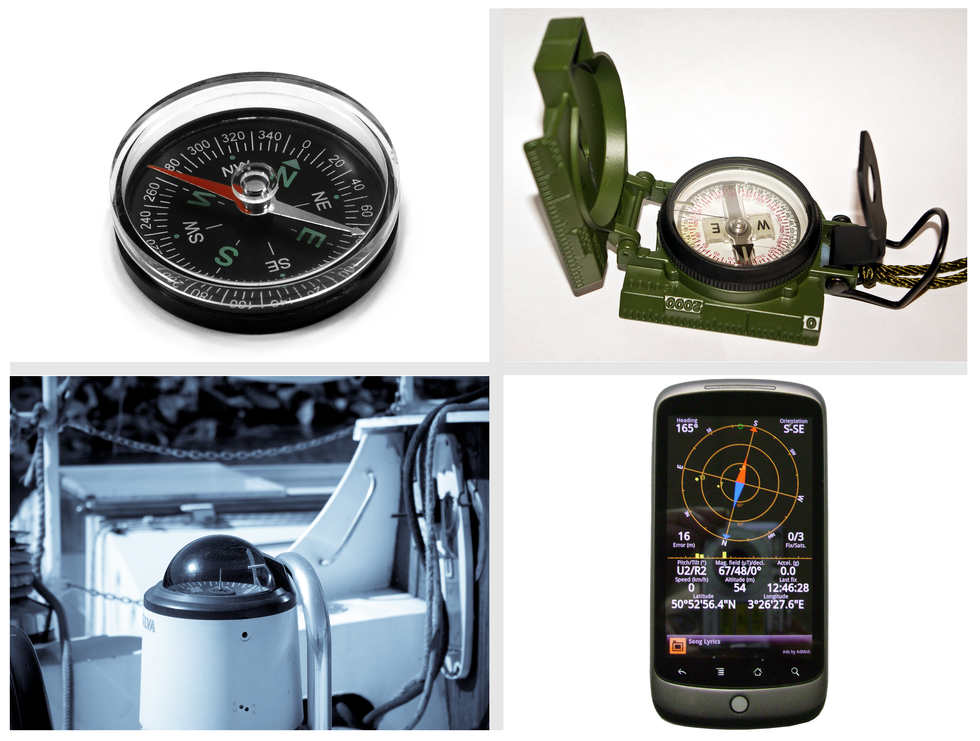
How does a compass work?
Let’s think why and how does a compass work. The compass needle is made of a material that has magnetic properties. Is there a magnetic field around us we are not aware of?
Deep inside our planet there is a core. This core produces the Earth’s magnetic fieldEarth’s magnetic field. The lines of this field are aligned north‑south more or less. The compass needle reacts to this field. It aligns itself along the lines of the Earth’s magnetic field.
Compass – when placed near metallic objects – can stop working properly. For this reason, classic compasses are completely useless on steel ships, for example – steel contains iron. Another case where the compass stops working is when it is close to electrical devices or magnets.
Investigating the effect of metal objects on the compass.
a compass,
a large object made of iron or steel, e.g. a smoothing iron.
Place the magnet away from the chosen object.
Move the steel object closer to the magnet and change its position around the compass.
The compass only works properly when you are away from objects containing iron.
How to build a compass
All compasses have a movable magnetic needle. A dial with marked cardinal directions is usually inserted into the compass housing. However, we can build the simplest compass on our own. All we need is a sewing needle, a strong magnet, a cork or polystyrene and a dish with water.
Orientating a map using a compass
When we want to use the map in the field, we need to orientate it in relation to the cardinal directions. This means that geographical directions on the map must show the real directions. So we have to position ourselves in such a way that the northern direction on the map corresponds to the north in the field.
Usually the northern direction on the map is at the upper edge – unless the signs indicate otherwise. You can make sure this is the case by using the compass. Modern compasses have needles suspended in the liquid (e.g. alcohol), which prevents their vibrations. It is important to remember that we should not use compasses near objects that interfere with the magnetic needle – i.e. near large iron and steel objects or working electrical devices.
Select the correct answers.
- The compass correctly indicates the Earth's magnetic poles.
- The compass indicates the Earth's geographical poles.
- Compass is useless at home.
Summary
Compass is a device that shows the cardinal directions.
The basic element of a compass is a movable magnetic needle, which aligns itself along the Earth's magnetic field lines.
Electrical devices, magnets and iron containing objects in the vicinity may interfere with the operation of the compass.
Draw up a plan for your apartment. Use the compass to point the north and mark it on the plan sketch.
Keywords
compass, Earth’s magnetic field, map orientation
Glossary
kompas – przyrząd nawigacyjny wykorzystujący oddziaływanie magnetyczne igły kompasu z polem magnetycznym Ziemi
pole magnetyczne Ziemi – przestrzeń wokół Ziemi, w której występują siły magnetyczne
orientacja mapy – ułożenie mapy w terenie, zgodne z rzeczywistymi kierunkami geograficznymi, a górna ramka mapy była zwrócona w kierunku północnym